As I announced in March, I’m devoting the month of September to Higan and the Six Pāramitās. Here’s a copy of the text of the Nichiren Shu brochure on Higan.
The equinox occurs twice a year, once during spring and again in autumn, specifically the day in which night and day are equal in length. The exact day upon which the equinox lands varies from year to year, but the vernal or spring equinox basically occurs during March and the autumnal equinox during September. In Japan, we refer to the seven-day period – that is, the equinox, including the three days prior and following the equinox – as higan.
Higan is understood by most in Japan as a seven-day period that happens twice a year. As such, higan has taken on a secular meaning, gradually shedding its original significance. Whereas, higan is in fact deeply ingrained within Buddhism. For Buddhists, this period is not just one characterized by days with almost equal portions of light and dark. Rather, it is a period in which we strive to consciously reflect upon ourselves and our deeds. Have our words hurt anyone around us? Are our actions serving ourselves more than others? How can we be productive for the sake of society? Are our decisions creating a world of strife rather than peace? Does our lifestyle encroach upon the liberty or happiness of others? Are we aware of how our actions may adversely affect our environment – the soil, air, plants, insects, fish, birds, and animals? In sum, the basic question from a Buddhist point of view is whether or not we are following the right path. Higan serves as an opportunity to consciously readdress some of these basic questions so that we may perhaps reinitialize our thoughts and actions should we be veering off Buddha’s path. In this sense, it is indeed a very important time of the year.
Buddhism is About Practice
Higan then is a period of shugyo or practice. We are often unaware that we are ourselves the cause of many problems. Oftentimes, though we may not intend to slight anyone, our words and deeds can be construed in different ways depending on how and by whom it is received. Therefore, during the period of higan, we try to be extra careful that we do not disrupt things and create problems for others.
The Buddha’s enlightenment can often be characterized as a state of being completely aware. For the Buddha, this may appear to be effortless and second nature. However, these attributes are ones that even the Buddha has nurtured by practicing the right way of living, consciously over a very long period of time. Actually practicing the right path in overcoming mishaps that create confusion and poor judgment eventually lead to a life that is harmonious with our surroundings, and ultimately to peace for all. By theory, should we earnestly follow in the footsteps of the Buddha, there is no reason why we cannot eventually approach the Buddha’s level of awareness.
Buddha’s Way
In any discipline, its practitioners are inclined to try and reach a certain objective. Exactly what that goal is and how it can be reached may vary in its scope and application. Nevertheless, there exists something to aim for. Buddhism is no different in this respect. Without debating the minor differences that we may each value, we as Buddhists are blessed with the metaphor of higan in helping us to visualize our advancement toward this goal.
Higan arrives from the Sanskrit word, pāramitā. A Chinese transliteration for this word was “dao bi an.” In Japanese, these characters would be read “tou hi gan”. tou means to “go to” or to “arrive.” hi means “that” or “there.” gan is “bank” or “shore.” This metaphor asks us to imagine our present station to be associated with “this shore,” called shigan in Japanese. “This shore” is one that is characterized by delusion and repeated suffering. Buddhism posits that there is another bank on the other side of the river or body of water. The other shore represents a goal to which we as Buddhists should aspire. It is characterized by understanding and assurance. This distant shore is called higan. Higan represents wisdom, liberty, and compassion. In our respective ways, we as Buddhists are all striving to reach the other shore, that is, to become like the Buddha. Pāramitā, then, involves crossing over from the shore of ignorance to the other shore of enlightenment. The word pāramitā has come to describe the basic components necessary to attain this.
Although there may be many ways of grasping the concept of pāramitā, it is generally understood to be composed of six basic components. The six pāramitās are as follows:
fuse means to offer one’s self wholeheartedly and unconditionally, without any expectation of its return.
jikai is to follow and maintain the general precepts of the Buddha.
nin-niku suggests a resilience to persevere through hardship.
syojin refers to the necessity of conscientious effort in accomplishing one’s goals.
zenjo points to qualities existent in meditation, calling upon one’s concentration, adjoined by calmness and poise.
Chie is the Buddha’s wisdom, reinforced with its practical application.
Each of these six are complementary with each other. The awareness, application, and internalization of all six of these general practices is thought to be requisite to approach the completeness of the Buddha. Thus, the pāramitās are also referred to as bodhisattva practices, or the necessary stepping stones upon one’s way to becoming a Buddha. The most important thing to note is that these concepts must be put into practice. Without application, it is not Buddhism. Higan, then, is a time to reaffirm and sincerely practice the six pāramitās.
Higan as Observed in Japan
With the practice of the pāramitās, Higan in Japan has incorporated the tradition of acknowledging one’s ancestors and loved ones who have passed away. Although there are many ways of observing higan, many will go to their temples, gravesites of their loved ones, or sit in front of their family alters to offer their prayers in memory of their loved ones. Many will also prepare a unique offering of sweet azuki-bean rice cakes as an offering to be placed on the alters of their loved ones. These azuki-bean rice cakes are called ailed bota mochi in spring and o-hagi during autumn.
During September I will be publishing quotes from Dale Wright’s The Six Perfections: Buddhism & the Cultivation of Character to illustrate the six perfections. Traditionally three perfections are discussed before the Equinox and three after. The Fall Equinox is Wednesday, Sept. 22. During September I will post quotes from Wright’s book about the perfection of generosity on Sunday, morality on Monday, tolerance on Tuesday, energy on Thursday, meditation on Friday and wisdom on Saturday.
How should we understand the higher form of generosity – “perfect giving”? The answer can be found throughout the Perfection of Wisdom Sutras, because wisdom is precisely what is needed to perfect generosity. Wisdom is the sixth perfection, the most perfect of the perfections, and the essential ingredient in all the others. Therefore it will need to be considered here in order to complete our understanding of the ideal of perfect generosity.
Perfect wisdom, whether related to generosity or any other dimension of life, consists in the realization of “emptiness,” and it is this teaching that the sutras promulgate from beginning to end. Although emptiness Śūnyatā) was an infrequently used word in the earliest layers of Buddhist literature, when it did make its appearance as the central concept in Mahayana sutras, it was defined in terms that were already familiar in the Pali sutras. To say that something is “empty” is to say that it is subject to continual change, that its existence is wholly dependent on factors outside of itself, and that it has no unchanging core or permanent essence. Making that claim, Mahayana Buddhists invoked the basic Buddhist teachings of impermanence, dependent arising, and no-self. All things are “empty” of their own self-established permanent essence because they are always subject to alteration and revision and because they are composed and defined in terms of what lies outside of them.
The “perfection” of giving incorporates the wisdom of “emptiness” to transform the perspective from which acts of giving occur. When the impermanence, dependence, and insubstantiality of all things are absorbed into one’s worldview down to the level of daily comportment, everything changes. A new, non-self-centered identity gradually emerges, one that entails reciprocity with everything that previously seemed to be other than oneself. This identity dissolves previous habits of self-protection and self-aggrandizement, opening the “self” to others in a connection of compassionate identification. To see how the vision of “emptiness” transforms thinking about generosity or giving, we look closely at passages in the sutras.
Instructing his disciple, Subhūti, in the perfection of generosity, the Large Sutra has the Buddha say: “Do not imagine that the gift is one thing, its fruit another, the donor another, and the recipient another. . . . And why? Because this gift is empty of a gift, its fruit empty of a fruit, and also the donor is empty of a donor and the recipient empty of a recipient. For in emptiness no gift can be apprehended nor its fruit, no donor, and no recipient. And why? Because absolutely those dharmas are empty in their own-being.”
The Buddha says, “Do not imagine.” Imagine what? Do not imagine that the world is divided up into separate self-subsistent entities, the way we ordinarily assume it to be. Do not imagine yourself as one of these isolated entities. Why not? Because all of these seemingly separate “things” are what they are only in connection to other things that make them what they are. Nothing stands on its own, and that is what it means to be “empty” of “own-being.” Applied to the act of giving, we see that the gift is not a gift without a donor and a recipient. Likewise, without the gift, there is no donor, no recipient. Each depends on the others, and when one changes, so do the others.
Several realizations make wisdom more difficult to imagine than the other five ideals we have examined. Wisdom differs from the others in the extent to which it is readily identifiable and noticeable. When we look for acts of generosity, morality, tolerance, energy, and meditation, we know roughly where to look. Acts of generosity, for example, are located in a certain sphere of our lives; they are easily identified wherever something beneficial is intentionally and freely transferred from one person or group to another. But where do we look to find examples of wisdom? Nowhere in particular, or anywhere. There is no specific domain of wisdom. You can be wise or unwise in any dimension of life. Wisdom can be found at work in all of the other perfections and in everything we do, rather than in its own domain. There is wise giving, wise tolerance, wise eating, wise shopping, and so on. Wisdom appears at a more comprehensive level than the other perfections, and this is how it can guide, encompass, and perfect the other perfections.
The ideal of this fifth perfection is to live in a meditative frame of mind regardless of whether we happen to be meditating. The goal, therefore, is not always to be meditating, always to be practicing a preparatory activity, but rather to live in the spirit of composure and insight that the practice has produced.
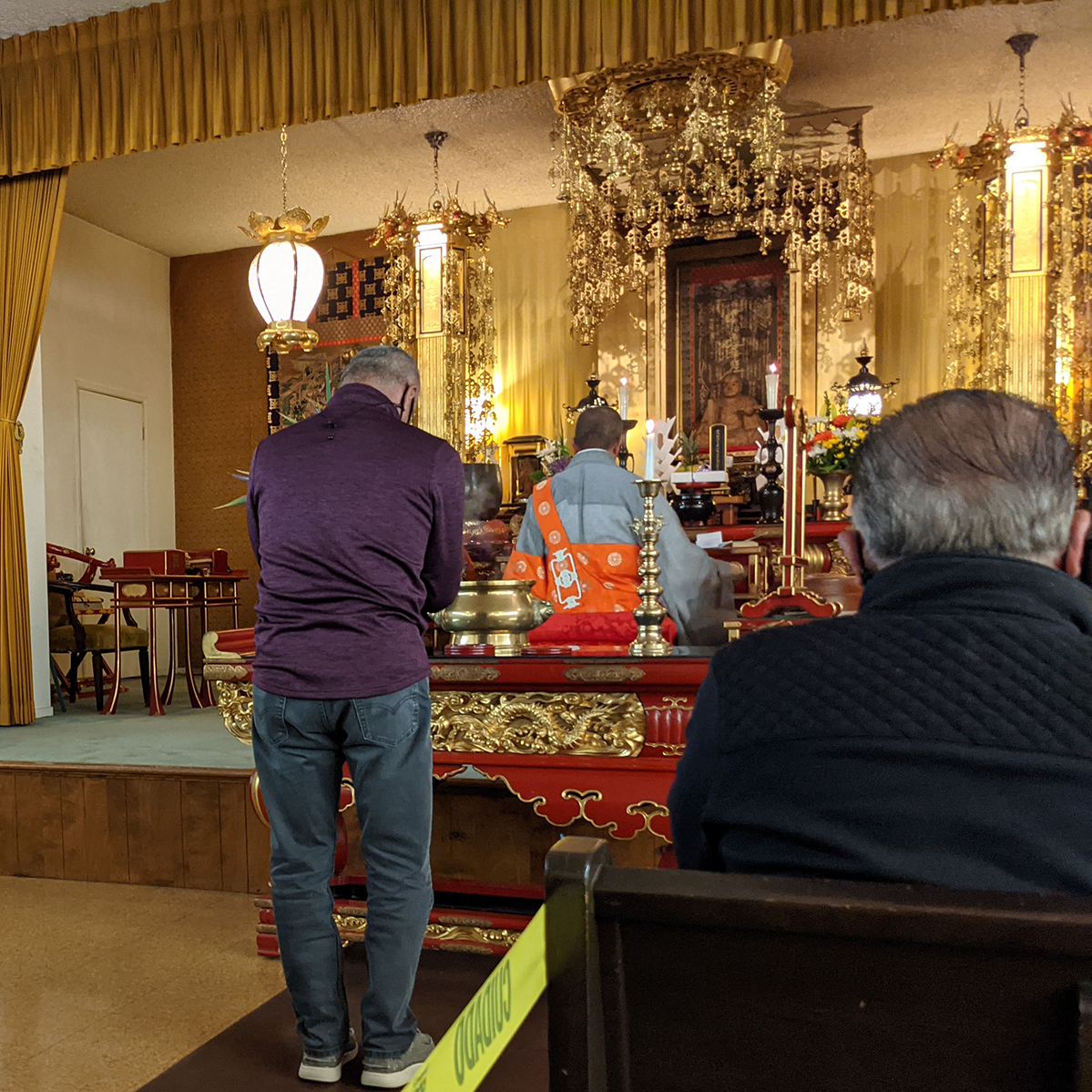
Offering incense during Daimoku chanting Note: This is an edited transcription of a recording from Ven. Kenjo Igarashi’s sermon following the Ohigan ceremony March 28, 2021. For some reason I can’t explain I didn’t publish this then and now I can’t see any reason not to post it late. While I’m posting this April 3, 2021, it will appear in my timeline March 28, 2021.
Spring Paramita service
Time to sew the seed of Buddhahood in our minds. All the time we need practicing during Higan week.
Everyone wonders why we are born into this world, this suffering world. This world is not a happy world, not paradise. If you ask someone why, they will most likely say they do not know. But Nichiren Shonin said the answer is to become a Buddha. That’s why we are born into this world.
Everybody’s life is different because of their previous life. Maybe we’ve come back from hell, hungry spirits or animals or asura. Now we are living in this world. Maybe sometime someone comes back from heaven. That’s why everyone’s life is different. Everybody’s cause and condition is different.
We are born into this world because we need practicing. Then we become a Buddha and help other people. We are not born into this world to become rich people or famous people. We are just born into this world to become a Buddha.
While we are practicing the six paramitas during paramita week we also have to think about our ancestors, our deceased parents. This is a matter of filial piety.
American’s think filial piety is satisfied if we just buy something for our parents on their birthday or some anniversary. In Buddhism we teach three kinds of filial piety. Just giving presents to parents is the lowest grade of filial piety. Intermediate filial piety is to obey your parents’ wishes. The higher grade filial piety is our memorial prayers. When parents pass away we cannot perform the lessor forms of filial piety. That’s why Nichiren Shonin said, If parents pass away we have to consider the question: Where did they go? If they are in the suffering world we try to save their spirit to a more good realm. That’s why we practice for ourselves and our parents.
I’ve been thinking, Was I dutiful to my parents. When I was 20 years old I became a minister and left home. After studying and practicing I moved to the United States when I was 27 years old. I didn’t call my parents when I arrived in the United States. It was too expensive. Was I a dutiful to my parents? Now my parents have passed away and I pray for them every day, seeking to send them to a better realm. That is my filial piety.
Everybody should pray for their parents. That’s why we have Higan and Obon to pray for deceased parents. They are waiting for your chanting and accept it and go to better realm and become a Buddha and never come back to the suffering world.
This is the teaching of Buddhism and Nichiren Shonin. That’s why we are born into this world — to become a Buddha.
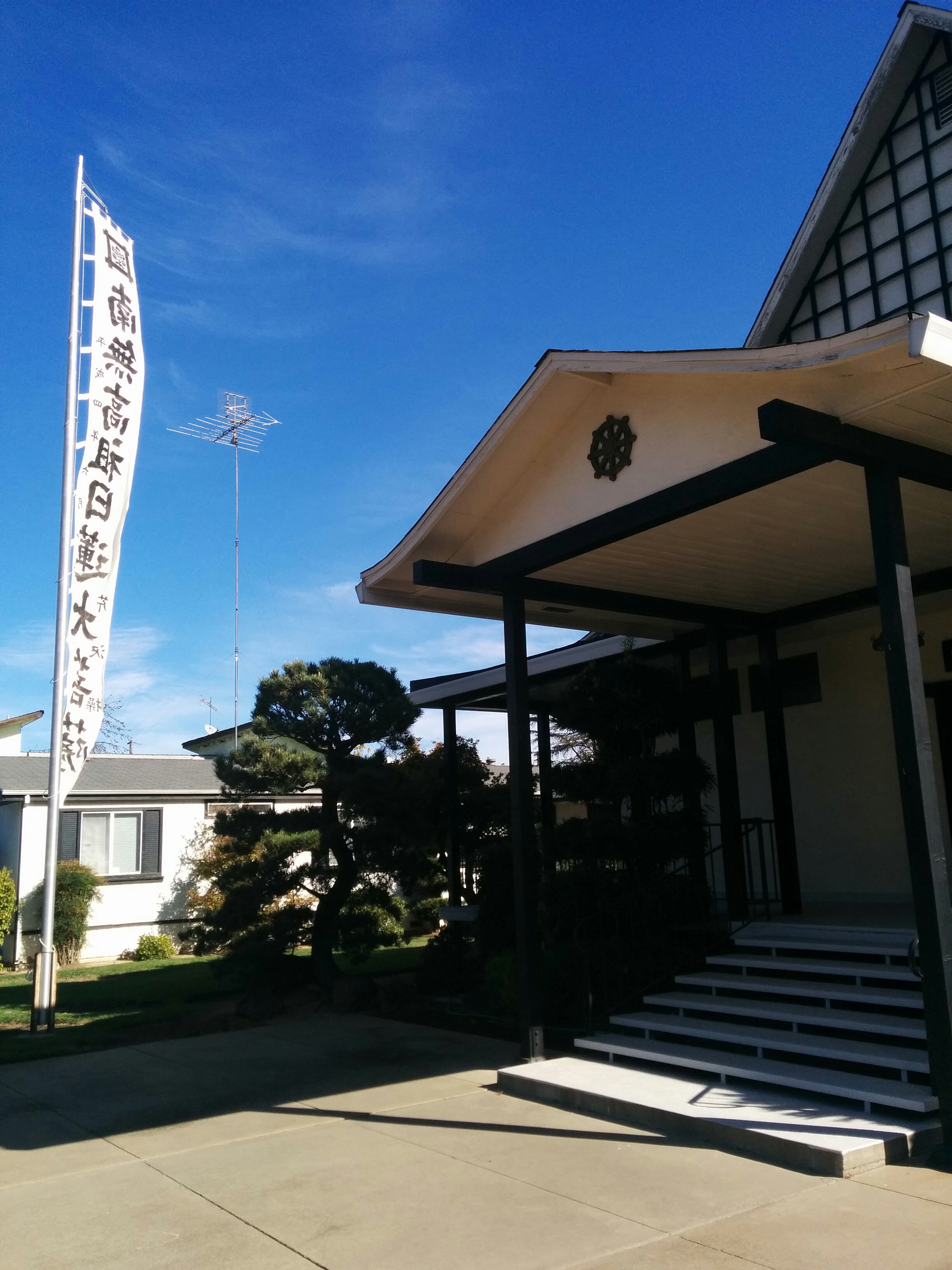
Banner says Namu Nichiren Bosatsu – Devotion to the Great Bodhisattva Nichiren
Missing from the Spring Higan service was the banner that always flies for special services. Rev. Igarashi said he did not fly the banner for Spring Higan for fear that the Chinese calligraphy might provoke anti-Asian problems. “I don’t want anybody to fool around with the banner so that is why he did not put up the banner this time,” he said.
Desire is the basis of motivation. It is the source of our energy. Without wanting something enough to motivate our will and energize our action, we are unlikely to pursue or get it. Imagine what it would be to eliminate all desire while still living a human life. Without desires we would be inactive and impotent. Lacking ambition, we would be without purposes and plans. Existing in so dispassionate a way that we desire nothing, we would be indifferent to any outcome; we would not care—about anything. Apathetic, that is, lacking pathos and passion, we would be devoid of feelings of any kind as well as the activities and spiritedness that follow from them. Although it is no doubt true that there have been a few aspirants who have understood the Buddha’s enlightenment to be a state of complete desirelessness, this is not the image of the compassionate and energized bodhisattva that we are likely to imagine and admire. A richer and more complete conception of Buddhist enlightenment encompasses and elevates desire rather than rejecting it. …
Those skilled in practices of mindfulness and in the discipline of character know how to assess desires. They consciously evaluate and rank desires, and when some of them are out of accord with chosen purposes—a “thought of enlightenment”—they also know how to extinguish them. Keeping these points in mind, we can still say, in the spirit of traditional forms of Buddhism, that the bodhisattva’s wisdom arises from having eliminated desires, as long as what we mean by that is that enlightenment is incompatible with many of our immature, uncultivated desires. Immature desires—based on a narrow self-understanding—are eliminated in the process of enlarging the sense we have of ourselves to encompass aspects of the world or ourselves previously beyond incorporation. Our very best desires, however—those honed by compassionate elevation of vision—need to be cultivated and maintained. Desire of this kind fuels our energy; it propels our most capacious vision.
During the month of March, I am publishing articles related to Higan, which occurs on the Spring and Fall Equinox and extends three days before and three days after to involve the six pāramitās.
The character Myō in the Myōhō Renge Kyō (Sūtra of the Lotus Flower of the Wonderful Dharma) was verified by the tongues of the two Buddhas (Śākyamuni and Many Treasures). The tongues of these two Buddhas are an eightfold double-blooming lotus flower. A wish-fulfilling gem, on top of this double-blooming lotus flower, is the character Myō. This wish-fulfilling gem, the character Myō, contains all the merits of Śākyamuni Buddha’s Six Paramita (the six kinds of practice by which He attained Buddhahood). In a previous life, Śākyamuni offered His own body to a hungry tiger and sacrificed His life to a hawk to save a dove (charity). When He was King Śrutasoma, he did not violate the Buddhist precepts even at the cost of his life (precepts). When he was Hermit Forbearance, he willingly endured the tortures of King Kālika cutting off his four limbs (forbearance). When he was Prince Dāna, he devoted his life to finding a wishfulfilling gem to save people (effort). When he was the Hermit Shōjari, he did not move until the eggs that a heron placed on his head hatched (meditation). And so on. Therefore, we in the Latter Age of Degeneration who simply believe in the Lotus Sūtra are able to receive the same merit gained by practicing the Six Pāramitā in full even if we haven’t performed any good deeds.
Nichimyō Shōnin Gosho, A Letter to Nichimyō Shōnin, Writings of Nichiren Shōnin, Followers II, Volume 7, Page 138-139
Accepting the reality in which we stand, tolerant people do not indulge in moods of resentment; they do not waste energy resenting that things are as they are. In the grip of resentment, we falsify the world, refusing to face the reality that has come to be. Wise patience does not struggle in this way; it does not exhaust resources of mind and body wishing that things were other than they are. Resentment of the real undermines our best efforts to see what we face and to deal with it constructively. Ideally, the practices of tolerance and patience would release us from the grip of these agitations, freeing the mind to deal with the situation calmly and directly. Letting go of unhelpful distractions, we are in a much better position to participate thoughtfully and effectively in the world.
“Guarding awareness” in the realm of morality, while indispensable, also leads to certain problems. The most significant of these recognized in Buddhist texts is attachment to rules and procedures themselves. “Grasping” the precepts too firmly and too rigidly was thought to prevent the development of more skillful forms of moral awareness. “Clinging” to rules for monks and nuns stands in the way of a deeper moral consciousness, just as craving and attachment cloud perceptions of the world generally. Moreover, attachment to moral rules often undermines the compassionate and liberating connection to other people that morality intends to cultivate in a society. Wherever rule-following becomes mechanical and self-serving, where there is only joyless guarding of one’s own moral standing, there the “perfection” of morality is rendered impossible.
[T]he attitude of the giver and the spirit of the gift are essential to the practice of generosity. Calm and even-minded, the enlightened donor is not moved by anything but the welfare of human beings and the openness of heart entailed in noble giving. Therefore, no thought is given to the rewards or “fruit” that inevitably flow back to the donor from a genuine act of generosity. Although there will be rewards that are a natural consequence of an act of giving, focus on those “fruits” demean and undercut the act. The higher and more selfless the conception of the gift, the greater is the perfection of giving. Thus the Large Sutra ends a section on the perfection of generosity by warning that the bodhisattva “does not aspire for any fruit of his giving which he could enjoy in Saṃsāra, and it is only for the purpose of protecting beings, of liberating them, that he courses [i.e., trains] in the perfection of giving.” Indeed, any attitude of self-congratulation on the part of the practitioner of giving is disdained. Self-satisfaction in a good deed displays the weakness of that act of generosity; it demonstrates that the motive and self-conception behind it are still immature. Coveting neither reward nor honor nor gratitude, the bodhisattva gives simply because a need exists. He gives anything, including himself, for the sake of others and in so doing meditates on the idea that “what is my very own this is yours.”


 Higan arrives from the Sanskrit word, pāramitā. A Chinese transliteration for this word was “dao bi an.” In Japanese, these characters would be read “tou hi gan”. tou means to “go to” or to “arrive.” hi means “that” or “there.” gan is “bank” or “shore.” This metaphor asks us to imagine our present station to be associated with “this shore,” called shigan in Japanese. “This shore” is one that is characterized by delusion and repeated suffering. Buddhism posits that there is another bank on the other side of the river or body of water. The other shore represents a goal to which we as Buddhists should aspire. It is characterized by understanding and assurance. This distant shore is called higan. Higan represents wisdom, liberty, and compassion. In our respective ways, we as Buddhists are all striving to reach the other shore, that is, to become like the Buddha. Pāramitā, then, involves crossing over from the shore of ignorance to the other shore of enlightenment. The word pāramitā has come to describe the basic components necessary to attain this.