Category Archives: WONS

Writings of Nichiren Shonin

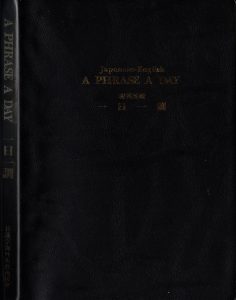
This category covers any article that contains a substantive quote from the Writings Of Nichiren Shonin. These are also found in the Daily Dharma and 100 Days of Study and A Phrase A Day.


For a discussion of Nichiren’s writings and the question of authenticity, see this Japanese Journal of Religious Studies 1999 article by Sueki Fumihiko, Nichiren’s Problematic Works.


NyoninGoshoCover
A Phrase A Day

Abandoning Provisional Sūtras

Now, when you decide to convert your faith to the Lotus Sūtra, you may be puzzled whether you should abandon the pre-Lotus sūtras preached in the first forty years or so, or whether you should still keep them and continue to chant the name of the Buddha of Infinite Life. We ordinary people should not decide this issue on our own. We should follow what our father Śākyamuni Buddha tells us. He declares in the “Expedients” chapter of the Lotus Sūtra, “Having abandoned all expedient teachings, I will expound only the unsurpassed way (Lotus Sūtra).” Expedient teachings here means the expedient means mentioned in the Sūtra of Infinite Meaning stating, “The truth has not been revealed for forty years or so as an expedient means.” All words of all sūtras such as the triple Pure Land sūtras are included in the word ‘expedient’ defined by Śākyamuni Buddha.

Therefore, those who do not abandon the various sūtras preached during some forty years or so and convert themselves to the Lotus Sūtra must be called the most impious in Buddhism, no matter how proud they may be in secular society. This is the reason why it is preached in the “Parable” chapter of the second fascicle of the Lotus Sūtra, “This triple world is My domain, where all living beings are My children. There are many sufferings in this world and only I can save all living beings. Although I taught and told this to all living beings, they did not believe in me because they are at a loss.” Those who refuse to abandon the provisional sūtras preached during forty years or so or practice them along with the Lotus Sūtra do not follow the wishes of the ruler, teacher, and parent. The word ‘taught’ in the citation from the “Parable” chapter means what is taught by a teacher or a parent, and the word ‘told’ means what is ordered by the emperor. The Buddha is the wisest king, the most venerable teacher, and the smartest father in the world. Therefore, those who do not convert themselves to the Lotus Sūtra by abandoning the various sūtras preached during the forty years or so or those who do not abandon the provisional sūtras even after converting themselves to the Lotus Sūtra are those who do not follow the instructions of our father Śākyamuni Buddha, who has the three virtues of the ruler, teacher, and parent. They should not live in this world.

Hōmon Mōsaru-beki-yō no Koto, The Way to Refute the Evil Teaching, Writings of Nichiren Shōnin, Biography and Desciples, Volume 5, Page 147

The Connection of a Poisonous Drum

QUESTION: How should we comprehend the statement in the chapter 3, “A Parable,” of the Lotus Sūtra, “You should not expound this sūtra to ignorant people”?

ANSWER: This applies to wise masters, who are able to discern the capacity of people, not to ordinary masters in the Latter Age of Degeneration.

We should also solely expound the Lotus Sūtra to those who slander the Dharma. This would establish the connection of a poisonous drum between the unfaithful people and the Lotus Sūtra as it is said that the sound of a drum smeared with poison kills a man who hears them. It is like the practice of Never-Despising Bodhisattva preached in the “Never-Despising Bodhisattva” chapter of the Lotus Sūtra.

If a person has the capacity of a wise man, though, we should teach him the Hinayāna sūtras first of all, then the provisional Mahāyāna sūtras, and finally the true Mahāyāna sūtra, the Lotus Sūtra. If a man is deemed ignorant, however, we should teach him the true Mahāyāna sūtra from the start, as it can plant the seed of Buddhahood in both believers and slanderers.

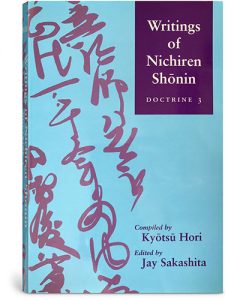
Kyōki Jikoku-Shō, Treatise on the Teaching, Capacity, Time and Country, Writings of Nichiren Shōnin, Doctrine 3, Page 90-91

The Order Of Teaching

Āgama (Hinayana) sūtras were preached following the Flower Garland Sūtra. … Regarding what sūtras were preached after the Flower Garland Sūtra, the “Introductory” chapter of the Lotus Sūtra states, “To those who suffer, hating old age, sickness and death, the Buddha preaches the teaching of Nirvana, showing ignorant people the way to tranquility and extinction of worldly passions.” In the “Expedients” chapter of the same sūtra, it states, “The Buddha went to the Deer Park in Bārāṇasī Kingdom . . . and preached the dharma to five monks.” It is also stated in the Nirvana Sūtra, “The Buddha preached on the Middle Way in the Deer Park of the Bārāṇasī Kingdom. ” This indicates what sūtras were preached after the Flower Garland Sūtra. According to these scriptural statements, it seems clear that it was the Āgama sūtras for śrāvaka disciples which were expounded after the Flower Garland Sūtra for great bodhisattvas.

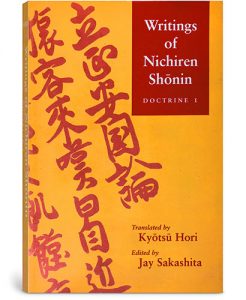
Shugo Kokka-ron, Treatise on Protecting the Nation, Writings of Nichiren Shōnin, Doctrine 1, Page 6-7

There Once Lived A Man Named Gyōbō Bonji

There once lived a man named Gyōbō Bonji. He visited numerous countries over the course of 12 years seeking the Buddha’s dharma. However, as the Buddha had not yet appeared in this world, neither His teaching nor any priest spreading the dharma was to be found. Nevertheless, Bonji sought the teaching of the Buddha just as a thirsty man seeks water or a hungry man searches for food.

One day he met a Brahman who told him, “I know a verse of a sacred teaching. If you are really eager to seek the Buddha’s teaching, I will teach it to you.” Bonji replied, “Yes, please.” The Brahman then said, “If you are so anxious to learn it, first peel off your own skin to make a sheet of paper, sharpen your own bone to use as a pen, grind your own marrow to use as ink and draw your own blood to use as water to write it down, then I will teach it to you.” Bonji was glad for the opportunity to hear the dharma and did what he was told to do. The Brahman, however, suddenly disappeared. Looking up at the sky then lying face down on the ground, Bonji bewailed his fate.

The Buddha pitied this man and emerged from underground to preach this verse: “Practice the right dharma, not the wicked dharma. By doing so one will live peacefully both in this life and the life to come.” Bonji attained Buddhahood immediately after hearing this. The words of the Buddha that led Bonji to attain Buddhahood consisted of merely 20 Chinese characters.

Nichimyō Shōnin Gosho, A Letter to Nichimyō Shōnin, Writings of Nichiren Shōnin, Followers II, Volume 7, Page 136-137

Śākyamuni Buddha Is The Very Father Of All Of Us

As for what should be done to refute the Pure Land teaching, before criticizing what Hōnen says in his Collection of Passages on the Nembutsu and the Original Vows, one should affirm first of all that Śākyamuni Buddha is the very father of all of us by revealing the scriptural statement, “This triple world is My property, where all living beings are My children” in the “Parable” chapter in the second fascicle of the Lotus Sūtra. Which Buddha other than Śākyamuni can also be our parent? More than 3,000 fascicles of Confucianism and Taoism teach loyalty and filial piety in the long run. They also teach that loyalty starts with filial piety. Therefore, Confucianism and Taoism are the first gates to enter Buddhism, the teaching of which is also based on filial piety. In short, though there is a difference in status, those who show piety to their parents are the most honorable in Buddhism as well as non-Buddhist teachings regardless of status.

Hōmon Mōsaru-beki-yō no Koto, The Way to Refute the Evil Teaching, Writings of Nichiren Shōnin, Biography and Disciples, Volume 5, Page 145-146

The Sin Of Slander

[T]he sin of not believing in and slandering the Lotus Sūtra is explained in detail in the “Parable” chapter. The sin of slandering the upholders of the Lotus Sūtra is preached in the “Teacher of the Dharma” chapter. The merits of those who believe in the Lotus Sūtra is expounded in the “Variety of Merits” and “Merits of Rejoicing at Hearing This Sūtra” chapters. Slandering the dharma means going against the teaching and rejoicing at hearing the dharma means to be obedient to the teaching. Do you think those who understand the preciousness of the Lotus Sūtra even for a moment without quite understanding its meaning are going against the teaching or being obedient to it? Aren’t the merits of ignorant people in the Latter Age of Degeneration holding a religious service in honor of or rejoicing at hearing the Lotus Sūtra even for a moment preached in scriptures? Besides, according to the interpretations of T’ien-t’ai and Miao-lê, it was an act of slandering the True Dharma when Buddhist masters of other schools regarded such Lotus practices as a child building a sand Stupa for play, rejoicing at hearing a verse or phrase of the sūtra, or the person rejoicing at hearing the sūtra equal to the practices for sages and wise people preached in the pre-Lotus sūtras.

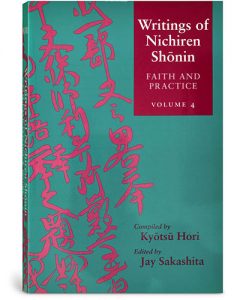
Shō Hokke Daimoku-shō, Treastise on Chanting the Daimoku of the Lotus Sūtra, Writings of Nichiren Shōnin, Faith and Practice, Volume 4, Page 7

Two Pillars Of The Tendai Doctrine

In my view the Tendai doctrine is supported by two pillars: the doctrinal study of various sūtras (kyōdō) and the true intent of the Buddha (shōdō). Based on these two pillars, Grand Master T’ien-t’ai wrote three major works (Profound Meaning of the Lotus Sūtra, Words and Phrases of the Lotus Sūtra, and Great Concentration and Insight) in sixty [sic] fascicles. The doctrinal study of various sūtras categorizes the sūtras in chronological order and assesses each of them, while the true intent of the Buddha means to be in a state of enlightenment of the Buddha. Which pillar do you think the interpretative sentences you quoted are of?

If they are of the doctrinal study, then consider that Grand Master T’ien-t’ai has established the three standards of comparison to assess the pre-Lotus sūtras against the Lotus Sūtra. Hence they should be asked what the three standards of comparison are.

If they answer that the three standards of comparison are (1) whether or not the capacity of the people is ripe for understanding the True Dharma, (2) whether or not the beginning and ending of the guidance of the Buddha is shown, and (3) whether or not the relationship between the Buddha and His disciples is eternal, we should then inquire which of the three standards their quotations are based on.

If they answer that they are based on the first comparison, we should further ask, “There are two ways of comparing the capacity of the people: comparison by doctrinal teachings (yakkyō) and comparison by periods of preaching (yakubu). Which one are they based on?”

If they answer that they were based on comparison by doctrinal teachings, then consider asking them further, “There are two kinds of interpretation in both the yakkyō and yakubu ways: lenient (yo) and strict (datsu) interpretations. Which of these two is it?”

If they reply that they do not know anything about yakkyō and yakubu or yo and datsu, it reveals that they are very ignorant of the Tendai doctrine.

Shoshū Mondō-shō, Questions and Answers Regarding Other Schools, Writings of Nichiren Shōnin, Doctrine 3, Page 162-163

The True Meaning of 3,000 Existences Contained In One Thought

It is not feasible to explain the true meaning of the doctrine of “3,000 existences contained in one thought” even in the theoretical section of the Lotus Sūtra. Needless to say, it is not mentioned at all in the pre-Lotus sūtras. The doctrine stems from the passage describing the ten aspects of existence in the paragraph on the “brief replacement of the three vehicles with the one true vehicle” (ryaku kaisan-ken’ichi) in the second chapter in the theoretical section of the Lotus Sūtra. Nevertheless, the true meaning of the doctrine is based solely on the essential section of the sūtra. The pre-Lotus sūtras should be judged according to the meaning of the theoretical section, which in turn should be judged by the meaning of the essential section. Only the essential section of the Lotus Sūtra can define its meaning as it preaches.

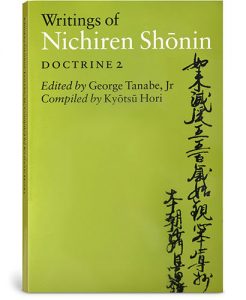
Jisshō-shō, A Treatise on the Ten Chapters of the Great Concentration and Insight, Writings of Nichiren Shōnin, Doctrine 2, Page 3-4

Mortal Enemy of the Buddha Dharma

(Hitherto missing) A sleeping lion does not turn angry unless it is provoked. Waves do not rise unless a pole is thrust in the river. Likewise, if we do not refute the slanderer of the True Dharma, we will not encounter hardship. It is preached in the Nirvana Sūtra, “If a virtuous priest upon seeing a person who destroys the dharma disregards him and does not censure him, such a priest is a mortal enemy of the Buddha Dharma.” If we do not take the word “disregard” seriously in this citation, it is inevitable that we will fall into the Hell of Incessant Suffering in the next life, though we seemingly may be able to pass through this life without trouble.

Therefore, Grand Master Nan-yüeh states in his Lotus Sūtra’s Four Peaceful Practices, “Suppose a bodhisattva protects an evil person and is unwilling to punish him, allowing his evil to increase, thus bringing trouble to virtuous people, and destroying the True Dharma. Such a bodhisattva is not a true bodhisattva. Outwardly he pretends to be a bodhisattva to deceive others, saying always, ‘I am practicing the paramita of perseverance.’ Such a person will fall into hell together with all the other evil people.”

The Ten Wheel Sūtra also preaches, “Do not live with a slanderer of the True Dharma. Do not befriend him or approach him. Doing so, will inevitably lead you to fall into the Avīci Hell.” When one enters a forest of sandalwood, the sweet fragrance clings to one’s body even though no branches are broken. Likewise, when one befriends or approaches a slanderer of the True Dharma, the merits one has accumulated will vanish and that person will fall into hell together with the slanderer. Therefore, Grand Master Miao-lê warns in his Annotations on the Great Concentration and Insight, “If one, who is not initially evil, approaches and befriends an evil person, it is inevitable that one will become evil in time, spreading his wicked ways throughout the country.”

Nambu Rokurō-dono Gosho, A Letter to Lord Nambu Rokurō, Writings of Nichiren Shōnin, Followers II, Volume 7, Page 170-171

Good and Wicked Countries

Of the 25 transmitters of the Buddhist dharma, all except the Buddha are men of temporary manifestation dispatched by the Buddha to lead living beings. Āryadeva, the 14th of the 25 transmitters, was killed by a non-Buddhist, and Venerable Simha, the 25th transmitter, was beheaded by King Dammira. Many others such as Buddhamitra and Bodhisattva Nāgārjuna encountered various difficulties. On the other hand, some were firmly supported by the rulers and were able to spread the dharma without encountering difficulties. Why is it that some transmitters were persecuted while others were not? I believe it is because there exist good and wicked countries in the world and aggressive and persuasive means of spreading a religion. This was true even during the Ages of the True Dharma and the Semblance Dharma. It was also true even in India, the central land of the Buddhist dharma. All the more so in Japan, a remote country land, at the beginning of the Latter Age of Degeneration. It has been expected from the beginning that I would encounter great difficulties when I tried to spread the teaching of the Lotus Sutra. I simply waited for them to arise.

Tenjū Kyōju Hōmon, Lightening the Karmic Retribution, Writings of Nichiren Shōnin, Followers 1, Volume 6, Page 30