The following are words of Grand Masters T’ien-t’ai and Miao-lê urging ordinary people in the Latter Age of Degeneration to have faith in the Lotus Sūtra. Grand Master T’ien-t’ai states in his Words and Phrases of the Lotus Sūtra, “A tree named kōken-ju has a thirty-three foot long bud in the ground. A bird named kalaviṅka twitters more beautifully than any other bird even when it stays in an eggshell.” This explains the merit of the fiftieth person who rejoices at hearing the Lotus Sūtra transmitted one after another by those who rejoice at hearing the Lotus Sūtra. The Buddha graciously revealed the merit of the fiftieth person in order to preach that the merits of an ignorant person who rejoices at having an opportunity to hear the Lotus Sūtra for even a moment are hundred thousand billion times more valuable than the merit of a great saint who has upheld the expedient practices and teachings expounded in the pre-Lotus sūtras for aeons. This is why Grand Master T’ien-t’ai presented these sayings—to show the heart of this sūtra. The koken-ju tree grows thirty-three feet in height a day. The bird kalaviṅka, even when very young, twitters more beautifully than other birds, large or small. Thus T’ien-t’ai compared the long period necessary to practice the expedient teachings to the slow growth of various plants and trees, and the immediate attainment of Buddhahood through the practice of the Lotus Sūtra to the rapid growth of the koken-ju which grows thirty-three feet a day. He also compared great or minor saints who keep expedient teachings to various birds, and ordinary people who intently keep faith in the Lotus Sūtra to the cry of a kalaviṅka bird in the eggshell which is superior to that of other birds.
Ichidai Shōgyō Tai-I, Outline of All the Holy Teachings of the Buddha, Writings of Nichiren Shōnin, Doctrine 3, Page 76-77
Conceptual Summary
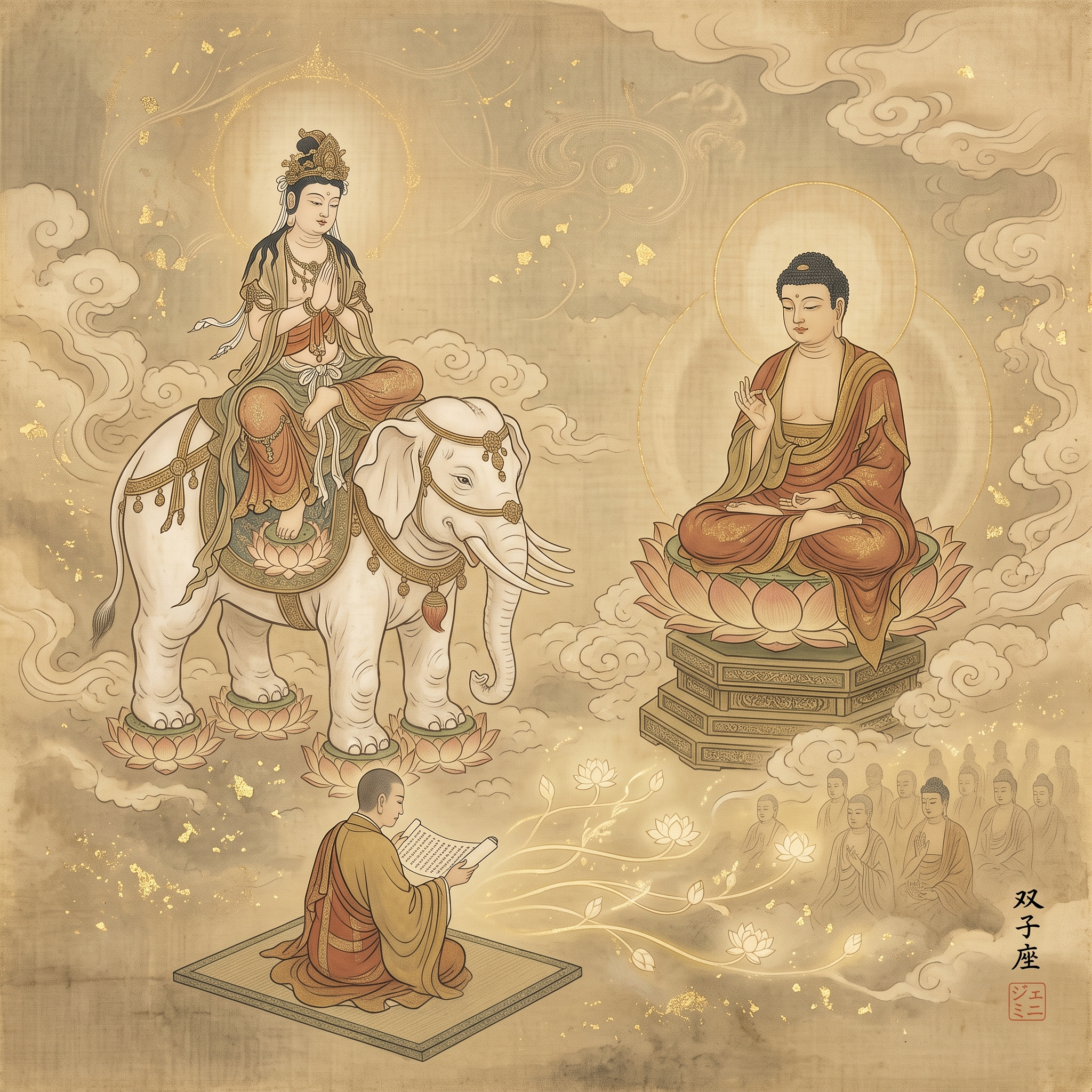
The illustration captures the profound cosmic interconnectedness and karmic inheritance described in Chapter Twenty-Eight of the Lotus Sūtra. At the upper right, Śākyamuni Buddha sits serenely in meditation on a multi-tiered lotus throne, receiving the sacred declaration. On the left, Universal-Sage (Fugen) Bodhisattva, adorned in elaborate regalia, approaches reverently while seated atop a magnificent six-tusked white elephant, a traditional icon representing the overcoming of obstacles and the strength of the Dharma.
In the foreground, the focus shifts to the mundane world where a pious devotee kneel-reads a sutra scroll, embodying the person who actively keeps, reads, and understands the teachings. Transforming this earthly practice into an act of cosmic significance, glowing tendrils of merit and lotus vines weave from the practitioner toward a vast, fading assembly of "innumerable Buddhas" in the misty, golden-flecked background. This visualizes the spiritual truth that the humble practitioner is not insignificant, but rather rooted in countless lifetimes of dedicated practice, equal in potential merit to the great Bodhisattva who watches over them.
Iconography & Character Identification
Item 1: Deities/Figures Featured:
Śākyamuni Buddha (Shaka Nyorai): Seated on a multi-tiered lotus throne on the right, embodying the historical and cosmic Buddha who receives the vow.
Universal-Sage Bodhisattva (Fugen Bosatsu): Seated atop the sacred six-tusked white elephant on the left, depicted with hands in anjalimudra (prayer/supplication).
The Six-Tusked White Elephant: The traditional mount of Fugen Bodhisattva, symbolizing the six perfections (paramitas) and spiritual power.
The Sūtra Practitioner (Devotee): Kneeling in the lower foreground on a mat, actively reading and reciting from a handscroll.
The Innumerable Buddhas: A spectral, fading assembly of countless past Buddhas in the lower right background, representing the deep-seated "roots of good" planted by the practitioner in previous existences.
Item 2: Text Translations:
双子座 (Signature, lower right): "Gemini" (literally "the Gemini constellation" or "Twins" in Japanese).
ジェミニ (Red square seal/hanko, lower right): "Gemini" (written in Katakana).
Anyone who keeps, reads and recites this sūtra, memorizes it correctly, understands the meanings of it, and acts according to it, know this, does the same practices that I do. He should be considered to have already planted deeply the roots of good under innumerable Buddhas [in his previous existence].
Universal-Sage (Fugen, Samantabhadra) Bodhisattva makes this declaration to the Buddha in Chapter Twenty-Eight of the Lotus Sūtra. In our mundane practice of the Wonderful Dharma, it is easy to overlook our place in the world and the benefits we bring to all beings. The magnificent character of Universal-Sage reminds us that despite our feelings of insignificance, we are the result of countless lives of practice and equal in our merits to this great Bodhisattva.
The Daily Dharma is produced by the Lexington Nichiren Buddhist Community. To subscribe to the daily emails, visit zenzaizenzai.com
I woke today an hour early. An hour lost. Why did I lose that hour? AI. Artificial intelligence has become such a topic of discussion that even Rev. Kenjo Igarashi spent his Sunday Dharma talk at the Sacramento Nichiren Buddhist Church railing against the failings of AI.
This is all wildly misdirected.
Here’s how AI (Google Gemini) explains Artificial Intelligence:
Artificial Intelligence (AI) is a field of computer science dedicated to creating systems capable of performing tasks that typically require human intelligence. These tasks include learning from experience, recognizing patterns, understanding natural language, solving complex problems, and making decisions.
Rather than a single technology, AI is an umbrella term that encompasses several distinct approaches and capabilities.
And what constitutes “Human Intelligence”? Again, Gemini explains:
Human intelligence is typically defined by five core dimensions that AI cannot fully replicate:
The 5 Dimensions of Human Intelligence
General Adaptability (Contextual Learning): Humans can learn a concept in one domain and immediately apply it to a completely unrelated situation (transfer learning). A human can read a book about leadership and use those insights to resolve a dispute between friends. Current AI requires specific retraining or prompt adjustments to switch contexts.
Intuition and Common Sense: Humans possess a massive, unwritten database of “how the world works” acquired through physical existence. We instantly know that an open umbrella won’t protect us from a falling bowling ball, or that a crying person might need space rather than logic. AI lacks this lived experience and must approximate it through statistical patterns in text and media.
Emotional Intelligence (EQ) and Empathy: Human intelligence includes the ability to feel, interpret, and mirror the emotions of others, as well as understand our own internal motivations. AI can simulate empathy by generating comforting words, but it does not experience emotional states or genuine interpersonal connection.
Intrinsic Motivation and Intentionality: Humans act out of desires, survival instincts, curiosity, and existential purpose. We decide what goals are worth pursuing. AI has no intrinsic intent; it is entirely reactive, executing tasks based on external prompts, reward functions, or objectives programmed by humans.
True Creativity and Innovation: While AI can recombine existing data into novel configurations (generative AI), human intelligence can create entirely new paradigms, art movements, or scientific theories out of emotional breakthroughs, existential crises, or accidental observations.
So, when Rev. Igarashi was telling the story of how the “AI” tool he uses to send his propagation report to Nichiren Shu headquarters in Japan doesn’t identify the correct kanji character for the word “propagation”, what was the lesson his listeners were supposed to take away about Artificial Intelligence?
I’m a technology early adopter. I think I inherited it from my father, who was a pioneer in computer hardware engineering and inertial guidance systems. When dial-up Internet access first became available in Sacramento in 1993, I signed up immediately. I loved the concept of meeting and interacting with people around the world. I spent many hours at night online playing Go with players in Asia.
I’ve taken a similar attitude toward the tools that have become available in the very short period since the first modern “Generative AI” app launched in 2022.
Notice that what I like – what really attracts my attention – is the tools that take advantage of generative artificial intelligence.
OpenAI CEO Sam Altman has coined the phrase “Revenge of the idea guys.” In the world of Silicon Valley startups before AI, the idea guys were the people who had great ideas but lacked the skills to implement them. Now, with the tools becoming available through Artificial Intelligence, the idea guys are suddenly able to put their ideas to work by themselves.
I’m an idea guy.
Using Google’s Gemini Notebook I am able to use generative AI to digest and interpret the writings of Nichiren Shonin, the academic papers published on the topic and the brochures and other publications of Nichiren Shu. I’ve uploaded several translations of the Lotus Sutra and commentaries to gain better understanding of the Lotus Sutra. When I ask questions, the answers come from these curated sources.
Each day I use Gemini’s image generator, Nano Banana, to create an illustration for that day’s Daily Dharma lesson. The image isn’t essential, I just think it gives the lesson an added dimension.
Google’s suite of AI tools have allowed me to gather together resources to create these websites:
Yes. These tools can make mistakes. These are still machines and if you don’t specify exactly what you want, they can make things up. Conversely, when you want to imagine something out of the ordinary they balk. I still can’t get Google’s Nano Banana to draw Universal Sage’s Six-Tusked White Elephant with six tusks. It just can’t do it.
What really bothers me about all this “AI is bad” talk, is that they might take away my toys.
Now in my humble opinion, there are many differences between those scriptures preached by the Buddha during the first forty years or so and the Lotus Sūtra, which was preached during the last eight years. However, what scholars consider to be most important, with which I certainly agree, are the concepts of nijō-sabutsu (obtaining Buddhahood by the Two Vehicles) and kuon-jitsujō (attaining Enlightenment in the eternal past.)
First, as for nijō-sabutsu, it is revealed in the Lotus Sūtra that
Śāripūtra is the future Flower Light Buddha (in chapter 3) while Kāśyapa will be Light Buddha in the future; Subhūti, Beautiful Form Buddha; Kātyāyana, Jāmbūnada Golden Light Buddha; Maudgalyāyana, Tamālapatracandana Fragrance Buddha (chapter 6); Pūrṇa, Law Brightness Buddha (chapter 8); Ananda, Mountain Sea Wisdom Buddha; Rāhula, Stepping On Seven Treasure Flower Buddha; two groups of arhats, 500 and 700 in number respectively, Universal Brightness Buddhas; 2,000 of those who have obtained arhatship and those who have not, Treasure Form Buddhas (chapter 9); and female disciples of Mahā-Prajāpatī and Yaśodharā will be Gladly Seen by All Buddha and Emitting Ten Million Ray Buddha respectively in the future (chapter 13).
These people of the Two Vehicles appear to be respected as future Buddhas in the Lotus Sūtra, but are often disappointing in scriptures preached before it, where it is considered that they are unable to ever obtain Buddhahood.
Kaimoku-shō, Open Your Eyes to the Lotus Teaching, Writings of Nichiren Shōnin, Doctrine 2, Page 36-37
Conceptual Summary
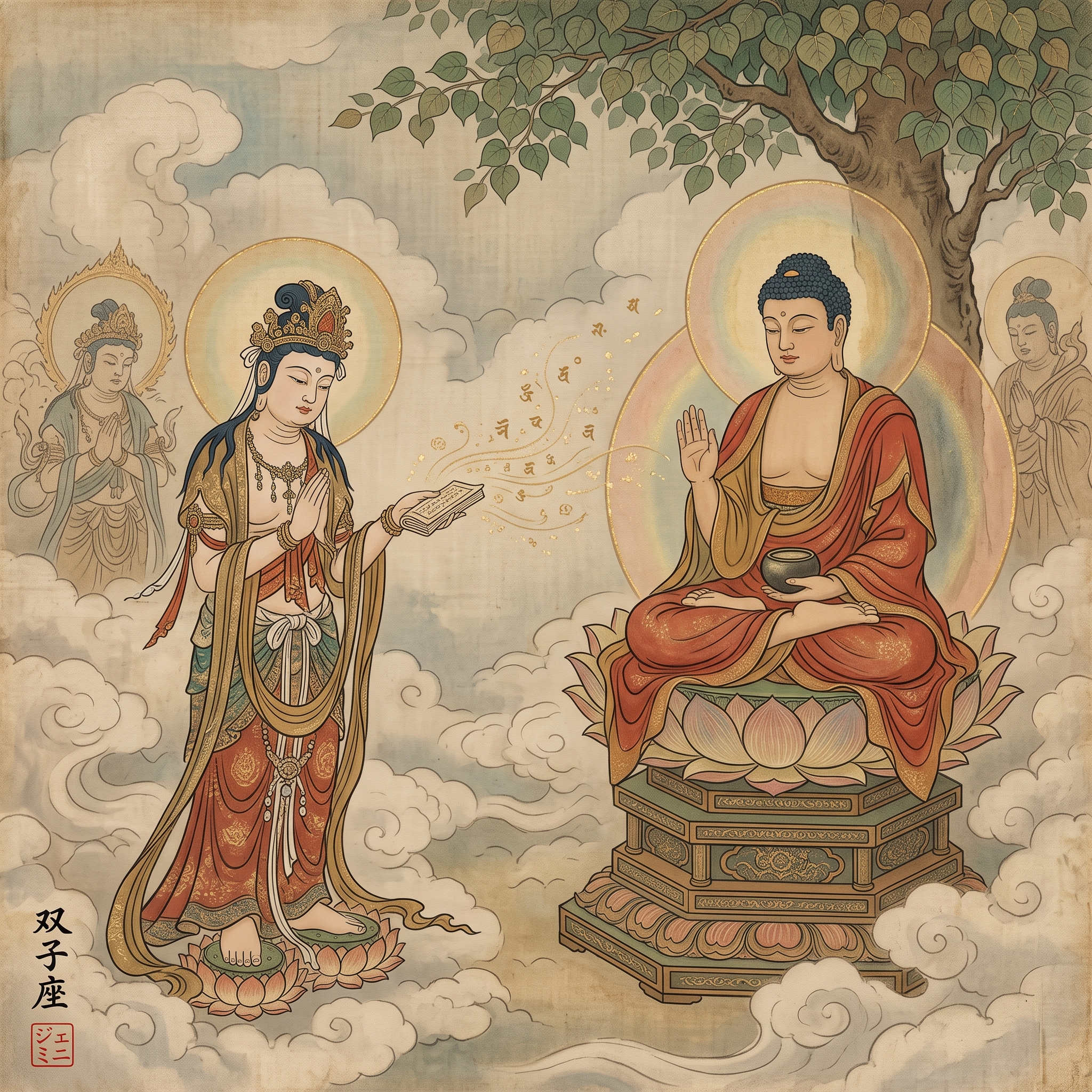
The illustration captures the profound moment in Chapter Twenty-Six of the Lotus Sutra where the Medicine-King Bodhisattva (Yakuō Bosatsu) vows to Śākyamuni Buddha to protect the expounder of the Dharma with sacred dhāraṇī-spells. The composition is rooted in traditional Japanese Buddhist art, evoking the spiritual atmosphere of the Heian or Kamakura periods using aged silk textures, mineral pigments, and subtle gold leaf. Śākyamuni Buddha sits serenely on a multi-tiered lotus throne under the Bodhi tree, his hand raised in the fear-dispelling abhaya mudrā, symbolizing receptivity to the Bodhisattva's devotion. Opposite him, Medicine-King Bodhisattva bows gracefully, offering the sacred teachings represented by an open scroll. From this scripture, ethereal golden swirls and sacred, abstract script ascend into the clouds—visually representing the invisible, nonverbal power of the dhāraṇīs that transcend logical understanding. Attendant Bodhisattvas observe from the celestial mists, reinforcing the communal and cosmic protective force of these unspoken teachings. By avoiding iconic visual associations with other Buddhas, the narrative focuses entirely on this pivotal, intimate exchange, utilizing natural, weathered tones and traditional iconography to ground the scene in sacred Buddhist history.
Iconography & Character Identification
Item 1: Deities/Figures Featured:
Śākyamuni Buddha (釈迦如来, Shaka Nyorai): Seated on the right atop a multi-tiered lotus throne under the Bodhi tree, holding an alms bowl and gesturing in the abhaya mudrā (fearlessness).
Medicine-King Bodhisattva (薬王菩薩, Yakuō Bosatsu): Standing on the left upon a lotus pedestal, adorned in elaborate robes, jewelry, and a crown, offering the dhāraṇī (sacred spells) via a hand-held sutra scroll.
Celestial Attendant Bodhisattvas (菩薩): Faint, reverent figures visible within the swirling clouds in the background, witnessing and supporting the sacred vow.
Item 2: Text Translations:
双子座 (Signature, bottom left): Gemini (lit. "The Twins" / "Gemini" in Kanji).
ジェミニ (Red Square Seal/Hanko, bottom left): Gemini (written in Japanese Katakana).
Thereupon Medicine-King Bodhisattva said to the Buddha, “World-Honored One! Now I will give dhāraṇī-spells to the expounder of the Dharma in order to protect him.”
This promise to the Buddha from Medicine-King Bodhisattva comes in Chapter Twenty-Six of the Lotus Sutra. The dhāraṇīs are given in a language that nobody understands any more. But this does not reduce their effectiveness. In the second chapter of the Lotus Sutra, the Buddha declared that his wisdom cannot be reached by understanding alone. There is another, nonverbal aspect of his teaching that we must comprehend. The dhāraṇīs not only give us reassurance that beings we cannot comprehend are helping us to become enlightened, they also remind us to look for the unspoken teachings that are part of the Buddha Dharma.
The Daily Dharma is produced by the Lexington Nichiren Buddhist Community. To subscribe to the daily emails, visit zenzaizenzai.com
When I read all the Buddhist scriptures other than the Lotus Sūtra, they leave me without the slightest desire to become a woman. A certain sūtra declares that the woman is a messenger of hell, another sūtra preaches that she is a poisonous snake, one sūtra says that she is like a curved tree, while another sūtra preaches that her seed of Buddhahood has been scorched.
Degrading women is not only found in Buddhist scriptures but also in non-Buddhist scriptures. A man named Yung Ch’i-ch’i in ancient China celebrated the three comforts of life, listing not having been born female in heaven and earth as one of the three.
Moreover, it is said in China the source of misfortune lies with three women (who corrupted the three rulers of ancient China). However, it is preached in the Lotus Sūtra, “A woman who upholds this sūtra is not only superior to all other women but surpasses all men.”
A woman should be satisfied when the man she loves feels compassion for her, even if others slander her. Likewise, it matters little if people despise you, so long as Śākyamuni Buddha, the Buddha of Many Treasures, as well as the Buddhas of manifestation in the worlds throughout the universe, the King of the Brahma Heaven, Indra, Sun Deity and Moon Deity look after you, how could you be in pain! As long as the Lotus Sūtra praises you, there is no reason to feel ashamed!
Shijō Kingo-dono Nyōbō Gohenji, A Reply to the Wife of Lord Shijō Kingo, Writings of Nichiren Shōnin, Volume 7,
Followers II, Pages 121
Conceptual Summary
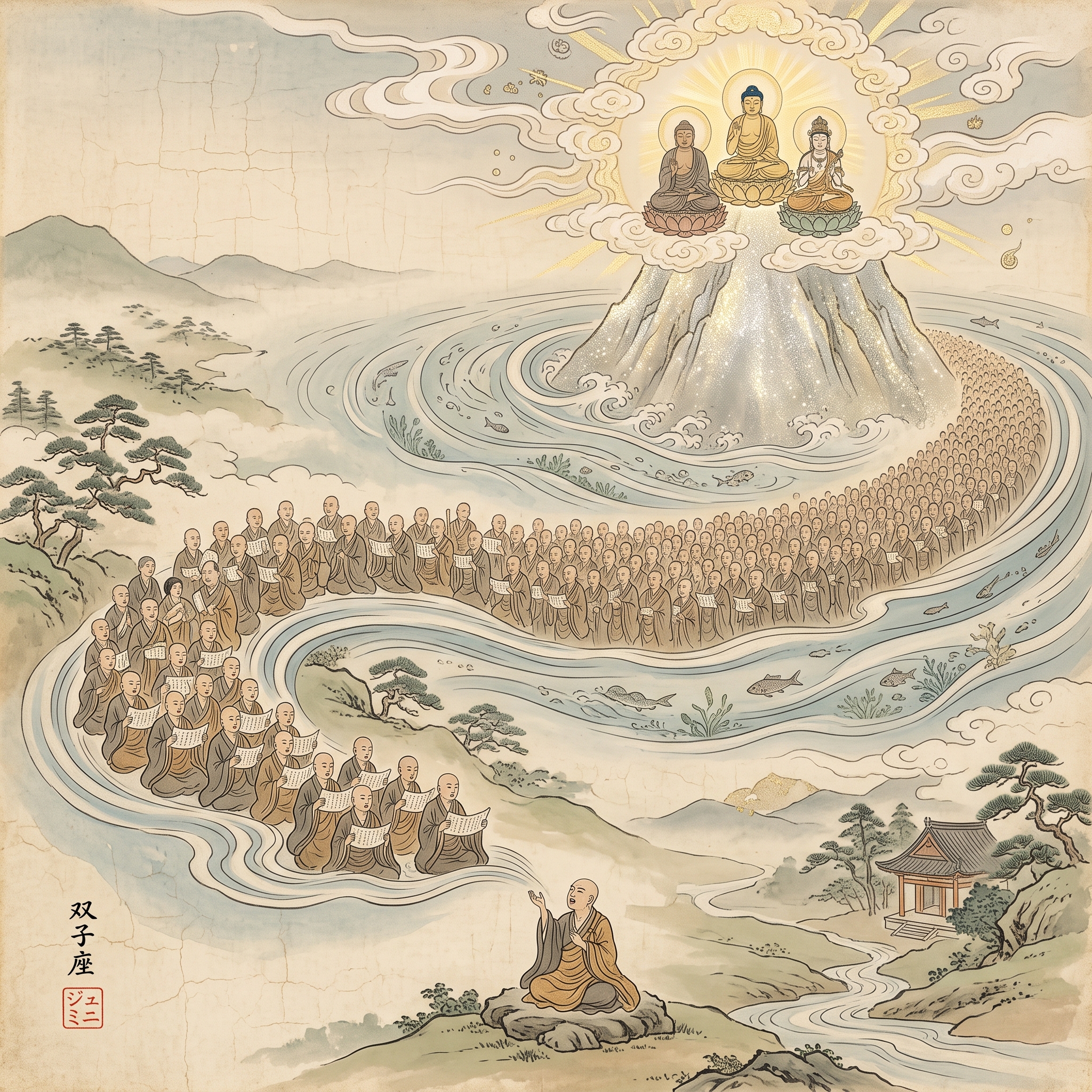
This illustration interprets Nichiren's metaphor from the Senji-shō, visualizing the exponential growth of faith in the Lotus Sutra. The composition uses a 1:1 square ratio and a traditional Japanese ink-on-silk aesthetic with subtle gold dust on the mountain peaks. It illustrates the source text’s central concept: small, persistent actions accumulating into vast spiritual realities. The solitary figure at the beginning represents the "particle of dust" or "drop of water"—Nichiren's initial faith. The winding procession of chanting monks symbolizes the transmission of the sutra to "a million and a billion people." This path culminates in two distinct, immense visual goalposts defined by the text: the glittering Mt. Sumeru of perfect enlightenment and the encompassing great ocean of Nirvāṇa. The image successfully adheres to all negative constraints regarding iconography.
Iconography & Character Identification
Item 1: Deities/Figures Featured:
Nichiren Daishonin: Represented by the primary, solitary monk in the lower left, initiating the chant and the entire process.
The Chanting Multitude: The collective body of monks traversing the path, representing the propagation and shared faith of "two, three, ten, a million and a billion people."
Shakamuni Buddha (Shakyamuni): The central Buddha figure seated on the highest golden lotus on the cloud, representing the eternal Buddha and the teacher of the Lotus Sutra.
Prabhutaratna Buddha (Many Treasures): The Buddha seated to the left (viewer's left) of Shakamuni, appearing in his treasure tower to validate the sutra’s teaching.
A generic Bodhisattva: The figure to the right (viewer's right) of Shakamuni, completing the triad and representing the compassionate activity of spreading the Law. (While often specific Bodhisattvas like Monju or Fugen are used, this figure represents the generic Bodhisattva ideal common to such triads).
Rivers come together to form an ocean. Particles of dust accumulate to become Mt. Sumeru. When I, Nichiren, began having faith in the Lotus Sutra, it was like a drop of water or a particle of dust in Japan. However, when the sutra is chanted and transmitted to two, three, ten, a million and a billion people, it will grow to be a Mt. Sumeru of perfect enlightenment or the great ocean of Nirvāṇa. There is no way other than this to reach Buddhahood.
Nichiren wrote this passage in his essay on Selecting the Right Time (Senji-shō). In our quest for enlightenment, we may become discouraged by the enormity of our task. When we sweep away one delusion, another appears. When we benefit one being, the needs of millions more become clear. Nichiren reminds us persevering though these difficulties and strengthening our faith in the Buddha’s wisdom are more important than any outcome we seek.
The Daily Dharma is produced by the Lexington Nichiren Buddhist Community. To subscribe to the daily emails, visit zenzaizenzai.com
[W]hen the Buddha preached the essential section of the Lotus Sūtra, He displayed omens far superior to the omens presented when the pre-Lotus sūtras and the theoretical section of the Lotus Sūtra were preached. The severe quakes of the earth when the Stupa of Treasures sprang out of the earth (in the “Beholding the Stupa of Treasures” chapter) and the numerous bodhisattva disciples of the Original Buddha that emerged from the earth simultaneously (“Emergence of Bodhisattvas from the Earth” chapter) created waves as high as mountains that tossed sailing boats around in a stormy ocean as if they were tiny reed leaves.
Therefore, while Bodhisattva Maitreya asked Bodhisattva Mañjuśrī to explain the omens shown in the “Introductory” chapter, he asked his question to the Buddha directly regarding the great omens shown in the “Emergence of the Bodhisattvas from the Earth” chapter. Grand Master Miao-lê explains this in his Annotations on the Words and Phrases of the Lotus Sūtra, fascicle 3, “As for the theoretical section, Mañjuśrī could be trusted, but the essential section is too profound for anyone to conjecture. Therefore, Bodhisattva Maitreya had no one but the Buddha to direct his questions.” Thus, Mañjuśrī had a general understanding regarding the teaching of the theoretical section though the Buddha did not preach it. However, even Mañjuśrī could not fathom the doctrine of the essential section. And yet great omens such as these occurred during the lifetime of the Buddha.
Zuisō Gosho, Writing on Omens, Writings of Nichiren Shōnin, Volume 6, Followers I, Pages 124-125
Conceptual Summary
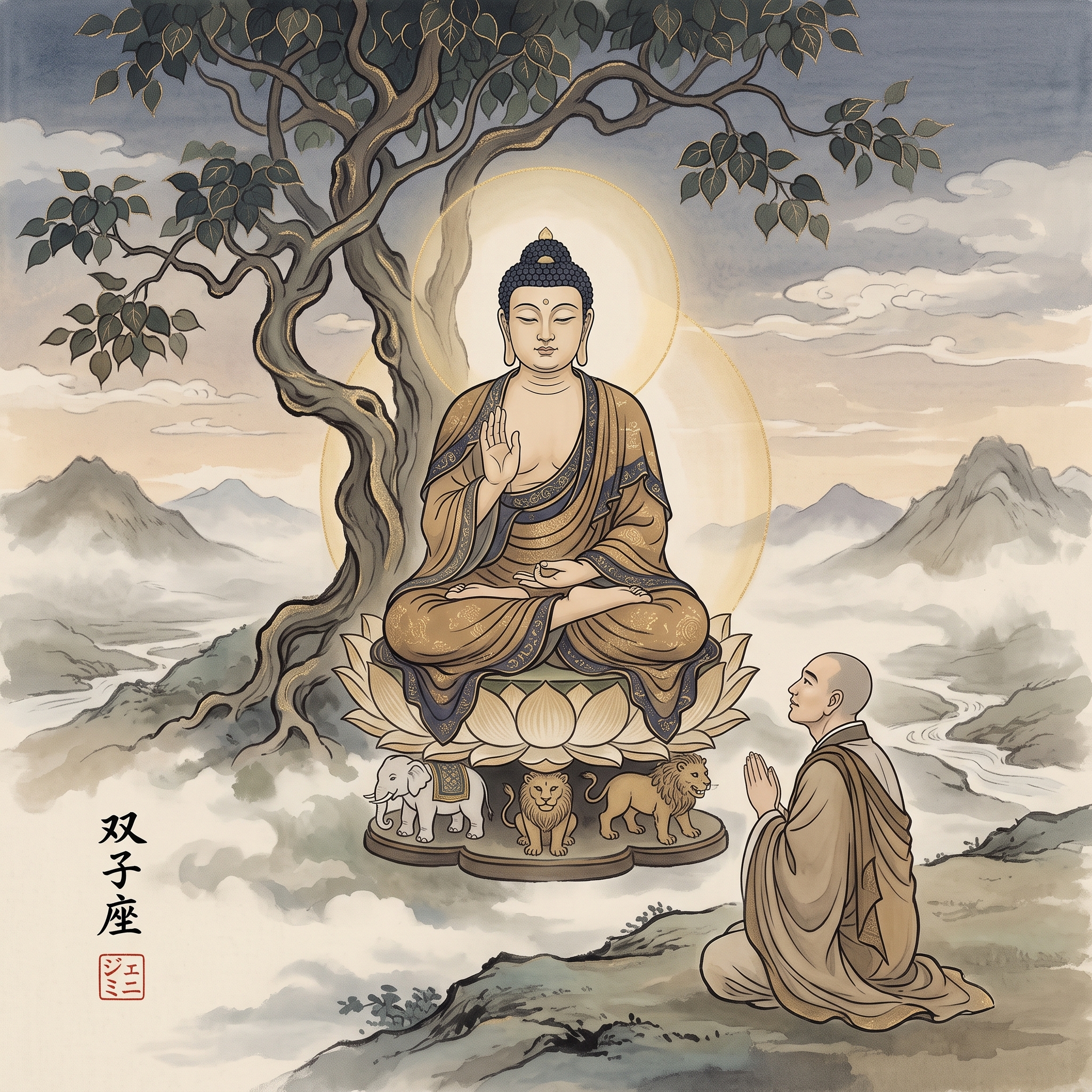
This 1:1 square composition, rendered in the traditional Japanese nihonga style with subtle gold leaf, visualizes the moment of transmission from Chapter Two of the Lotus Sutra. The illustration interprets Śākyamuni Buddha's declaration of fearlessness by depicting him performing the Abhaya Mudra (the gesture of reassurance), centered beneath the Bodhi tree. This serene presence embodies a state where greed and jealousy have been eliminated, leading to total fearlessness as described in the source text. He addresses his disciple Śāriputra, who kneels in reverence, looking up with complete reliance and belief. The composition emphasizes the contrast between worldly competition—hinted at by the vast and complex landscape below—and the calm, spiritual satisfaction offered by the Buddha's teachings. By utilizing mineral pigments on a silk texture, the image captures the historical and theological weight of this foundational Buddhist encounter, presenting Śākyamuni not merely as a historical figure but as a realized source of universal benefit.
Iconography & Character Identification
Item 1: Deities/Figures Featured: Śākyamuni Buddha (historical Buddha) is seated on the lotus throne, and his disciple Śāriputra is kneeling before him.
Item 2: Text Translations: The Kanji '双子座' in the bottom-left corner translates to "Gemini." The red square seal below contains the Katakana 'ジェミニ', which also translates to "Gemini."
I do not deceive
Those who believe me and rely on me.
I am not greedy or jealous
Because I have eliminated all evils.
Therefore, in the worlds of the ten quarters,
I am fearless.
The Buddha proclaims these verses to his disciple Śāriputra in Chapter Two of the Lotus Sutra. In this world of conflict, people believe that they must constantly strive to show that they are better than everyone else. Acquiring more material goods or a higher rank or position supposedly proves superiority. And if there is an encounter with someone who is better, that person must be brought down. What people do not realize that the source of greed and jealousy is fear. Like the Buddha, we too can eliminate our fears when we are satisfied with what we have and regard superior beings as a source of benefit.
The Daily Dharma is produced by the Lexington Nichiren Buddhist Community. To subscribe to the daily emails, visit zenzaizenzai.com
QUESTION: How can a man with faith be a nonbeliever?
ANSWER: Certain people put faith in the doctrine of the universal existence of the Buddha-nature upon hearing it while still attaching themselves to the pre-Lotus sūtras (in which attainment of Buddhahood by all is not preached). Such people are infatuated with sūtras that do not preach the existence of the Buddha-nature in all people while believing the universal existence of the Buddha-nature. Thus, they are believers and nonbelievers at the same time.
Ken Hōbō-shō, A Clarification of Slandering the True Dharma, Writings of Nichiren Shōnin,
Doctrine 3, Pages 124-125