
 In the Nichiren notebook I asked Gemini Notebook to explain the 10 suchnesses and explain how they are interpreted by Tiantai and Nichiren. In the Lotus Sutra notebook I asked Gemini Notebook to explain the 10 suchnesses from Chapter 2. Explain any commentary interpretations. Explain why the 10 suchnesses do not appear in the extant sanskrit versions of the Lotus Sutra. I took the two documents created in Gemini Notebook and uploaded them to Gemini. I then told Gemini: You are a scholar priest of the Nichiren Shu. You want to convey the fundamentals of Nichiren Buddhism to readers curious about the topic. Consider these readers an advanced, college-level audience. Combine these two documents into an extensive essay to be published on a Nichiren Shu website. I also asked Gemini to create an infographic for this essay that illustrates and explains the 10 suchnesses. The infographic and essay are below.
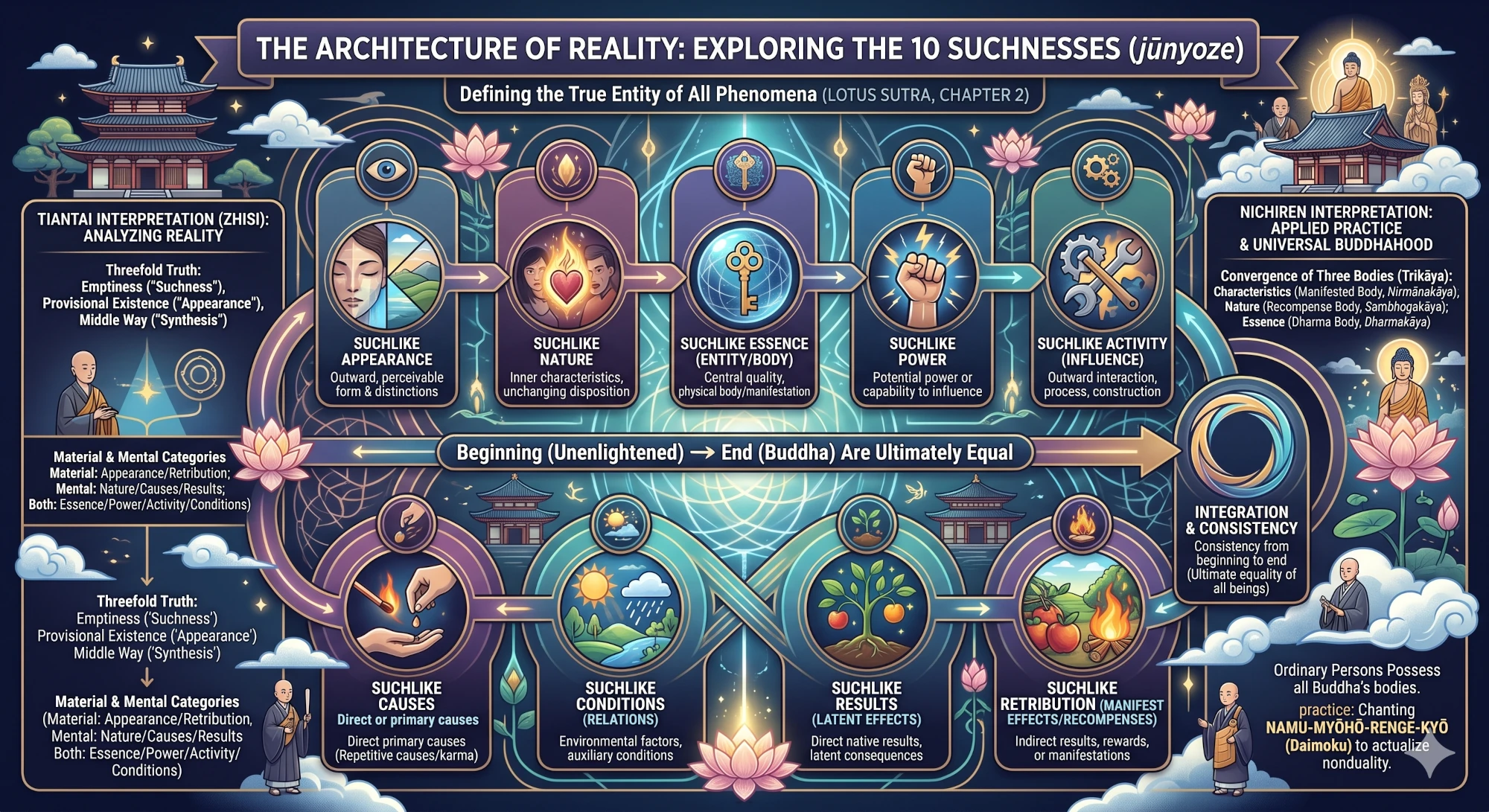
Welcome, students and seekers. As we explore the intellectual and spiritual foundations of Nichiren Buddhism, we must look closely at how the Nichiren Shu tradition parses the fabric of reality itself. Central to this exploration is the concept of the jūnyoze, or the Ten Suchnesses (often translated as the “ten reality aspects”).
Originating in Chapter 2 of the Lotus Sutra—alternately titled the “Expedient Means” or “Skillful Means” chapter—the ten suchnesses are used by the Buddha to describe the “true entity of all phenomena” or the “true character of things.” According to the sutra, this ultimate reality is so profound that it can only be fully understood and shared among Buddhas. Yet, far from being a remote metaphysical abstraction, these ten universal characteristics constitute the “true aspect” of reality common to all beings, spanning from the denizens of hell to the Buddhas themselves. They form the definitive doctrinal basis for the Mahayana principle that all categories of beings interpenetrate.
Anatomy of Existence: Defining the Ten Factors
To understand how reality operates on a functional level, we must first examine the individual components of the ten suchnesses. As defined through the Nichiren Shu lineage and early commentators like Zhiyi (Chih-i), the founder of the Tiantai school, the ten factors map both the internal and external realities of any given phenomenon:
- Suchlike Appearance (or Characteristics): The outward, perceivable forms and distinctions of a thing; that which is external and can be readily distinguished by sight.
- Suchlike Nature: The internal, intrinsic, and unchanging characteristics or disposition dwelling quietly inside.
- Suchlike Essence (or Entity/Body): The central quality or physical manifestation that constitutes the core of a thing.
- Suchlike Power: The potential power, capability, or latent ability to exert an influence.
- Suchlike Activity (or Influence): The outward interaction, behavior, or active process of construction.
- Suchlike Causes: The direct or primary causes, which can be understood as repetitive causes or karma.
- Suchlike Conditions (or Relations): The auxiliary, contributing, or environmental causes that act upon primary causes.
- Suchlike Results (or Effects/Latent Effects): The direct or repetitive results produced natively by the primary causes.
- Suchlike Retribution (or Recompenses/Manifest Effects): The indirect results, rewards, or retributive effects stemming from the unique combination of primary causes and environmental conditions.
- Suchlike Beginning and End being ultimately the same (or Ultimate Equality from Beginning to End): The absolute integration, harmony, and consistency of the first nine factors, proving they all belong together and are ultimately equal from start to finish.
The Tiantai Meta-Framework: Categories and the Threefold Truth
The Tiantai Buddhist tradition places immense philosophical weight on this specific passage, utilizing the ten suchnesses as an analytical lens to explain the exact nature of reality. Zhiyi developed a highly structured hermeneutic by dividing these ten factors into material and mental dimensions, while mapping them directly to human existence:
Dimension of Reality Associated Factors Anthropological Significance The Material Category Appearance and Retribution Indicates the individual’s body The Mental Category Nature, Causes, and Results Indicates the individual’s mind The Dual Category Essence, Power, Activity, and Conditions Indicates the totality of body and mind together Furthermore, Tiantai philosophy applies the profound doctrine of the “Threefold Truth” to the phrasing of the text. By appropriately transposing the punctuation of the original Chinese text and reading the characters (nyoze) in three distinct “turnings,” Zhiyi demonstrated that all things simultaneously embody Emptiness, Provisional Existence, and the Middle Way:
- The Truth of Emptiness (“Suchness”): Reading the text as “These their characteristics are such” indicates that all things are ultimately empty of permanent, independent existence.
- The Truth of Provisional Existence: Reading it as “Their such-like characteristics” emphasizes that appearances are conventionally so-and-so, possessing temporary form, characteristics, and distinction.
- The Truth of the Middle Way: Reading it as “Their characteristics are like this” reveals the synthesis where things are simultaneously empty and provisionally existent, displaying the true character of reality.
In traditional Tiantai thought, multiplying the ten realms of existence by their mutual possession and then by these ten universal suchnesses yields the “thousand suchnesses,” which serves as a core component of the totalistic worldview known as “three thousand realms in a single thought-moment” (ichinen sanzen).
Grounded Hermeneutics: The Factors in Everyday Life
While Tiantai metaphysics can feel abstract, the text fundamentally indicates that everything in existence possesses specific characteristics, a nature, a physical form, and operates on clear laws of cause and effect. As Rev. Shokai Kanai observes, we can easily see these ten factors playing out in everyday human interactions and physical phenomena:
“Consider a person you encounter: their immediate facial expression reveals their outward appearance, while their gentle or angry disposition represents their internal nature.
To look at cause and effect, imagine striking a match. The act of striking the match itself is the primary cause. However, whether you attempt to strike it in the open air or submerged under water represents the crucial environmental conditions. The harmony—or disharmony—of these conditions inevitably dictates whether fire (the effect or reward) is successfully brought into reality.”
The Nichiren Breakthrough: Universal Buddhahood and Practice
When we turn to the writings attributed to Nichiren Shonin, we find that he heavily expanded upon the intellectual scaffolding of Tiantai, infusing it with immediate soteriological urgency. Nichiren directly equated the ten suchnesses to the innate, unshakeable Buddhahood of the ordinary person.
The Convergence of the Three Bodies (Trikāya)
In a brilliant interpretive leap, Nichiren associated the first three suchnesses directly with the three bodies (trikāya) of the originally enlightened Buddha:
- Characteristics corresponds to the manifested body (nirmānakāya), the truth of provisional existence, and the virtue of emancipation.
- Nature corresponds to the recompense body (sambhogakāya), the truth of Emptiness, and the virtue of prajna (wisdom).
- Essence corresponds to the Dharma body (dharmakāya), the truth of the Middle Way, and the essential Dharma nature.
By drawing these precise numerical correspondences, Nichiren’s thought radically denies any ontological or hierarchical distinction between the ordinary person and the Buddha. The texts assert that the three bodies of the Buddha are not distant, external entities; they exist nowhere else but within ourselves as our own immediate characteristics, nature, and essence.
Collapsing the Gap Between Ignorance and Enlightenment
To further emphasize this nonduality, Nichiren reinterpreted the tenth factor—ultimate equality from beginning to end. He posited that “beginning” represents the ten suchnesses of ordinary, unenlightened beings, while “end” represents the ten suchnesses of the fully awakened Buddhas. Their “ultimate equality” means that ordinary worldlings and the Buddha of supreme enlightenment are fundamentally identical and without distinction.
The Applied Practice: Recitation and the Daimoku
How do we actualize this realization? In terms of concrete practice, texts in the Nichiren corpus advocate a dual approach of liturgical recitation and contemplation:
- The Liturgy: Practitioners are encouraged to recite the Lotus Sutra passage on the ten suchnesses three times while mindfully contemplating its threefold meaning (Emptiness, Provisional Existence, and the Middle Way). Through these three recitations, a practitioner can simultaneously realize the three truths and dynamically acquire the Buddha’s three bodies.
- The Ultimate Realization: Ultimately, the Nichiren tradition equates the ten suchnesses directly with the chanting of the daimoku—Namu-myōhō-renge-kyō. The tradition asserts that all ten realms of existence and all ten suchnesses arise from a single moment of human consciousness and are perfectly, seamlessly encompassed within this single chanted title.
A Textual Enigma: The Sanskrit Discrepancy
It is vital to balance our devotional practice with historical awareness. Interestingly, the passage detailing the ten suchnesses does not appear in any existing Sanskrit manuscripts of the Lotus Sutra that survive today, such as those discovered in Nepal or Gilgit. The concept as we know it is entirely a product of Kumārajīva’s foundational Chinese translation of the text.
While contemporary scholars cannot definitively explain this discrepancy, we must recognize that surviving Sanskrit manuscripts are actually much more recent than the early Chinese translations. It is highly probable that the original Sanskrit texts Kumārajīva worked from have been completely lost to history. He may have been translating from a Sanskrit manuscript vastly different from those available to modern archeologists, or he may have translated the text very freely to elegantly convey these profound structural concepts to a Chinese audience.
Regardless of its manuscript lineage, Kumārajīva’s rendering provided the exact philosophical vocabulary required for East Asian Buddhism—and eventually Nichiren—to articulate the ultimate nonduality of our lives and the cosmos. When we chant Namu-myōhō-renge-kyō, we are activating the perfect harmony of the ten suchnesses inherent within our very breath.