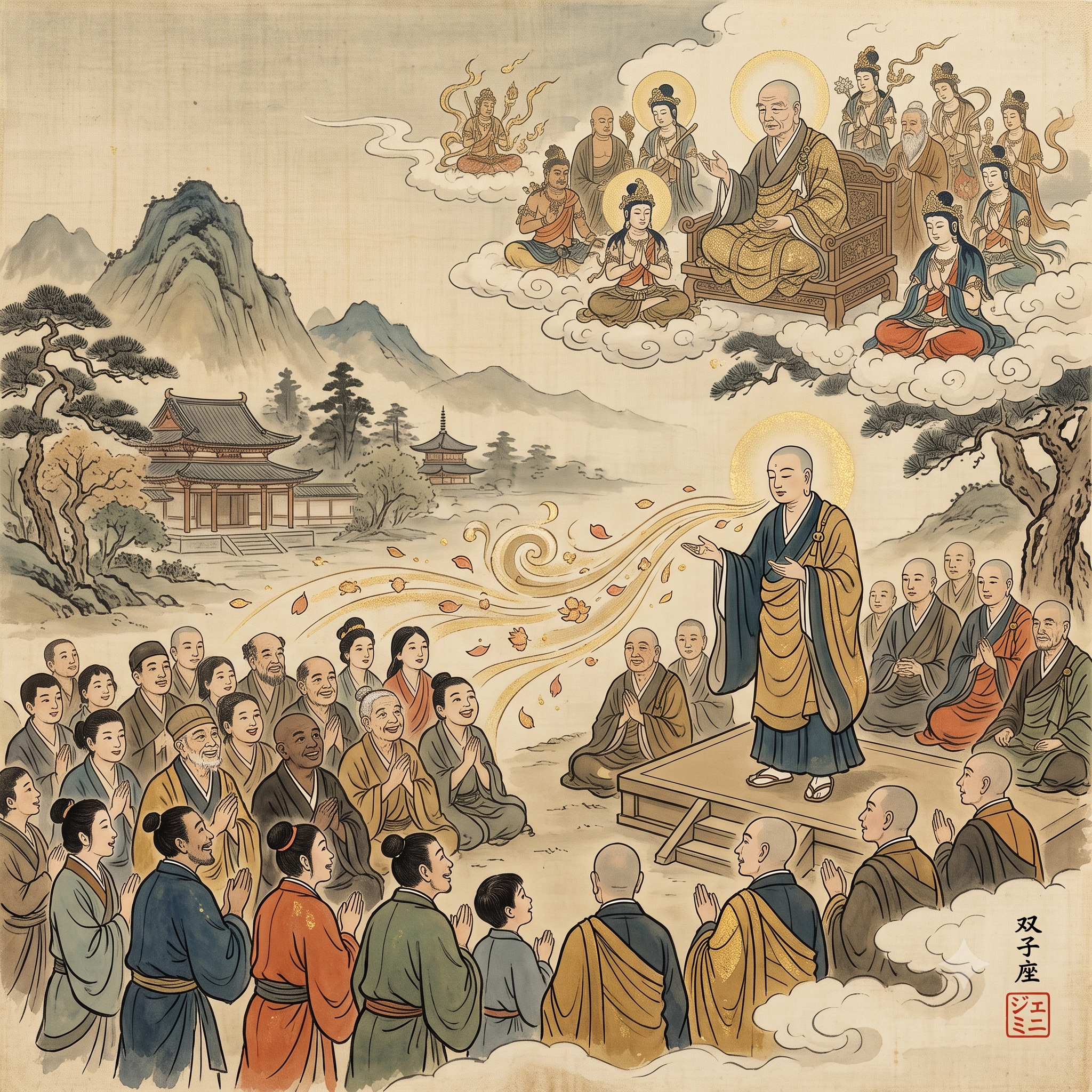
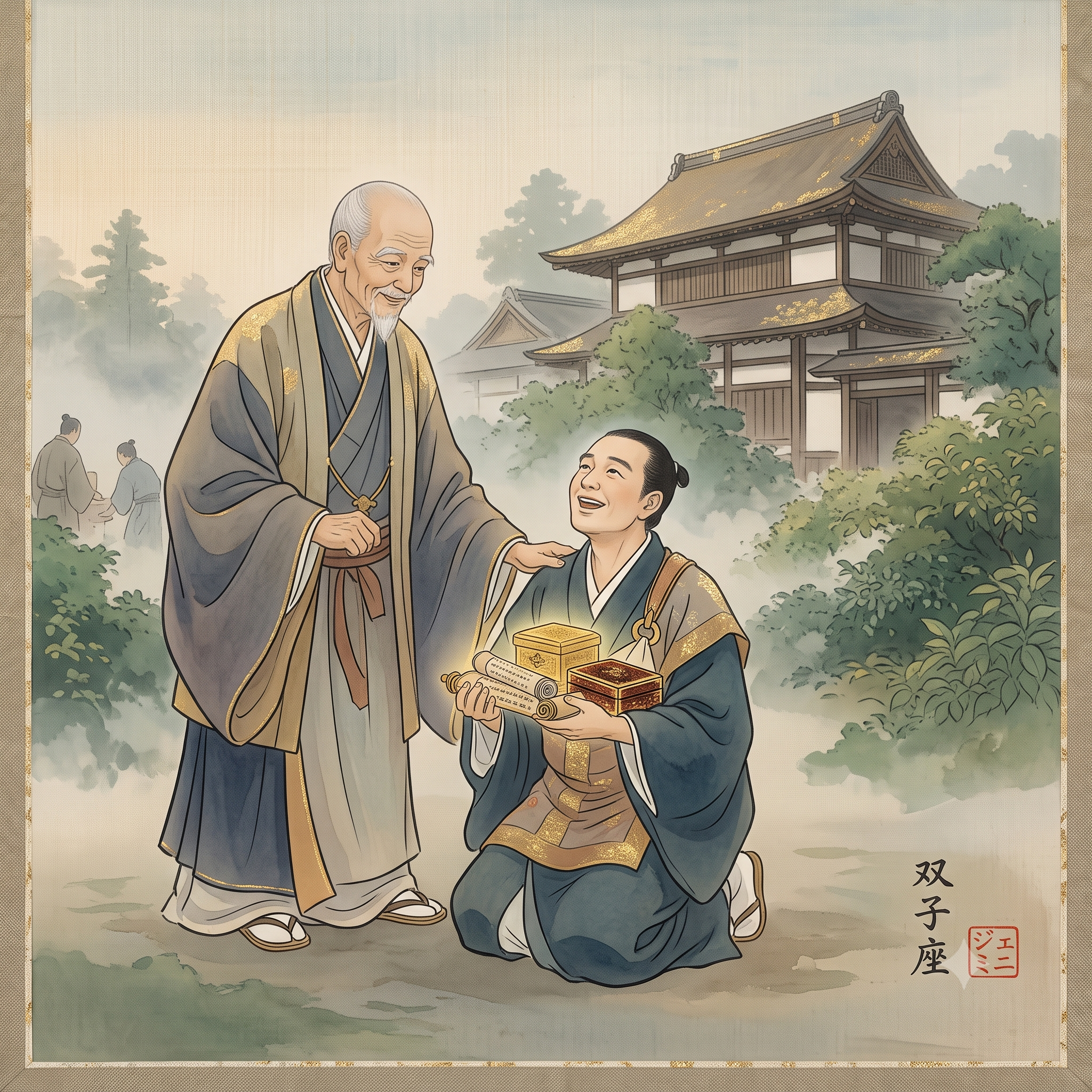
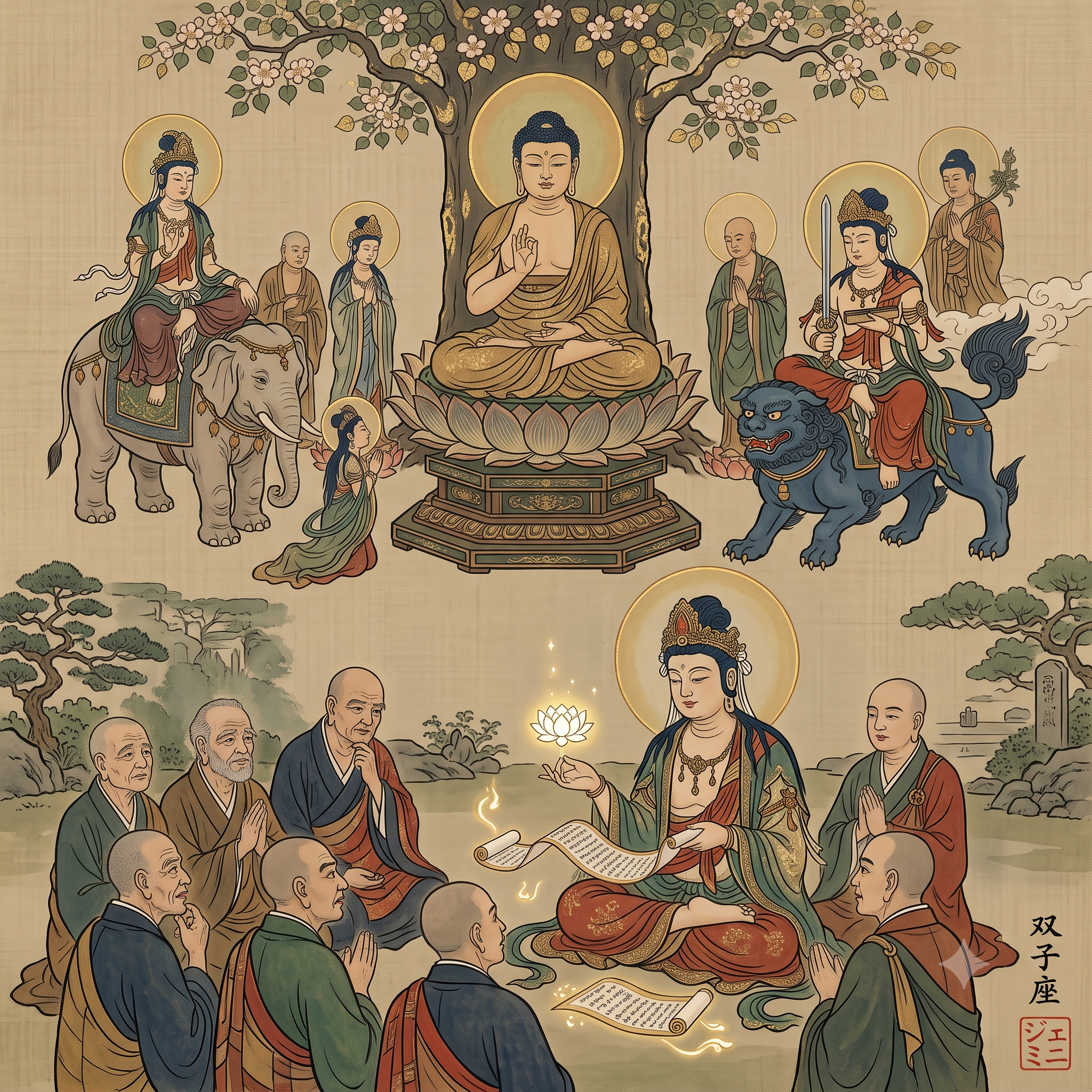
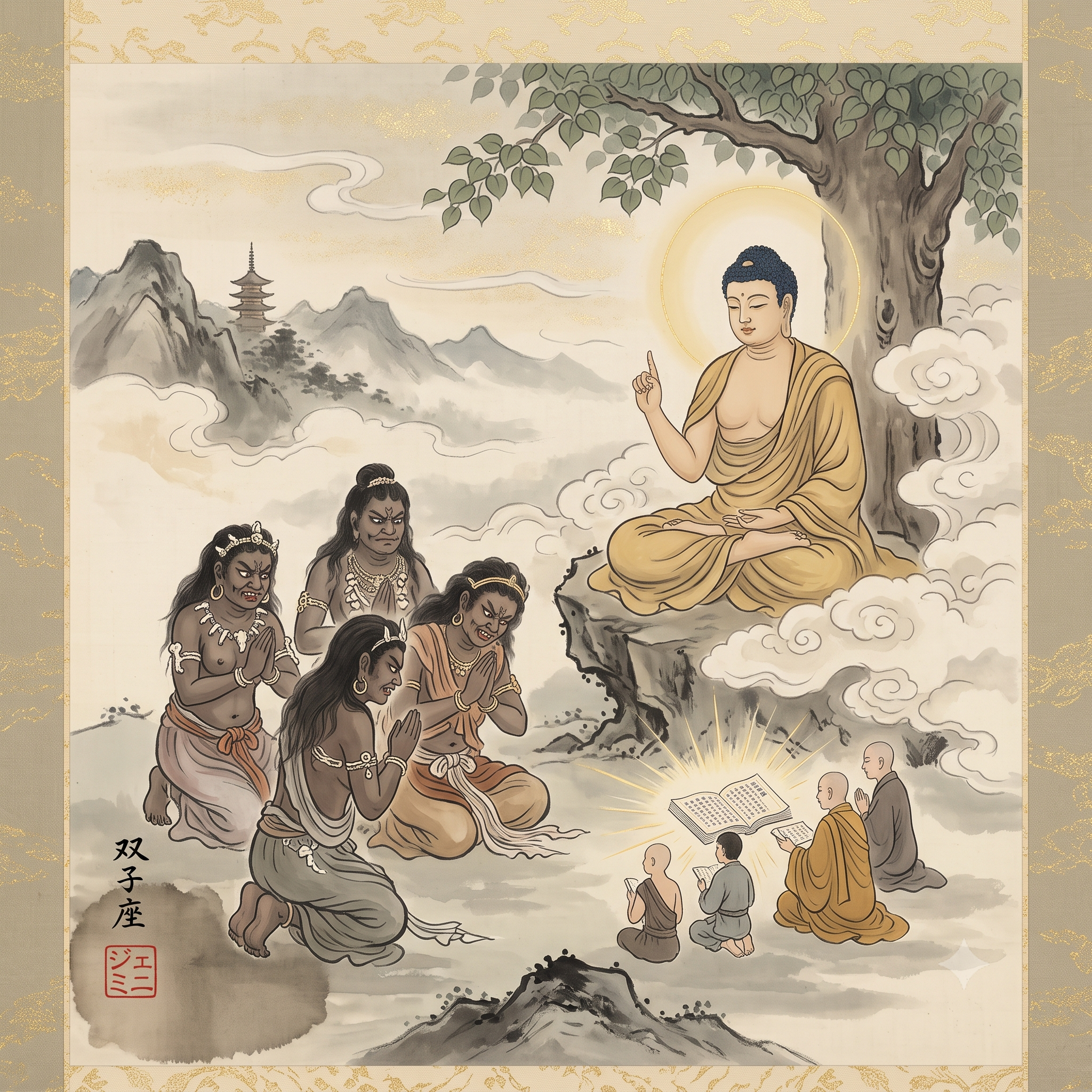
Śākyamuni Buddha is quoted to have declared in the third chapter on “A Parable” of the Lotus Sūtra, fascicle 2, “This triple world is My domain.” It means that the Buddha Śākyamuni has the virtue of being our master, the king and the most respectable in the world. His words, “All living beings therein are My children,” means that the Buddha has the virtue of our parent; and “There are many sufferings in this world; only I can save all living beings” points out His virtue of being our teacher. In the sixteenth chapter on “The Life Span of the Buddha” of the Lotus Sūtra, the Buddha is quoted to have declared, “I am the father of the world.” …
Grand Master Miao-lê declares in his Five Hundred Questions and Answers (Wu-pai wén-lun): “A man who does not know the long life of his father is like a man who wanders around the country governed by his father. Such a man cannot be a son of a man no matter how talented he is;” and “Even though his talent is as great as that of all the people in the country put together, he is nothing but a fool if he does not know how old his parents are.” Precept Master Tao-hsüan (Dōsen) of the Fen-te-ssu Temple at Chung-nan-shan in T’ang China mentions in his Ancient and Modern Disputes between Buddhism and Taoism (Ku-chin fu-tao lun-hêng), “Before the time of the Three Emperors (Fu Hsi, Shen Nung and Yellow Emperor) in ancient China, they had no characters for writing; they knew who their mother was but did not know their father. They acted as if they were birds and beasts.” These are words that Priest Hui-yüan (Eon) of Sui China uttered when he admonished the Emperor Wu of Northern Chou against his persecuting Buddhists.
Hasshū Imoku-shō, A Treatise on the Differences of the Lotus Sect from Eight Other Sects, Writings of Nichiren Shōnin, Doctrine 2, Page 16
Monthly Archives: July 2026
Daily Dharma for July 21, 2026
Conceptual Summary
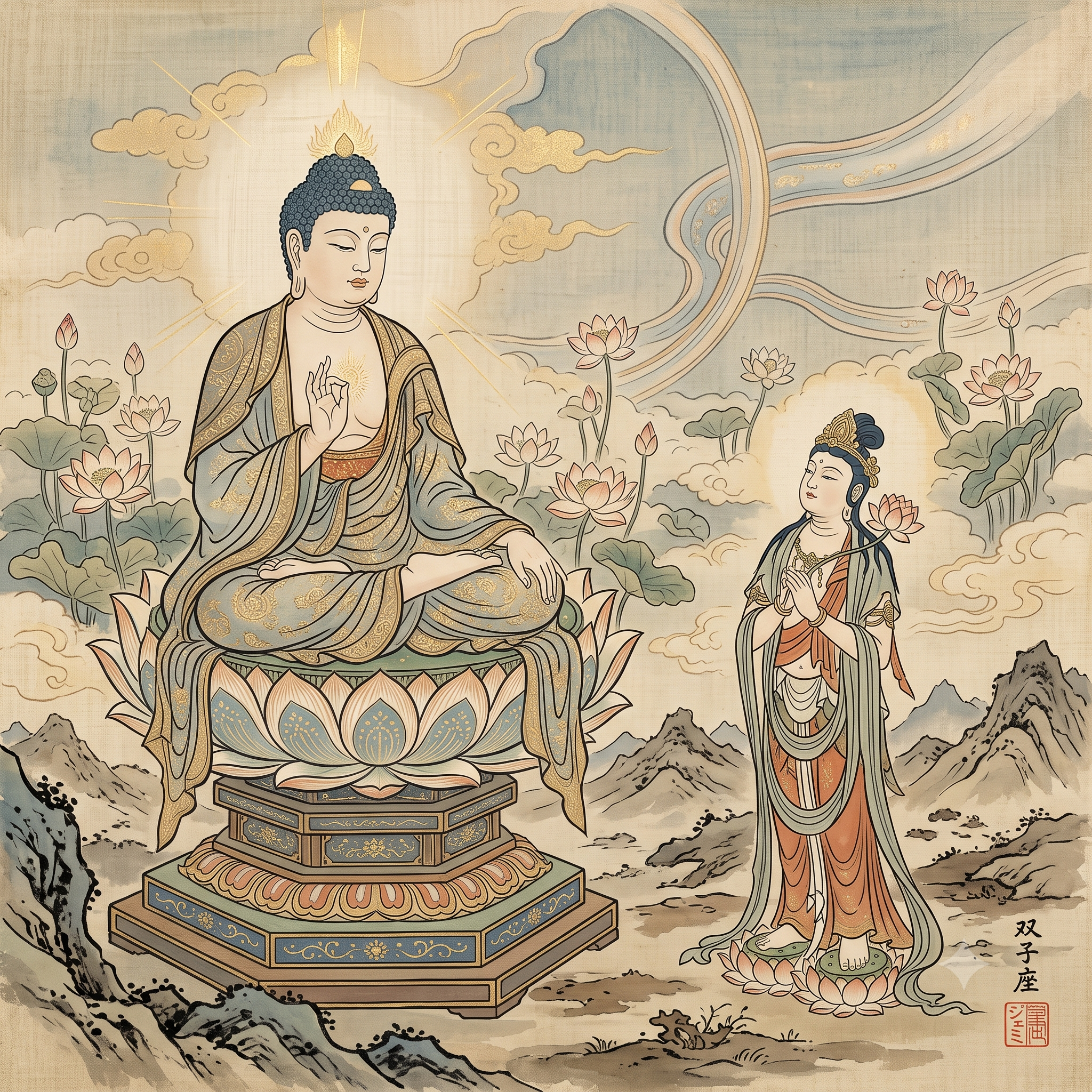
The illustration is a visual interpretation of Chapter Nineteen of the Lotus Sūtra, translating the abstract concept of purified sensory perception into classical Japanese Buddhist iconography. Śākyamuni Buddha is the central figure, demonstrating that enlightenment is attained in this world using our worldly form. His teaching gesture directly addresses the accompanying figure, Constant-Endeavor Bodhisattva. The vast, layered landscape surrounding them visualizes the "one thousand million Sumeru-worlds" mentioned in the source text. The subtle gold leaf lines and stylized ribbons connecting the mountains to the central figures represent the "sounds and voices" being recognized. The inclusion of tiny details like birds and villagers within these distant worlds emphasizes the scope of this recognition, showing that a practitioner with a purified hearing organ can perceive all existence without being overwhelmed or destroyed by the complexity. The style utilizes soft colors and mineral pigments on silk to create a serene, detached atmosphere, reflecting the clarity of a mind that has shed delusions.
Iconography & Character Identification
Item 1: Deities/Figures Featured:
Śākyamuni Buddha (Seated centrally on a lotus throne).
Constant-Endeavor Bodhisattva (Kneeling with hands in anjali mudra (palms pressed together), receiving the teaching).
Item 2: Text Translations:
Kanji Signature (双子座): Gemini
Red Seal (ジェミニ): Gemini
They will be able to recognize all the sounds and voices inside and outside the one thousand million Sumeru-worlds, although they have not yet obtained heavenly ears. Even when they recognize all these various sounds and voices, their organ of hearing will not be destroyed.
The Buddha gives this explanation to Constant-Endeavor Bodhisattva in Chapter Nineteen of the Lotus Sūtra, describing those who keep the Lotus Sūtra. As we shed our delusions and see the world more for what it is, we begin to see and understand things not visible or comprehensible to those still mired in their suffering and attachment. Knowing the suffering we have left behind, we may be lured into abandoning this world and those in it. In this chapter, the Buddha shows that all of the sense organs we have in this life, sight, hearing, smell, taste, touch and thought, all of these can be used either to increase our delusion or bring us towards awakening. The Buddha reached enlightenment in this world, and so do we.
The Daily Dharma is produced by the Lexington Nichiren Buddhist Community. To subscribe to the daily emails, visit zenzaizenzai.com
100 Reasons to Chant the Daimoku
I’ve been working with Google’s Gemini Notebook for some weeks to generate a comprehensive explanation of why one should chant Namu-Myoho-Renge-Kyo. The ostensive goal is teach my grandchildren. Since my grandson is less than 4 years old and my granddaughter is just one year old, they’re a little young to be picking this up right now. But, at 74 years of age, my time is running out.
In Gemini Notebook you upload sources and then ask the notebook’s AI agent to answer questions or produce reports. All of the answers and reports are derived from the sources provided. As of this moment I have 89 sources. Here’s a source list.
From these sources Gemini Notebook has identified:
100 Reasons to Chant the Daimoku
The Power of Sacred Language (Reasons 1–20)
- Chanting is the language of waking reality that startles and rouses the mind from the sleep of ignorance.
- It allows you to achieve the stage of myōji-soku (verbal identity), where you recognize yourself as a buddha through names and letters.
- Your vocalization becomes the “Pure Voice” ( brahmasvara ) that echoes the Buddha’s own eternal preaching.
- Chanting manifests the Buddha’s intent by utilizing your own physical vocal organs as instruments of the Dharma.
- It transforms the “language of dreams”—our discriminative, deluded thoughts—into the absolute truth of the Dharma.
- The five characters of the Daimoku contain the spiritual essence and power of all the Buddha’s lifetime teachings.
- By holding these words in your heart, you literally “hold the Buddha-body” within your own physical form.
- Chanting serves as the specific “seed of buddhahood” required for those living in the age of Mappo .
- It is the “audible sound” of the original Buddha’s enlightenment manifesting in the phenomenal world.
- It functions as a profound meditative discipline that requires no complex or exclusionary mental visualization.
- The characters you chant are “not mere written words” but the living presence of the Thus Come One.
- Each character of the Daimoku is like a “living buddha” seated upon a lotus pedestal within your mind.
- Chanting represents the “unproduced manifested body” of the original Buddha of original enlightenment.
- It is the “path of language” that leads directly to the ultimate truth, rather than wandering through provisional concepts.
- Through the Daimoku, the sutra is shown to be interchangeable with the Buddha himself.
- Chanting allows you to gain access to enlightenment through the “names and letters” that represent the Buddha’s mind.
- It utilizes the “six sense objects” to reveal that all dharmas are, in their essence, the buddhadharma.
- Your voice acts as the “spirit” ( tamashii ) that animates the “body” of your daily practice.
- Chanting is the “pre-eminent form of practice,” replacing the “medicine” of previous ages that no longer fits our illness.
- It reveals the “verbal identity” of all things, showing that even names and letters instantiate the three truths.
Enlightenment in This Very Body (Reasons 21–40)
- Chanting provides the “shortened path” to realization, bypassing the need for countless kalpas of practice.
- It fulfills the principle of sokushin jōbutsu —attaining buddhahood within your very body, just as you are.
- It collapses the linear stages of practice into the single moment of “verbal identity.”
- Chanting rouses you from the “dream of birth and death” that characterizes the nine deluded realms.
- It aligns you with the “mandalic view” where the cause (practice) and effect (enlightenment) are simultaneous.
- It proves that “delusion and enlightenment are a single suchness,” requiring only a change in perspective.
- Chanting allows even those “difficult to save” to manifest their inherent buddha-nature instantly.
- It reveals the “original ground” of your life, which has been enlightened since the remote past.
- Chanting is the “Buddha’s self-practice” shared with the common person to elevate their life-condition.
- It enables you to “attain the Way” through the simple act of vocalizing the title of the King of Sutras.
- Each word of the Daimoku is endowed with the “eight phases of the Buddha’s life,” from birth to nirvana.
- Chanting is the “originally inherent turning of the wheel of the Wonderful Dharma” within your own heart.
- It transforms the “temporary union of the five aggregates” into a permanent vessel of the Buddha’s wisdom.
- It connects your finite mind to the “mind-ground of waking reality” that is never born and never dies.
- Chanting provides the necessary “medicine” for those born in Mappo without prior good roots.
- It functions as the “seed” that naturally produces the fruit of enlightenment without artificial effort.
- It allows you to recognize the “original mind” that exists before the arising of a single thought.
- Chanting reconciles all disparate and provisional paths into the “One Vehicle” of the Lotus.
- It manifests the “inconceivable threefold truth” in every single thought-moment of the practitioner.
- It allows the practitioner to achieve the “stage of identity in principle” ( ri-soku ) through the hearing of the name.
The Reality of Three Thousand Realms (Reasons 41–60)
- Chanting accesses the “original mind of waking reality” that is inherent in all phenomena.
- It reveals the “true aspect of all phenomena” ( shohō jissō ) as they exist before your very eyes.
- Chanting proves that the “assembly on Sacred Vulture Peak is still present” and has not yet dispersed.
- It manifests the doctrine of ichinen sanzen —the interpenetration of three thousand realms in a single thought.
- It empowers your environment, recognizing that the “land” is an extension of your own life-conditioned mind.
- Chanting reveals that the “ten suchlikes” are present in your own physical form and mental dharmas.
- It recognizes the “buddhahood of grasses and trees,” affirming the sacred potential of the insentient world.
- Chanting connects you to the “entirety of the enlightened Dharma realm” through a single sound.
- It affirms “phenomena just as they are” as being absolute and ultimate reality.
- Chanting shows that “heaven and earth have not yet divided” in the realm of ultimate truth.
- It recognizes the “mutual interpenetration of concrete particulars” in your daily life.
- It allows the “inner enlightenment of the practitioner” to fill and transform their surroundings.
- Chanting proves that the “real Buddha has no separate aspect” from the world we inhabit.
- It provides the “contemplation of actuality” ( jikan ), seeing original enlightenment in every object.
- Chanting reveals that “the finger the word is itself the moon the truth,” refuting the Zen idea of a wordless transmission.
- It empowers the “realm of the land” ( kokudo seken ) through the resonance of the True Dharma.
- It helps you realize the “nonduality of physical and mental dharmas” ( shiki shin funi ).
- It acknowledges that the “spirit of the Buddha” resides within the written characters of the sutra.
- Chanting opens the “eye of all buddhas” within your own limited, ordinary vision.
- It validates the “sacred nature of all life,” providing a foundation for universal dignity.
Protection and Averting Disaster (Reasons 61–80)
- Chanting moves the “benevolent deities” and heavenly kings to protect you and your household.
- It provides the spiritual “infrastructure” that protects a land from the three calamities and seven disasters.
- Chanting “establishes the True Dharma” ( risshō ) as the only foundation for a truly peaceful country ( ankoku ).
- It causes the “four heavenly kings” to guard the place where the sutra is recited.
- Chanting serves as a spiritual defense against “pestilence, famine, and war” by rectifying the human heart.
- It moves the “gods and sages” who have abandoned a corrupt land to return and provide protection.
- Chanting is the specific practice to “eliminate calamities” by aligning the nation with the truth.
- It rouses the “benevolent guardians” mentioned in the Medicine Master Sutra to avert strange celestial omens.
- It provides the “spiritual power” needed to protect the nation ( Shugo Kokka ) from foreign invasion.
- Chanting acts as a “shield” against the “strange occurrences on earth” and “disturbances in the heavens.”
- It moves the deities of the Golden Light Sutra to ensure the harmony of the natural world.
- It invokes the “spiritual and political order” of a life centered on the Dharma.
- Chanting requires you to “face facts squarely,” taking responsibility for the state of your world.
- It prevents “the gods from abandoning the country” by upholding the law of the Lotus.
- Chanting helps you overcome the “three powerful enemies”—the ignorant, the arrogant, and the false saints.
- It addresses the “strange celestial omens” like eclipses and unseasonable storms mentioned in the Medicine Master Sutra .
- Chanting counters the “false views of reality” that lead to social and natural decay.
- It allows the practitioner to “admonish evil” and uphold the good, creating a culture of integrity.
- Chanting creates “peace in the land” by transforming the “masterless house” of the human mind.
- It ensures that the “laws of the state” are in harmony with the “laws of the Dharma.”
Transformation of Life and Death (Reasons 81–100)
- Chanting possesses the “thaumaturgical power” to ritually animate and empower insentient objects.
- It is the essential power used in the “eye-opening ceremony” to consecrate the Gohonzon .
- Chanting “infuses a spirit” ( chinkon ) into the sacred icons, making them “living teachers.”
- It transforms the “remains of the dead” into the Dharma body through the power of the Daimoku.
- Chanting is the “eye of all buddhas” that grants vision and guidance even after death.
- It saves the deceased by “transforming the spirit into the Buddha’s mind” during the interim state.
- Chanting allows the living to “retrieve the departed spirit” and anchor it in the Buddha’s lifespan.
- It serves to “expiate” even the gravest sins and cleanses the heavy karma of the past.
- Chanting ensures that even the “remains” ( hone ) are connected to the unborn nature of reality.
- It transforms “death” from a point of despair into the realization of the “deathless lifespan.”
- Chanting the “five characters” is the act of giving “spirit” to the physical “body” of life.
- It creates a “seamless continuum” between your doctrinal understanding and your daily ritual.
- Chanting provides the “merit” needed for birth in a pure land or a favorable future existence.
- It proves that the “Buddha’s intent” can be embodied in the wood and paper of the Honzon.
- Chanting allows you to “revere the living teacher” within the mandala of the Gohonzon.
- It acts as the “spirit” ( tamashii ) that gives life to the “body” of the Honzon.
- Chanting is the “eye-opening” power that distinguishes a true buddha from a deceptive demon.
- It allows one to “attain the stage of acquiescence” ( tokunin ) in their present physical body.
- Chanting transforms the “temporary union” of your life into the eternal “Dharma body.”
- It ensures that your life—and the lives of those you love—are anchored forever in the “eternal Buddha-body.”
Three Kinds of Enemies
It is predicted in the Lotus Sūtra, in the 13th chapter “Encouragement for Upholding This Sūtra,” that 2000 years after the Buddha’s extinction, in the Latter Age of Degeneration, three kinds of enemies will appear against those who spread the Lotus Sūtra. The time at hand matches exactly the Latter Age of Degeneration preached in the Lotus Sūtra as the “fifth 500-year period” after the death of the Buddha. As I, Nichiren, contemplate whether or not the Buddha’s words have proved to be true, three kinds of enemies surely exist today. If I deny the existence of the three enemies and spread the Lotus Sūtra in a manner so as to avoid persecution, I cannot claim to be a practicer of the Lotus Sūtra. On the other hand, if I spread the sūtra in such a way that I am persecuted by enemies, I certainly will lose my life.
Kyōki Jikoku-shō, Treatise on the Teaching, Capacity, Time and Country, Writings of Nichiren Shōnin, Doctrine 3, Page 95-96
Daily Dharma for July 20, 2026
Conceptual Summary
The conceptual thinking for this image draws directly from Śākyamuni Buddha's verses in Chapter Two of the Lotus Sūtra. The central figure is Śākyamuni, seated under the bodhi tree, radiating serene golden light. Instead of standard mudras associated with specific meditation or protection, his hands are depicted in the 'Abhaya' (fearlessness) and 'Varada' (boon-giving) mudras, symbolizing his universal vow to protect and elevate all beings. The image visually interprets "leading all living beings" by showing people of all types ascending towards him, many transforming into Buddha-like figures themselves. The distant background, rendered in soft gold, depicts "innumerable Buddhas in limitless worlds," a direct translation of the conceptual outcome described in the text. The composition keeps focus strictly on the direct, expedients-leading-to-universal-Buddhahood path revealed by Śākyamuni himself.
Iconography & Character Identification
Item 1: Deities/Figures Featured:
Śākyamuni Buddha (Central Figure)
Various Celestial Attendants and Musicians (Around the Central Buddha)
Multitudes of Living Beings (Guiding path ascending towards enlightenment, transforming into Buddhas)
Item 2: Text Translations:
'双子座': Gemini
'ジェミニ': Gemini
Know this, Śāriputra!
I once vowed that I would cause
All living beings to become
Exactly as I am.
That old vow of mine
Has now been fulfilled.
I lead all living beings
Into the Way to Buddhahood.
The Buddha sings these verses in Chapter Two of the Lotus Sūtra. Earlier in the chapter he explained that all the teachings he used before the Lotus Sūtra were mere expedients, intended to use our desire for happiness to bring us out of our suffering and onto the path of enlightenment. The expedient teachings were tailored to the ignorant and deluded minds of those who heard them, but had not yet revealed the true wisdom and compassion of the Buddha. Now that we have met this Wonderful Dharma, we are assured of our enlightenment and that of all beings. We learn to see innumerable Buddhas in limitless worlds through unimaginable time, and our own true selves at the heart of reality.
The Daily Dharma is produced by the Lexington Nichiren Buddhist Community. To subscribe to the daily emails, visit zenzaizenzai.com
Time To Spread the True Dharma
Nāgārjuna and Vasubandhu were great commentators who wrote one thousand commentaries. However, they commented only on provisional Mahāyāna sūtras, and even though they inwardly grasped the Lotus Sūtra, they did not outwardly speak of it. (There is an oral transmission about this). T’ien-t’ai and Dengyō spread the Lotus Sūtra but they did not reveal the Most Venerable One of the essential section, the four bodhisattvas guided by the Original True Buddha, precept dais of the essential section, and the five characters of “Namu Myōhō Renge Kyō.” Their reasons were, first of all they did not receive the teaching from the Buddha. Secondly the time was not right to spread the teaching. The time has now arrived, however, and the four bodhisattvas guided by the Original True Buddha will appear in this world to spread the True Dharma according to the sūtra. I, Nichiren, have known this for a while. During the time of Emperor Wu in Han China a blue bird flew from the West signaled the omen of Hsi-wang-mu’s coming or a magpie sang as the omen of a visiting guest. My disciples should think this through seriously. You should not abandon your faith in the Lotus Sūtra even at the risk of your life.
Hokke Gyōja Chinan-ji, Difficulty of the Practicer of the Lotus Sūtra, Writings of Nichiren Shōnin, Biography and Disciples, Volume 5, Pages 16
Daily Dharma for July 19, 2026
Conceptual Summary
The illustration is a Kamakura-style silk painting interpreting Śākyamuni Buddha’s declaration of universal impartiality from the Lotus Sūtra. The core challenge was visually translating the metaphor of a single, equalizing rain shower into a devotional portrait without depicting a physical storm. The solution was to focus on the effect of the rain. Śākyamuni Buddha is seated at the center-left on a lotus throne, radiating a soft, pervasive light. The diverse assemblage of sentient beings in the foreground—including monks, children, an elderly figure, and generalized animals like a deer and a bird—receives this light and energy equally. This visual sameness across different figures, combined with the lack of distinct mudras distinguishing him as Dainichi or Amida, reinforces his identity as Śākyamuni manifesting perfect, undifferentiated compassion for all.
Iconography & Character Identification
Item 1: Deities/Figures Featured:
Śākyamuni Buddha (Shaka Nyorai)
An diverse assembly of sentient beings, representing the multitude of classes and forms of life.
Item 2: Text Translations:
The Kanji at the top of the image are:
釋迦牟尼佛
Which translates to:
Śākyamuni Buddha
(The Historical Buddha)
Break down of the translation:
釋迦 (Shaka): Refers to the Śākya clan, the noble family the historical Buddha was born into. It is often translated as "Sage of the Śākyas."
牟尼 (Muni): An ancient Indian term for a sage, acetic, or holy man, signifying someone who has attained high spiritual knowledge.
佛 (Butsu/Fo): The standard Kanji for "Buddha," meaning "Enlightened One."
Kanji signature '双子座': Gemini
Seal 'ジェミニ': Gemini
I see all living beings equally.
I have no partiality for them.
There is not ‘this one’ or ‘that one’ to me.
I transcend love and hatred.
The Buddha makes this declaration in Chapter Five of the Lotus Sūtra. He compares himself to a rain shower that waters all plants equally. He uses this example to show us how we should approach all living beings. Our respect for them and wish that they become enlightened cannot depend on whatever personal feelings we have towards them.
The Daily Dharma is produced by the Lexington Nichiren Buddhist Community. To subscribe to the daily emails, visit zenzaizenzai.com
Those Who Uphold the Teaching of the Lotus Sūtra
[T]he eleventh chapter of the Lotus Sūtra, “Appearance of the Stupa of Treasures,” states: “Those who uphold the teaching of this sūtra are deemed to serve Me, Śākyamuni, and the Buddha of Many Treasures. They also serve Buddhas in manifestation here who adorn and glorify their respective worlds.” This means that Śākyamuni Buddha, the Buddha of Many Treasures, and all the Buddhas in manifestation are in our minds, and that we, upholders of the Lotus Sūtra, will follow their steps and inherit all the merits of those Buddhas.
This is the meaning of the passage in the tenth chapter of the Lotus Sūtra, “The Teacher of the Dharma,” which reads: “Those who hear of this Lotus Sūtra even for a moment, will instantly attain Perfect Enlightenment.”
Kanjin Honzon-shō, A Treatise Revealing the Spiritual Contemplation and the Most Venerable One, Writings of Nichiren Shōnin, Doctrine 2, Page 144-145
Daily Dharma for June 18, 2026
Conceptual Summary
The illustration represents World-Voice-Perceiver Bodhisattva (Kannon), specifically interpreting the metaphor of a compassion "as deep as the sea." By utilizing the aesthetic of traditional ink and mineral pigments on aged silk, the image captures the depth and vastness mentioned in the Lotus Sūtra text. Kannon is depicted with numerous arms, symbolizing the boundless ability to practice "according to the conditions of the places of salvation"—responding to diverse needs without limitation. Gold leaf accents and subtle soft colors emphasize a shift from overwhelming material power to the quiet "wonders that surround us" through wisdom. The visualization emphasizes boundlessness and profound dependency on spiritual support, manifesting as a serene savior figure present across kalpas of sea and suffering.
Iconography & Character Identification
Item 1: Deities/Figures Featured: World-Voice-Perceiver Bodhisattva (Kannon, Avalokitesvara); and numerous suffering or reverent beings representing the general populace in various environments and boats.
Item 2: Text Translations:
双子座 (Kanji signature): Gemini (or Gemini Constellation)
ジェミニ (Red square seal - Hanko): Gemini
Listen! World-Voice-Perceiver practiced
According to the conditions of the places [of salvation].
His vow to save [people] is as deep as the sea.
You cannot fathom it even for kalpas.
The Buddha gives this description of World-Voice-Perceiver Bodhisattva (Kannon, Kanzeon, Kuan Yin, Avalokitesvara) to Endless-Intent Bodhisattva in Chapter Twenty-Five of the Lotus Sūtra. As the embodiment of Compassion, World-Voice perceiver demonstrates the boundlessness of our ability to benefit others. We can often feel overwhelmed by the problems in the world, and believe that we are not capable of doing everything that is necessary to lead beings out of their delusions. This chapter reminds us that we are not working alone, and that by depending on wisdom rather than power, we learn to see the wonders that surround us.
The Daily Dharma is produced by the Lexington Nichiren Buddhist Community. To subscribe to the daily emails, visit zenzaizenzai.com
Ultimate Doctrine of Compassion
[B]eginning with Śākyamuni Buddha, such Buddhas as the Buddha of Infinite Life, Medicine Master Buddha, and the Buddha of Many Treasures as well as such bodhisattvas as Avalokiteśvara, Mahāsthāmaprāpta, Samantabhadra, and Mañjuśrī are compassionate parents to us. You should not forget that the ultimate doctrine of compassion with which these Buddhas and bodhisattvas guide the people is solely in the Lotus Sūtra. You should remember that the secret doctrine to save the evil, the stupid, women, and those without Buddha-nature is not revealed in sūtras other than the Lotus Sūtra. This is the very reason why the Lotus Sūtra is superior to all other Buddhist scriptures.
Shō Hokke Daimoku-shō, Treastise on Chanting the Daimoku of the Lotus Sūtra, Writings of Nichiren Shōnin, Faith and Practice, Volume 4, Page 15