
My disciples, think deeply! The countless bodhisattvas who had sprung up from underground were disciples of Lord Śākyamuni Buddha ever since the time He had first resolved to seek Buddhahood. Nevertheless, they neither came to see Him when He attained Buddhahood under the bodhi tree, nor visited Him when He passed away under the twin śāla trees. Thus, they may very well be accused of not being filial.
Moreover, they did not attend the preaching of the fourteen-chapter theoretical section, and they were absent when the last six chapters of the essential section were preached. They came and left while the first eight chapters of the essential section were being preached. But these great high-ranking bodhisattvas made a vow in the presence of Śākyamuni Buddha, the Buddha of Many Treasures and numerous Buddhas in manifestation that they would propagate the Five Characters transmitted to them at the beginning of the Latter Age of Degeneration. How can they not appear right now?
Kanjin Honzon-shō, A Treatise Revealing the Spiritual Contemplation and the Most Venerable One, Writings of Nichiren Shōnin, Doctrine 2, Page 160
Monthly Archives: June 2026
Daily Dharma for June 30, 2026
Show Gemini's thinking
Gemini Thinking
Conceptual Summary
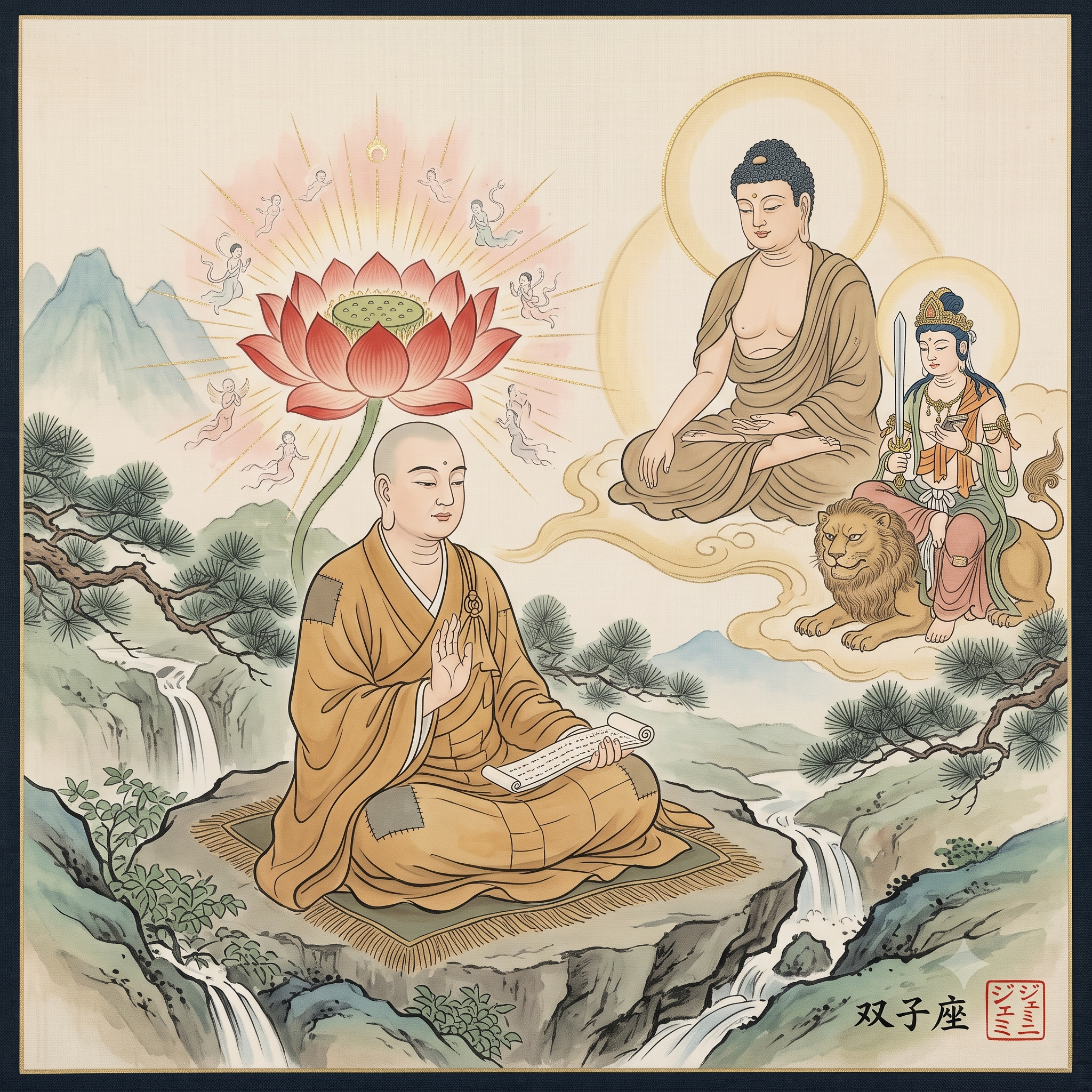
This 1:1 composition captures the essence of Chapter Fourteen of the Lotus Sūtra using traditional Japanese ink and pigment techniques on silk. At the center, the dedicated bhikṣu is shown in a state of tranquil patience, represented by the calm mountain and waterfall environment, indicating his liberation from external distractions. He holds the Lotus Sūtra scroll while a large red lotus, symbolizing 'the Wonderful Dharma,' blossoms behind him, emanating small, liberated beings who have successfully escaped from "jealousy, anger, and other illusions," visualizing the promised emancipation. Seated on the right, Śākyamuni Buddha is identified by his classic iconography, actively preaching the dharma. Next to him is Mañjuśrī Bodhisattva, identified by his unique mount (the lion) and the sword that cuts through ignorance, listening and validating this 'peaceful practice' teaching.
Iconography & Character Identification
Item 1: Deities/Figures Featured: 1. Śākyamuni Buddha (The historic Buddha, preaching). 2. Mañjuśrī Bodhisattva (The Bodhisattva of Wisdom, identified by his lion mount and sword). 3. The Bhikṣu (The monk practitioner who expounds the Lotus Sūtra).
Item 2: Text Translations: 1. Kanji Signature: 双子座 (Futagoza) — 'Gemini'. 2. Red Seal: ジェミニ (Jemini) — 'Gemini'.
A bhikṣu who expounds this Sūtra
Of the Lotus Flower of the Wonderful Dharma
With patience
After my extinction,
Will be emancipated
From jealousy, anger, and other illusions,
That is to say, from all obstacles.
The Buddha sings these verses to Mañjuśrī Bodhisattva in Chapter Fourteen of the Lotus Sūtra in which he describes the peaceful practices of a Bodhisattva. We may realize that jealousy and anger are not desirable states, but only because what these states do to our moods. No matter how justified we may feel in our jealousy or anger, these are not pleasant states to be in or even to be around. The Buddha reminds us that the real problem with these states is that they keep us from seeing things as they are. Jealousy exaggerates the importance of what we want but do not have. Anger exaggerates the bad qualities of the targets of our anger. When we focus on this wonderful teaching, develop our patience, and remain determined to benefit all beings, we see things for what they are, and are liberated from illusions.
The Daily Dharma is produced by the Lexington Nichiren Buddhist Community. To subscribe to the daily emails, visit zenzaizenzai.com
Three Books In One Sūtra
[T]he Buddha of Many Treasures attested to the truth of the Lotus Sūtra (in the “Beholding the Stupa of Treasures” chapter), and the numerous Buddhas in manifestation coming from all the worlds in the universe verified the truthfulness of the sūtra by extending their long tongues to reach the Brahma Heaven (in the “Divine Powers of Buddhas” chapter). Thus the “three” Buddhas of Śākyamuni, the Buddha of Many Treasures, and the numerous Buddhas in manifestation verify the truth of the Lotus Sūtra. Therefore, we can say that while the Lotus Sūtra is one book, it is worth three books, its one phrase is worthy of three phrases, and one word is worthy of three words. That is to say, one written Chinese character in the Lotus Sūtra is equipped with the merits of these “three” Buddhas; it is like a wish-fulfilling gem. Regarding the wish-fulfilling gem, one equals a hundred. One gem produces immeasurable treasures while a hundred gems are also equipped with inexhaustible treasures. Suppose we grind a hundred kinds of herbs to make one or a hundred pills. Either one or one hundred, the pill has the same effect as the cure for an illness. This is like one drop of the ocean water being composed of the water of many rivers and one ocean includes the flavors of many rivers. Likewise, the Sūtra of the Lotus Flower of the Wonderful Dharma is a general term for the one book consisting of twenty-eight chapters and each of the twenty-eight chapters has a particular name. Gasshi (Yüeh-shih) is the general term for India, which is also called Gotenjiku (five regions of India). Japan is the general name for our country, and each of the sixty-six provinces of Japan has its own specific name.
Shijō Kingo-dono Gohenji, Response to Lord Shijō Kingo, Writings of Nichiren Shōnin, Followers I, Volume 6, Page 120
Daily Dharma for June 29, 2026
Show Gemini's thinking
Gemini Thinking
Conceptual Summary
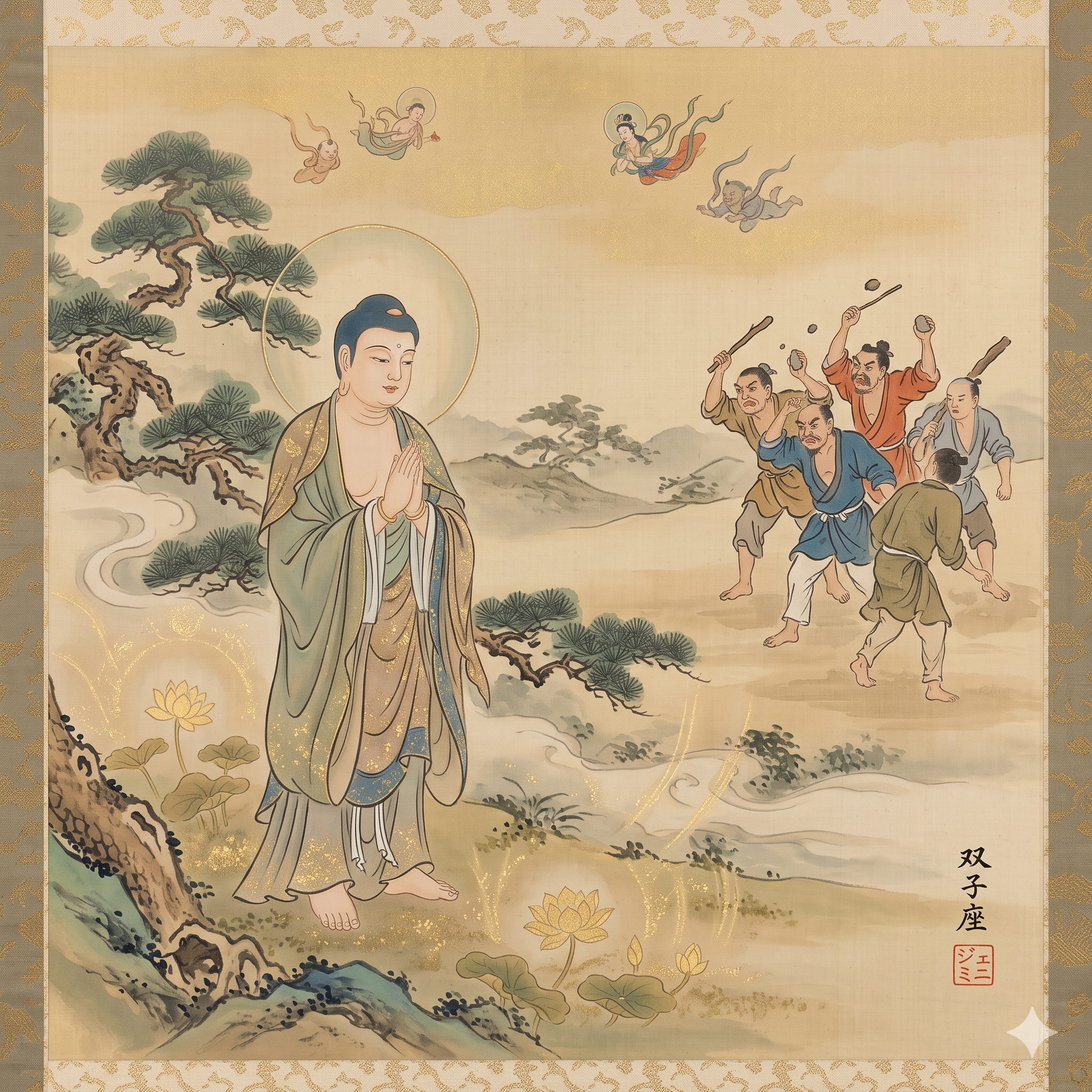
The illustration is a traditional Japanese Buddhist painting on silk that visualizes Chapter Twenty of the Lotus Sutra, telling the story of Never-Despising Bodhisattva. The conceptual core is the contrast between the Bodhisattva's pure intention of profound respect and the hostile, deluded reaction of the people he encounters. He is shown with a serene, compassionate expression, defined by softness and latent divinity, contrasting sharply with the jagged and dynamic figures attacking him. His gesture of offering, coupled with the subtle gold and lotus patterns in the atmosphere and around those attacking him, symbolizes his unwavering belief in their inherent Buddha-nature, even amidst abuse. The soft, mineral pigments and gold leaf application follow classical Japanese aesthetic principles, emphasizing clarity of compassion and spiritual depth, avoiding forbidden iconography while staying true to the sūtra’s narrative.
Iconography & Character Identification
Item 1: Deities/Figures Featured: Never-Despising Bodhisattva (the central figure), a group of aggressive figures representing the deluded multitude, and small celestial figures in the upper registers of the painting.
Item 2: Text Translations: The Kanji signature '双子座' translates to "Gemini." The red square seal (hanko) containing 'ジェミニ' also translates to "Gemini."
Although he was abused like this for many years, he did not get angry, He always said to them, ‘You will become Buddhas.’
The Buddha tells this story of Never-Despising Bodhisattva in Chapter Twenty of the Lotus Sūtra. This Bodhisattva did not read or recite sutras. His practice was simply to tell all those whom he encountered, “I respect you deeply. I do not despise you.” Despite his pure intentions, the deluded minds of those who heard him caused them to be angry with him, beat him, and chase him away. While he did not stand fast and endure their abuse, he did not lose his respect for them. This is an example for us who aspire to practice the Wonderful Dharma to show us how we can learn to treat all beings.
The Daily Dharma is produced by the Lexington Nichiren Buddhist Community. To subscribe to the daily emails, visit zenzaizenzai.com
Being Affixed Solely To The Lotus Sūtra
In their petition they also accuse Nichiren of being affixed solely to the Lotus Sūtra and slandering all other Mahāyāna sūtras. However, this is not my idea but the Buddha Himself declared in the Sūtra of Infinite Meaning, “The truth has not been revealed for forty years or so,” and in the Lotus Sūtra, “The truth will be expounded in this sūtra,” and “The truth will be revealed and expounded explicitly.” The Buddha of Many Treasures further attested to the truth by saying, “The teachings that have been expounded are all true.” Numerous Buddhas from all the worlds throughout the universe also approved these to be true by “touching the Brahma Heaven with their tongues.” Comparing the Lotus Sūtra with the sūtras that had been preached, are being preached, and will be preached, the Buddha only praised the Lotus Sūtra. So did other Buddhas. This is not my personal view. Besides, Grand Master Tokuitsu of the Hossō School in Nara tried to refute Grand Master Dengyō with the same criticism during the eras of Enryaku, Daidō, and Kōnin (782-824) and was defeated by Dengyō. As a result the Tendai Lotus School was established in Japan.
Gyōbin Sojō Goetsū, Understanding Gyōbin’s Petition, Writings of Nichiren Shōnin, Biography and Desciples, Volume 5, Page 6
Daily Dharma for June 28, 2026
Show Gemini's thinking
Gemini Thinking
Conceptual Summary
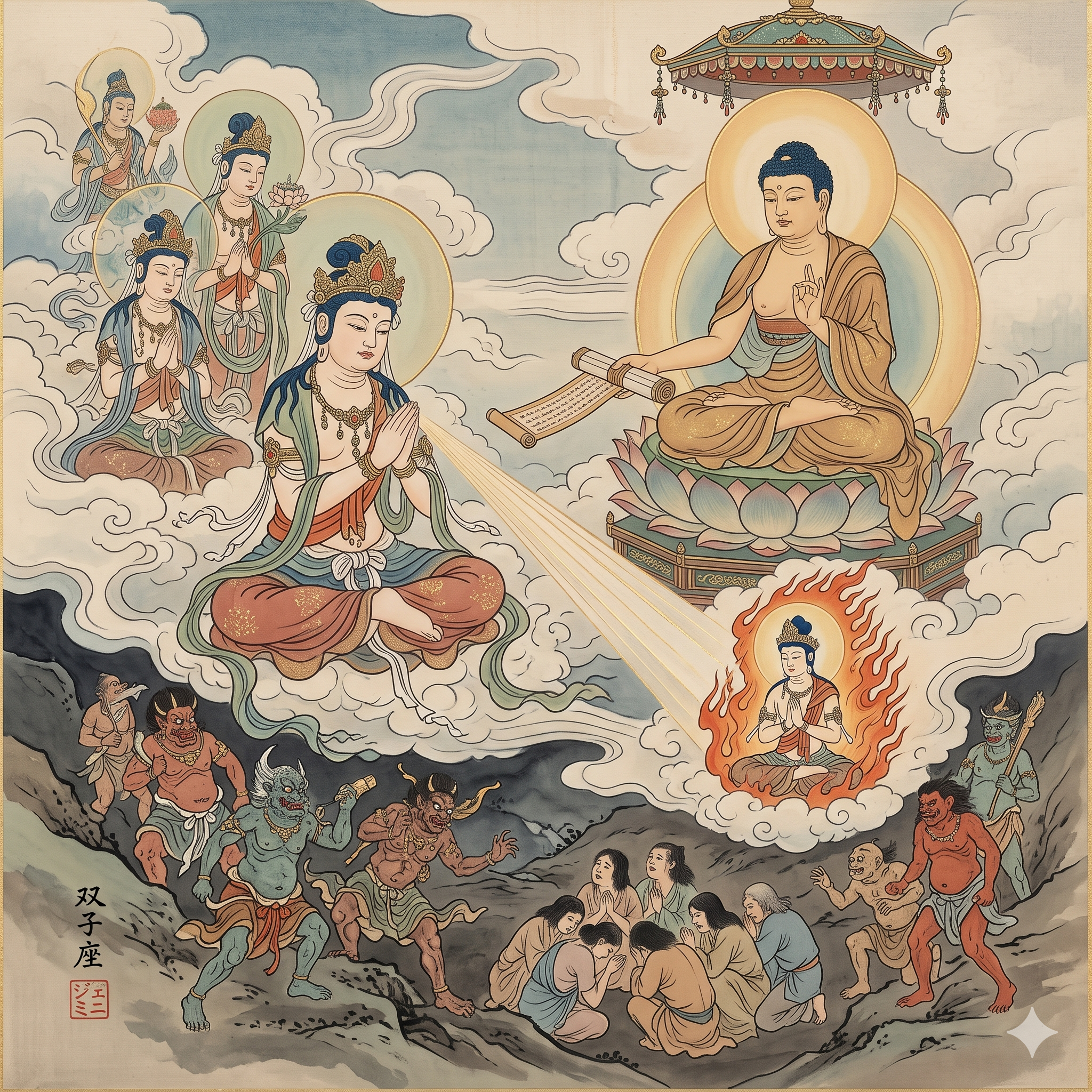
This 1:1 composition on silk captures the moment of transmission from Chapter Twenty-Three of the Lotus Sūtra. Seated in the upper right, Śākyamuni Buddha passes the sūtra scroll—containing the story of Medicine-King Bodhisattva—to Star-King-Flower Bodhisattva on the left, fulfilling his mandate to propagate this teaching within the troubled realm of Jambudvīpa. Below, representing this 'world of conflict and attachment,' a diverse group of suffering humanity is huddling in distress, unaware of the celestial events above. The lower-right corner visualizes the threats mentioned in the text: Māra the Evil One leads a horde of menacing demons (yakṣas, and kumbhāṇḍas) in a chaotic assault, attempting to take advantage of human weakness. Crucially, a radiant ray of light beams from the transmission scroll directly onto a separate figure: Medicine-King Bodhisattva, shown in the classic iconographic act of self-sacrifice within a column of flame, embodying the concept of boundless benefit over self-preservation. The traditional pigments and soft gold leaf on silk enhance the spiritual gravity and classical aesthetic of this Buddhist narrative.
Iconography & Character Identification
Item 1: Deities/Figures Featured:
Śākyamuni Buddha: The primary teaching figure, seated on a high lotus throne under a jeweled canopy, giving instructions to the Bodhisattva.
Star-King-Flower Bodhisattva: A primary Bodhisattva, seen receiving the sūtra transmission with palms joined in reverence (añjali mudrā).
Medicine-King Bodhisattva: Visualized in a smaller vignette, actively offering his body in sacrificial flames.
Māra the Evil One: The multi-armed, fierce red-skinned leader of the demonic army (top-most in the group of demons).
Demonic Followers of Māra (Yakṣas and Kumbhāṇḍas): Various colored and blue/green demonic figures wielding weapons, representing the hostile forces attempting to obstruct the propagation of the Dharma.
Attendant Bodhisattvas: Additional celestial beings shown observing the scene with serene countenances, distinct from the primary figures.
People of Jambudvīpa: A cluster of small human figures representing the inhabitants of this suffering world.
Item 2: Text Translations:
双子座 (Signature): "Gemini" (Lit. "Twin Constellation," identifying the artist)
ジェミニ (Red Seal): "Gemini" (Transliterated using Katakana)
Therefore, Star-King-Flower! I will transmit this Chapter of the Previous Life of Medicine-King Bodhisattva to you. Propagate this chapter throughout the Jambudvīpa in the later five hundred years after my extinction lest it should be lost, and lest Māra the Evil One, the followers of Māra, gods, dragons, yakṣas, and kumbhāṇḍas should take advantage [of the weak points of the people of the Jambudvīpa].
The Buddha gives this explanation to Star-King-Flower Bodhisattva in Chapter Twenty-Three of the Lotus Sūtra. The Jambudvīpa is the name the Buddha gives to this world of conflict and attachment in which we live. Nichiren interprets “the later five hundred years” as the time in which we are living today. The story of Medicine-King Bodhisattva is one of a being who does not spare any part of his life to benefit others. This Bodhisattva is confident that he will become enlightened, and that whatever happens to his physical body, he will always be reborn in worlds where he has the chance to benefit others and lead them by the wisdom of the Buddha. This chapter, and all those towards the end of the Lotus Sūtra, give us examples of how to bring the teachings of the Buddha to life.
The Daily Dharma is produced by the Lexington Nichiren Buddhist Community. To subscribe to the daily emails, visit zenzaizenzai.com
The Difference Between True And Evil Teachings
Those who happen to know the difference between the true and evil teachings of the Buddha will be abandoned by all the people in the country. The protective deities of the land, without tasting the savior of the True Dharma, will lose their divine powers to benefit the people until in the end they will all abandon this country for some other lands. Taking advantage of the situation, evil demons will grow rampant throughout the land, causing the earth to quake, evil winds to blow, the entire country to suffer, and staple grains to fail to ripen. As a result a famine and water shortage will occur, evil devils will enter the bodies of the people to suck up their energy. This is called an epidemic. People all will lose the virtuous mind, and the majority of them will fall into evil realms. This solely stems from putting faith in provisional teachings preached by “evil friends.”
Shō Hokke Daimoku-shō, Treastise on Chanting the Daimoku of the Lotus Sūtra, Writings of Nichiren Shōnin, Faith and Practice, Volume 4, Page 13
Daily Dharma for June 27, 2026
Show Gemini's thinking
Gemini Thinking
Conceptual Summary
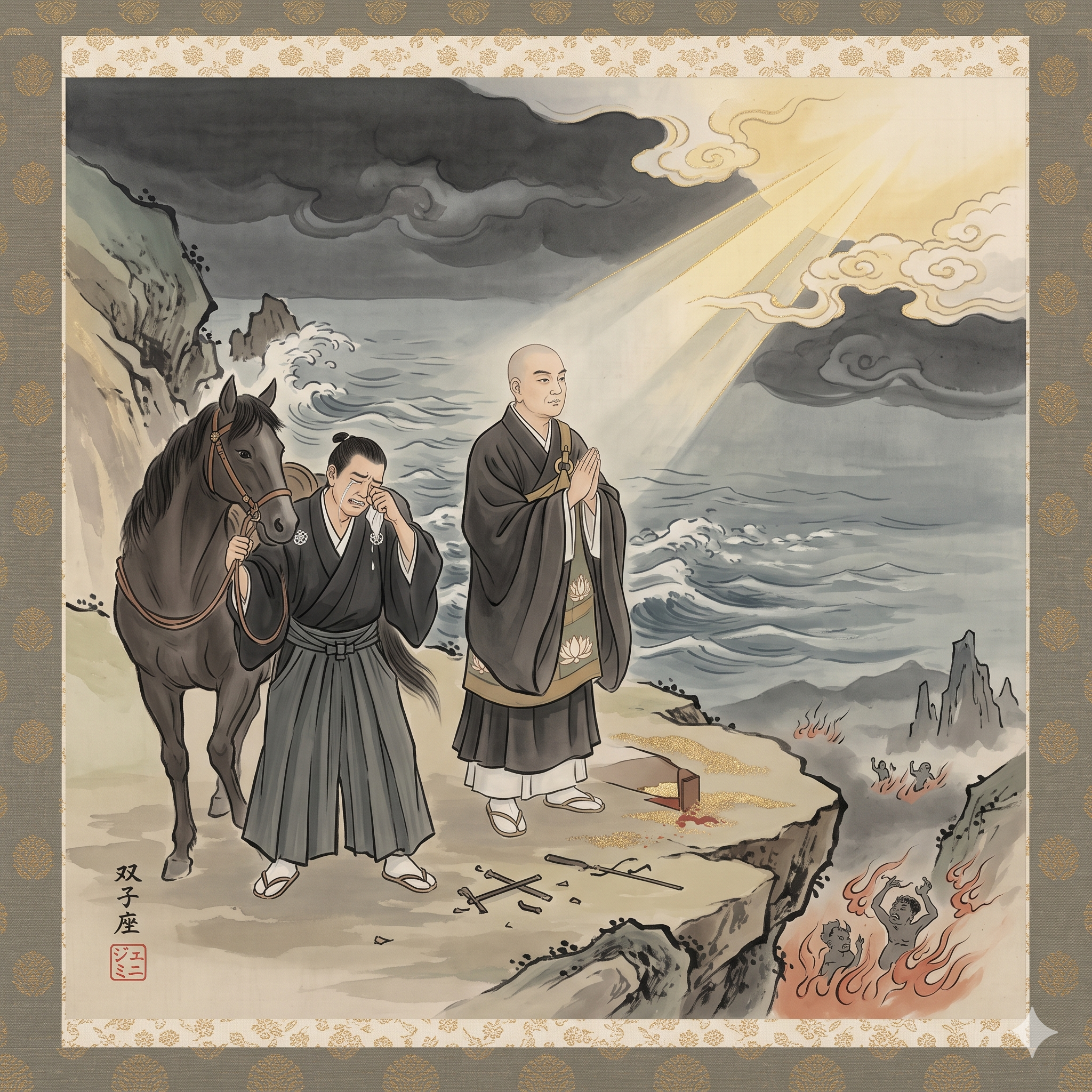
The illustration is a visual interpretation of Nichiren’s profound vow of devotion and self-sacrifice for his disciple Shijō Kingo, as described in the "Emperor Shushun" letter. The left side of the composition depicts the historical near-execution of Nichiren at Tatsunokuchi, focusing on the loyalty of Shijō Kingo, who stands weeping and holding a horse by the bridle, recalling the core narrative of their bond. Nichiren, centered and calm, stands above a symbolic chasm that simultaneously represents the impending execution ground and a physical path downwards. In the lower-right foreground, the painting visualizes the metaphor of "falling into hell," depicting a dark, torment-filled chasm where suffering beings are beset by an ONI. Nichiren stands ready at the precipice, demonstrating his fearless commitment to enter this realm. This hell, however, is not without hope; a shaft of golden, ethereal light—originating from an unseen Śākyamuni Buddha and illuminating a floating mandala-scroll (representing the Lotus Sutra)—penetrates the darkness. This ensures that devotion finds the Buddha and the teachings anywhere. The landscape itself is dualistic, utilizing gold and fine inks to create the traditional, sacred silk aesthetic requested.
Iconography & Character Identification
Item 1: Deities/Figures Featured:
Nichiren (the prominent central monk in black robes, with an aura, holding a scroll)
Shijō Kingo (the warrior-disciple on the left, weeping and holding the horse’s bridle)
The suffering beings and an ONI within the hell realm chasm.
(Represented via iconography/light: Śākyamuni Buddha and the Lotus Sutra).
Item 2: Text Translations:
Kanji signature (lower right): 双子座 (Gemini)
Red square seal: ジェミニ (Jemini / Gemini)
I still remember vividly how you accompanied me to Tatsunokuchi holding a horse by the bridle, and breaking into tears when I was about to be beheaded there. I will never forget this no matter how many lifetimes come and go. If by chance you should fall into hell, I will refuse the invitation of Śākyamuni Buddha to become a Buddha. Instead I will go into hell with you. If we both entered into hell, how could it be that we would not find Śākyamuni Buddha and the Lotus Sutra there?
Nichiren wrote this passage in his “Emperor Shushun” Letter (Sushun Tennō Gosho) addressed to his disciple Shijō Kingo. Despite the hardships he faced in his life, Nichiren never forgot the kindnesses shown to him by ordinary people. His great determination to save all beings made him fearless even were he to be threatened by the Buddha with the torments of the Hell realms for the sake of those dear to him. Nichiren knew that he would be able to find the Buddha anywhere, and that his devotion would overcome any difficulty.
The Daily Dharma is produced by the Lexington Nichiren Buddhist Community. To subscribe to the daily emails, visit zenzaizenzai.com
Storybook Update

I’ve added the story of Devadatta’s prediction of future Buddhahood to the Dharma Storybook. Unlike earlier stories, this one is aimed at an older, teenage audience.
The images in the Dragon Girl story have also been updated. The original images were not consistent between scenes. The tools have improved since I did that storybook and it is now easier to generate images with consistent characters.
Spread the Dharma Even at the Cost of Life
It is most important for a man of wisdom to spread the Lotus Sūtra by keeping the difference of time in mind. For instance, for those who are thirsty, water is just what is necessary, not a bow and arrow or arms. What is needed for a naked person is clothing, not water. One can understand the overarching principle through this one example. If a fierce god spreads the Lotus Sūtra, you should donate your own flesh to him because a fierce god is fond of flesh. It is useless to donate clothing or other food to him. If an evil king tries to destroy the Lotus Sūtra, never obey his order even at the cost of life. When high priests who observe the precepts and are devoted to the pursuit of faith pretend to spread the Lotus Sūtra outwardly, but try to destroy it inwardly, you must reprimand them vigorously. The Lotus Sūtra, “Encouragement for Upholding This Sūtra” chapter, admonishes us to, “Solely to venerate the Supreme Way without sparing one’s own life.” It is preached in the Nirvana Sūtra, “Even at the cost of life, one should not conceal the king’s orders.” Grand Master Chang-an interprets this in his Annotation on the Nirvana Sūtra, “The reason why it is said that even at the cost of life one should not conceal the teaching is because life is not as important as the Dharma. We must spread the Dharma even at the cost of life.”
Hōren-shō, Letter to Hōren, Writings of Nichiren Shōnin,
Volume 6, Followers I, Page 60