
Gemini Thinking
Conceptual Summary
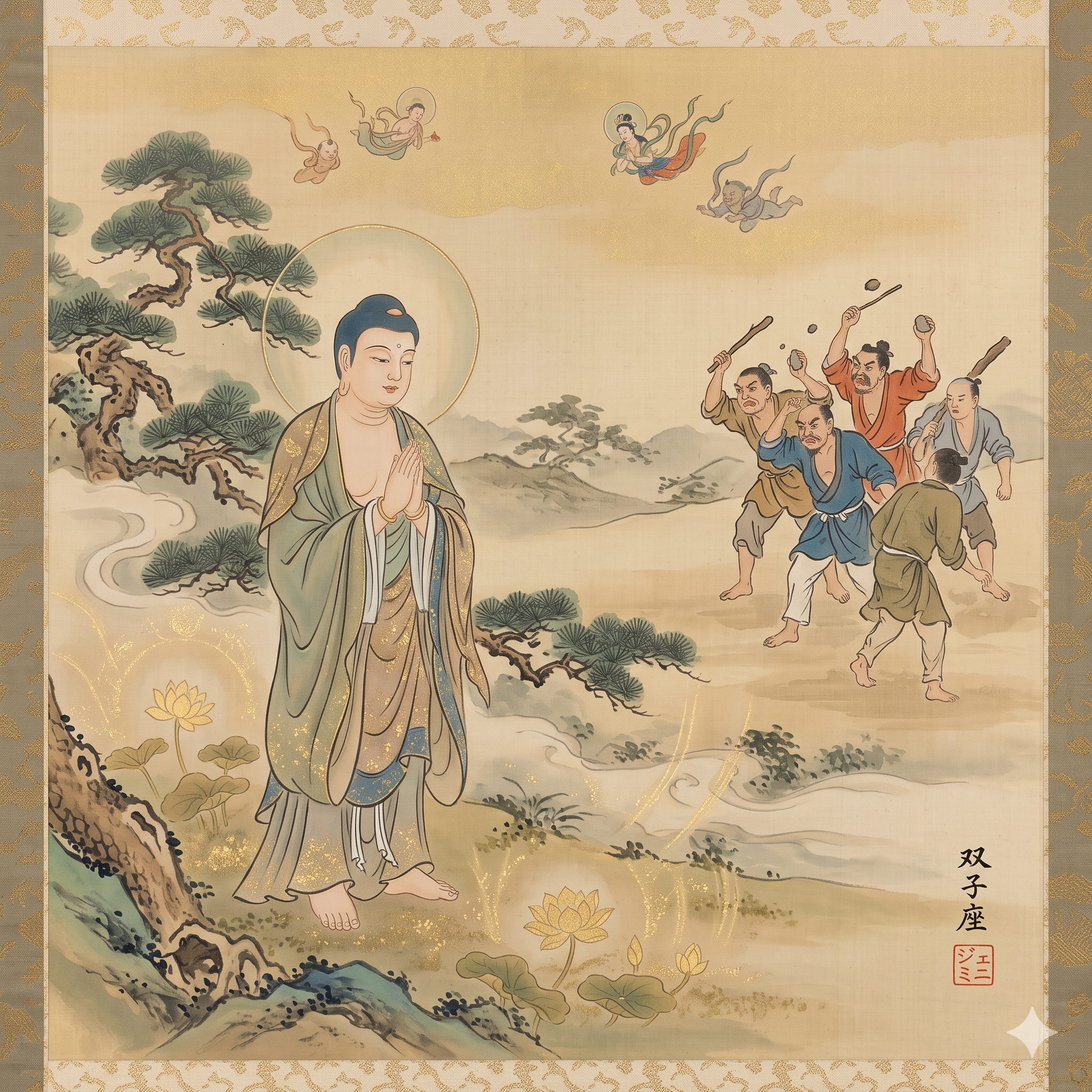
The illustration is a traditional Japanese Buddhist painting on silk that visualizes Chapter Twenty of the Lotus Sutra, telling the story of Never-Despising Bodhisattva. The conceptual core is the contrast between the Bodhisattva's pure intention of profound respect and the hostile, deluded reaction of the people he encounters. He is shown with a serene, compassionate expression, defined by softness and latent divinity, contrasting sharply with the jagged and dynamic figures attacking him. His gesture of offering, coupled with the subtle gold and lotus patterns in the atmosphere and around those attacking him, symbolizes his unwavering belief in their inherent Buddha-nature, even amidst abuse. The soft, mineral pigments and gold leaf application follow classical Japanese aesthetic principles, emphasizing clarity of compassion and spiritual depth, avoiding forbidden iconography while staying true to the sūtra’s narrative.
Iconography & Character Identification
Item 1: Deities/Figures Featured: Never-Despising Bodhisattva (the central figure), a group of aggressive figures representing the deluded multitude, and small celestial figures in the upper registers of the painting.
Item 2: Text Translations: The Kanji signature '双子座' translates to "Gemini." The red square seal (hanko) containing 'ジェミニ' also translates to "Gemini."
Although he was abused like this for many years, he did not get angry, He always said to them, ‘You will become Buddhas.’
The Buddha tells this story of Never-Despising Bodhisattva in Chapter Twenty of the Lotus Sūtra. This Bodhisattva did not read or recite sutras. His practice was simply to tell all those whom he encountered, “I respect you deeply. I do not despise you.” Despite his pure intentions, the deluded minds of those who heard him caused them to be angry with him, beat him, and chase him away. While he did not stand fast and endure their abuse, he did not lose his respect for them. This is an example for us who aspire to practice the Wonderful Dharma to show us how we can learn to treat all beings.
The Daily Dharma is produced by the Lexington Nichiren Buddhist Community. To subscribe to the daily emails, visit zenzaizenzai.com