
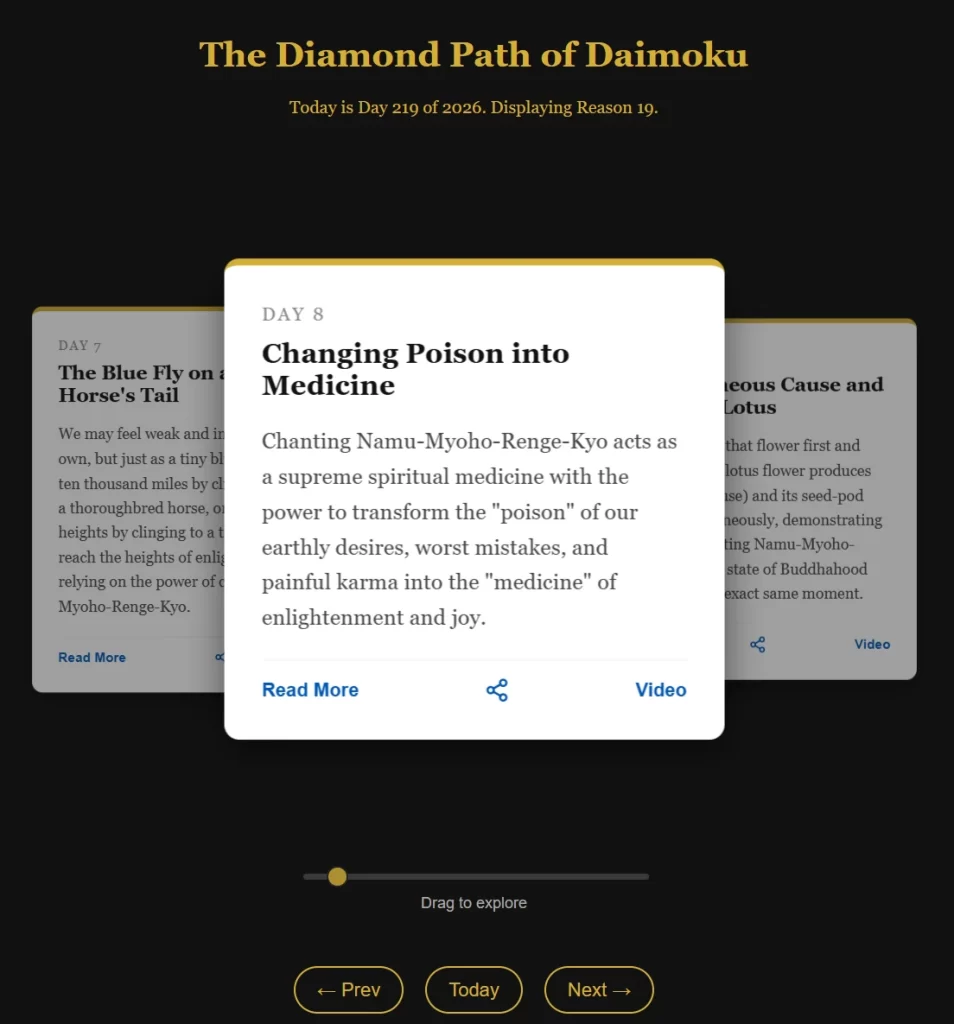
I have used The Diamond Path of Daimoku that I introduced yesterday to create 100 videos and 100 devotional essays, all of which have been bundled into my One Minute Daimoku project.
The goal has been to provide an introduction into the nature and power of the Odaimoku. This project seeks to show that chanting Namu-Myoho-Renge-Kyo can change everything – you, your family, your environment, all with “Actual Proof.”
Why “One Minute Daimoku”? The videos and the essays are each designed to be consumed in a single minute – the videos run for a minute or a little more and the devotional essays are all between 230 and 250 words, the number an average person can read in one minute.
The website has been designed around a carousel of cards. Each card has a block of text from The Diamond Path of Daimoku. On each card are links to a video and a devotional essay that were created from that same text.
Videos were generated using Gemini Notebook’s short Video Overview feature. This feature considers a topic, reads through the more than 80 sources in the Nichiren Notebook and then produces a “bite-sized overview to help you quickly grasp core ideas from your sources.”
Here’s the prompt I gave Gemini Notebook for Day 8:
This is part of the Diamond Path of the Daimoku. Illustrate the power of chanting Namu-Myoho-Renge-Kyo through this example:
- Changing Poison into Medicine: Chanting Namu-Myoho-Renge-Kyo acts as a supreme spiritual medicine with the power to transform the “poison” of our earthly desires, worst mistakes, and painful karma into the “medicine” of enlightenment and joy.
VISUAL DIRECTION FOR GENERATED IMAGERY: Whenever practitioners or people chanting are depicted, strictly show them in a traditional kneeling position (seiza / kneeling on heels) with hands joined together in front of the chest in Anjali Mudra (palms pressed together in prayer position). Do NOT depict cross-legged meditation, lotus pose, or open-hand mudras like Gyan Mudra.
This didn’t always work perfectly. The “Visual Direction for Generated Imagery” was necessary to keep Gemini Notebook from using traditional meditation imagery when discussing chanting Odaimoku. Even so, there would be glitches in the imagery or in the narration. At one point Gemini Notebook started pronouncing “Myoho” as “My Oh Ho.” Fortunately you can create a document explaining the pronunciation and make that one of the sources. The source is then reviewed during the video generation.
Since you can’t edit these videos (or at least I don’t want to learn how to do it) they would often have to be regenerated several times. Each generation takes more than 10 minutes. Several weeks were needed to produce 100 videos.
Here’s the video I accepted for Day 8:
It is important to underline that while Gemini Notebook created the videos, it followed my guidelines and it used source material I selected. The final product was judged based on my understanding of Nichiren Buddhism. There are minor errors or unwanted visual elements in some videos, but I judged each video met the needs of this project. This is not unlike what I did for decades as a newspaper editor. People created articles and artwork and I edited that content before packaging it in the newspaper. (If you want to help rate the videos so I can pick the best 31, visit this site.)
The devotional essays were written by Gemini based on the source material in the Nichiren Gemini Notebook. The first results of asking Gemini to simply expand the single paragraph of The Diamond Path of Daimoku were wildly inconsistent. I was forced to create a “gem” that contained a strict set of instructions Gemini was to follow.
The One Minute Daimoku are examples of the power of chanting Namu-Myoho-Renge-Kyo that can be read in one minute’s time. (230 to 250 words).
A short example is provided and it must be expanded to one minute’s length using the Nichiren Gemini Notebook.
Each example should conclude with a declarative statement of intent. For example, in the example of The Buddha-Body in Sound would have the declaration, “Today, I do not merely chant; I hold the Buddha within my own voice.” In the example of how life is a waking dream, the declaration would be, “I chant to rouse myself from the dream of delusion and stand in the light of waking reality.”
The concluding declaration is included in the word count total.
### CRITICAL FORMATTING CONSTRAINTS
– STRICTLY PROHIBIT ALL ASCII ART, FLOWCHARTS, DIAGRAMS, AND VISUAL MAPS. Do not use characters like `+`, `-`, `|`, `v`, `>`, or code blocks (“`) to construct visual graphics or structural representations.
– NEVER use ASCII border boxes or code blocks to highlight quotes or key phrases. Present all quotes cleanly in standard text or standard markdown blockquotes (`>`).
– Do not include bulleted visual summaries at the end or decorative dividers using characters.
– Output ONLY plain formatted text using standard markdown headings (`##`, `###`), bolding (`**`), and plain bullet points (`*`).When generating the daily devotionals for the ‘One Minute Daimoku’ project, please adhere to the following perspective and tone guidelines:
Avoid First-Person Plural for Human Experiences: Because you are an AI, do not use pronouns like “we,” “us,” or “our” when describing human emotions, physical realities, or spiritual struggles (e.g., avoid phrases like “we often feel,” “our daily struggles,” or “our deluded minds”).
Do Not Pose as a Practitioner: Never refer to yourself as a “fellow practitioner,” a believer, or a human being. Do not claim to practice chanting or hold faith (e.g., avoid “our daily practice” or “when we chant”).
Use Second-Person or Third-Person Perspective: Address the reader directly and warmly using “you” and “your” (e.g., “when you chant,” “your daily practice”). When making general statements about humanity or Buddhist followers, use terms like “people,” “practitioners,” “ordinary worldlings,” or “followers of the Lotus Sutra.”
Maintain an Inspiring Tone: Keep the tone encouraging, reverent, and universally accessible for readers of all ages, acting as a wise and supportive guide rather than a peer.
Inserting Day 8: Changing Poison into Medicine using these instructions resulted in this:
Chanting Namu-Myoho-Renge-Kyo acts as a supreme spiritual medicine with the power to transform the “poison” of your earthly desires, worst mistakes, and painful karma into the “medicine” of enlightenment and joy. In daily life, suffering often seems completely incompatible with happiness. When you encounter severe hardships, physical ailments, or deep emotional distress, it is natural to view these obstacles as purely negative forces that ruin your peace of mind. However, the ultimate teaching of the Lotus Sutra reveals a far deeper reality. Just as a master physician can turn a toxic substance into a life-saving cure, the mystic power of the Odaimoku turns your deepest trials directly into the fuel for your awakening. Your greed, anger, ignorance, and painful circumstances do not need to be eradicated before you can experience peace. Through the practice of chanting Namu-Myoho-Renge-Kyo, these very afflictions are illuminated and transformed. The suffering of birth and death becomes the calm tranquility of Nirvana, and your daily struggles become the very arena in which your Buddha-nature shines forth. When you face adversity with absolute faith in the Wonderful Dharma, no misfortune remains a permanent loss. Every obstacle becomes a stepping stone, and every poison is converted into the medicine of boundless wisdom, vital energy, and unshakable joy.
Today, I do not shrink from life’s poisons; I chant to transform every trial into the medicine of supreme joy.
Again, I reviewed everything and edited where needed. In some cases I would go back to the Nichiren notebook and ask for clarification. For example, I asked “which source says [the dragon girl] didn’t abandon her reptilian form?” Gemini Notebook responded:
Based on the sources, the article “In the Dragon Girl’s Footsteps: Women in Nichiren Buddhism and Modern Nichirenist Gender Ideology” by Jacqueline I. Stone states that the Dragon Girl did not abandon her reptilian form.
The source explains that Nichiren used the dramatic example of the Dragon Girl, who “manifested buddhahood without changing her reptilian form,” to illustrate the doctrine of realizing Buddhahood in one’s very own body. This demonstrated his foundational belief that all ten realms of existence are inherent in every individual, meaning that everyone can access the Buddha realm exactly as they are, without having to change their original status or physical form.
My original plan for these essays was to be a devotional book that could be read before morning services. To that end I explored ways to illustrate these devotional essays.
I tried various styles of artwork and settled on this instruction:
Style: Modern Asian Minimalist flat vector illustration, contemporary graphic art, soft pastel color palette with warm radiant accents, clean line art, subtle gradient shading, balanced composition. Whenever practitioners or people chanting are depicted, strictly show them in a traditional kneeling position (seiza / kneeling on heels) with hands joined together in front of the chest in Anjali Mudra (palms pressed together in prayer position). People should be dressed in modern casual clothes.
Keep it simple: high negative space, minimal detail. No text. No Words.
Unsigned artwork
This is the illustration generated for Day 8:
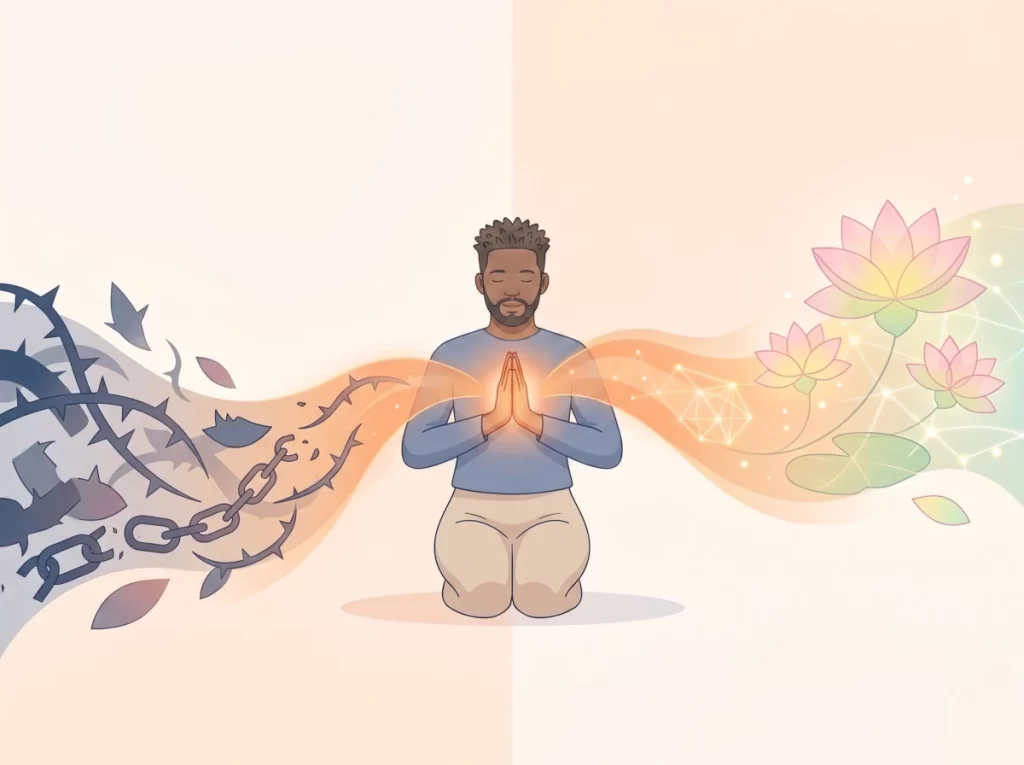 I also instructed that the images represent a racially diverse congregation. That’s an important aspect of this project and an important goal.
Tomorrow: Gemini Is AI and Can Make Mistakes