The Architecture of Awakening: From Zhiyi’s Theory to Nichiren’s Reality

NotebookLM logo In NotebookLM a report was generated to explain the basic 3,000 realms in a single thought moment and then show the difference between Zhiyi’s theory and the actuality created by Nichiren. This report was then taken to Gemini, where Gemini was directed to transform the report into a detailed essay suitable for publication of a Nichiren Shu website. Ask questions of these sources here.


20260530-The_Architecture_of_Awakening

For seekers of the Way, the Lotus Sutra has never been regarded as a mere historical artifact or static scriptural text. Rather, it is an interactive blueprint of the enlightened mind—a text to be “read not merely with the eyes, but with the very flesh and blood of one’s bodily life”.

To trace the lineage of this profound visual and philosophical framework is to look back upon a grand intellectual journey spanning centuries and borders. It begins with the intricate, multi-layered philosophical architecture of the Chinese Tiantai patriarch, Great Master Zhiyi (538–597). It then flows through the medieval Japanese discourses on Original Enlightenment (hongaku shisō). Finally, it finds its dynamic, concrete actualization in the prophetic realism of Nichiren Shonin (1222–1282).

This essay explores how the sublime metaphysics of ancient China evolved into a lived, immediate reality, transforming our regular world into the pristine Buddha Land.


1. Zhiyi and the Cosmic Matrix of Tiantai

At the absolute foundation of our philosophical tradition stands the Great Master Zhiyi, who systematically organized the vast corpus of Buddhist scriptures into a coherent, unified whole. Dissatisfied with the purely negative, deconstructive language (apophasis) found in some Indian Madhyamaka commentaries—which sought to describe reality only by what it was not—Zhiyi sought a more positive, affirmative articulation of ultimate truth.

He achieved this by expanding the traditional Mahayana model of the Two Truths into a dynamic, interconnected triad known as the Perfect Interfusion of the Three Truths (en’yū santai):

  1. Emptiness (Ku): The realization that all phenomena are devoid of fixed, independent substance, existing only in a state of ontological ambiguity and fluid potential.
  2. Provisional Positing (Ke): The recognition that despite lacking a permanent essence, things do exist conventionally, presenting themselves as temporary particulars bound by causes and conditions.
  3. The Center or Middle Way (Chū): The simultaneous, inseparable awareness of both emptiness and provisional existence. Here, the universal and the particular are perfectly harmonized; the universal realizes its true nature in the particular, and the particular derives its meaning from the universal.
       [The Middle / Center (Chū)]
                 /           \
                /             \
               /               \
       [Emptiness (Ku)] ---- [Provisional (Ke)]

From this Threefold Truth, Zhiyi developed the crowning conceptual pillar of our school: Three Thousand Realms in a Single Thought-Moment (ichinen sanzen). This architectonic model asserts that our ordinary, fleeting mind at any given instant (ichinen) inherently contains and encompasses the entirety of the cosmos (sanzen).

This number is calculated by multiplying the Ten Worlds (the psychological and cosmological realms from Hell to Buddhahood) by their Mutual Possession (the reality that each world inherently contains the other nine), further multiplied by the Ten Suchnesses or structural factors of existence, and finally multiplied by the Three Realms of Existence:

  • The realm of the five aggregates (go’on seken).
  • The realm of living beings (shujō seken).
  • The realm of the environment or container world (kokudo seken).

Crucially, Zhiyi’s schema establishes that the living subject and the physical environment are fundamentally inseparable—a relationship known as the Non-duality of Primary and Dependent Recompense (eshō funi). Our surroundings are not a neutral, external stage; they are the literal shadow cast by our inner life-condition. When the mind reaches awakening, the environment itself must pervade the Dharma realm.


2. The Medieval Drift into Abstraction

As these profound doctrines traveled to Japan, they evolved into the pervasive scholastic discourse of Original Enlightenment Thought (hongaku hōmon) within the Tendai tradition. Hongaku doctrine radically inverted traditional linear paths of practice. Instead of treating Buddhahood as a distant destination to be reached through eons of merit accumulation and the systematic pruning away of defilements, it boldly asserted that all ordinary worldlings (bonbu) are fully realized Buddhas from the very outset. Radiant Buddhas with their extraordinary marks were relegated to mere provisional signs; the true Buddha was the ordinary person just as they are.

However, this absolute non-dual monism carried a dangerous, latent vulnerability: it risked slipping into a quietistic, uncritical affirmation of reality that undermined the necessity of concrete moral effort and religious practice. If an ordinary person is already identical to the ultimate reality prior to any cultivation, formal practice becomes superfluous, and the critical distinction between delusion and enlightenment is dangerously obscured.

Scholars within the traditional Tendai academies endlessly debated these points, but their realizations remained largely confined to intellectual exercises and secret oral initiations (kuden) shared among elite scholar-monks. It was a magnificent architecture of awakening, but it remained ri no ichinen sanzen—the three thousand realms as an abstract, theoretical principle.


3. Nichiren Shonin and the Shift to Actuality

This was the historical and institutional landscape that Nichiren Shonin confronted. Educated in the rich scholastic environment of Mount Hiei, Nichiren fully accepted the structural validity of ichinen sanzen and the Threefold Truth. Yet, living in a tumultuous era ravaged by earthquakes, famines, epidemics, and the terrifying specter of Mongol invasion, he recognized that an abstract philosophy could not save a desperate populace.

“When the priesthood in the Final Dharma age forgets the two great practical forces… and does nothing but preach sermons, then it becomes powerless to accomplish anything.”

Nichiren’s unique religious contribution lay in his demand for Actuality (ji). He lifted the ichinen sanzen principle out of the realm of theoretical speculation and anchored it firmly into the concrete domain of dynamic religious practice, establishing what we revere as ji no ichinen sanzen—the three thousand realms in concrete actuality.

To achieve this, Nichiren collapsed the traditional, long path of fifty-two progressive stages of bodhisattva practice into a singular, immediate point of entry: the stage of Verbal Identity (myōji-soku). This is the profound moment when an ordinary person first hears the words of the true teaching and arouses faith.

Nichiren asserted that all the unfathomable practices carried out by Shakyamuni Buddha since the remotest past (causes), and all the boundless wisdom and merits he gained in consequence (effects), are fully contained and wrapped within the five characters of the Holy Title: Myōhō-renge-kyō.

Traditional Path:
[Stage 1] ───> [Stage 2] ───> [Progressive Eons of Practice] ───> [Buddhahood]

Nichiren's Interventions (Mandalic Time):
[Myōji-soku (Verbal Identity / Faith)] 
       │
       ▼ (Chanting Namu-Myōhō-renge-kyō)
[Simultaneity of Cause and Effect / Immediate Attainment]

When an ordinary person chants the Daimoku in the formula Namu-myōhō-renge-kyō, they are not striving to travel across time to reach a distant, external enlightenment. Instead, they open an immediate point of access where linear historical time intersects with the timeless, eternal realm of the primordial Buddha.

Through faith, the practitioner immediately receives the complete transfer of the Buddha’s merits, realizing the ultimate goal of “attaining Buddhahood in this very body” (sokushin jōbutsu) right in the midst of their ordinary, everyday life.


4. The Sacred Blueprint: Inscribing the Daimandara

The visual manifestation of this actualized reality is Nichiren Shonin’s calligraphic Great Mandala (Daimandara), universally revered across our lineages as the Gohonzon (the supreme object of worship).

Rather than relying on traditional anthropomorphic statues or multi-colored paintings that might encourage an ordinary viewer to perceive the Buddha as an external entity separate from their own life-essence, Nichiren chose to construct his mandala entirely out of written characters. In doing so, he preserved the absolute identity between the graphic icon and the sacred scriptural text of the Lotus Sutra.

Down the exact center of this sacred diagram, Nichiren inscribed the vertical axis of cosmic reality: Namu-myōhō-renge-kyō. Flanking this central mantra are the names of the two Buddhas, Shakyamuni and Many Treasures (Tahō), seated side by side within the floating Treasure Tower. This dynamic scene represents the perfect fusion of Objective Truth (kyō) and Subjective Wisdom (chi):

  • Many Treasures (Tahō) embodies the immutable, universally abiding principle of ultimate truth (kyō).
  • Shakyamuni represents the active, dynamic subjective wisdom (chi) that perceives and reveals that truth in human history.
                 [ Gohonzon Architecture ]

                      Tahō     Shakyamuni
                     (Truth)    (Wisdom)
                       │           │
                       ▼           ▼
               ┌───────────────────────────────┐
               │      NAMU-MYŌHŌ-RENGE-KYAO     │
               └───────────────────────────────┘
                               ▲
                               │
               ┌───────────────────────────────┐
               │    Four Leaders of Earth      │
               │   (Jōgyō, Anryūgyō, etc.)     │
               └───────────────────────────────┘
                               ▲
                               │
               ┌───────────────────────────────┐
               │ Representing All Ten Worlds   │
               │  (From Devadatta to Devas)    │
               └───────────────────────────────┘

Surrounding this central axis are the names of the four leaders of the Bodhisattvas of the Earth—headed by Jōgyō (Superior Conduct)—along with representatives of all ten realms of existence, including shifting cosmic forces, historic disciples, and even figures who traditionally epitomized deep delusion, like Devadatta.

Through the lens of ji no ichinen sanzen, none of these forces are banned or expunged. In the presence of the Central Law, every single realm is beautifully transfigured, anchored into place, and illuminated, revealing its true, enlightened nature as a necessary component of the cosmic whole.

When a follower of Nichiren sits before the Gohonzon, establishes pure faith, and raises their voice to chant the Daimoku, they are not merely looking at an external icon. They physically step into that very diagram, crossing the threshold of historical layout to take their rightful place within the eternal, un-dispersed Assembly on Vulture Peak.


5. Establishing the Pure Land in a Troubled World

Because our primary framework takes the non-duality of person and environment (eshō funi) as an absolute reality, our spiritual practice can never remain a purely private, internal pursuit.

Nichiren Shonin taught that a society that willfully ignores the true nature of reality—casting aside the ultimate vehicle of universal inclusion in favor of partial, one-sided, or otherworldly paths—will inevitably manifest that inner fragmentation as outer chaos, visible as natural calamities, social division, and widespread despair.

The message of Nichiren’s foundational treatise, the Risshō Ankoku Ron (“Establishing the True Teaching and Bringing Peace to the Land”), is a profound clarion call for social responsibility:

“Now you must quickly reform the faith that you hold in your heart and return to the single good that is the vehicle of the true teaching. Then the threefold world will all become the Buddha land…”

The transformation of our mundane world (Saha world) into the pristine Land of Tranquil Light (shaba soku jakkōdo) is achieved not by fleeing this reality after death, but by actively engraving the Wonderful Dharma into the structures of our everyday lives.

When we meet hardships, opposition, or secular uncertainties with unshakeable faith, we are following in the footsteps of Nichiren Shonin himself. We undergo our own personal “bodily reading” (shikidoku) of the scripture, transforming human suffering into a powerful, living witness to the un-destructible reality of the true aspect of all things.


Conclusion: The Lived Architecture

The architecture of awakening developed by our great ancestors is not a collection of abstract, dry academic definitions to be memorized or debated in isolation. From Zhiyi’s deep insights into ontological ambiguity and the interfusion of the truths, to the medieval understandings of our innate potential, the entire lineage finds its practical culmination when we place our hands together before the Mandala.

By chanting Namu-myōhō-renge-kyō, we take the profound theory of the universe and make it our lived, breathing reality. We awaken from the dream of false conceptualization, align our small selves with the great rhythm of the cosmos, and actively participate in the sacred task of manifesting the pristine Buddha Land right here and now, in this very body, and in this very world.
Nichiren: A Timeline

NotebookLM logo This timeline was created from the sources uploaded to NotebookLM. The “common” dates are used because some sources translate the lunar calendar in Gregorian dates, which can be confusing. Ask questions of these sources here.


February 16, 1222

  • Birth: Born to a fisherman’s family in the coastal village of Kominato in Awa Province. His childhood name is Zen’nichimaro.

1233–1237

  • Early Education & Ordination: At age eleven, he enters Kiyosumidera to study. Around the age of fifteen or sixteen (1237), he was formally ordained, taking his full ordained name, Zeshō-bō Renchō.

1238/1239–1253

  • The 15-Year Period of Study: Renchō leaves Kiyosumidera to embark on a 15-year quest to master the Buddhist teachings, initially studying in Kamakura.

1243–1253

  • The 10-Year Period of Intensive Study: Renchō relocates to the Kyoto and Nara regions to engage in rigorous study at traditional centers like Mt. Hiei.

April 28, 1253

  • Declaration of a New Faith: Renchō returns to Kiyosumidera and, facing the rising sun, chants Namu Myōhō-renge-kyō for the first time. Adopting the name Nichiren, he preaches his first sermon and fiercely criticizes the exclusive Nembutsu movement.

July 16, 1260

  • First Remonstration: Nichiren submits his first major treatise, the Risshō ankoku ron, to the retired shogunal regent Hōjō Tokiyori. Following this, his hermitage was attacked by a mob on August 27, 1260.

May 12, 1261 – February 22, 1263

  • First Exile (Izu): Arrested by the Kamakura government, Nichiren is exiled to the Izu Peninsula on May 12, 1261. He was officially released and returned to Kamakura on February 22, 1263.

November 11, 1264

  • The Komatsubara Ambush: While traveling in his home province, Nichiren’s party is ambushed by retainers of the steward Tōjō Kagenobu. Nichiren survives with a broken arm and a sword cut to his forehead.

September 12, 1271

  • The Tatsunokuchi Persecution: Nichiren is arrested by Hei no Yoritsuna and taken to the Tatsunokuchi execution grounds, where he narrowly escapes being beheaded.

October 10, 1271 – March 8, 1274

  • Second Exile (Sado Island): Nichiren departed for Sado Island on October 10, arriving October 28, 1271. On November 1, he was placed in the dilapidated, abandoned graveyard hut. During this harsh exile, he produces some of his most vital works:
  • February 1272: Completes the Kaimoku shō (Opening of the Eyes).
  • April 25, 1273: Completes the Kanjin honzon shō (The Contemplation of the Mind and the Object of Worship).
  • July 8, 1273: Formalizes the Great Mandala (gohonzon) for the first time.
  • March 8, 1274: The official sentence of release arrives at Sado.

April 8, 1274

  • Third Remonstration: Having returned to Kamakura, Nichiren meets with Yoritsuna, accurately predicting a Mongol attack within the year.

May 12, 1274 – 1282 (The Minobu Years)

  • Retirement: Realizing his warnings will not be heeded, Nichiren leaves Kamakura on May 12, 1274, arriving at his retreat on Mt. Minobu on May 17, 1274.
  • September 21, 1279 (The Atsuhara Persecution): Twenty of Nichiren’s peasant followers in the Fuji district are arrested, and three are eventually executed for refusing to abandon their faith.
  • April 27, 1281: Completes his work on the Three Great Secret Dharmas.

October 13, 1282

  • Death: After leaving Mt. Minobu and designating six senior disciples to lead the propagation of his teachings, Nichiren passes away at Ikegami.


The True Meaning of 3,000 Existences Contained In One Thought

It is not feasible to explain the true meaning of the doctrine of “3,000 existences contained in one thought” even in the theoretical section of the Lotus Sūtra. Needless to say, it is not mentioned at all in the pre-Lotus sūtras. The doctrine stems from the passage describing the ten aspects of existence in the paragraph on the “brief replacement of the three vehicles with the one true vehicle” (ryaku kaisan-ken’ichi) in the second chapter in the theoretical section of the Lotus Sūtra. Nevertheless, the true meaning of the doctrine is based solely on the essential section of the sūtra. The pre-Lotus sūtras should be judged according to the meaning of the theoretical section, which in turn should be judged by the meaning of the essential section. Only the essential section of the Lotus Sūtra can define its meaning as it preaches.

Jisshō-shō, A Treatise on the Ten Chapters of the Great Concentration and Insight, Writings of Nichiren Shōnin, Doctrine 2, Page 3-4

Daily Dharma for May 31, 2026

20260531-ddi

Illustration by Google Gemini

Show Gemini's thinking

Gemini Thinking

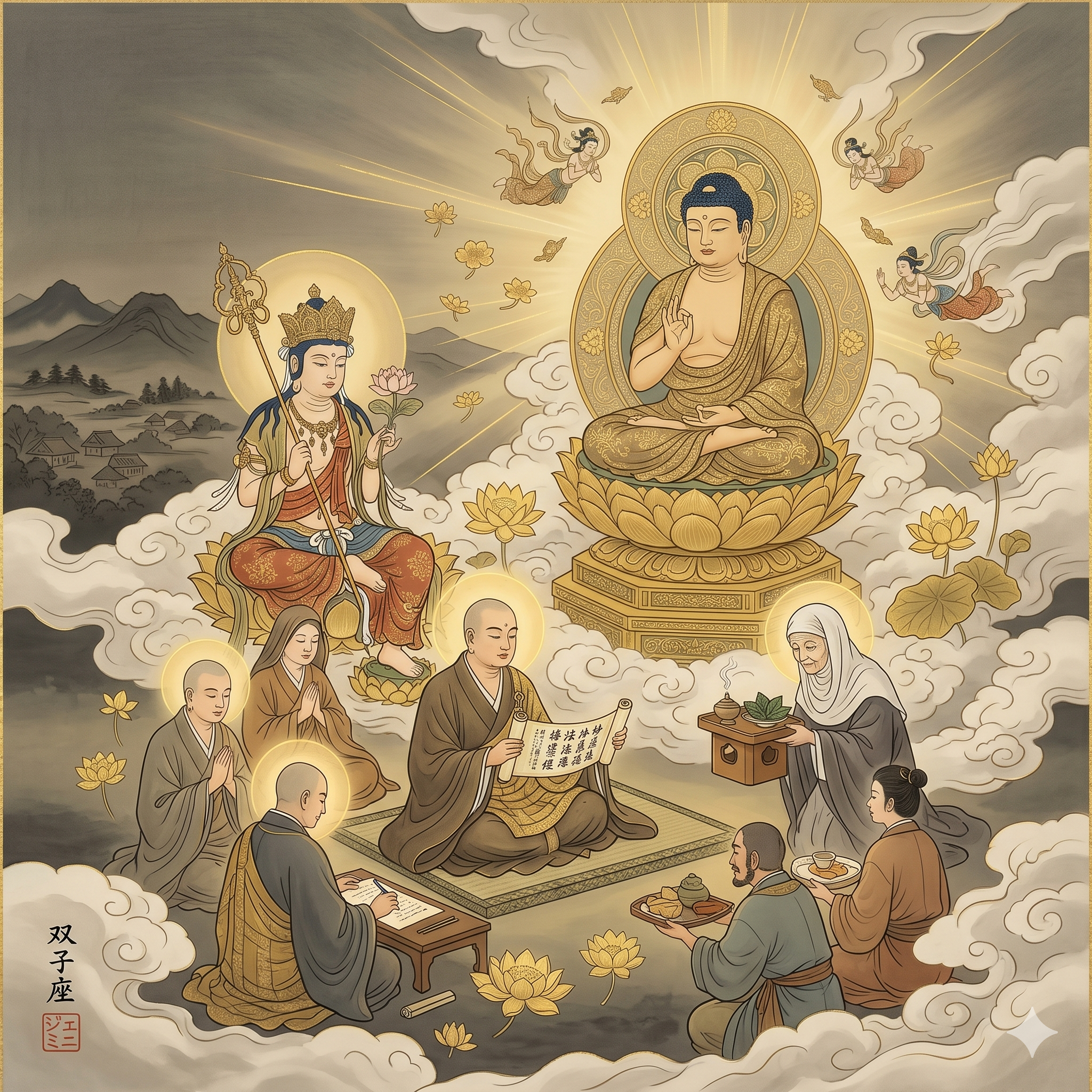
I have conceptualized the provided Lotus Sūtra verses through a traditional classical Japanese Buddhist style, featuring Šākyamuni Buddha preaching to Medicine-King Bodhisattva and an assembly of monastic and lay practitioners. The scene illustrates the dual themes of "keeping the sūtra" and "making offerings" with figures shown writing, holding scrolls, and presenting devotional items. The setting integrates the suffering saha world in the background with the blissful wonders of the Lotus sūtra in the foreground, illuminated by divine light to symbolize the opening of one's eyes to the truth.

Identified Individuals: The central preaching deity is Šākyamuni Buddha. Seated to his right, holding a sūtra, is Medicine-King Bodhisattva. The surrounding figures represent various monastics and lay devotees ("keepers of the sūtra").

Kanji Translations: The vertical signature text reads 双子座 (Gemini). Within the red hanko seal, the Katakana text reads ジェミニ (Gemini). The text on the primary sūtra scroll is purely symbolic calligraphic text meant to evoke classical sacred sūtra handwriting and has no translation.

If you wish to obtain quickly the knowledge
Of the equality and differences of all things,
Keep this sūtra, and also make offerings
To the keeper of this sūtra!

The Buddha sings these verses to Medicine-King Bodhisattva at the beginning of Chapter Ten of the Lotus Sūtra. When we see things for what they are, how they are similar and how they are different, we see them with the eyes of the Buddha. This Wonderful Dharma in the Lotus Sūtra is the Buddha showing us how to open our eyes to the joys and wonders that exist in this world of conflict and suffering. When we find something valuable, we offer it our time, our thoughts and our devotion. By making offerings to this Wonderful Dharma, and to all those who keep it, our eyes open even more to the truth of our lives.

The Daily Dharma is produced by the Lexington Nichiren Buddhist Community. To subscribe to the daily emails, visit zenzaizenzai.com

The Doctrinal Evolution of ‘Fruit to Cause’ in Nichiren Buddhism

NotebookLM logo This essay was created from the sources uploaded to NotebookLM. Ask questions of these sources here.


20260530-From_Scholasticism_to_Chanting_Law

The trajectory of medieval Japanese Buddhist thought is defined by a radical ontological shift: the transition from “linear” asceticism, predicated on gradual progress, to a “simultaneous” realization. In traditional paradigms, enlightenment was envisioned as a distant shore, accessible only through the exhaustive accumulation of merit over  asankhya-kalpas . However, Nichiren Buddhism precipitated a “Copernican Revolution” in this soteriology by asserting that Buddhahood is the foundational ground of practice rather than its terminal result. This is encapsulated in the inversion from  Jūin Shika  (From Cause to Fruit)—the teleological movement from practice toward enlightenment—to  Jūka Kōin  (From Fruit to Cause), wherein the practitioner begins from the Buddha’s enlightened state.To grasp this simultaneity, one must look to the source’s vivid metaphors: just as the moon rising over the eastern mountain is reflected in water the very instant it appears, or as a sound and its echo occur in the same moment, the “Fruit” of enlightenment and the “Cause” of practice are non-dual. The objective of this monograph is to analyze how Nichiren identified a strategic necessity to bridge the chasm between the abstract heights of Tendai “Original Enlightenment” ( Hongaku ) and the spiritual exhaustion of the  Mappō  era. By crystallizing these scholastic theories into the concrete practice of chanting  Namu-Myoho-Renge-Kyo , Nichiren transformed the practitioner from a seeker into a recipient of the Buddha’s own merit.

2. Historical Foundations: The Quest for Rapid Enlightenment

The early Heian period was characterized by an obsession with “Speedy Enlightenment” ( Sokushitsu Jōbutsu ), a doctrinal reaction against the Hosso school’s staggering timeline for Buddhahood. Saichō and Kūkai, the giants of this era, sought to provide a “direct path” ( Jikidō ) that bypassed the traditional requirement of three  asankhya-kalpas .

  • Kūkai (Shingon):  Kūkai’s model of  Sokushin Jōbutsu  (Becoming a Buddha in this lifetime) relied on the esoteric union of the “Three Mysteries” ( Sanmitsu ). By aligning mudra (body), mantra (mouth), and visualization (mind), the practitioner synchronized their finite existence with the cosmic Buddha, Mahavairocana.
  • Saichō (Tendai):  Saichō utilized the Lotus Sutra to argue for a universal path, specifically citing the Dragon King’s daughter ( Ryūnyo ). Crucially, while previous Chinese commentators like Ji-zang and Kuei-chi (Ki) argued her attainment was possible only because she was already at the 10th Stage of a Bodhisattva, Saichō “lowered the bar” by redefining her as being at the  First Dwelling  ( Hatsu-jū ) stage. This was a critical transfer point where an ordinary person ( bonbu ) could shed their mundane status for a sagely one.This historical trajectory involved a progressive “lowering of the bar.” Scholastic successors like Annen and Enchin pushed this further, moving the stage of realization down from the First Dwelling to the  Stage of Name and Words  ( Myōji-soku )—the very inception of the path. This set the stage for the medieval era’s total inversion of Buddhist praxis.

3. The Hongaku Inversion: Transitioning from “Cause-to-Fruit” to “Fruit-to-Cause”

In medieval Tendai,  Hongaku  (Original Enlightenment) discourse became the mainstream philosophical apparatus. It abandoned the notion of “becoming” a Buddha in favor of “self-awareness” that one is already enlightened. This shift was grounded in the structural tension between the two halves of the Lotus Sutra.

Contrast between Trace and Essential Teachings
Feature
Trace Teaching (Shakumon)
Essential Teaching (Honmon)
Logic
Jūin Shika (From Cause to Fruit)
Jūka Kōin (From Fruit to Cause)
Temporal Orientation
Linear / Past-to-Future
Simultaneous / Eternal Now
Buddha Type
Historical Buddha (Shakyamuni)
Eternal Buddha (Kuon Jitsujō)
Nature of Fruit
“Dream-like” goal (Mumei no kenka)
Inherent Reality (Ji-jōjū)
Status of Practice
Cultivation to attain Wisdom
Manifesting inherent Enlightenment

The “So What?” of this logic is found in the metaphor of the  Lotus Flower , where the flower (cause) and the fruit (effect) appear simultaneously. This eliminates the temporal gap between practice and result. However, while Tendai  Hongaku  was intellectually sophisticated, it remained an elite monastic “meditation on the mind” ( Kanshin ). It was a theory of awareness that lacked a visceral, physical methodology for the masses struggling in a declining age.

4. Nichiren’s Rupture: Transforming Theory into the Daimoku

Nichiren identified a strategic necessity to ground the abstract ontological heights of  Hongaku  in a concrete religious practice accessible to the people of  Mappō . His rupture with the past was total; he  inhibited  ( seishi ) the traditional practices of the Precepts ( Kai ) and Meditation ( ), arguing they were insufficient for the age. Instead, he proposed the  substitution of Faith for Wisdom .Nichiren’s innovation was the concept of the  “Bottom of the Text”  ( Mombutei ). He argued that the “Cause” (the Buddha’s practices) and the “Fruit” (the Buddha’s virtues) are entirely contained within the five or seven characters of the Daimoku. This is the  Seed of the Law  ( Shimmin ).

Key Differentiators of Nichiren’s Practice
  1. Mediation through Sound:  In contrast to the “silent contemplation” of Tendai monks, Nichiren emphasized enlightenment through the mouth and ear. Chanting is a physical act that “puts the Buddha into the mouths of the people,” bypassing the need for intellectual mastery.
  2. Faith as the Cause of Wisdom:  At the  Myōji-soku  stage, where ordinary people lack the capacity for profound wisdom ( E ), Nichiren asserted that  Faith  ( Shin ) serves as the functional equivalent, allowing the practitioner to access the Buddha’s enlightened state instantly.
  3. Mandala as Environment:  Nichiren externalized the internal state of enlightenment through the  Gohonzon . By facing this mandala, the practitioner’s environment is not merely a place of suffering but is revealed as the “Constant Pure Land.”Through this shift, the practitioner is no longer a “seeker” toiling up a mountain; they are a “recipient” inheriting the total merit of the Eternal Buddha.

5. Soteriology in the Age of Mappō: The Mission of the “Bodhisattvas of the Earth”

In the era of  Mappō , the “Fruit-to-Cause” model is not merely a philosophical preference but a soteriological requirement. Nichiren distinguished between those who had “sown seeds in past lives” ( Hon-ni-uzen ) and those of the current age who have “no previous merit” ( Honmi-uzen ). For the latter, linear practice is impossible because there is no seed to cultivate. Only the  Seed of the Law  ( Shimmin )—the Daimoku found at the  Mombutei —can plant the potential for Buddhahood directly into their lives.This realization fundamentally reinterprets the practitioner’s identity through the concept of the  Bodhisattvas of the Earth  ( Jiyu no Bosatsu ). By adopting the “Fruit-to-Cause” model, one’s perspective on suffering undergoes a profound transformation:

  • From Karma to Vow:  Personal sufferings are no longer viewed as “debts” from the past (a linear, past-focused view) to be endured. Instead, they are seen as a  voluntarily chosen circumstance —a vow made to demonstrate the power of the Law in the midst of adversity.
  • From Seeker to Provider:  The practitioner moves from being “one who is saved” to “one who saves.” Their life becomes an expression of the Buddha’s work, actualized through  Risshō Ankoku  (establishing the correct teaching for the peace of the land).In this framework, the “Fruit” is the internal state of the Buddha, and the “Cause” is the outward manifestation of that state through compassionate action in a troubled world.

6. Conclusion: The Enduring Impact of the Simultaneous Path

The doctrinal journey from early Heian scholasticism to Nichiren’s praxis reveals a profound continuity in the logic of “Fruit-to-Cause” ( Jūka Kōin ), yet it marks a sharp rupture in implementation. While Tendai provided the theoretical framework that collapsed the distance between cause and effect, it remained trapped in abstract contemplation. Nichiren liberated this logic, turning it into a tangible reality for the common person by replacing the “wisdom” of the elite with the “faith” of the many.

Critical Takeaways of the “Fruit-to-Cause” Paradigm
  1. The Collapse of Linear Time:  The “Fruit-to-Cause” model posits that practice is not a means to an end but the end itself, removing the anxiety of a distant, unattainable goal.
  2. The Primacy of the Seed:  For those in a state of spiritual decline ( Honmi-uzen ), enlightenment is only possible by receiving the “Seed of the Law” ( Shimmin ) contained at the “Bottom of the Text” ( Mombutei ).
  3. The Agency of the Vow:  By beginning from the “Fruit,” practitioners reinterpret their lives as a mission, transforming their identity from passive victims of karma to active messengers of the Buddha.Ultimately, Nichiren’s transformation of Buddhist doctrine provided a limitless sense of purpose to the ordinary individual. It suggests that even in an era of decline, one can stand as a Buddha in the present moment, transforming both self and society through the simple yet profound act of chanting.


Studying Nichiren in NotebookLM

NotebookLM logo A listing of all the sources included in the Nichiren Study Notebook are available here.

Search Study Papers

Mortal Enemy of the Buddha Dharma

(Hitherto missing) A sleeping lion does not turn angry unless it is provoked. Waves do not rise unless a pole is thrust in the river. Likewise, if we do not refute the slanderer of the True Dharma, we will not encounter hardship. It is preached in the Nirvana Sūtra, “If a virtuous priest upon seeing a person who destroys the dharma disregards him and does not censure him, such a priest is a mortal enemy of the Buddha Dharma.” If we do not take the word “disregard” seriously in this citation, it is inevitable that we will fall into the Hell of Incessant Suffering in the next life, though we seemingly may be able to pass through this life without trouble.

Therefore, Grand Master Nan-yüeh states in his Lotus Sūtra’s Four Peaceful Practices, “Suppose a bodhisattva protects an evil person and is unwilling to punish him, allowing his evil to increase, thus bringing trouble to virtuous people, and destroying the True Dharma. Such a bodhisattva is not a true bodhisattva. Outwardly he pretends to be a bodhisattva to deceive others, saying always, ‘I am practicing the paramita of perseverance.’ Such a person will fall into hell together with all the other evil people.”

The Ten Wheel Sūtra also preaches, “Do not live with a slanderer of the True Dharma. Do not befriend him or approach him. Doing so, will inevitably lead you to fall into the Avīci Hell.” When one enters a forest of sandalwood, the sweet fragrance clings to one’s body even though no branches are broken. Likewise, when one befriends or approaches a slanderer of the True Dharma, the merits one has accumulated will vanish and that person will fall into hell together with the slanderer. Therefore, Grand Master Miao-lê warns in his Annotations on the Great Concentration and Insight, “If one, who is not initially evil, approaches and befriends an evil person, it is inevitable that one will become evil in time, spreading his wicked ways throughout the country.”

Nambu Rokurō-dono Gosho, A Letter to Lord Nambu Rokurō, Writings of Nichiren Shōnin, Followers II, Volume 7, Page 170-171

Daily Dharma for May 30, 2026

20260530-ddi

Illustration by Google Gemini

Show Gemini's thinking

Gemini Thinking

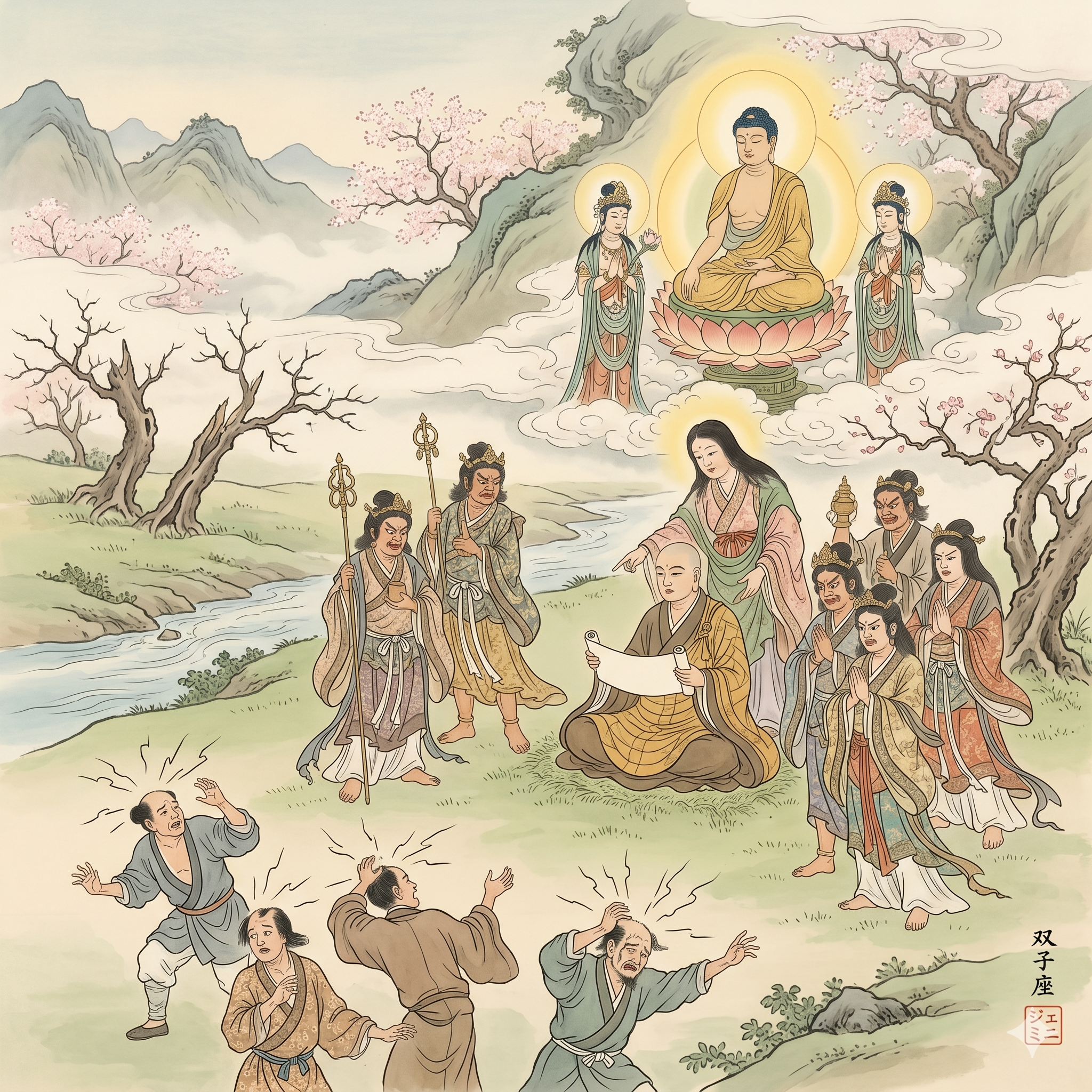
The illustration conceptualizes the verses from Chapter Twenty-Six of the Lotus Sūtra, focusing on the vow of protection and the psychological consequences of creating harm. The painting centers on an 'expounder of the Dharma,' a monk reading a scroll, who is flanked by supportive figures representing the Mother-of-Devils and the rakṣasī demons (though fewer than ten, representing the group). In the lower section, three figures represent those who 'trouble' the teacher; they are shown in varying states of mental and physical anguish, their heads symbolically 'split' (indicated by stress lines), paralleling the bare, broken branches of the arjaka-tree on the far left. The natural, cohesive landscape represents living in harmony, as Śākyamuni Buddha looks down with compassion from the upper realm.

Translation:

双子座 (Signature): Gemini

ジェミニ (Hanko Seal): Gemini

Anyone who does not keep our spells
But troubles the expounder of the Dharma
Shall have his head split into seven pieces
Just as the branches of the arjaka-tree [are split].

The ten rakṣasī demons and Mother-of-Devils sing these verses in Chapter Twenty-Six of the Lotus Sūtra. They are among the many gods and other supernatural beings who vow to protect all those who keep and practice the Buddha Dharma. These verses help us to understand the nature of those who create harm in the world and to develop a heart of compassion towards them. The nature of delusion is that it sets up a world separate from the world we all share. It puts a barrier between us and the world out of fear that this world will harm us. The Buddha’s teachings show us how to develop the courage to live in harmony with this world, rather than splitting ourselves from it, and splitting ourselves in it.

The Daily Dharma is produced by the Lexington Nichiren Buddhist Community. To subscribe to the daily emails, visit zenzaizenzai.com

Good and Wicked Countries

Of the 25 transmitters of the Buddhist dharma, all except the Buddha are men of temporary manifestation dispatched by the Buddha to lead living beings. Āryadeva, the 14th of the 25 transmitters, was killed by a non-Buddhist, and Venerable Simha, the 25th transmitter, was beheaded by King Dammira. Many others such as Buddhamitra and Bodhisattva Nāgārjuna encountered various difficulties. On the other hand, some were firmly supported by the rulers and were able to spread the dharma without encountering difficulties. Why is it that some transmitters were persecuted while others were not? I believe it is because there exist good and wicked countries in the world and aggressive and persuasive means of spreading a religion. This was true even during the Ages of the True Dharma and the Semblance Dharma. It was also true even in India, the central land of the Buddhist dharma. All the more so in Japan, a remote country land, at the beginning of the Latter Age of Degeneration. It has been expected from the beginning that I would encounter great difficulties when I tried to spread the teaching of the Lotus Sutra. I simply waited for them to arise.

Tenjū Kyōju Hōmon, Lightening the Karmic Retribution, Writings of Nichiren Shōnin, Followers 1, Volume 6, Page 30

Daily Dharma for May 29, 2026

20260529-ddi

Illustration by Google Gemini

Show Gemini's thinking

Gemini Thinking

Here is a conceptual summary and translation of the elements included in this visual Dharma teaching:

Conceptual Thinking:
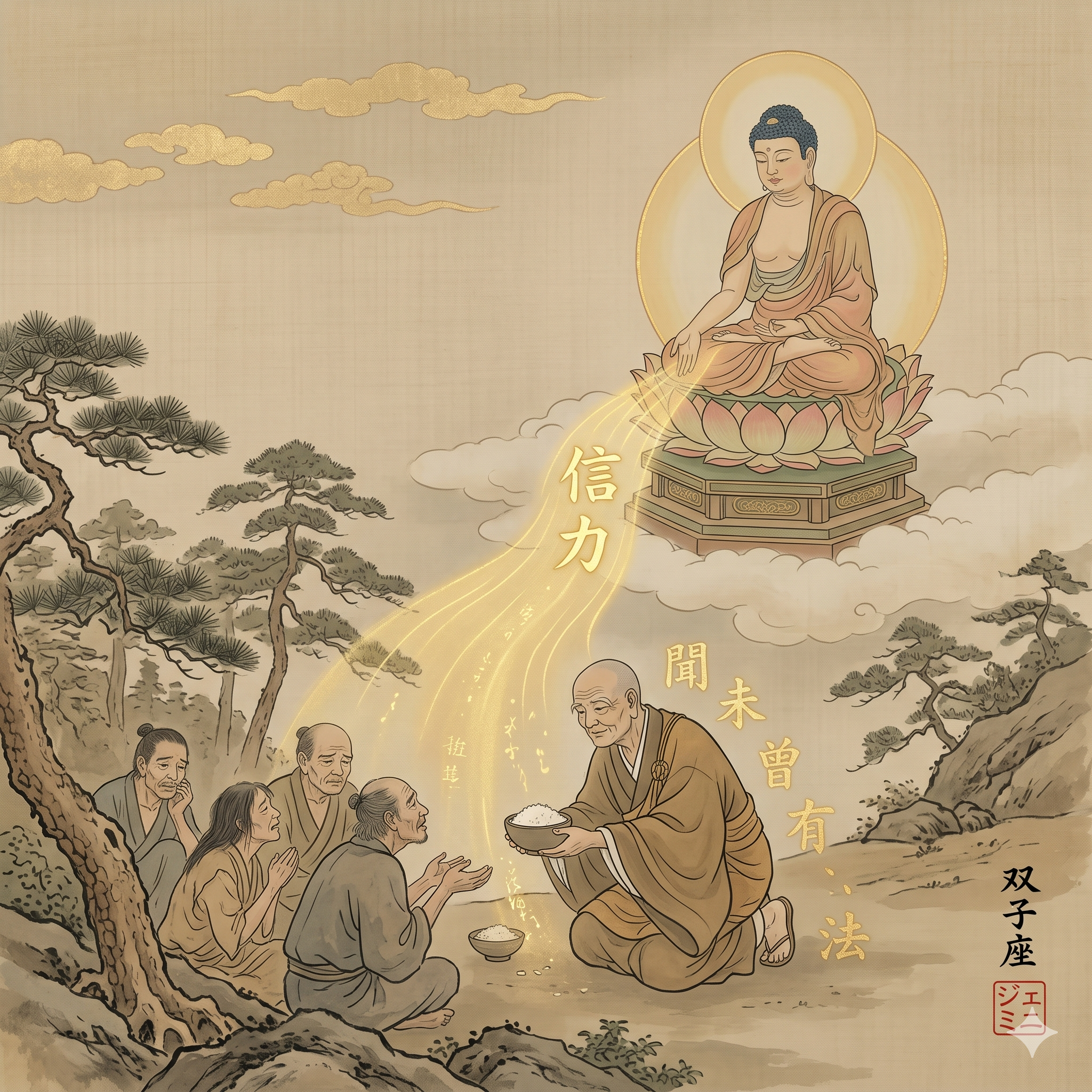
This illustration visualizes the passage from Chapter Fifteen of the Lotus Sūtra by depicting the inseparable connection between faith, benevolent action, and the realization of the highest Dharma. In the heavenly realm, Śākyamuni Buddha emits a stream of golden light representing the "power of faith," which flows directly to a monk practicing good deeds in the earthly realm. The monk, representing the practitioner, is actively "doing good patiently" by offering food to those in need. This act of creating benefit in the world allows him to "hear" or perceive the golden verses of the Dharma that rise around him—teachings only accessible through direct practice.

Identified Figures & Deities:

Śākyamuni Buddha: Seated on the lotus throne in the heavenly realm.

A Buddhist Monk: In the foreground, practicing compassion.

Kanji Translation:

信力 (Shinriki): The Power of Faith.

聞未曾有法 (Mon Mizouhou): Hear the Dharma that you have never heard before.

Arouse your power of faith,
And do good patiently!
You will be able to hear the Dharma
That you have never heard before.

The Buddha sings these verses in Chapter Fifteen of the Lotus Sūtra. These are another emphasis of the superiority of those who put the Buddha’s teachings into practice rather than those who merely hear and understand them. It is only when we are engaged in creating benefit in the world, in helping all beings to become enlightened, that we are able to hear the Buddha’s highest teaching, the teaching of his own enlightenment.

The Daily Dharma is produced by the Lexington Nichiren Buddhist Community. To subscribe to the daily emails, visit zenzaizenzai.com