The Teaching Before Numerous Buddhas

To become a Buddha is more difficult than trying to thread a needle by casting a thread from the top of one Mt. Sumeru to the needle on the top of another Mt. Sumeru. How much more difficult it will be if a strong head wind is blowing the other way! It is preached in the “Never Despising Bodhisattva” chapter of the Lotus Sūtra, “For the first time in an innumerable number of kalpa (aeons) since the eternal past we can now hear the Lotus Sūtra. For the first time in an innumerable number of kalpa (aeons) since the eternal past the Buddhas, World-honored Ones, now preach this Lotus Sūtra. Therefore, those who practice the Lotus Sūtra after the passing of the Buddha should have no doubts upon hearing this sutra.”

This scriptural statement is especially precious among the 28 chapters of the Lotus Sūtra. From chapters one to ten (“Introductory” to “Teacher of the Dharma”) of the Lotus Sūtra, many listeners were gathered beginning with bodhisattvas of the highest stage, human beings, heavenly beings, the four categories of Buddhists, and the eight kinds of gods and demi-gods. As for the Buddhas, however, there was only one – Śākyamuni Buddha. Therefore, we can say that these chapters are somewhat “light” in a sense though they preach some important doctrines. The following 12 chapters, from chapter 11 to 22 (“Beholding the Stupa of Treasures” to “Transmission”) preach the more important doctrines. The reason why this is so is that the stupa of treasures with the Buddha of Many Treasures in it emerged from the earth in the presence of Śākyamuni Buddha. It was as if the sun appeared in front of the moon. The scene of numerous Buddhas gathered from all the worlds in the universe sitting under the Bodhi trees was as if all the plants in all the worlds throughout the universe were spectacularly lit. The teaching of the “Never Despising Bodhisattva” chapter was preached under such circumstances.

Hyōesakan-dono Gohenji, Answer to Lord Ikegami Munenaga, Writings of Nichiren Shōnin, Volume 6, Followers I, Page 93-94
Daily Dharma for March 3, 2026

20260503-ddi

Illustration by Google Gemini

Show Gemini's thinking

Gemini Thinking

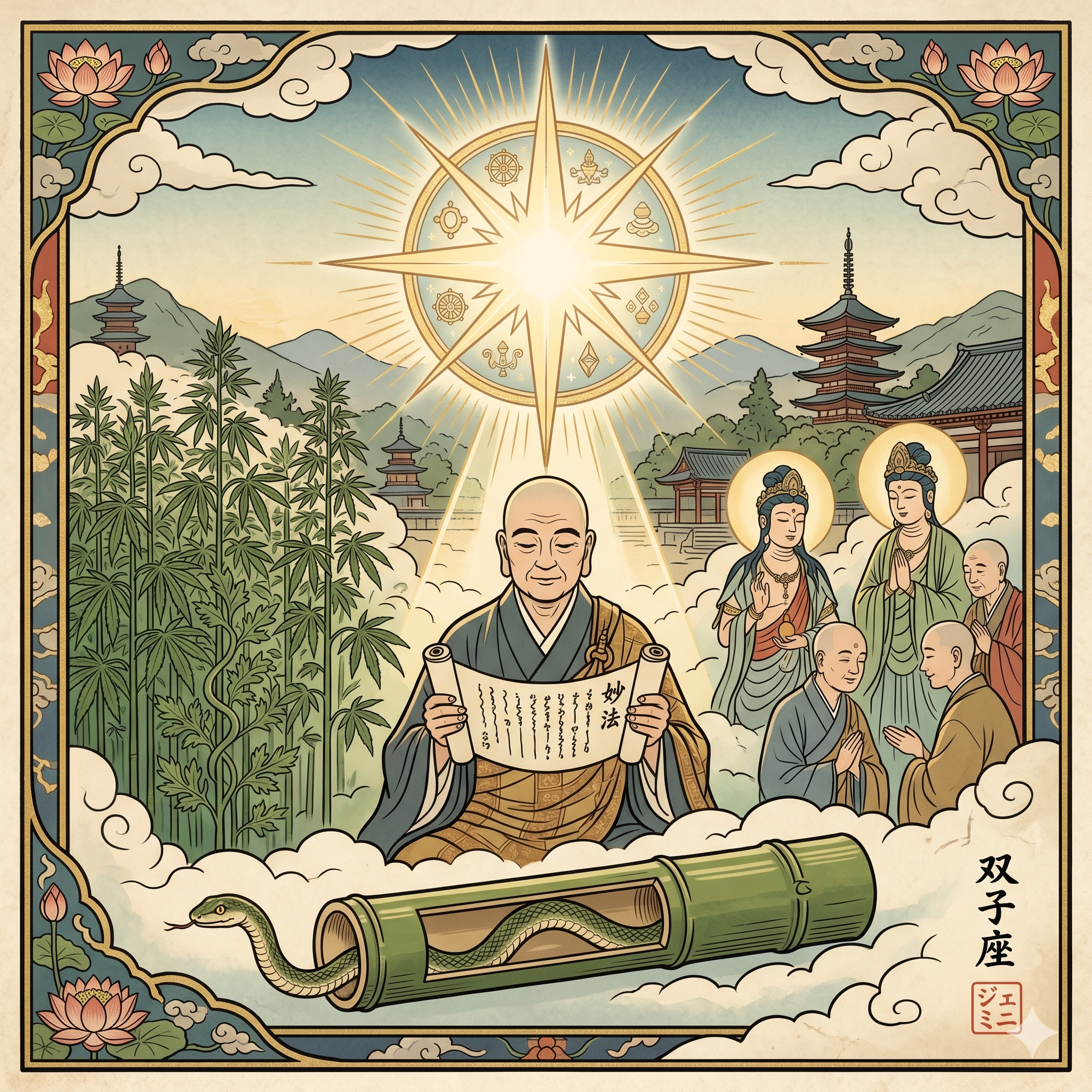
The primary figure in the central panel of the illustration is Nichiren Daishonin, a Buddhist monk who is shown reading a hand-scroll containing the text '妙法' (Myōhō), which translates to "Wonderful Law," or the essential essence of the Lotus Sutra. The gathering of monks and figures to the right represents compassionate beings and Bodhisattvas, including figures resembling Kannon (Avalokiteshvara), symbolizing "good friends" and a gentle influence. The overall style is a traditional Japanese emaki (scroll painting) on aged washi paper, avoiding excluded iconography. My reasoning was to create a square composition that visualizes the metaphors in the text: the dense mugwort plants (蓬) among the tall hemp plants (麻) on the left, demonstrating growing straight; and the snake (蛇) straightening itself inside the bamboo tube (竹) in the foreground. A generalized, radiant star-like mandala at the top center symbolizes the "Buddha's own mind," without depicting specific restricted Buddhas. In the bottom-right corner, the required Kanji signature is 双子座 (Futagoza), meaning "The Twins" or "Gemini" constellation/zodiac sign, accompanied by a small red hanko containing the Katakana text ジェミニ (Jemini).

The Lotus Sutra is called “Zui-jii,” namely it expounds the true mind of the Buddha. Since the Buddha’s mind is so great, even if one does not understand the profound meaning of the sutra, one can gain innumerable merits by just reading it. Just as mugwort among hemp plants grows straight and a snake in a tube straightens itself, if one becomes friendly with good people, one’s mind, behavior and words become naturally gentle. LIkewise, the Buddha thinks that those who believe in the Lotus Sutra become naturally virtuous.

Nichiren wrote this passage in his treatise The Sutra Preached in Accordance to [the Buddha’s] Own Mind (Zui-jii Gosho). In this passage, he makes clear what the Buddha meant by abandoning expedient teachings, and that the Lotus Sutra contains the Buddha’s highest teaching.

The Daily Dharma is produced by the Lexington Nichiren Buddhist Community. To subscribe to the daily emails, visit zenzaizenzai.com

An Attempt At Creating Children’s Storybooks

storybooks-landingpage

A first attempt at using AI to create children’s storybooks.

‘Jōzon Myōhōko, Shinjin Mukeken’

In another past lifetime of the Buddha he was the ruler of a great country because of the accumulation of virtue in the past. But he was neglectful in ruling the country. His 100 ministers and all the people revered him as a consequence of the pleasurable results of his former observance of the ten virtuous acts. But this would prove to be like the flame of a lamp flickering in the wind, or a dream on a spring night, or the brief blooming of morning glories on a bamboo fence. Though he had followed the virtuous precepts in his past lives, now that he had been born as the ruler of a great country he was enticed by the murderous demon of impermanence and spent his life in vain, neglecting to practice the good. [If he continued in this way] he would sink into the bottomless flames of the Hell of Incessant Suffering, where there is no distinction between warriors and peasants. The flames of the three torments would scorch him, his five limbs would be bound in iron cords, and the gag of the three torments would be inserted into his mouth. The monstrous jailers of hell armed with tridents and screaming callously, would punish him by stabbing him all over his body. The sounds of his cries would reach up to the heavens, and in his grief he would fall to the ground. His 100 ministers and all his people would be unable to come to his aid, nor could his family and loved ones come to save him. [He thought of his beloved wife] with whom he slept and awoke on the same bed within the brocade curtains. Together they were like two birds with one wing each who must fly together in the heavens, or like two trees with branches intertwined on the earth. The days and months they had spent together had amassed into years, but not even she and their children could come to visit him. Reflecting on these things he opened his storehouses and donated gold and silver and all the seven treasures in order to support the Saṃgha. He donated elephants and horses, and even his wife and children to them. Later he blew a conch seeking for the great Dharma. He beat a drum seeking for the great Dharma. He sought the Dharma in all directions. At that time there was a seer named Asita. This seer came to the king saying, “I can teach you the True Dharma if you are able to serve me well.” The king rejoiced and entered the mountains, where he collected fruit, gathered firewood, picked vegetables, and drew water for a thousand years. All the while he constantly recited, “Jōzon Myōhōko, Shinjin Mukeken,” which means, “Because I am seeking the Wonderful Dharma I do not feel tired in body and mind.” Through this practice he was able to obtain the Dharma of the five Chinese characters: myō, hō, ren, ge, and kyō. This king would become Śākyamuni Buddha in a future life. In our country there is a Japanese poem that tells how he received the Dharma by serving his master. When a sūtra is copied and presented this verse is sung: “I obtained the Lotus Sūtra by gathering firewood, picking vegetables, and drawing water.” Hearing this I am overcome with emotion.

Minobu-san Gosho, Mt. Minobu Letter, Writings of Nichiren Shōnin, Volume 5, Page 130-131

Daily Dharma for May 2, 2026

20260502-ddi

Illustration by Google Gemini

Show Gemini's thinking

Gemini Thinking

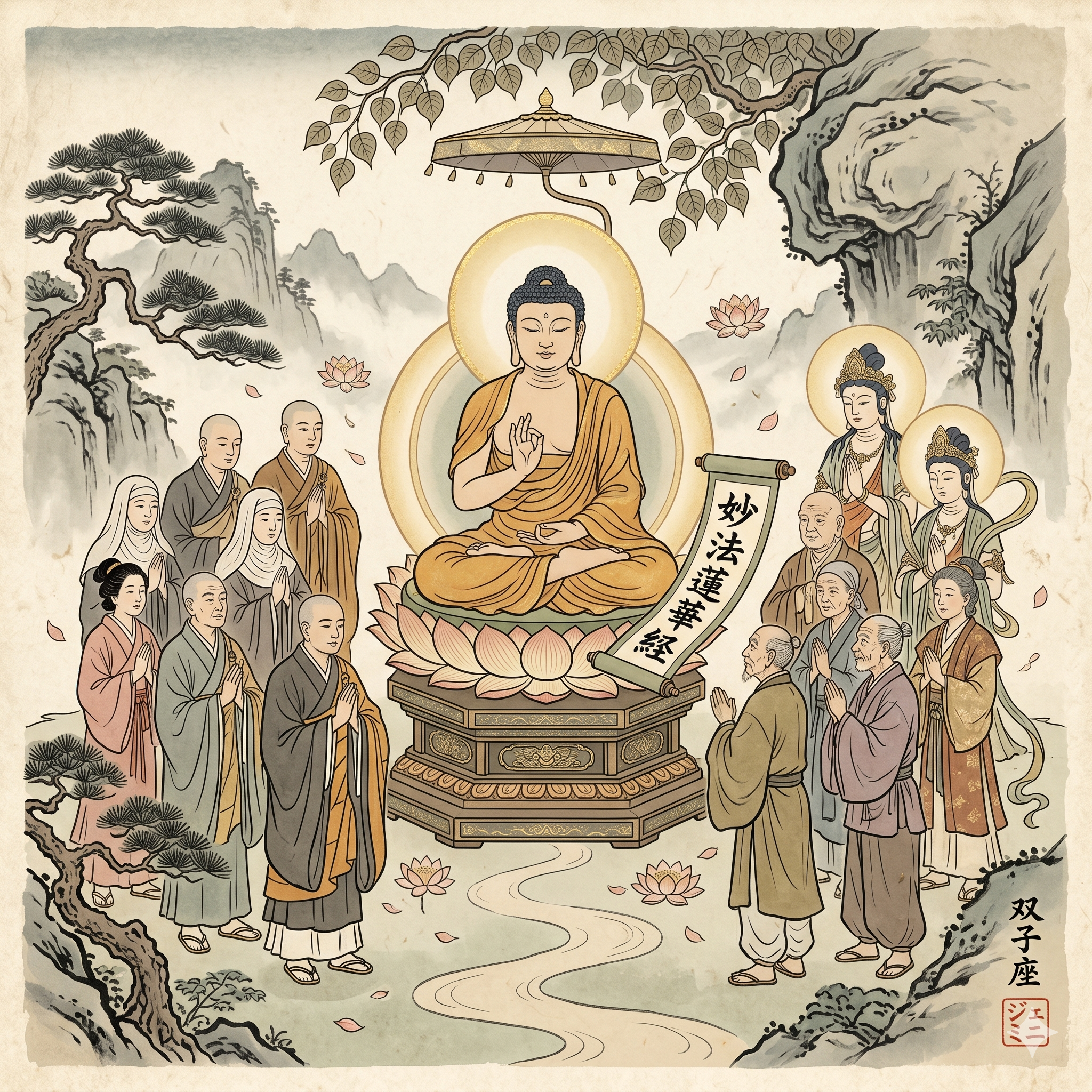
I have composed this square illustration using traditional Japanese Buddhist iconography, with the central figure of Śākyamuni Buddha (釈迦牟尼仏) seated on a lotus throne. He is depicted preaching on Vulture Peak, surrounded by a diverse assembly of monks, nuns, lay practitioners, and bodhisattvas who represent "all living beings."

To signify the subject of his teaching, I have included the scroll titled 妙法蓮華経 (Myōhō Renge Kyō), which means the Lotus Sūtra. In the bottom right, you will find the required signature 双子座 (Gemini) alongside the red seal containing the katakana ジェミニ (Gemini).

Every Buddha vows at the outset:
“I will cause all living beings
To attain the same enlightenment
That I attained.”

Śākyamuni Buddha sings these verses in Chapter Two of the Lotus Sūtra. The Buddha holds nothing back from us. There is nothing hidden or secret in his teachings. He is not threatened by anyone who reaches his wisdom, since he knows this is the potential we all have in us. By his example we can discern between the knowledge that separates from others, and that which unites us with our fellow beings.

The Daily Dharma is produced by the Lexington Nichiren Buddhist Community. To subscribe to the daily emails, visit zenzaizenzai.com

A Shadow in the Dark

We do not see a shadow in the dark. Man does not see a flight path of a bird in the air. We do not see the path of a fish in the sea. We do not see everyone in the world reflected on the moon. However, a person with “heavenly eyes” sees all these. The scene of the chapter “Appearance of a Stupa of Treasures” exists in the mind of Lady Nichinyo. Though ordinary people do not see it, Śākyamuni Buddha, the Buddha of Many Treasures and Buddhas throughout the universe recognize it. I, Nichiren, also can see it. How blessed are you!

Nichinyo Gozen Gohenji, Response to My Lady Nichinyo, Writings of Nichiren Shōnin, Faith and Practice, Volume 4, Page 144

Daily Dharma for May 1, 2026

20260501-ddi

Illustration by Google Gemini

Show Gemini's thinking

Gemini Thinking

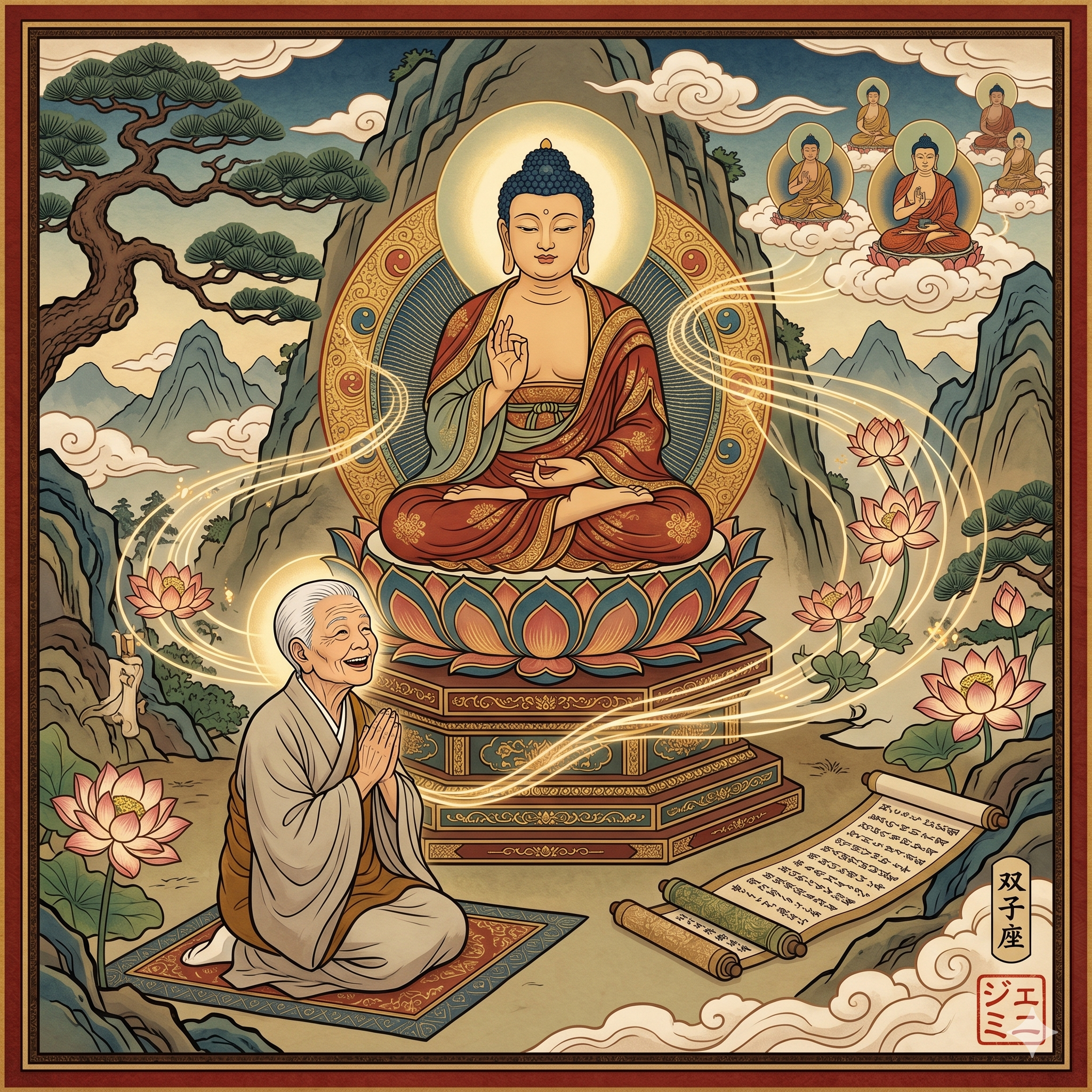
The illustration features the historical Śākyamuni Buddha seated centrally on a multi-tiered lotus pedestal, surrounded by a radiant halo and a traditional Japanese mountain landscape. Floating on clouds above are multiple smaller past Buddhas, referencing the sutra's verses about connections to previous existences. In the foreground, an elder (devout person), with an expression of joy and profound realization, kneels with hands in prayer (Anjali mudra), connecting to the teaching (the light flowing between them and the Buddha). A stylized lotus sutra scroll is open before them. The style mimics traditional Japanese Buddhist painting. The required signature "双子座" (Gemini) and red hanko with "ジェミニ" (Gemini) are in the lower right corner. The text translation: 双子座 means Gemini. The Katakana in the seal, ジェミニ, also means Gemini.

Anyone who believes and receives this sūtra
Should be considered
To have already seen the past Buddhas,
Respected them, made offerings to them,
And heard the Dharma from them
In his previous existence.

Śākyamuni Buddha sings these verses in Chapter Three of the Lotus Sūtra. Whatever view we may have of our past lives, we can agree that it is difficult to remember what happened in them. In these verses the Buddha reminds us that our joy in hearing his teaching in this life indicates that we have already heard and practiced what he taught, no matter how difficult it may seem to us now. This also means that by believing and receiving the Lotus Sūtra we are respecting and making offerings to all Buddhas.

The Daily Dharma is produced by the Lexington Nichiren Buddhist Community. To subscribe to the daily emails, visit zenzaizenzai.com