For seekers of the Way, the Lotus Sutra has never been regarded as a mere historical artifact or static scriptural text. Rather, it is an interactive blueprint of the enlightened mind—a text to be “read not merely with the eyes, but with the very flesh and blood of one’s bodily life”.
To trace the lineage of this profound visual and philosophical framework is to look back upon a grand intellectual journey spanning centuries and borders. It begins with the intricate, multi-layered philosophical architecture of the Chinese Tiantai patriarch, Great Master Zhiyi (538–597). It then flows through the medieval Japanese discourses on Original Enlightenment (hongaku shisō). Finally, it finds its dynamic, concrete actualization in the prophetic realism of Nichiren Shonin (1222–1282).
This essay explores how the sublime metaphysics of ancient China evolved into a lived, immediate reality, transforming our regular world into the pristine Buddha Land.
1. Zhiyi and the Cosmic Matrix of Tiantai
At the absolute foundation of our philosophical tradition stands the Great Master Zhiyi, who systematically organized the vast corpus of Buddhist scriptures into a coherent, unified whole. Dissatisfied with the purely negative, deconstructive language (apophasis) found in some Indian Madhyamaka commentaries—which sought to describe reality only by what it was not—Zhiyi sought a more positive, affirmative articulation of ultimate truth.
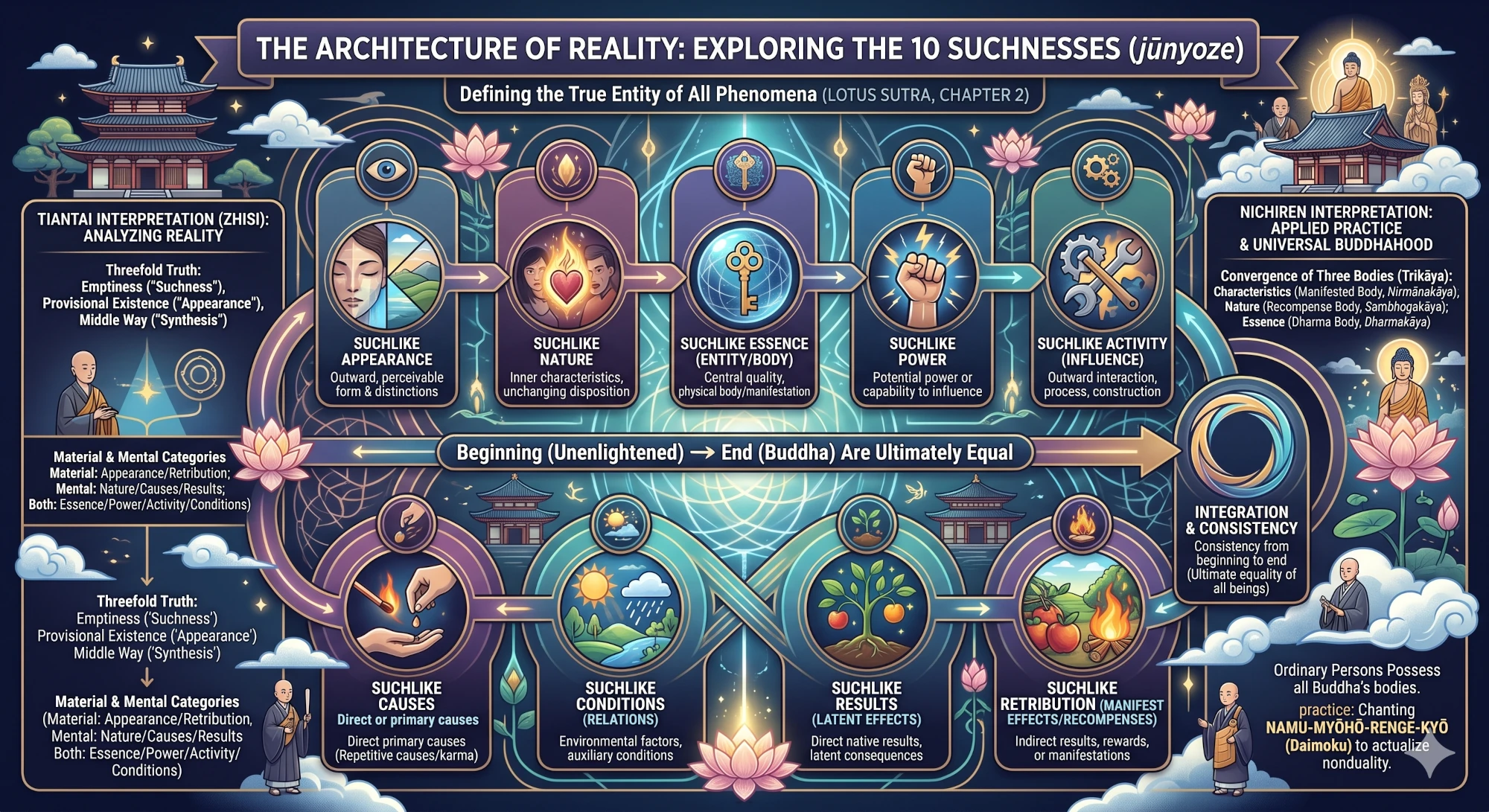
He achieved this by expanding the traditional Mahayana model of the Two Truths into a dynamic, interconnected triad known as the Perfect Interfusion of the Three Truths (en’yū santai):
- Emptiness (Ku): The realization that all phenomena are devoid of fixed, independent substance, existing only in a state of ontological ambiguity and fluid potential.
- Provisional Positing (Ke): The recognition that despite lacking a permanent essence, things do exist conventionally, presenting themselves as temporary particulars bound by causes and conditions.
- The Center or Middle Way (Chū): The simultaneous, inseparable awareness of both emptiness and provisional existence. Here, the universal and the particular are perfectly harmonized; the universal realizes its true nature in the particular, and the particular derives its meaning from the universal.
       [The Middle / Center (Chū)]
                 /           \
                /             \
               /               \
       [Emptiness (Ku)] ---- [Provisional (Ke)]
From this Threefold Truth, Zhiyi developed the crowning conceptual pillar of our school: Three Thousand Realms in a Single Thought-Moment (ichinen sanzen). This architectonic model asserts that our ordinary, fleeting mind at any given instant (ichinen) inherently contains and encompasses the entirety of the cosmos (sanzen).
This number is calculated by multiplying the Ten Worlds (the psychological and cosmological realms from Hell to Buddhahood) by their Mutual Possession (the reality that each world inherently contains the other nine), further multiplied by the Ten Suchnesses or structural factors of existence, and finally multiplied by the Three Realms of Existence:
- The realm of the five aggregates (go’on seken).
- The realm of living beings (shujō seken).
- The realm of the environment or container world (kokudo seken).
Crucially, Zhiyi’s schema establishes that the living subject and the physical environment are fundamentally inseparable—a relationship known as the Non-duality of Primary and Dependent Recompense (eshō funi). Our surroundings are not a neutral, external stage; they are the literal shadow cast by our inner life-condition. When the mind reaches awakening, the environment itself must pervade the Dharma realm.
2. The Medieval Drift into Abstraction
As these profound doctrines traveled to Japan, they evolved into the pervasive scholastic discourse of Original Enlightenment Thought (hongaku hōmon) within the Tendai tradition. Hongaku doctrine radically inverted traditional linear paths of practice. Instead of treating Buddhahood as a distant destination to be reached through eons of merit accumulation and the systematic pruning away of defilements, it boldly asserted that all ordinary worldlings (bonbu) are fully realized Buddhas from the very outset. Radiant Buddhas with their extraordinary marks were relegated to mere provisional signs; the true Buddha was the ordinary person just as they are.
However, this absolute non-dual monism carried a dangerous, latent vulnerability: it risked slipping into a quietistic, uncritical affirmation of reality that undermined the necessity of concrete moral effort and religious practice. If an ordinary person is already identical to the ultimate reality prior to any cultivation, formal practice becomes superfluous, and the critical distinction between delusion and enlightenment is dangerously obscured.
Scholars within the traditional Tendai academies endlessly debated these points, but their realizations remained largely confined to intellectual exercises and secret oral initiations (kuden) shared among elite scholar-monks. It was a magnificent architecture of awakening, but it remained ri no ichinen sanzen—the three thousand realms as an abstract, theoretical principle.
3. Nichiren Shonin and the Shift to Actuality
This was the historical and institutional landscape that Nichiren Shonin confronted. Educated in the rich scholastic environment of Mount Hiei, Nichiren fully accepted the structural validity of ichinen sanzen and the Threefold Truth. Yet, living in a tumultuous era ravaged by earthquakes, famines, epidemics, and the terrifying specter of Mongol invasion, he recognized that an abstract philosophy could not save a desperate populace.
“When the priesthood in the Final Dharma age forgets the two great practical forces… and does nothing but preach sermons, then it becomes powerless to accomplish anything.”
Nichiren’s unique religious contribution lay in his demand for Actuality (ji). He lifted the ichinen sanzen principle out of the realm of theoretical speculation and anchored it firmly into the concrete domain of dynamic religious practice, establishing what we revere as ji no ichinen sanzen—the three thousand realms in concrete actuality.
To achieve this, Nichiren collapsed the traditional, long path of fifty-two progressive stages of bodhisattva practice into a singular, immediate point of entry: the stage of Verbal Identity (myōji-soku). This is the profound moment when an ordinary person first hears the words of the true teaching and arouses faith.
Nichiren asserted that all the unfathomable practices carried out by Shakyamuni Buddha since the remotest past (causes), and all the boundless wisdom and merits he gained in consequence (effects), are fully contained and wrapped within the five characters of the Holy Title: Myōhō-renge-kyō.
Traditional Path:
[Stage 1] ───> [Stage 2] ───> [Progressive Eons of Practice] ───> [Buddhahood]

Nichiren's Interventions (Mandalic Time):
[Myōji-soku (Verbal Identity / Faith)]
       │
       ▼ (Chanting Namu-Myōhō-renge-kyō)
[Simultaneity of Cause and Effect / Immediate Attainment]
When an ordinary person chants the Daimoku in the formula Namu-myōhō-renge-kyō, they are not striving to travel across time to reach a distant, external enlightenment. Instead, they open an immediate point of access where linear historical time intersects with the timeless, eternal realm of the primordial Buddha.
Through faith, the practitioner immediately receives the complete transfer of the Buddha’s merits, realizing the ultimate goal of “attaining Buddhahood in this very body” (sokushin jōbutsu) right in the midst of their ordinary, everyday life.
4. The Sacred Blueprint: Inscribing the Daimandara
The visual manifestation of this actualized reality is Nichiren Shonin’s calligraphic Great Mandala (Daimandara), universally revered across our lineages as the Gohonzon (the supreme object of worship).
Rather than relying on traditional anthropomorphic statues or multi-colored paintings that might encourage an ordinary viewer to perceive the Buddha as an external entity separate from their own life-essence, Nichiren chose to construct his mandala entirely out of written characters. In doing so, he preserved the absolute identity between the graphic icon and the sacred scriptural text of the Lotus Sutra.
Down the exact center of this sacred diagram, Nichiren inscribed the vertical axis of cosmic reality: Namu-myōhō-renge-kyō. Flanking this central mantra are the names of the two Buddhas, Shakyamuni and Many Treasures (Tahō), seated side by side within the floating Treasure Tower. This dynamic scene represents the perfect fusion of Objective Truth (kyō) and Subjective Wisdom (chi):
- Many Treasures (Tahō) embodies the immutable, universally abiding principle of ultimate truth (kyō).
- Shakyamuni represents the active, dynamic subjective wisdom (chi) that perceives and reveals that truth in human history.
                 [ Gohonzon Architecture ]

                      Tahō     Shakyamuni
                     (Truth)    (Wisdom)
                       │           │
                       ▼           ▼
               ┌───────────────────────────────┐
               │      NAMU-MYŌHŌ-RENGE-KYAO     │
               └───────────────────────────────┘
                               ▲
                               │
               ┌───────────────────────────────┐
               │    Four Leaders of Earth      │
               │   (Jōgyō, Anryūgyō, etc.)     │
               └───────────────────────────────┘
                               ▲
                               │
               ┌───────────────────────────────┐
               │ Representing All Ten Worlds   │
               │  (From Devadatta to Devas)    │
               └───────────────────────────────┘
Surrounding this central axis are the names of the four leaders of the Bodhisattvas of the Earth—headed by Jōgyō (Superior Conduct)—along with representatives of all ten realms of existence, including shifting cosmic forces, historic disciples, and even figures who traditionally epitomized deep delusion, like Devadatta.
Through the lens of ji no ichinen sanzen, none of these forces are banned or expunged. In the presence of the Central Law, every single realm is beautifully transfigured, anchored into place, and illuminated, revealing its true, enlightened nature as a necessary component of the cosmic whole.
When a follower of Nichiren sits before the Gohonzon, establishes pure faith, and raises their voice to chant the Daimoku, they are not merely looking at an external icon. They physically step into that very diagram, crossing the threshold of historical layout to take their rightful place within the eternal, un-dispersed Assembly on Vulture Peak.
5. Establishing the Pure Land in a Troubled World
Because our primary framework takes the non-duality of person and environment (eshō funi) as an absolute reality, our spiritual practice can never remain a purely private, internal pursuit.
Nichiren Shonin taught that a society that willfully ignores the true nature of reality—casting aside the ultimate vehicle of universal inclusion in favor of partial, one-sided, or otherworldly paths—will inevitably manifest that inner fragmentation as outer chaos, visible as natural calamities, social division, and widespread despair.
The message of Nichiren’s foundational treatise, the Risshō Ankoku Ron (“Establishing the True Teaching and Bringing Peace to the Land”), is a profound clarion call for social responsibility:
“Now you must quickly reform the faith that you hold in your heart and return to the single good that is the vehicle of the true teaching. Then the threefold world will all become the Buddha land…”
The transformation of our mundane world (Saha world) into the pristine Land of Tranquil Light (shaba soku jakkōdo) is achieved not by fleeing this reality after death, but by actively engraving the Wonderful Dharma into the structures of our everyday lives.
When we meet hardships, opposition, or secular uncertainties with unshakeable faith, we are following in the footsteps of Nichiren Shonin himself. We undergo our own personal “bodily reading” (shikidoku) of the scripture, transforming human suffering into a powerful, living witness to the un-destructible reality of the true aspect of all things.
Conclusion: The Lived Architecture
The architecture of awakening developed by our great ancestors is not a collection of abstract, dry academic definitions to be memorized or debated in isolation. From Zhiyi’s deep insights into ontological ambiguity and the interfusion of the truths, to the medieval understandings of our innate potential, the entire lineage finds its practical culmination when we place our hands together before the Mandala.
By chanting Namu-myōhō-renge-kyō, we take the profound theory of the universe and make it our lived, breathing reality. We awaken from the dream of false conceptualization, align our small selves with the great rhythm of the cosmos, and actively participate in the sacred task of manifesting the pristine Buddha Land right here and now, in this very body, and in this very world.

 I have a NotebookLM notebook devoted to Nichiren and his teachings. I asked that notebook to provide a deep dive into the principle of eshō funi, from its origins to its impact on Nichiren’s teachings. I then took this to Gemini and asked it to convert this deep dive into a blog post by a Nichiren Shu scholar priest.