Author: Gemini Notebook

  • The Lotus Sutra in Four Parts

    NotebookLM logoThis summary of the Lotus Sutra was generated by Gemini Notebook from sources I provided. See this explanation.

    LotusSutraInFourParts-P1

    Illustration by Google Gemini

    Show Gemini's thinking

    Gemini Thinking

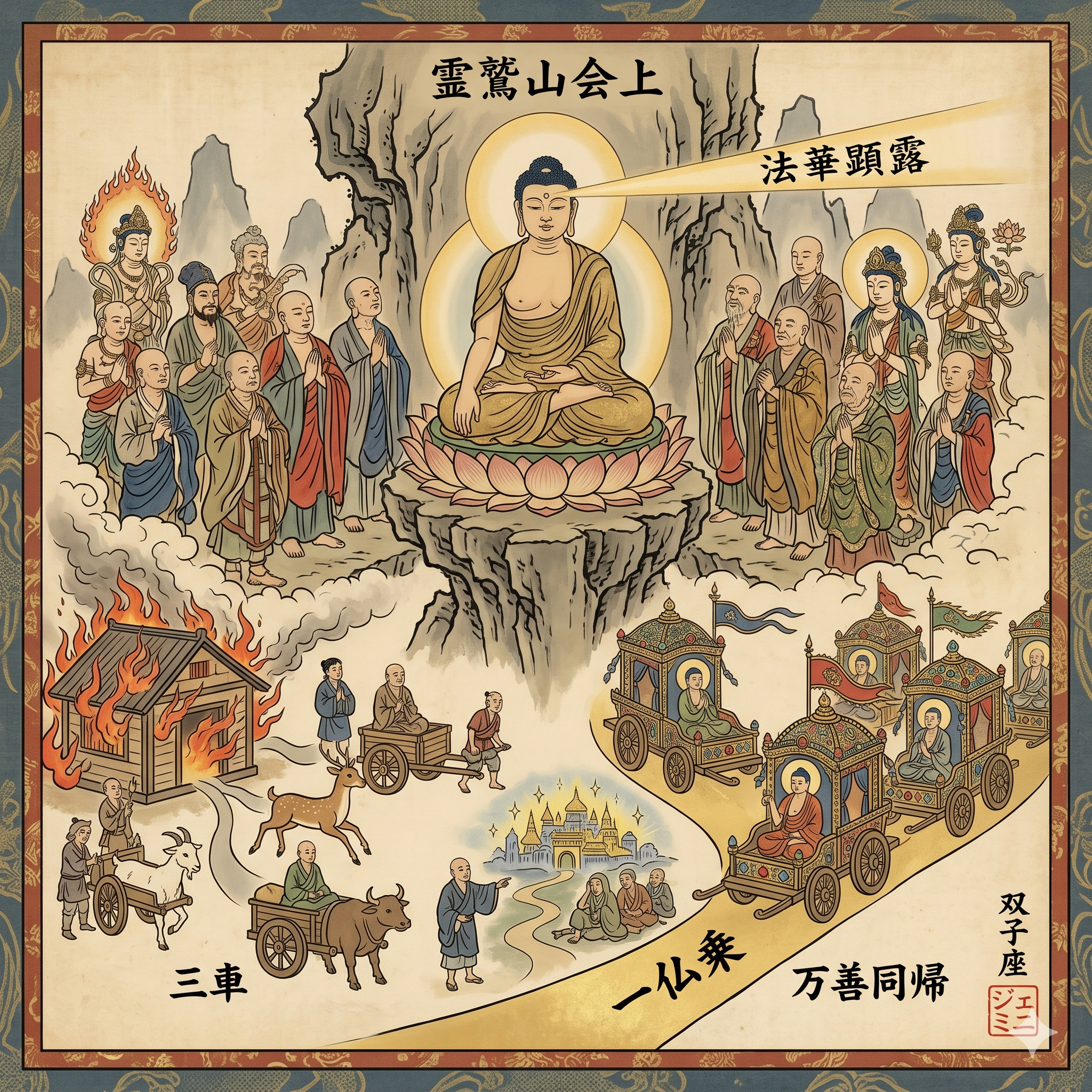
    Here is the translation of the Kanji text, grouped by section for context:

    Main Scene and Manifestation (Top)
    霊鷲山会上 (Ryōjusen’e jō)

    Translation: "Assembly at Vulture Peak" or "Gathering on Vulture Peak"

    Context: This refers to the sacred mountain where the Buddha expounded the Lotus Sutra. The scene depicts the moment he enters deep meditation, causing miracles and attracting a vast audience of beings.

    法華顕露 (Hokke kenro)

    Translation: "The Revelation of the Lotus [Dharma]" or "The Manifesting of the Lotus Sūtra"

    Context: The arrow points to the beam of light (the ūrṇā) emanating from the Buddha’s brow, which illuminates distant worlds and signals the beginning of the sutra's supreme teaching.

    Parables and Concepts of Expedient Means (Bottom Left)
    三車 (Sanjū)

    Translation: "The Three Vehicles" or "Three Carts"

    Context: This refers to the Parable of the Burning House. To rescue his children from a burning house, a father entices them out with promises of three distinct carts (goat, deer, and ox carts). These represent the three provisional paths of Buddhist practice that the Buddha taught as expedient means (upāya) to reach those of different abilities.

    The Ultimate Truth (Bottom Center)
    一仏乗 (Ichibutsujō)

    Translation: "The One Buddha Vehicle" or "The Single Buddha Vehicle"

    Context: This is the central tenet of the Lotus Sutra. The Buddha reveals that the three distinct carts were a skillful fiction. The true path is the singular, supreme "One Buddha Vehicle," symbolized by the identical, magnificent jeweled carts, intended for all beings to achieve full Buddhahood.

    万善同帰 (Manzen dōki)

    Translation: "All Goodness Returns to the Same [One Vehicle]" or "All Virtuous Practices Converge"

    Context: This phrase emphasizes universal salvation. It means that all distinct, virtuous acts, across all previous paths and lifetimes, ultimately lead to and are consolidated within the path to full Buddhahood.

    Artist Signature (Bottom Right)
    双子座 (Futagoza)

    Translation: "Gemini"

    Context: This is the artist’s name. It is the Japanese name for the zodiac constellation Gemini. The red katakana seal next to it also reads ジェミニ (Gemini).

    1. The Revelation of the Great Vehicle and the Doctrine of Expedient Means

    The assembly at Mount Sacred Eagle establishes a cosmic theater for the systematic subversion of Hinayana limitations. As Śākyamuni Buddha enters a state of profound meditation, the emission of a ray of light from his brow serves as the catalyst for a fundamental shift in Buddhist teleology. This luminous signal prepares the assembly for the transition from the “provisional” teachings of the past to the “ultimate” truth of the One Buddha Vehicle (Ekayāna). This move is strategic; it recontextualizes the Buddha’s entire career not as a series of disconnected lessons, but as a unified pedagogical program designed to bridge the ontological gap between the Buddha’s infinite vision and the finite capacity of his disciples.

    The core mechanism of this transition is the doctrine of expedient means (upāya). Far from being a mere “noble lie,” upāya is a necessary response to the psychological and spiritual limitations of sentient beings. The Buddha reconciles the previously separate paths of the śrāvakas (voice-hearers) and pratyekabuddhas (solitary realizers) by revealing them as temporary rests rather than final destinations. This is exemplified by the Parable of the Phantom City, where a guide conjures a magical city to provide weary travelers with the respite needed to eventually reach the true treasure. This theme of strategic enticement is refined in the Parable of the Burning House, which distinguishes between the diverse motivations of seekers and the singular reality of the Great Vehicle:

    • The “Toy Carts” (Ox, Deer, and Goat carts): These represent the provisional, individual paths of salvation deployed to rescue beings from the “burning house” of saṃsāra, tailored to their specific temperaments and capabilities.
    • The “Identical Jeweled Carts”: These represent the supreme Great Vehicle—a singular, magnificent path of Buddhahood intended for all beings without distinction.

    This revelation shifts the focus from the isolation of individual nirvana to a collective inheritance, transforming the disciples from passive followers into potential architects of their own cosmic awakening.
    LotusSutraInFourParts-P2

    Illustration by Google Gemini

    Show Gemini's thinking

    Gemini Thinking

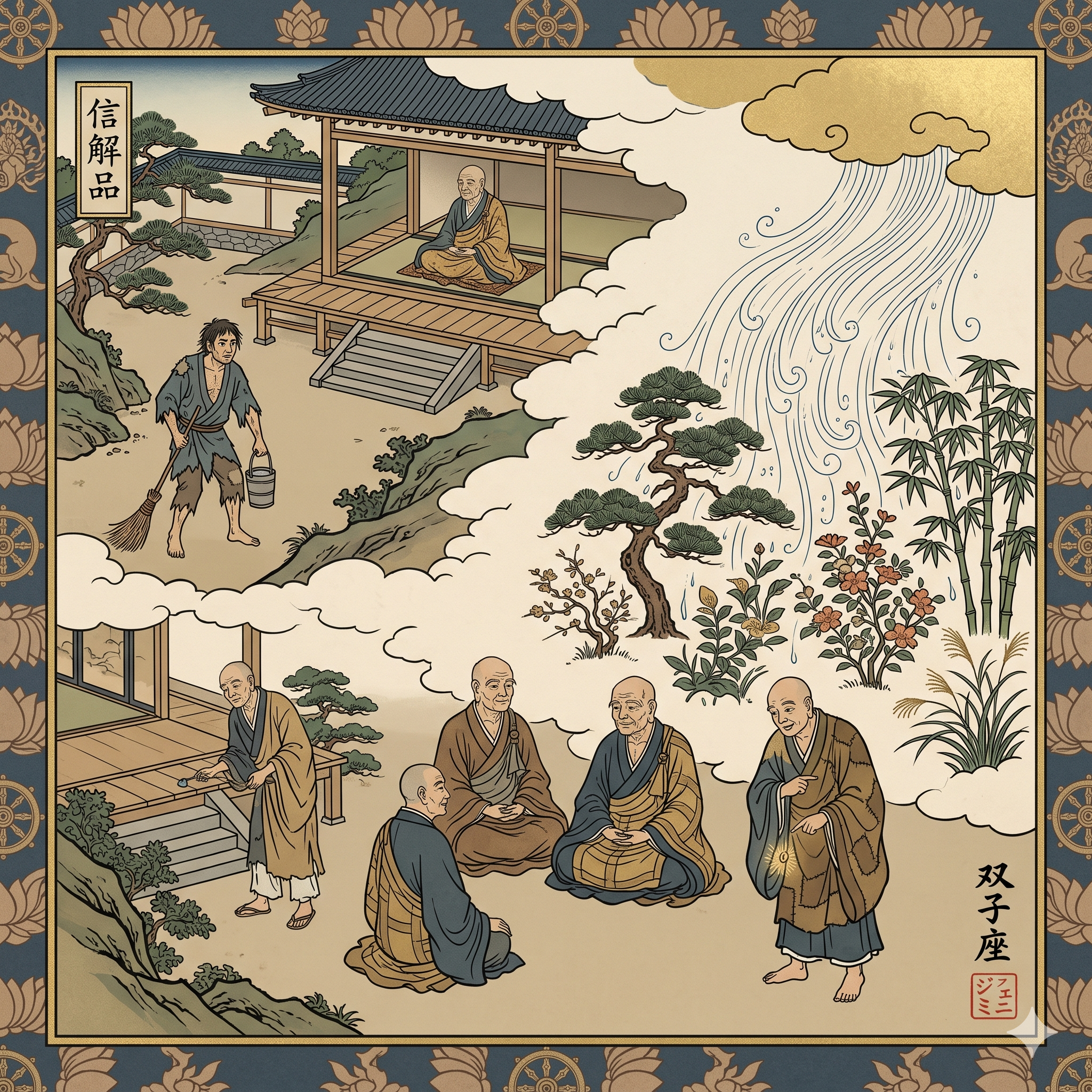
    My illustration visualizes the critical theological shift within the Lotus Sutra where the senior disciples transcend their status as mere arhats to become noble heirs. The composition captures the psychological evolution described in the text, framing it through two intersecting parables that dismantle the disciples' previous ego-constructions and celebrate the democratization of universal Buddhahood. I designed the square image to flow across a single narrative ground divided by clouds, blending the parables within one scene.

    On the left side, I illustrate the core of the Parable of the Destitute Son. I depict the character Mahākāśyapa in his prior life as a ragged, disheveled beggar, toiling as a humble sweeper within the grand palace courtyard of his wealthy, estranged father (representing the Buddha). A subsequent scene shows his transformation after recognizing his true lineage; he is now dressed in clean, noble robes, standing as a trusted steward overseeing the estate. On the right, the Parable of the Rain and Diverse Plants illustrates how the Dharma nourishes all beings, regardless of capacity. I rendered a shower of rain descending from golden clouds upon various distinct botanical elements: a massive pine tree, a detailed bamboo stalk, flowering shrubs, and simple grasses. Each plant, though unique in size and type, grows vigorously on the same soil, absorbing the singular “flavor” of the water.

    In the foreground, I integrated the group dynamics of the quartet. Four prominent monks—Mahākāśyapa, Subhūti, Mahākatyāyana, and Mahāmaudgalyāyana—are shown in contemplation, observing these narrative events and reflecting on their realization. The illustration explicitly depicts their subsequent formal prophecies of future Buddhahood (as received by Śāriputra, Ānanda, Rāhula, Pūrṇa, and five hundred others). I positioned a senior disciple, likely Pūrṇa, slightly to the side, pointing discreetly inside the hem of his modest patched robe to reveal a hidden, glowing golden jewel. This serves as a clear metaphorical confession that the potential for supreme enlightenment was always with them, like a treasure carried unwittingly in poverty.

    The Kanji text in the vertical cartouche in the upper left corner is:

    信解品 (Shingai-hon)

    It translates to "Chapter on Faith and Understanding," which is a specific chapter within the Lotus Sutra.

    The bottom corner features my required artist signature: the Kanji characters 双子座, which translate to "Futagoza" (meaning Gemini). Adjacent to it is the red square seal (hanko) containing the Katakana ジェミニ, also translating to "Jemini" (Gemini).

    2. The Parables of Inheritance and Universal Capacity

    The senior disciples—Mahākāśyapa, Subhūti, Mahākātyāyana, and Mahāmaudgalyāyana—process this radical shift through a narrative framework that dismantles their previous ego-constructions as “mere” arhats. Their response, articulated through parables, marks a psychological evolution from servants to heirs. By contrasting the Parable of the Destitute Son with the Parable of the Rain and Diverse Plants, the sutra illustrates how the Buddha’s wisdom is simultaneously singular in “flavor” yet multifaceted in application. While the Destitute Son narrative highlights the gradual process of accepting one’s noble heritage, the Parable of the Rain demonstrates that the Dharma nourishes all seekers according to their capacity, yet leads them to a common fruition.

    This democratization of the ultimate goal is not merely theoretical but is formally ratified through specific prophecies of future Buddhahood. This process begins with Śāriputra and extends to the senior quartet, as well as to Pūrṇa, Ānanda, Rāhula, and five hundred arhats (including Kauṇḍinya). These disciples offer the “jewel in the garment” parable as a metaphorical confession—an admission that they possessed the potential for supreme enlightenment all along, like a man carrying a priceless gem sewn into his robe while living in needless poverty. These internal realizations among the disciples serve as the foundation for the external, physical manifestations of the truth that follow.
    LotusSutraInFourParts-P3

    Illustration by Google Gemini

    Show Gemini's thinking

    Gemini Thinking

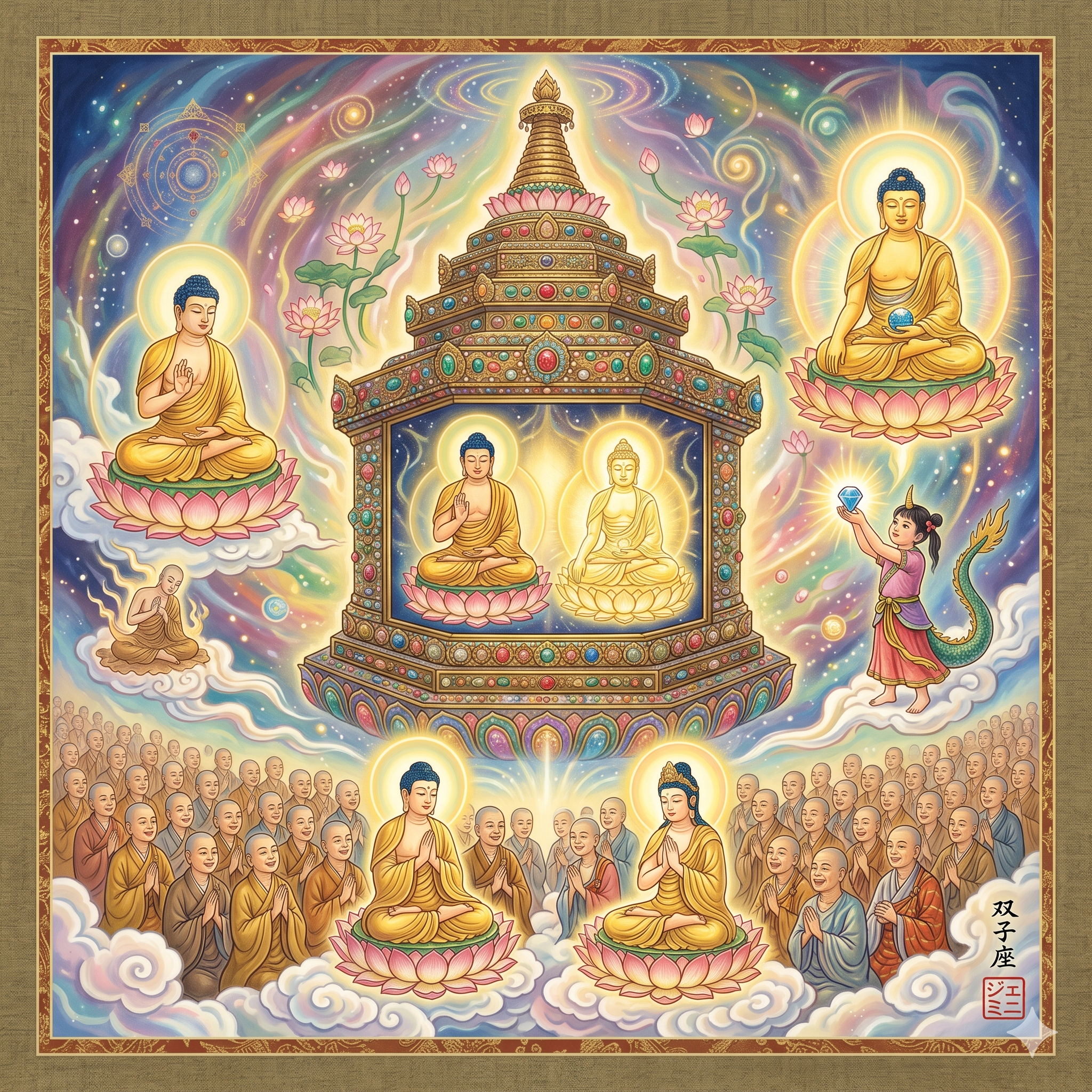
    I have created this square illustration in the style of traditional Japanese Buddhist iconography to depict the core concepts of the "supernatural assemblage."

    Central to the composition is the Treasure Stupa, which has emerged to validate the Lotus Sutra. Within it, I have illustrated Shakyamuni Buddha and the past Buddha Prabhūtaratna (Many-Treasures) sharing a throne, testifying to the eternal nature of the teachings.

    In accordance with your directives on the democratization of enlightenment, I have included the following figures:

    The Dragon-King's Daughter: On the right, she is shown with a dragon tail, offering her jewel as she transforms into a Buddha, illustrating instant enlightenment that bypasses the "five obstructions."

    Devadatta: In the upper-left, receiving his prophecy of Buddhahood. This inclusion dismantles the moral binary of "good" and "evil" by showing the universal potential for awakening, even for the Buddha's adversary.

    The Assemblage of Nuns: At the base, representing the extension of Buddhahood to all, including Mahāprajāpatī (the Buddha’s step-mother) and Yaśodharā (his wife).

    Following your technical requirements, I have excluded representations of Amida Nyorai or Dainichi Nyorai. I have placed the signature 双子座 (Futagoza) and the red square seal containing ジェミニ (Jemini) in a traditional location in the lower right.

    3. The Supernatural Assemblage and the Democratization of Enlightenment

    The emergence of the Treasure Stupa—a colossal, jeweled structure containing the past Buddha Many-Treasures (Prabhūtaratna)—functions as a cosmic validation of the Lotus Sutra’s supremacy. Many-Treasures does not merely spectate; he acts as a juridical witness, his presence testifying to the eternal validity of the One Buddha Vehicle across all space and time. This supernatural assembly provides the platform for an “ontological subversion” of traditional hierarchies, specifically targeting entrenched views on morality, gender, and spiritual capacity.

    The inclusion of Devadatta, the Buddha’s historical adversary, and the Dragon-King’s daughter represents a radical departure from conventional Buddhist exegesis. By revealing Devadatta as a past teacher and future Buddha, the sutra dismantles the moral binary of “good” versus “evil.” Simultaneously, the eight-year-old daughter of Sāgara achieves instant Buddhahood, bypassing the “five obstructions” traditionally thought to hinder women and the young.

    Previous Barriers to Buddhahood Lotus Sutra Revelations
    Moral Failure: The belief that “evil” or “icchantika” beings (like Devadatta) are permanently excluded from the path. Universal Potential: The Buddha’s past-life connection to Devadatta reveals even adversaries as catalysts for enlightenment.
    Gender/Age Limitations: The assumption that women and the young must undergo multiple rebirths to overcome physical and spiritual “barriers.” Instant Enlightenment: The Dragon-King’s daughter achieves supreme awakening immediately, proving the innate nature of capacity.
    Strict Monastic Asceticism: The doctrine that only those who follow the śrāvaka path can achieve the goal. Democratized Salvation: Prophecies are extended to the Buddha’s step-mother (Mahāprajāpatī), his wife (Yaśodharā), and thousands of nuns.

    LotusSutraInFourParts-P4

    Illustration by Google Gemini

    Show Gemini's thinking

    Gemini Thinking

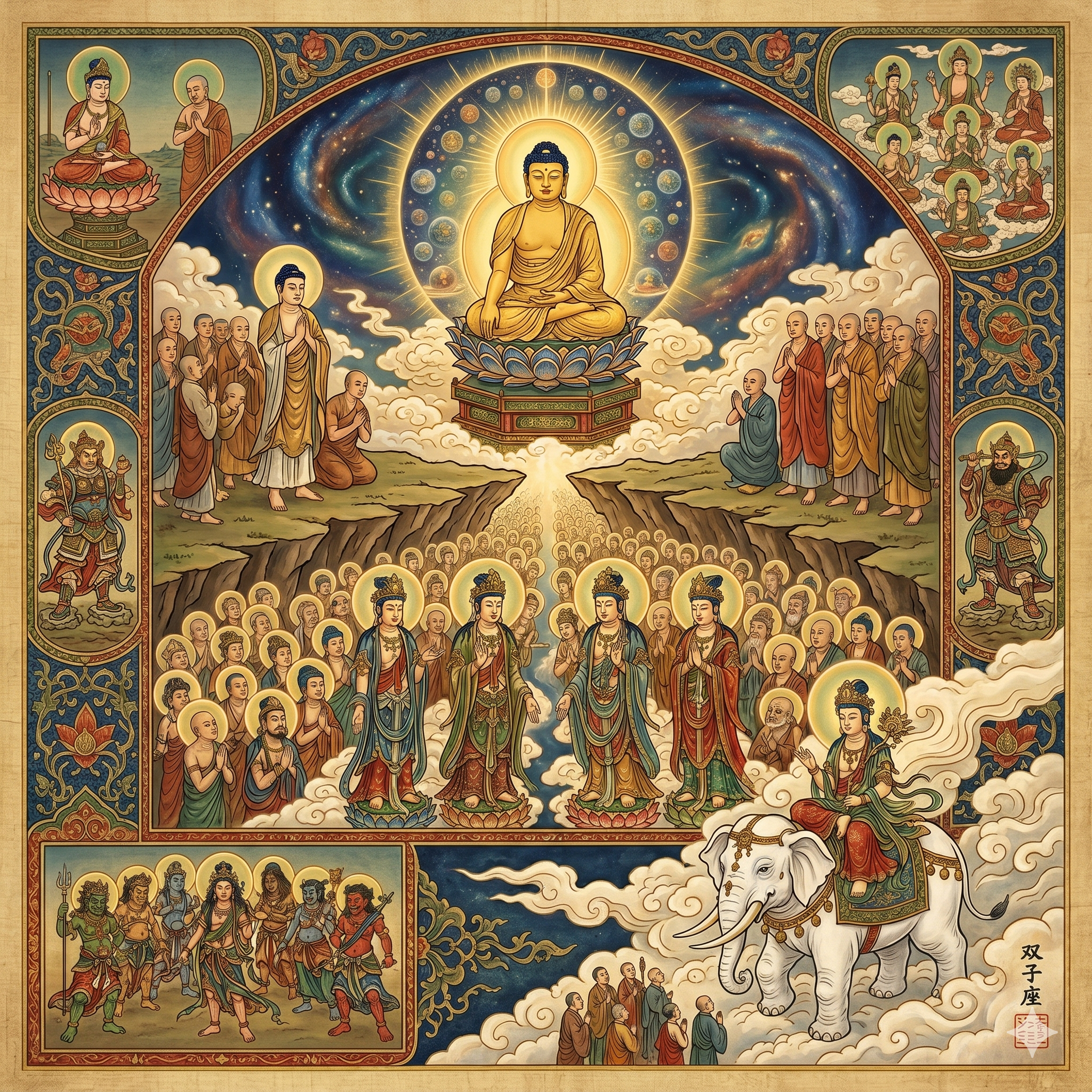
    The illustration captures the pivotal "Ceremony in the Air" from the Lotus Sutra, visualizing the revelation of the Eternal Buddha and the emergence of the vast multitude of "Bodhisattvas of the Earth" from the ground below. Following the narrative provided, the scene features:

    The Eternal Śākyamuni Buddha: Seated centrally in a vast cosmic array.

    The Bodhisattvas of the Earth: Led by the four principal guides (Superior-Practice, Limitless-Practice, Pure-Practice, and Steadily-Established-Practice).

    Models of Salvation: The inclusion of Universal-Sage (Samantabhadra) on a multi-tusked white elephant in the lower-right, alongside vignettes illustrating the roles of Medicine-King, Wonderful-Voice, and Avalokiteśvara.

    Protection Details: The Heavenly Kings (Vaiśravaṇa and World-Holding) and the converted Rākṣasīs (appearing in the lower-left section) are present as protectors of the One Buddha Vehicle.

    Artist Signature: In the lower-right corner, you will find the required Kanji signature 双子座 (Gemini) and the traditional red square hanko seal.

    4. The Secret of Longevity: The Eternal Buddha and the Earth’s Bodhisattvas

    The strategic core of the Lotus Sutra is found in the revelation of the “lifespan of the Tathāgata.” When the earth splits to reveal a staggering multitude of “Bodhisattvas of the Earth,” Maitreya voices the assembly’s confusion: how could the historical Śākyamuni have trained such a vast host in the forty years since his enlightenment? The Buddha’s response unveils the sutra’s most profound secret: his historical life, his attainment of enlightenment under the bodhi tree, and even his impending parinirvana are expedient illusions.

    In truth, the Buddha’s lifespan is eternal. He has been guiding beings in the Sahā world since the infinite past. This “expedient illusion” of death is a pedagogical tool designed to prevent disciples from falling into complacency. The Bodhisattvas of the Earth, led by Superior-Practice, Limitless-Practice, Pure-Practice, and Steadily-Established-Practice, are specifically entrusted with the future propagation of the sutra. Unlike visiting bodhisattvas from other realms, these figures are “indigenous” to this world, signifying that the task of maintaining the Dharma in a corrupt age belongs to those who have been nurtured by the Eternal Buddha since the beginning of time. This revelation transforms the Buddha from a historical figure into an eternal, cosmic presence.
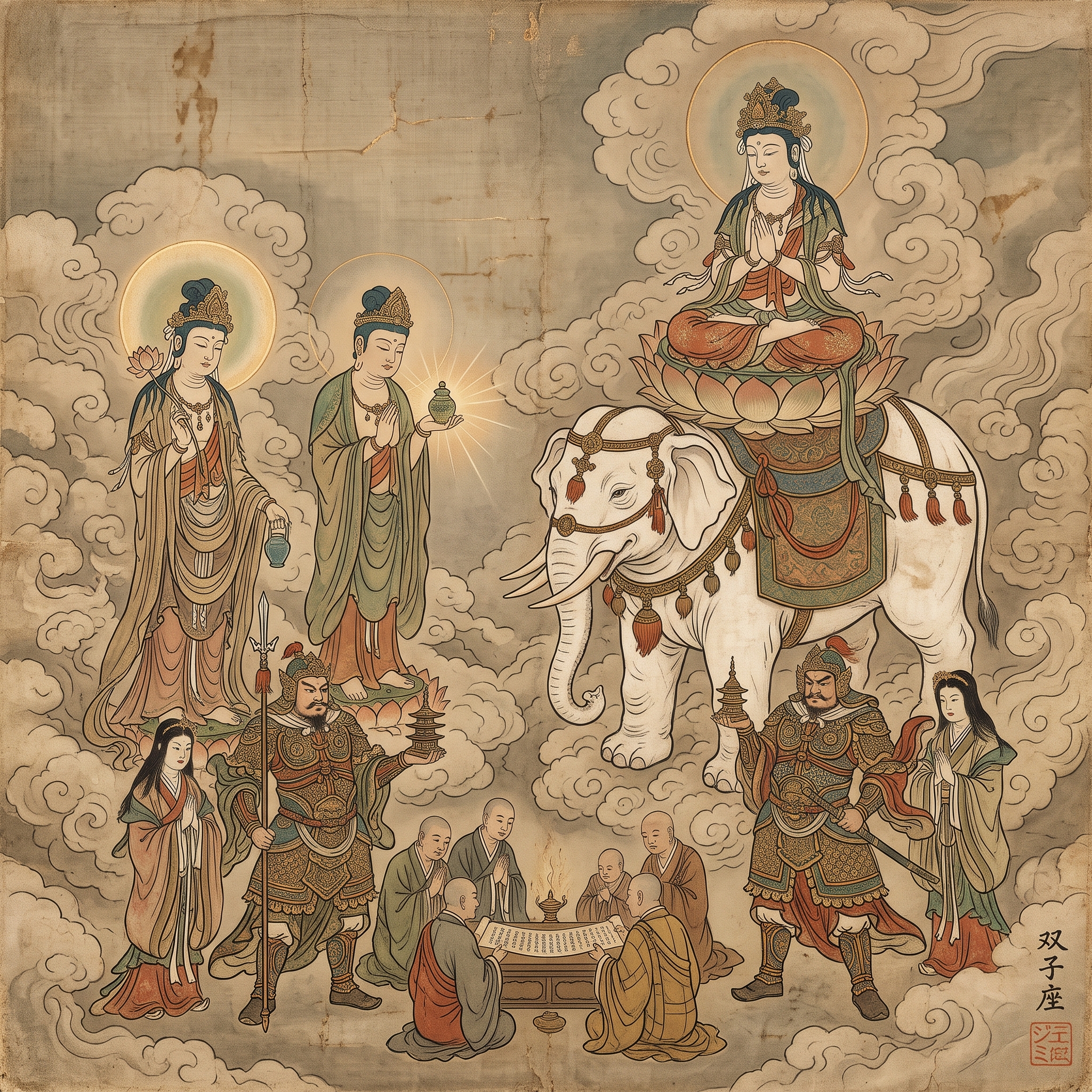
    lotus-sutra-five-parts-5

    Illustration by Google Gemini

    Show Gemini's thinking

    Conceptual Summary

    The illustration translates the protective, salvation-oriented vision of the Lotus Sutra’s final chapters into a classical Japanese Buddhist painting on aged, worn silk. It emphasizes the "divine security" and continuity of the Dharma in the latter days by assembling the sutra’s key protective figures around a devoted group of practitioners reading the scroll at the bottom. Positioned prominently on the right, Bodhisattva Universal-Sage (Fugen) sits atop his iconic six-tusked white elephant, a direct embodiment of future propagation and guardianship. On the left, Avalokiteśvara (Kannon) with a halo and water jar alongside Medicine-King (Yakuō) with a glowing vessel represent compassionate relief and the ultimate sacrifice for the Dharma. They are flanked below by armored Heavenly Kings (Bishamonten/Vaiśravaṇa) and protective figures (Rākṣasīs) who form an active, celestial shield. Utilizing Kamakura-era motifs—fine ink contours, muted mineral pigments, and delicate gold leaf on weathered silk—the composition captures the sacred, timeless vow to protect those who uphold the Buddha’s One Vehicle.

    Iconography & Character Identification

    Item 1: Deities/Figures Featured:

    • Bodhisattva Universal-Sage (Samantabhadra / Fugen Bosatsu): Seated atop a six-tusked white elephant in the upper right.

    • Bodhisattva Avalokiteśvara (World-Voice-Perceiver / Kannon Bosatsu): Seen on the far left, holding a lotus and water vessel (kundika).

    • Bodhisattva Medicine-King (Bhaiṣajyarāja / Yakuō Bosatsu): Seen beside Kannon, holding a glowing medicine jar.

    • Heavenly Kings / Guardians (Bishamonten/Vaiśravaṇa): armored protector deities clutching a spear and a pagoda on the bottom left and bottom right.

    • Rākṣasīs / Protective Figures: Female figures on the lower left and lower right representing the guardians of the Dharma, such as Hārītī and the ten Rākṣasīs.

    • Monks & Practitioners: An assembly of devout Buddhist practitioners at the bottom center chanting over a sacred scroll (the Lotus Sutra).

    Item 2: Text Translations:

    • 双子座: Gemini (Traditional Kanji signature in the bottom right corner).

    • ジェミニ (Within the red square hanko seal): Gemini (Katakana translation in the artist seal below the signature).

    5. Models of Salvation, Protection, and Future Propagation

    The final chapters of the sutra serve as a practical “field guide” for the survival of the Dharma in the “latter days.” They offer diverse models of dedication and provide a layer of divine security for those who uphold the teaching. These models are exemplified by three major figures:

    • Medicine-King (Bhaiṣajyarāja): In his past life as Gladly-Seen-By-All-Beings, he practiced extreme ascetic self-sacrifice, burning his body as a supreme offering. This model emphasizes the total dedication required of a Dharma teacher.
    • Wonderful-Voice (Gadgadasvara): Demonstrates the absolute versatility of the One Vehicle by assuming 34 different forms to meet the specific needs of living beings.
    • Avalokiteśvara (World-Voice-Perceiver): Embodies the principle of multifaceted compassion, manifesting in 33 different forms to rescue anyone in suffering who calls his name.

    To ensure the safety of those propagating the sutra in a hostile world, the text provides a series of dhāraṇīs (magical spells) offered by Medicine-King, the bodhisattva Brave-In-Giving, the Heavenly Kings (Vaiśravaṇa and World-Holding), and ten Rākṣasīs led by Hārītī. The grand narrative concludes with the vow of Universal-Sage (Samantabhadra), who promises to appear on a six-tusked white elephant to guard any practitioner who faithfully upholds the text. These protective elements ensure that despite the corruption of the age, the One Buddha Vehicle remains an active and guarded path for the liberation of all beings.

  • Looking Toward 2031

    In the Winter 2026 Nichiren Shu News, the top article is Rev. Chokei Mitsuoka’s New Year’s message. In that message he states, “Last year, we established the “Nichiren Shu Grand Design.” What is the Grand Design and what does it involve? I have a Gemini Notebook project where I have been keeping sources relevant to Nichiren Shu’s efforts since the 1966 Protect the Dharma Movement. (See it here.) I asked Gemini Notebook to do some deep research and, from the sources it identified, create a briefing doc for Western readers describing the Nichiren Shu Grand Design. What’s planned? What are the goals? How does this compare to earlier efforts such as the Protect the Dharma Movement. Below is that report.


    grand-design
    grand-design

    The Evolution of Faith: A Strategic Briefing on the Nichiren Shū “Grand Design”

    1. Introduction: The Contemporary Mandate for Sectarian Regeneration

    In the high-stakes landscape of traditional Japanese Buddhism, historic institutions are currently navigating a precarious transition toward relevance within a post-secular global environment. For Nichiren Shū, institutional survival is no longer a matter of passive heritage preservation but a strategic mandate for active engagement. The “Grand Design”—the Long-term Comprehensive Plan (長期総合計画)—serves as the critical mechanism for this evolution. Formulated under the successive leadership of the Tanaka Keshen and Mitsuoka Chokei administrations, the Grand Design is articulated as the path to “Sectarian Regeneration” (宗門再生). It represents a deliberate shift away from the fragmented, short-term administrative cycles of the past toward a future-oriented model of institutional continuity. This briefing analyzes the Grand Design not as an isolated initiative, but as the modern culmination of a reformist trajectory that began with the existential crises of the mid-20th century.

    2. The Genesis of Reform: The Postwar Crisis and the 1966 “Protect the Dharma” Movement

    The 1966 “Protect the Dharma” (Gohō Undō) movement was a reactionary modernization necessitated by the structural collapse of the traditional Buddhist order following World War II. The sect faced a series of existential ruptures that rendered the traditional Danka (parishioner) system untenable. To survive, the leadership recognized that Nichiren Shū had to transition from a religion of hereditary obligation to one of conscious, active faith.

    The 1966 movement was precipitated by five primary strategic catalysts:

    • Agricultural Land Reforms and Financial Ruin: Postwar government reforms stripped temples of their independent agricultural estates, their primary source of revenue. This forced a desperate and often undignified reliance on funeral and memorial fees for survival.
    • The Stigma of “Funeral Buddhism”: The resulting financial dependence on death rites led to the scathing critique of the sect as a “funeral business,” spiritually stagnant and disconnected from the needs of the living.
    • Rapid Urbanization and Rural Collapse: The disintegration of the traditional family system and a mass migration to urban centers caused a rural collapse. Families left ancestral temples behind, resulting in a catastrophic decline in the hereditary Danka membership base.
    • Social “Egotism” and Modern Anxiety: In an era defined by industrial pollution and the specter of nuclear war, leaders observed a culture of “spiraling egotism” where the trauma of defeat led individuals to prioritize self-interest over community welfare.
    • The Aggressive Rise of New Religious Movements: Most notably, Soka Gakkai utilized confrontational proselytization (shakubuku) to successfully recruit millions of passive Nichiren Shū parishioners by offering a practical, lay-led application of faith.

    Crucially, this redefined the role of the layperson. The core theological shift of this era was the transition from a passive “Parishioner consciousness” (Danka) to an active “Follower identity” (Shinto). Laypeople were no longer mere supporters of a temple hierarchy; they were empowered as “Bodhisattvas of the Earth,” tasked with a personal mission to spread the Dharma and protect the faith in a turbulent society.

    3. The Grand Design: Goals, Infrastructure, and the 750th Memorial

    The strategic anchor for the “Grand Design” is the 750th Memorial of Nichiren Shōnin’s passing (scheduled for 2031/32). While the 800th Anniversary of the founder’s birth (2021) served as a past milestone for the Kechien movement, the Grand Design looks forward, utilizing the upcoming memorial to instill long-term administrative stability. Under the Tanaka and Mitsuoka administrations, the objective has been to prevent institutional drift by moving toward a plan that prioritizes “mobility and action.”

    Key initiatives within the Grand Design include:

    1. Administrative Centralization and Continuity: The plan is centralized at the Nichiren Shū Administrative Headquarters to ensure that strategic goals transcend four-year administrative terms, providing a consistent 10-to-20-year trajectory for the sect.
    2. 750th Memorial Infrastructure: Systematic preparations for the 2031/32 celebrations act as a driver for sectarian unity and provide a concrete target for large-scale propagation and temple revitalization.
    3. The Digital Transition to a Global Sangha: Accelerated by the COVID-19 pandemic, the Grand Design has integrated online propagation—such as 24-hour digital chanting—to transition the sect from a “Japanese temple religion” to a borderless, international faith community.
    4. Social Action and Sectarian Regeneration: The plan seeks to regenerate the sect’s purpose by addressing modern social crises—including isolation, poverty, and environmental degradation—thereby proving the Lotus Sutra’s utility in a globalized, pluralistic world.

    4. Comparative Analysis: 1966 “Protect the Dharma” vs. 2026 “Grand Design”

    The strategic evolution of Nichiren Shū is best understood by contrasting the internal focus of the mid-20th century with the external social ambitions of the current era.

    Dimension 1966 “Protect the Dharma” 2026 “Grand Design”
    Primary Threat Aggressive “New Religions” (Soka Gakkai) Modern social crises (Isolation, poverty, instability)
    Core Methodology Internal standardization and self-reflection Mobility, social action, and global regeneration
    Target Audience Passive hereditary parishioners (Danka) Global Sangha and the socially vulnerable
    Theological Emphasis Shoju (Gentle persuasion) / Standardized practice Active Humanism and “Inochi ni Gasshō”

    The strategic implication of this shift is profound. In 1966, the priority was internal standardization to create a unified identity against rivals, typified by the Shingyō Hikkei (Handbook of Faith and Practice). By 2026, the focus has pivoted to sectarian regeneration through external social action. The sect has moved from a defensive posture—protecting its borders—to an offensive, humanitarian posture, leveraging its unified identity to address global suffering.

    5. Ethical Action: The “Inochi ni Gasshō” Philosophy

    The behavioral engine of the modern Grand Design is the slogan “Inochi ni Gasshō” (Palm to Palm with All Life). This philosophy translates the abstract theology of the Lotus Sutra into a humanistic ethical framework. It utilizes the “Four Infinite Virtues”—Benevolence, Compassion, Joy, and Selflessness—to guide the sect’s engagement with a world plagued by “spiraling egotism.”

    The Grand Design grounds its social action in the model of Bodhisattva Never-Disparaging (Jōfukyō), who revered the inherent Buddha-nature in every being he encountered. This model is not merely theoretical; it is exemplified by historical figures such as Tsunawaki Ryūmyō (1876–1970). A Nichiren Shū priest, Tsunawaki founded the Minobu Shinkei-en (Deeply Respect Garden), the first Japanese-led hospital for leprosy patients, embodying the “Deeply Respect” (Shinkei) ethos of Jōfukyō long before the modern Grand Design was formalized.

    Modern Nichiren Shū differentiates itself through three critical frameworks:

    1. Universal Inclusion: Following the Jōfukyō model, the sect mandates respect for all life, contrasting with the perceived exclusivity of some Nichiren-based “New Religions.”
    2. Shoju as Preferred Methodology: In a pluralistic society, the sect emphasizes Shoju (gentle persuasion) over the aggressive Shakubuku. This requires intense self-discipline, as the practitioner must first embody the Dharma before they can embrace others warmly according to their circumstances.
    3. Eshō Funi (Nonduality of Person and Environment): This doctrine asserts that social peace (Ankoku) is inseparable from internal spiritual discipline, linking personal practice directly to the resolution of environmental and social crises.

    6. Conclusion: The Future of Nichiren Shū in a Global Context

    The Grand Design represents the successful transition of Nichiren Shū from a localized, heritage-based organization to a strategically agile global institution. By moving from the 1966 mandate of “protecting” the faith from external rivals to the 2026 mandate of “regenerating” the sect for global service, the institution has repositioned itself for a non-specialist, international audience.

    This move from internal standard-setting to external social engagement demonstrates a mature institutional trajectory. Through the implementation of these long-term comprehensive goals, Nichiren Shū is fulfilling its mandate to turn “Prophecy into Peace,” ensuring that the teachings of the Lotus Sutra remain an active, compassionate force in a fragmented world.


    Research this topic and the other Nichiren Shu efforts since 1966 on NotebookLM. Read more

  • Nichiren Shu’s Modernization and Global Reach

    This is the second of two essays written by Google’s Gemini. Gemini was told to write this from the perspective of a Nichiren Shu scholar priest. That’s why you see “we” and “our” throughout. Gemini was directed to base the essay on the source material found in this Notebook.


    protect-the-dharma-movement
    protect-the-dharma-movement

    As we established in our previous analysis, the postwar landscape of Japan was one of shattered financial foundations and spiritual disorientation. Faced with the decay of the Danka system and the aggressive expansion of lay-led New Religions, the leadership of Nichiren Shū recognized that a passive “funeral business” model would no longer suffice. In 1966, the 18th Sectarian Assembly inaugurated the Protect the Dharma Movement (Gohō Undō). This was not merely an administrative reorganization; it was a profound theological and practical revolution designed to turn institutional crisis into a global spiritual force.

    I. Theological Shifts: Defining a Modern Identity

    To differentiate our sect from the confrontational image of groups like the Soka Gakkai, we strategically embraced a theology of “deep humanism” and social engagement.

    • From “Parishioner” to “Follower”: We moved to replace “parishioner consciousness” (danka ishiki), rooted in social obligation and death rites, with a “follower” (shinto) identity. We sought to empower laypeople as “Bodhisattvas of the Earth” who held a personal, active mission to spread the Dharma.
    • Gentle Persuasion (Shōju) over Confrontation (Shakubuku): While our Founder utilized shakubuku to break false views, we explicitly denounced forced conversions through intimidation. We clarified that true shakubuku requires strict self-discipline first. In a modern pluralistic society, we pivoted toward shōju – a gentler method of persuasion adapted to individual circumstances.
    • The Nonduality of Self and Environment (Eshō Funi): To reclaim our doctrine from pre-war militaristic associations, we grounded our peace efforts in eshō funi. This asserts that protecting the Dharma within one’s own heart is inextricably linked to creating peace in the external world. Only by overcoming individual egotism can true societal peace (Ankoku) be realized.

    II. Practical Initiatives: The Mechanics of Renewal

    The movement was executed in distinct phases, transitioning from organizational mobilization to internal spiritual unification.

    • Quantitative Growth (1966–1970): The early phase focused on structural modernization leading up to the 750th anniversary of Nichiren’s birth. We dispatched “Goho Missionaries” to host large conventions and established Maintenance Associations (Goji-kai) to formalize lay support.
    • The Shingyō Hikkei and Unified Faith (1971–1978): Realizing that participation was often still perfunctory, Chief Administrator Watanabe Kōin shifted the focus to “Unified Faith” (Gohō Tōnitsu Shingyō). In 1972, we published the Shingyō Hikkei (Handbook of Faith and Practice) to standardize liturgy and daily chanting across the globe.
    • Synchronized Global Prayer: To foster unity, the handbook instituted global morning prayers at 8:00 AM, directing the hearts of all followers toward Mt. Minobu, the spiritual home of our Founder.

    III. Turning Global: The Linguistic Bridge

    A critical turning point occurred in 1978 when, urged by Chief Administrator Matsumura Juken, Rev. Kyotsu Hori published the English translation of the Shingyō Hikkei.

    • The Global Mandate: This translation provided the linguistic bridge to export our unified system to overseas missions in North America, Brazil, Europe, and Southeast Asia.
    • Fulfilling the Vow: This expansion fulfilled Nichiren Daishonin’s mandate to spread the Lotus Sutra worldwide (ittenshikai kaiki myoho). It transformed the Nichiren Shū from a purely Japanese cultural religion into a global faith dedicated to interfaith dialogue and peace advocacy.

    Conclusion: The Legacy of Protection

    The Protect the Dharma Movement reached its organizational peak in 1981, the 700th memorial of Nichiren’s passing. Its legacy continues today through current initiatives like the “Inochi ni Gassho” (Palm to Palm with All Life) slogan, which expands the concept of protection to include environmental conservation and universal inclusion.

    By synthesizing the militant energy of Nichiren’s medieval mission with the humanistic values of the postwar era, we created a sustainable model for institutional survival. We proved that the protection of the Dharma is not an act of exclusion, but an effort to build a “bright and secure” world through the practice of the Lotus Sutra.

  • Nichiren Shū’s Postwar Crisis and Reform

    This is the first of two essays written by Google’s Gemini. Gemini was told to write this from the perspective of a Nichiren Shu scholar priest. That’s why you see “we” and “our” throughout. Gemini was directed to base the essay on the source material found in this Notebook.


    shingyo-hikkei-postwar-trouble

    As we look back upon the landscape of 1945, a year etched in fire and ash, one might be forgiven for thinking the Latter Day of the Law (Mappō) had arrived in its most literal sense. For the leadership of the Nichiren Shū, the smoke clearing from the ruins of our cities revealed more than just physical destruction; it exposed an unprecedented existential crisis that threatened the very survival of our traditional temple network.

    The following analysis examines the cascade of intersecting historical changes that shattered our institutional foundations and forced us into a period of deep, often painful, self-reflection.

    1. The Collapse of Financial Foundations

    Historically, many of our Buddhist temples were sustained by the income generated from vast, independent agricultural estates. However, in the immediate postwar years, the Japanese government instituted sweeping agrarian land reforms.

    • Financial Ruin: These reforms stripped temples of their traditional landholdings, delivering a massive financial blow to the clergy.
    • The Stigma of “Funeral Buddhism”: Deprived of independent revenue, temples were forced to rely almost entirely on performing hereditary funeral and memorial rites to survive. This led to a spiritual stagnation where the Sangha was increasingly criticized as a mere “funeral business,” lacking relevance for the living.

    2. Urbanization and the Decay of the Danka System

    Simultaneously, the traditional family system (ie), which had functioned as a cohesive patriarchal unit for centuries, began to disintegrate. This social shift triggered a mass migration from rural communities to urban centers.

    • Membership Decline: As families moved to the cities, they left their ancestral temples behind.
    • Systemic Collapse: This caused a drastic decline in the Danka membership base – the hereditary parishioner system – that rural temples relied upon for their very existence. The bond between the people and the Dharma was no longer a matter of community, but a fading memory of the countryside.

    3. Social Anxiety and “Spiraling Egotism”

    The postwar environment was characterized by defeat, grinding poverty, and the loss of traditional values. Citizens were surrounded by modern anxieties: inflation, industrial pollution, and the terrifying specter of nuclear war – particularly after the 1954 Bikini Atoll hydrogen bomb tests.

    Nichiren Shū leaders observed that these societal strains were fostering a culture of “spiraling egotism”. Individuals became increasingly self-centered, prioritizing worldly desires and personal survival over community welfare and mutual help. The heart of the nation was becoming fragmented.

    4. The Rise of New Religious Movements

    The vacuum left by traditional Buddhism’s stagnation was quickly filled by “new religions” such as the Soka Gakkai, Reiyukai, and Rissho Kosei-kai. These movements appealed directly to the disenfranchised urban worker by offering a practical, lay-led application of faith that promised health and wealth in the present life.

    • Aggressive Proselytization: The Soka Gakkai, in particular, utilized a confrontational method called shakubuku.
    • A “Wake-Up Call”: This aggressive expansion poached countless passive Nichiren Shū parishioners. To our leadership, this was a glaring signal that the traditional temple structure was inadequate for the modern “thought war”.

    Conclusion: The Path to Reform

    By the early 1960s, it was clear that piecemeal efforts – such as the Nichiren Shu Reform Alliance or the anti-nuclear World Rissho Peace Movement – were not enough to stem the tide of decline.

    The leadership realized that institutional survival depended on a radical transformation: they had to convert their passive “parishioners” into dedicated, active “followers”. We could no longer be a religion of the dead; we had to become a movement for the living.

    This realization culminated in the 1966 inauguration of the Protect the Dharma Movement (Gohō Undō), a sweeping, sect-wide campaign to modernize our identity and reclaim the humanistic heart of Nichiren Daishonin’s mission.

    In my next essay, I shall detail the specific theological shifts and practical initiatives of this movement, and how they sought to turn a crisis into a global spiritual force.


    Tomorrow: Nichiren Shu’s Modernization and Global Reach