Reconcile the theological shift from a gradual, “works-based” path to the immediate, “faith-based” nonduality of Nichiren Buddhism with Nichiren’s emphasis on strict ‘polishing’ and practice.
At first glance, a profound theological tension seems to exist between the immediate, “faith-based” nonduality of Nichiren Buddhism and its relentless demand for strict, rigorous “polishing” and practice. On one hand, you are taught that the eon-spanning, works-based path of gradual self-cultivation is collapsed. Through the single act of faith, the practitioner immediately accesses the complete virtues of the Buddha. On the other hand, Nichiren strictly warns that this is a “difficult practice” requiring followers to “polish the mirror of the mind” night and day, morning and evening, without neglect.
This tension is resolved when you realize that in Nichiren’s nondual theology, strict practice is not a works-based means to attain a future Buddhahood, but rather the active, necessary expression of a Buddhahood that is already inherently present within you.
1. The Reversal of the Path: Practice as Expression, Not Cause
Traditional Buddhist schools operate on the model of “proceeding from cause to effect” (jūin shika). In this works-based framework, a practitioner must systematically keep hundreds of monastic precepts, eliminate defilements, and master the six paramitas over countless lifetimes to gradually construct enlightenment.
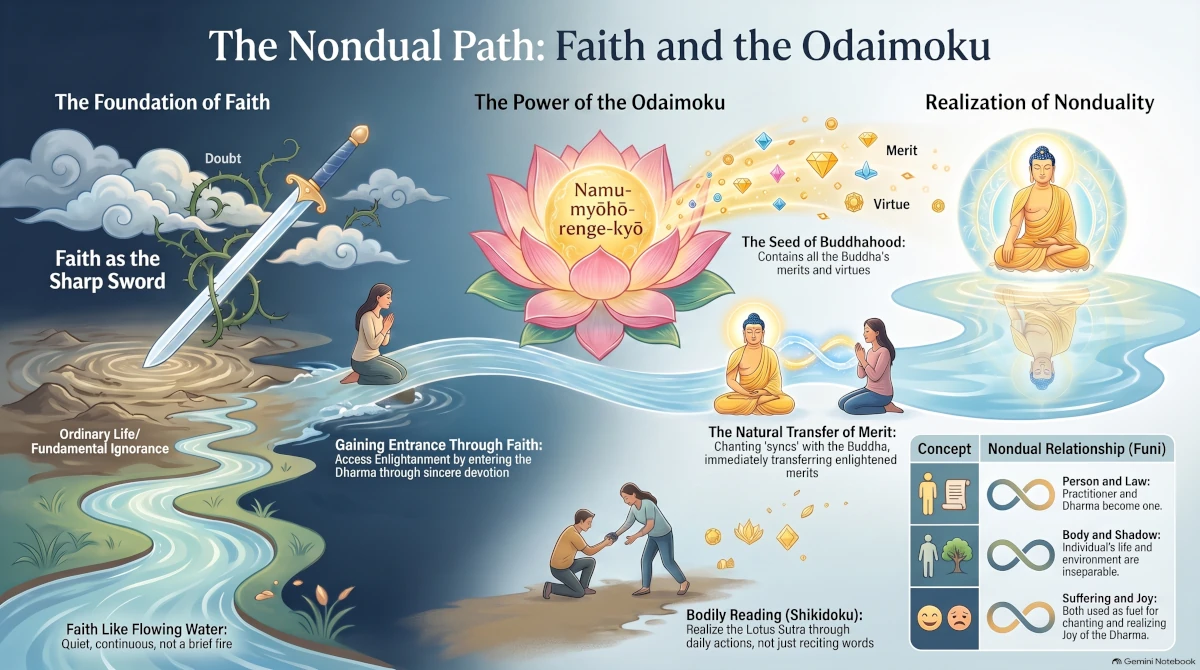
Nichiren’s nondual framework completely inverts this path to “proceeding from effect to cause” (jūka kōin). Because Śākyamuni Buddha’s eon-spanning causal practices and resulting virtues are perfectly encapsulated within the five characters myō-hō-ren-ge-kyō, the moment you take faith in the Daimoku, the Buddha “spontaneously transfers” the entirety of his merits directly to you.
Therefore, you do not practice in order to become a Buddha; you practice because you are a Buddha. Your daily chanting is not a grueling climb up a spiritual ladder; it is the dynamic, joyful outflow of the uncreated state of original enlightenment already operating within your life.
2. The Nonduality of the Mirror and the Act of Polishing
To reconcile this immediate nonduality with the demand for rigorous effort, you must examine Nichiren’s central metaphor of the tarnished mirror. Nichiren explains:
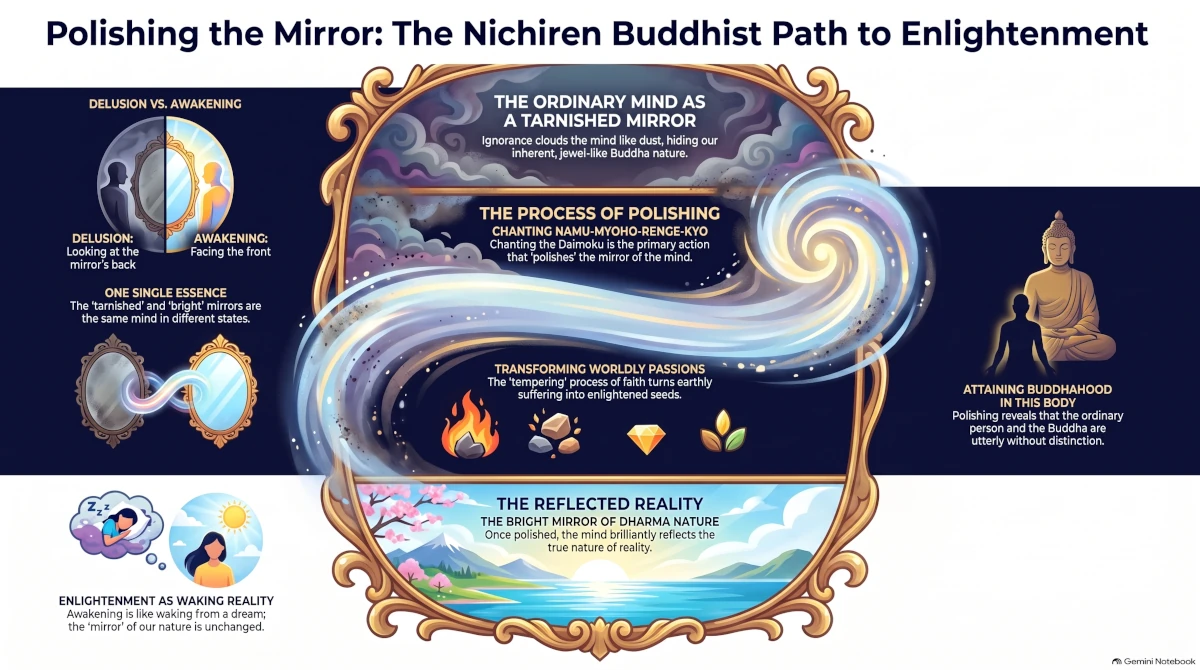
“While deluded, one is called an ordinary worldling, and when awakened, one is called a Buddha. To illustrate, even a tarnished mirror, when polished, will appear like a jewel.”
In this teaching, the unpolished mirror and the bright, jewel-like mirror are not two separate entities; they are the exact same mirror viewed from different sides. Ignorance is looking at the back of the mirror; enlightenment is looking directly into its front.
Crucially, the mirror does not need to be structurally altered or replaced; it simply must be turned and polished. Even though delusion and awakening are ontologically one, their distinction remains empirically real in your day-to-day experience. If you cease polishing, the dust of fundamental ignorance immediately accumulates, reversing your view to the back of the mirror. Thus, strict, daily “polishing” through chanting Namu-myōhō-renge-kyō is the precise mechanism by which you continuously align yourself with the “front” of the mirror.
3. The Indestructible Precept: Juji Soku Jikai
This nondual reconciliation is formally institutionalized in the doctrine of juji soku jikai (“upholding the Law is itself keeping the precepts”).
Traditional Buddhist paths rely on highly fragile “earthenware” monastic precepts, which are easily shattered by human error. In contrast, Nichiren reveals that by embracing and chanting the Daimoku with faith, you receive the Diamond Chalice Precept (Kongō-hōki-kai). Because this precept is absolute and carved from the indestructible reality of the Buddha’s own life, it is ontologically impossible to break, even if you should try.
Because your connection to the Dharma is permanently secured, the rigor of your practice is no longer a fearful, defensive effort to avoid violating moral rules. Instead, the practitioner is instructed to simplify their focus: dispense with the first five Paramitas and secondary disciplines, and devote your entire life to the single, concentrated practice of the Daimoku.
The strictness is shifted from external behavioral restriction to the internal intensity of your “resolve” (kokorozashi), which acts as the supreme, life-giving offering of your entire being to the Law.
4. “Bodily Reading” and Faith Like Flowing Water
Finally, this nondual alignment must be actively lived out in the crucible of the physical world. Nichiren calls this the “bodily reading” (shikidoku) of the Lotus Sutra. It is the total commitment to embody the scripture not just with your mind or voice, but with your physical actions.
Because you live in the chaotic, spiritually degraded reality of the Final Dharma age (mappō), maintaining this alignment is fundamentally a “difficult practice” that invites constant psychological and external challenges. To survive these trials without regressing, Nichiren instructs followers to avoid a brief, enthusiastic faith that resembles a blazing fire—which flares up brightly but quickly cools down when encountering adversity. Instead, your faith must resemble flowing water, which moves steadily, quietly, and continuously, day and night, never retreating or slacking.
Ultimately, this steady, water-like practice is woven directly into the fabric of your daily existence. Nichiren famously advised his followers that your secular work and daily labor are themselves the 24-hour practice of the Lotus Sutra.
Because the worldly law is the shadow cast by the body of the Buddha Dharma, there is no separation between sacred contemplation and everyday activity. Every challenge faced at home or in your profession becomes the very water in which the pure moon of your innate Buddhahood is brilliantly reflected.
In Nichiren Buddhism, enlightenment is not a static state of intellectual understanding, but a dynamic reality that must be continuously actualized through action. While provisional teachings often encourage passive contemplation or a reliance on distant, otherworldly salvations, Nichiren places supreme weight on a highly active, rigorous, and localized discipline. To understand the depth of this practice, one must look at how the mirror of the mind is maintained, how daily life is transformed into a sacred arena, and why true practice demands a steady, uninterrupted resolve.
1. The Metaphor of the Tarnished Mirror: “Polishing” the Mind
A central pillar of this teaching is that the potential for Buddhahood is not something external to be acquired, but a reality inherently present within every individual. To explain how this innate potential is revealed, Nichiren employs the famous metaphor of the tarnished mirror:
“While deluded, one is called an ordinary worldling, and when awakened, one is called a Buddha. To illustrate, even a tarnished mirror, when polished, will appear like a jewel.”
The human mind, when clouded by fundamental ignorance, is like an unpolished mirror. Crucially, the tarnished mirror and the bright, jewel-like mirror are not two separate objects; they are the exact same entity in different states. There is no need to discard your ordinary mind. Instead, you must diligently polish it morning and evening.
When practitioners ask how this polishing is practically achieved, Nichiren’s answer is absolute:
“Simply chanting Namu-myōhō-renge-kyō is what is called ‘polishing.’”
By focusing your voice and mind on the Odaimoku, you directly wipe away the dust of delusion and allow the bright mirror of your inherent Buddha-nature to shine forth.
2. The Inseparability of Practice, Study, and Faith
For a practitioner of the Lotus Sutra, spiritual progress relies upon the balanced cultivation of faith, practice, and study (learning). These elements are not separate pathways; they are deeply intertwined components of a single spiritual life. Nichiren writes:
“Strive to carry out the two ways of practice and learning. Without practice and learning Buddhism will cease to exist. Endeavor yourself and cause others to practice these two ways of practice and learning, which stem from faith.”
Study illuminates your understanding of the Buddha’s intent, preventing your practice from drifting into blind dogmatism or shallow custom. Practice, in turn, is the active expression of your study. Without this dual commitment, faith cannot grow. Even if you can only share a single word or phrase with others, you are encouraged to actively teach and study to keep the living spirit of the Dharma alive.
3. Strict Diligence: Integrating Faith into Daily Works
Nichiren’s view of practice is famously rigorous. In his letter to Lord Toki (Tokidono Gosho), he urges followers to maintain an unwavering focus on their ultimate spiritual potential:
“Nichiren’s followers must strive to attain Buddhahood by shortening sleeping hours and by cutting the time for rest. If not, you will repent forever.”
This intensity reflects the understanding that while people routinely undergo immense hardships, make sacrifices, and lose sleep to achieve transient, worldly goals—such as passing examinations or securing business profits—the true, eternal goal of perfecting your character deserves far greater dedication.
However, this strictness does not mean turning away from the secular world to live in monastic isolation. Nichiren teaches that faith must be actively manifested in your daily work, your home, and your society. He famously advised Shijō Kingo that “the service to your lord itself is practicing the teaching of the Lotus Sutra twenty-four hours a day.”
Your profession, your family responsibilities, and your interactions with others are the very mirror reflecting your inner life and spiritual polish.
4. Upholding the “Difficult Practice” Like Flowing Water
Although chanting the Odaimoku is outwardly simple enough for anyone to perform, Nichiren strictly categorizes it as a “difficult practice.” He notes:
“To receive the Lotus Sutra is easy; to uphold it is difficult. But the realization of buddhahood lies in upholding it.”
Human nature is volatile and easily swayed by changing circumstances. It is easy to arouse a temporary, highly enthusiastic faith when first encountering the Dharma, but such a stance is like fire—it flares up brightly but is quickly extinguished when major obstacles or intellectual doubts arise. Instead, Nichiren advises Lord Matsuno to maintain a constant faith resembling flowing water. Water flows quietly, steadily, and continuously, day and night, never retreating or slackening no matter what obstacles block its path. To practice in this way is to possess a stout heart. It means refusing to compromise your devotion to the true teaching, actively rebuking error through the confrontational practice of shakubuku to protect the integrity of the Dharma, and remaining completely unmoved like a mountain of gold when facing the storms of life. By dedicating your voice, body, and mind to this continuous effort, the simple act of chanting is transformed into the most profound, direct path to supreme awakening.
Build a comparative chart contrasting the stages of the traditional “works-based” path (the six paramitas and monastic precepts) with the nondual “faith-based” model of juji soku jikai.
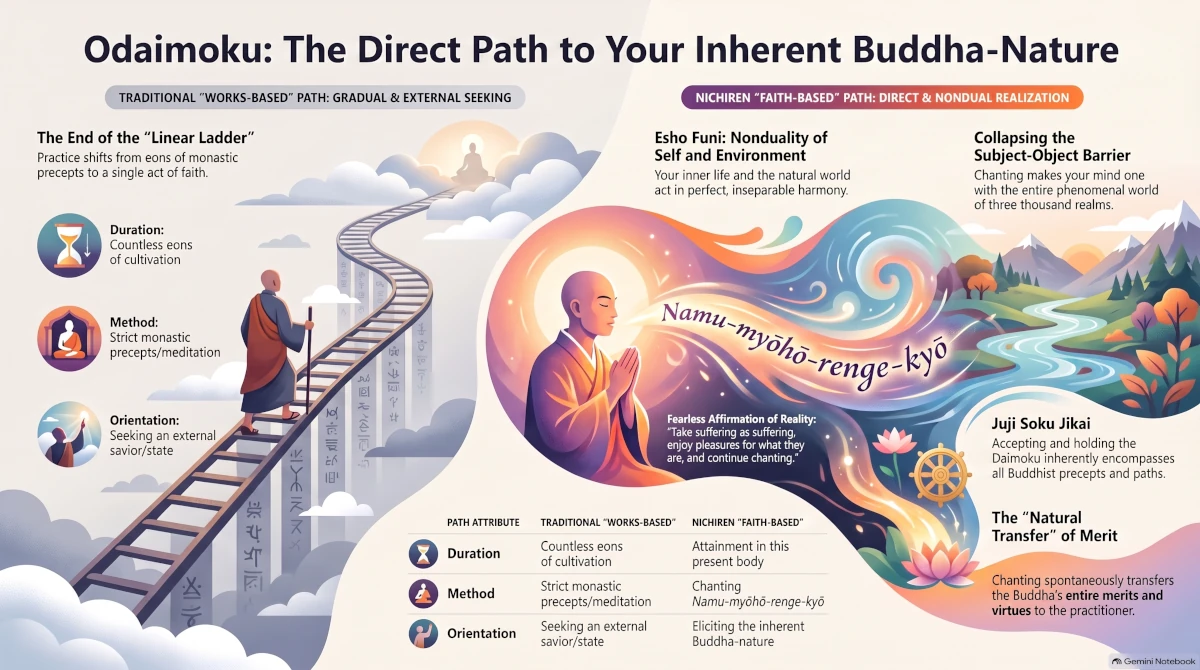
To fully visualize the profound theological shift from a gradual, “works-based” path to the immediate, “faith-based” nonduality of Nichiren Buddhism, it is helpful to look at how the entire structure of Buddhist practice is transformed. Traditional Buddhist paths present a linear journey of self-purification, where you must slowly climb a ladder of virtues across countless lifetimes to reach enlightenment. In contrast, Nichiren’s teachings collapse this distance entirely, revealing that the ultimate fruit of Buddhahood is fully present and immediately accessible in your very first step of faith.
The following comparative chart contrasts these two paradigms across their core doctrinal dimensions:
Theological Dimension
Traditional “Works-Based” Path (Gradual / Provisional Teachings)
Nondual “Faith-Based” Path (Juji Soku Jikai / Original Gate)
Philosophical Orientation
Linear Progression (Cause-to-Effect / Jūin Shika): Delusion and enlightenment are treated as separate, sequential states. Practitioners must systematically eradicate delusions and cultivate virtues before they can enter the Buddha realm.
Simultaneity & Nonduality (Effect-to-Cause / Jūka Kōin): Delusion and enlightenment are fundamentally nondual (funi). The complete, uncreated enlightenment of the Buddha is immediately accessed and manifested within your ordinary life in the moment of practice.
Soteriological Timeframe
Eon-Spanning (Asamkhyeya Kalpas): Achieving awakening requires countless lifetimes of difficult, painful, and self-sacrificial practices to slowly accumulate merit and purify the mind.
Immediate Awakening (Sokushin Jōbutsu): The infinite eons of linear cultivation are completely collapsed. You can realize Buddhahood with your very body, in this present lifetime, through a single moment of faith.
The Nature of Precepts
Earthen Vessel Precepts (Goki-kai): Composed of hundreds of specific prohibitive rules (e.g., 250 for monks, 500 for nuns) that regulate external behaviors. Highly fragile; if violated or broken, the precept-body is shattered and lost.
Diamond Chalice Precept (Kongō-hōki-kai): A singular, absolute, and internal precept that directly aligns with your inherent Buddha-nature. It is indestructible; once embraced, it can never be broken or lost, even if you should try.
Mechanics of Practice
Individual Effort (Jiriki): Relying on personal meditative discipline, strict monastic boundaries, and the step-by-step mastery of the Six Paramitas (generosity, morality, patience, effort, meditation, wisdom).
Natural Transfer of Merit (Tariki within Jiriki): Śākyamuni Buddha’s infinite causal practices and resulting merits are fully contained in the Daimoku (Namu-myōhō-renge-kyō). Chanting with faith naturally transfers these merits to you.
The Three Trainings (San-gaku)
Monastic Disciplines: Morality (Śīla), Meditation (Samādhi), and Wisdom (Prajñā) are practiced as separate, sequential fields of study and behavior.
Three Great Secret Laws (Sandai Hihō): The Three Trainings are perfectly concentrated and simultaneously completed in the Kaidan (Morality), the Honzon (Meditation), and the Daimoku (Wisdom).
Stage of Attainment
Ultimate Identity (Kukyō-soku): Buddhahood is treated as a distant, future goal achieved only at the final, fifty-second stage of the spiritual path.
Verbal Identity (Myōji-soku): Buddhahood is fully entered and manifested at the very first step of practice, where you take faith upon hearing the names and letters of the True Dharma.
Primary Pedagogical Metaphor
The Arduous Ascent: Climbing a steep mountain, or clearing and preparing a field through grueling labor in the spring to eventually reap a future harvest.
The Blue Fly on the Swift Horse: A tiny, fragile fly travels ten thousand miles effortlessly by clinging to the tail of a swift horse—analogous to your faith clinging to the completed power of the Daimoku.
Deeper Doctrinal Insights into the Shift
Consider how three of these dimensions redefine the relationship between the practitioner and the Buddha:
1. From Progressive Precepts to the Indestructible Vessel
In traditional monastic Buddhism, keeping the precepts is akin to maintaining a highly fragile clay pot (an “Earthen Vessel”. If you commit a major offense, the vessel shatters, and you must begin the arduous process of rebuilding your moral standing from scratch.
The Diamond Chalice Precept entirely bypasses this precarious behavioral regulation. Nichiren explains that because the Daimoku is the absolute essence of the Buddha’s life, when you accept and hold Namu-myōhō-renge-kyō, you receive a precept-body that is indestructible. Even if you should make mistakes, stumble, or fail, the diamond does not turn into clay; every broken shard of a diamond remains pure diamond. The essential connection to your innate Buddhahood is never severed.
2. The Power of “Natural Transfer” (Juji Soku Jikai)
Traditional Mahayana teachings demand that a bodhisattva master the Six Pāramitās over three immeasurable eons (asamkhyeya kalpas) to earn the merit required for Buddhahood. In the Latter Day of the Law (Mappō, attempting such a complex and grueling path is unsuited to the capacity of ordinary people.
Through the doctrine of juji soku jikai (“upholding the Dharma is itself keeping the precepts”), Nichiren reveals that Śākyamuni Buddha performed all of those eon-spanning causal practices and attained their resulting virtues on your behalf. He then encapsulated those completed merits entirely within the five characters myō-hō-ren-ge-kyō. When you embrace the Daimoku with faith, the Buddha “spontaneously transfers” the entirety of his merits directly to you. You do not have to perform the causal works because you are riding upon the completed “effect” of the Buddha.
3. Collapsing the Stages of Practice at the Beginning
In traditional Tiantai scholasticism, the path to enlightenment is divided into the Six Identities (roku-soku). The second stage, Verbal Identity (myōji-soku), is merely the intellectual beginning of the path, where you first hear the name of the Dharma. You are expected to spend lifetimes progressing through the subsequent stages of meditation and purification before reaching Ultimate Identity (kukyō-soku).
Nichiren’s “faith-based” model collapses this sequence. Because the names and letters of the Lotus Sutra are the direct voice and mind of the Buddha, the moment you take faith and vocalize the Daimoku, the ultimate fruit of Buddhahood is fully realized then and there. As Nichiren beautifully asserts: “Faith is the cause for wisdom and represents the stage of verbal identity… The single word ‘faith’ is defined as the seed of wondrous enlightenment.”
By chanting Namu-myōhō-renge-kyō, you are not acting in order to become a Buddha; rather, your practice is an active, joyful outflow of the Buddhahood already operating.
In considering that Nichiren revealed that we do not need to walk the long, eon-spanning path of gradual self-cultivation because the Buddha has already completed that arduous journey for us, is Nichiren Buddhism a “faith-based” rather then a “works-based” practice?
Chanting the Odaimoku is not a simple, passive recitation, but rather a profound gateway to realizing your own inherent Buddha-nature.
1. Adopting the Buddha’s Stance Toward the World
In traditional paths, a vast gulf is presumed to exist between the ordinary, deluded person and the fully awakened Buddha. However, Nichiren’s teachings radically collapse this subject-object barrier. In the act of chanting the Odaimoku, your mind (a single thought-moment) becomes one with the entire phenomenal world (the three thousand realms). Rather than seeking an external savior, you are directly eliciting the Buddha of original enlightenment that is already present within your own mind.
As the writing Myōhō-ama Gozen Gohenji beautifully states: “The person who chants Namu-myōhō-renge-kyō is a Buddha. His body is the dharma-body of the Buddha; his mind, the reward-body of the Buddha; and his behavior, the manifestation-body of the Buddha.” This nonduality of the self and the environment (eshō funi) means that when you chant, the natural world and your inner state of life act in perfect harmony. In Nichiren’s nondual hermeneutic, “the moon is the mind, the flower is the mind.” Consequently, you are empowered to face the world with the Buddha’s own unshakable stance.
This is not a state of world-denial or escape, but rather a total, fearless affirmation of reality. In your daily life, you are encouraged to embrace Nichiren’s famous instruction to Shijō Kingo:
“Take suffering as suffering, enjoy pleasures for what they are, and whether in suffering or joy, continue chanting Namu-myōhō-renge-kyō.”
This is the ultimate stance of the Buddha. It provides you with an inner ground that transcends the world’s fluctuations while allowing you to remain deeply active within it—participating in all of life’s pleasures and sorrows, involved but completely unfettered.
2. A “Faith-Based” vs. “Works-Based” Practice
There is indeed a sense in which this is a profoundly “faith-based” practice rather than a “works-based” one. In traditional “works-based” Buddhism, the path is viewed as a linear journey of gradual self-cultivation over countless eons. To attain enlightenment, a practitioner was expected to strictly observe hundreds of monastic precepts, engage in highly advanced silent meditations, and slowly eradicate all defilements. But for practitioners in the Latter Day of the Law (mappō), who lack the capacity for such arduous undertakings, this linear ladder is completely collapsed.
Nichiren formulated the landmark doctrine of juji soku jikai—the realization that the single act of accepting and holding the Daimoku inherently encompasses the keeping of all Buddhist precepts and the performance of all Buddhist paths. The theological foundation for this is the concept of “natural transfer.” Because Śākyamuni Buddha completed the arduous journey of causal practices over countless lifetimes, all of his causes and effects are perfectly encompassed within the five characters myō-hō-ren-ge-kyō. When you embrace and chant this phrase with faith, the Buddha spontaneously transfers to you the entirety of his merits and virtues.
Thus, the entire path of awakening is accessed through the single key of faith. As the Nirvana Sutra declares, “There are many causes of attaining Buddhahood; faith, however, is all-inclusive.” By taking faith in the Odaimoku, you enter the stage of “verbal identity” (myōji-soku), where the initial step of believing is recognized as fully containing the ultimate fruit of Buddhahood.
I have a Gemini Notebook notebook devoted to Nichiren and his teachings. I asked that notebook to provide a deep dive into the principle of eshō funi, from its origins to its impact on Nichiren’s teachings. I then took this to Gemini and asked it to convert this deep dive into a blog post by a Nichiren Shu scholar priest.
Oneness_of_Life_and_Environment
As a Nichiren Shu scholar priest, one of the most profound and applicable concepts I share with my Sangha is Eshō funi (依正不二). This profound Buddhist principle translates to the “nonduality of primary and dependent karmic recompense,” asserting the fundamental inseparability of the living subject and their objective environment.
The Origins of Our Connection to the Cosmos
To understand this teaching, we must look at its philosophical roots in the Chinese Tiantai tradition. It traces back to the Tiantai patriarch Zhiyi (538–597) and his architectonic model of reality known as ichinen sanzen (three thousand realms in a single thought-moment). This framework posits that our mind and the entire cosmos are mutually encompassing, meaning the living being and the insentient “container world” we inhabit cannot be separated. The specific formulation of this concept as the “nonduality of primary and dependent recompense” was fully elaborated by the sixth Tiantai patriarch, Zhanran (711–782), as one of the “ten nondualities”.
Primary and Dependent Recompense
To understand this framework, we must look at how karma is believed to operate:
Primary Recompense (shōhō): The cumulative effects of an individual’s past and present deeds (karma) manifest internally as the physical and mental aggregates that compose the living subject.
Dependent Recompense (ehō): Those exact same deeds simultaneously manifest externally as the individual’s specific environment, or the “container world” upon which they depend.
Nichiren beautifully likened this inextricable bond between the individual and the environment to that of a body and its shadow. Just as a shadow cannot exist without a physical substance, the dependent environment cannot exist independently of the principal living beings who inhabit it.
Nichiren’s Application of Eshō Funi
While previous Tiantai scholars largely treated eshō funi as an abstract object for inner contemplation, Nichiren radically insisted that this principle could be used to physically and objectively transform the outer world. This principle heavily impacted his teachings in three core ways:
1. The Subjective Experience of the Pure Land
Because the environment acts as a mirror reflecting the internal life-condition of its inhabitants, individuals perceive their surroundings entirely differently based on their state of awakening. A person in the realm of hell will experience the world as a hellish place of suffering, whereas a fully awakened person experiences the exact same physical space as a buddha realm. Nichiren declared that there are not two separate lands—one pure and one impure; rather, the distinction depends entirely on the good or evil within people’s minds. Therefore, by chanting the Odaimoku (Namu-Myōhō-renge-kyō), practitioners unify their own bodies and minds with the ultimate truth, instantly realizing the Pure Land wherever they currently reside.
2. The Root Cause of Worldly Calamities
During Nichiren’s lifetime, Japan was ravaged by famines, earthquakes, epidemics, and the looming threat of Mongol invasion. Viewing these crises through the lens of eshō funi, Nichiren concluded that natural and social disasters were not random, but were the direct environmental (dependent) recompense for the spiritual corruption (primary recompense) of the people. He argued that widespread “slander of the Dharma”—specifically, the rejection of the Lotus Sutra in favor of provisional teachings—had defiled the minds of the populace. When the minds and five sense organs of living beings are distorted by false teachings, it is inevitable that the earth trembles, mountains crumble, and rivers dry up.
3. Actualizing the Buddha Land (Risshō Ankoku)
The core thesis of his famous 1260 treatise, Risshō ankoku ron (Establishing the Correct Dharma and Bringing Peace to the Country), is that if the people and the ruler would abandon inferior teachings and embrace exclusive faith in the Lotus Sutra, the resulting inner purification of the populace would physically manifest as a utopian society. Nichiren prophesied that through collective chanting, the phenomenal world would be transformed into an indestructible treasure realm where harmony with nature is restored—meaning “the wind will not thrash the branches nor the rain fall hard enough to break clods”—and the people would enjoy longevity, peace, and security in their present lives.
Our Social Responsibility
Ultimately, eshō funi elevated Nichiren’s religious mission from a quest for personal enlightenment into a profound social responsibility. Because the self and the outer world are completely nondual, privately embracing or rejecting the Lotus Sutra had massive public consequences, making the aggressive propagation of the Dharma (shakubuku) the only viable way to save the nation. Let us continue to chant Namu-Myōhō-renge-kyō and reflect on our profound connection to the world around us.
I have a Gemini Notebook devoted to sources related to the Lotus Sutra and one related to Nichiren and his teachings. I asked each of these to explain the origin of the idea that this Saha world is the Buddha Śākyamuni’s Pure Land. In the Nichiren notebook I asked it also to explain Nichiren’s teachings on the subject. I then took the two documents generated by NotebookLM and asked Gemini to combine them into a blog post written by an ardent follower of Nichiren who seeks to inspire others to chant Namu-Myoho-Renge-Kyo. I’ve made some minor changes in Gemini’s blog post – changing Daishonin to Shonin and removing a reference to Human Revolution. I’m still not over my years of Soka Gakkai.
Awakening the Saha World Through the Power of the Daimoku
Have you ever felt completely overwhelmed by the chaos, pain, and instability of our modern world? Have you ever found yourself wishing to escape to a distant, peaceful paradise far away from the struggles of daily life?
It is completely natural to look around at our environment and feel a sense of weariness. We live in what Buddhism terms the Saha world—a realm defined literally as the “world of endurance and suffering.” Every day, we face trials, anxieties, and the harsh realities of human existence. But today, I want to share with you a revolutionary, life-altering truth that comes directly from the heart of the Lotus Sutra and the profound teachings of Nichiren Shonin: This very world, with all its turmoil, is not a place to escape from. It is, in its ultimate, hidden reality, the Eternal Buddha’s Pure Land.
You do not need to wait until after death to find peace in a distant paradise. By placing your absolute faith in the Lotus Sutra and chanting Namu-Myoho-Renge-Kyo, you hold the key to unveiling this pure, indestructible reality right where you are standing.
The Scriptural Revelation: Unveiling the Eternal Land
To understand the magnitude of this truth, we must journey back into the visionary canvas of the Lotus Sutra. The deep-rooted misconception of medieval times—and even today—is that a “Pure Land” is a separate, celestial planet far removed from our gritty reality. The Lotus Sutra completely shatters this dualistic view through two monumental scenes.
First, in Chapter 11, “The Emergence of the Treasure Tower,” a magnificent jeweled stupa floats in midair. To make room for the countless replica Buddhas summoned from across the cosmos, Sakyamuni Buddha magically purifies the Saha world not once, but three distinct times. In that mystical moment, the ground transforms into absolute purity, paved with lapis lazuli, bordered by golden cords, and shaded by exquisite jeweled trees. This stunning transformation birthed the core doctrine that the Saha World is identical with the Pure Land of Tranquil Light.
Second, this imagery moves from a temporary vision to an eternal reality in Chapter 16, “The Lifetime of the Tathagata”. Here, Sakyamuni Buddha delivers a paradigm-shifting revelation. He explains that he did not attain enlightenment for the first time under the bodhi tree in India; rather, he has been a fully awakened Buddha since the inconceivably remote and infinite past. Consequently, he makes an astounding declaration: “I have always been here in this sahā world, preaching the Dharma, and teaching and converting.”
The Buddha never left us. He further explains that even when deluded living beings look out and perceive the world ending, consumed by a catastrophic fire at the close of an eon, his land remains perfectly safe, tranquil, and filled with heavenly beings, beautiful gardens, and jeweled trees. This teaches us a fundamental lesson: the pure land is not a distant geographic location. It is this very world, seen through the clear, unclouded eyes of an awakened Buddha.
The Philosophical Framework: Later Buddhist thinkers, particularly the Chinese patriarch Tiantai Zhiyi, formalized these visions into the doctrine of ichinen sanzen (three thousand realms in a single thought-moment). Central to this is eshō funi—the absolute nonduality of the living subject and their environment. Your environment is a perfect mirror of your inner life-state.
Four Life-Changing Implications for Us Today
Nichiren Shonin took this profound philosophical legacy and radicalized it, turning it into a practical blueprint. When you embrace faith in the Lotus Sutra and dedicate your life to chanting Namu-Myoho-Renge-Kyo, your entire relationship with reality undergoes a massive shift. Here is what this means for your daily life:
1. A Resounding Rejection of Escapism
In Nichiren’s time, the popular Pure Land (Nembutsu) school taught people to loathe this corrupt, painful world, encouraging them to focus solely on chanting to be reborn after death in a distant “Western Paradise.” Nichiren vehemently opposed this otherworldly view, labeling it a dangerous form of escapism. He argued that to abandon our present world in search of another is to completely abandon the true domain of Sakyamuni Buddha.
As followers of Nichiren, we do not wish away our lives or hope for a peaceful afterlife. We stand tall in the face of our challenges. As Nichiren boldly wrote, “Why should one abandon this world and aspire to another land? The place where one who practices the Lotus Sutra dwells should be regarded as the pure land.” Your home, your office, your neighborhood—no matter how stressful—is the exact location of your enlightenment.
2. Finding Noble Value in Life’s Impurities
The Lotus Sutra does not look at the world through rose-colored glasses. It acknowledges that the Saha world contains “hellish conditions,” severe hardships, and deep suffering. Yet, incredibly, Chapter 15 of the sutra actively praises the Saha world precisely because of these difficulties!
Why? Because a smooth, painless environment cannot forge a Buddha. The suffering of this world is the ultimate training ground. The sutra extols the Bodhisattvas who make courageous efforts and endure hardships to practice the Dharma in this actual human world, identifying them as the true, authentic disciples of the Buddha. Every problem you face is fuel for your spiritual growth. When you chant through your pain, you are acting as an authentic disciple, transforming poison into medicine.
3. Activating the Power of the Mind to Mirror Purity
Because of the principle of eshō funi (the inseparability of person and environment), we recognize that there is no difference between a mundane world of suffering and a Pure Land. The only difference lies entirely within the human mind: is it deluded or is it awakened?
If our minds are defiled by anger, greed, and delusion, the land we experience will naturally appear defiled, hostile, and broken. But when we align our lives with the Lotus Sutra by chanting Namu-Myoho-Renge-Kyo, we purify our inner lives. Because the environment merely mirrors our inner state, an awakened mind will naturally experience and manifest its environment as an awakened, safe, and tranquil realm. Purity starts within you!
4. Actualizing and Physically Transforming Reality Here and Now
This is where Nichiren’s teaching becomes beautifully concrete and infinitely inspiring. He took the theoretical concepts of older schools and brought them down to earth. He taught that faith and the chanting of the Daimoku do not just offer a subjective, psychological shift in perspective. It possesses the objective, cosmic power to physically transform the outer world.
Nichiren prophesied that when the people of the world genuinely embrace the Lotus Sutra and chant Namu-Myoho-Renge-Kyo, this threefold world will literally become a Buddha land. He beautifully described a transformed world where “the wind will not thrash the branches nor the rain fall hard enough to break clods,” and where the people are profoundly protected from disasters and calamities. Spreading this faith is a sacred mission to physically alter the karma of our planet, establishing an ideal, stable Buddha-land out of our current troubled reality.
A Call to Action
Do not look to the sky for salvation. Do not wait for circumstances to change before you decide to be happy. The Land of Eternally Tranquil Light is right beneath your feet, waiting to be pulled into reality.
No matter how dark your current environment seems, you possess the ultimate spiritual power to revolutionize it. Wake up every morning, sit facing your dynamic purpose, and chant with the ferocity of a lion. Let your voice ring out with the sound of absolute victory Let us actively transform this Saha world, day by day, thought by thought, into the brilliant, jewel-encrusted Pure Land it was always meant to be!
Gemini Notebook was asked: Explain the origin, understanding and implementation of the Diamond Chalice Precept (Japanese: Kongō-hōki-kai). Below is a report generated from the sources Gemini Notebook identified. Ask questions of the sources here.
The_Diamond_Chalice_Precept_Guide-20260605
Conceptual Evolution: From Monastic Code to Ontological Realization
The historical trajectory of Japanese Buddhism is defined by a radical strategic shift from externalized monastic discipline ( śīla ) to an immanent, absolute vow of awakening.
In the early Nara period, the religious landscape was governed by the Dharmaguptaka Vinaya ( Shibun-ritsu ), which functioned not merely as a moral guide but as the foundational legal code for the Ritsuryō state.
This “provisional” system, requiring strict adherence to hundreds of behavioral prohibitions, served as the state-recognized basis for ordination and clerical legitimacy.
However, the transition to the Kongō-hōki-kai (Diamond Chalice Precept) represented an ontological revolution.
Authority was transferred from the external jurisdiction of the state and the monastic community to the internal, inherent nature of the practitioner.
This shift redefined the nature of karma and Buddha-nature ( Tathāgatagarbha ).
In the older paradigm, moral purity was a causal prerequisite—a state constructed through the incremental accumulation of behavioral corrections.
The new paradigm proposed that morality is an “ultimate” realization, an indestructible quality of the mind activated through faith rather than social regulation.
This transition from “behavioral prohibitions” to “ontological realization” fundamentally altered the practitioner’s relationship with the divine, suggesting that the “precept body” ( kaitai ) is an eternal, internal reality.
This doctrinal pivot was meticulously constructed through the hermeneutic reinterpretation of specific Chinese scriptures.
Philological Origins and the “Vessel” Hermeneutic
The construction of Japanese Buddhist identity relied heavily on the reception and commentary of the Brahma Net Sutra ( Fanwang jing ), a text now recognized by historians as a Chinese apocryphon composed around 420 CE.
Its emphasis on intentionality and the universal presence of Buddha-nature allowed it to eclipse the more rigid Indian Vinayas in the Japanese imagination.
Central to this development is a profound philological evolution: the transformation of Kumārajīva’s “radiant adamantine precepts” ( kōmyō kongō hōkai ) into the “Diamond Chalice Precept” ( Kongō-hōki-kai ).
This shift was precipitated by a notorious punctuation error in the Taishō version of the text, where Heian scholars parsed “radiant” ( kōmyō ) with the preceding sentence.
Seeking to resolve the resulting linguistic ambiguity, scholars turned to the Korean commentator Taehyeon and his Exposition of the Sūtra of Brahmā’s Net.
Taehyeon facilitated a transition from hōkai (宝戒 – “treasure precept”) to hōki (宝器 – “treasure vessel”).
This was not merely a cosmetic change; the “vessel” metaphor suggests an ontological container capable of holding the “seed of Buddhahood,” shifting the focus from the rule itself to the capacity of the practitioner’s life to house the absolute.
The Jurisprudential Nature of the Vajra in Taehyeon’s exegesis, the term vajra (adamant) identifies a substance with three specific jurisdictional qualities:
Hardness: It is an exceptionally hard substance, signifying the unyielding nature of the vow.
Support: It is uniquely capable of supporting and containing all forms of merit.
Protection: It dispels unwholesomeness and prevents spiritual attainments from slipping away or being “leaked.”
These philological roots provided the intellectual scaffolding for Saichō to dismantle the Nara establishment’s monopoly on ordination.
The Tendai Institutionalization and the Vessel Metaphor Framework
Saichō’s campaign to establish a “Perfect and Sudden” ordination platform ( Endon-kai ) on Mount Hiei was a calculated strike against the Nara monastic establishment’s legal authority.
By rejecting the Four-Part Vinaya as “provisional” and “Hinayana,” Saichō sought to institutionalize a system where spiritual authority was derived from the universal Bodhisattva path.
To validate this hierarchy, the Tendai lineage utilized a metallurgical metaphor framework, notably preserved in the Isshin Kongō Kaitai Hiketsu.
Precept Category
Material Metaphor
Theological Status
Efficacy (The “So What?” Factor)
Earthen Vessel Precept ( Goki-kai )
Clay / Earthenware
Provisional (Hinayana/Nikaya)
Limited capacity and fragile; a major violation “shatters” the kaitai, requiring legal expulsion.
Gold & Silver Vessel Precept ( Kinginki-kai )
Gold or Silver
Provisional Mahayana
Malleable and valuable; violations can be “melted down” and reshaped through repentance ( sange ).
Diamond Chalice Precept ( Kongō-hōki-kai )
Diamond / Adamant ( Vajra )
Absolute (Nyorai’s treasure precept: Nyorai no hōkai)
Indestructible: Even if the vessel is dropped, every fragment remains pure diamond. The connection to Buddhahood is never severed.
The strategic implication of the “Diamond” status was revolutionary for the practitioner: because the precept body was carved from the absolute, it was ontologically impossible to destroy.
Saichō’s successor, Annen, pushed this to a jurisprudential breaking point by arguing that because precepts are rooted in “dharma-nature,” they are inherently present in both good and evil.
This radicalization set the stage for the Hongaku (Original Enlightenment) debates, where the absolute was seen as so pervasive that external discipline risked being viewed as redundant.
Ontological Indestructibility: Zen Parallels and Hongaku Tensions
The concept of the “indestructible body” is a cornerstone of Mahayana thought, appearing prominently in Zen exegesis.
Zen masters describe the vajra-body of Buddha-nature as imperceptible and formless, yet possessing infinite function.
This aligns with Bodhidharma’s “beholding the mind” ( kanjin ), which spiritualizes discipline as an internal mechanism to overcome the three poisons rather than an external set of rules.
This internal state is clarified by the Nirvana Sutra’s sun and cloud metaphor: the Sun (Buddha-nature/Precept-body) is always radiant, while the Clouds (delusions) only temporarily obscure it.
The “So What?” of this metaphor is a radical “impossible violation” logic: if the Sun is never destroyed by the clouds, then the precept-body is never truly broken by immoral behavior.
This creates a severe theological tension; the Hongaku Shisō (Original Enlightenment) doctrine risked descending into moral laxity.
If one is already a Buddha, the necessity of ethical training vanishes.
This crisis forced a refinement of the doctrine, leading Nichiren to transform the passive ontological state into an active, relational commitment.
Nichiren’s Synthesis: Upholding the Dharma as Supreme Discipline
In the “Latter Day of the Law” ( Mappō ), an era of perceived spiritual and social collapse, Nichiren argued that the capacity for traditional monastic discipline had completely vanished.
He proposed a new “moral technology”: the doctrine of juji soku jikai (“upholding the Dharma is itself keeping the precepts”).
This doctrine collapses the distinction between the internal state of the Buddha and the external action of the practitioner.
By embracing the Odaimoku, one receives the entirety of the Buddha’s merit in a single act of faith.
Nichiren famously noted that once this “wonderful precept” is embraced, the practitioner “cannot break it, even if he should try.”
The Diamond Chalice Precept is the engine within Nichiren’s Sandai Hihō (Three Great Secret Laws):
The Gohonzon: The object of devotion representing the Buddha Treasure.
The Daimoku: The practice of chanting, representing the Dharma Treasure.
The Kaidan: The Precept Platform, representing the Sangha Treasure.
Nichiren “democratized” the Kaidan. It was no longer a restricted imperial site; rather, any space where a believer chants before the Gohonzon becomes the supreme precept platform.
This localization made enlightenment accessible to the laity, transitioning the “Diamond” vow from a monastic secret to a universal reality.
Ritual Enactment and Sectarian Applications
The Gojukai (Acceptance of the Precepts) ceremony serves as the ritual bridge where abstract doctrine becomes lived experience.
Jurisprudential Comparison: Clerical and Lay Disciplines
Area of Discipline
Clerical Vows ( Sō-gyō )
Lay Householder Vows ( Zokō-gyō )
Aspiration
Seek and Guide Awakening: Vowed to make bodaishin the central life force and guide others.
Faith and Diligence: Vowed to maintain daily practice ( Gongyo ) within secular life.
Secular Ties
Metaphorical Renunciation: Priority of awakening over “householder ambitions.”
Integrative Compassion: Duties to family/society are lived as a Bodhisattva ideal.
Defense of Dharma
Active Doctrine Correction: Vowed to correct slanders and guide the sangha legally.
Protecting the Gohonzon: Vowed to revere the object of devotion as the enlightened life of the Buddha.
While Soto Zen retains a specific list of prohibitions to serve as a conscious moral compass, the Nichiren approach collapses all rules into the absolute state of faith.
The Diamond metaphor provides a psychological anchor of non-regression; the practitioner’s connection to the Dharma remains intact even amidst personal failures.
Metaphors of Perseverance and Final Theological Conclusions
To ensure resilience, Buddhist pedagogy employs vivid metaphors that shift the focus from human effort to cosmic power.
The Blue Fly and Swift Horse: A tiny fly travels ten thousand miles by clinging to the tail of a swift horse.
The jurisprudential takeaway is that the fly’s success is not due to its own “causal morality,” but to the “effect-based” power of the horse (the Gohonzon).
The Diamond is the horse.
The Mountain of Gold: Just as a mountain of gold shines brighter when a wild boar brushes against it, the practitioner’s resolve is refined by obstacles.
The transition from “causal morality” (acting to become a Buddha) to “effect-based morality” (acting as an outflow of awakening) fundamentally altered the spiritual landscape of Japan.
The Diamond Chalice Precept dismantled the barriers between the perfect monk and the flawed layperson, localizing the “indestructible reality” in the life of every practitioner.
The Kongō-hōki-kai stands as the ultimate existential pledge: a vow that is not merely kept, but one that is ontologically impossible to lose.
The Architecture of Reality: Unpacking the Ten Suchnesses in Nichiren Buddhism article created by Google’s Gemini from sources in two Gemini Notebook projects, briefly discussed the fact that Kumārajīva’s translation of the Lotus Sutra is the only translation that includes the 10 suchnesses. The 10 suchnesses are not in an earlier translation or in later versions of the Sanskrit. I asked Gemini Notebook to identify the theories of why this is so. Here’s what it found.
20260603-Decoding_the_Ten_Suchnesses
A Comparative Analysis of Textual Transmission and Translation Methodology
The presence of the “Ten Suchnesses” (Chinese: 十如是, shí rúshì ; Japanese: jūnyoze ) in Chapter 2, “Skillful Means” (方便品, Fangbian pin ), of Kumārajīva’s 406 CE Chinese translation of the Lotus Sutra ( Miaofa lianhua jing , T 262) represents one of the most intriguing and influential textual divergences in East Asian Buddhist history. While this list of ten ontological factors serves as the doctrinal cornerstone for the Tiantai (Tendai) and Nichiren schools of Buddhist thought, it is completely absent from all other surviving historical recensions of the text. Neither the earlier Chinese translation by Dharmarakṣa (286 CE, Zheng fahua jing , T 263), the classical Tibetan translation, nor any of the extant Sanskrit manuscripts discovered across Nepal, Gilgit, and Central Asia contain this specific tenfold list.
Instead, the Sanskrit recensions present a series of five relative-interrogative clauses repeated in a parallel, redundant sequence. To explain why Kumārajīva’s translation contains the Ten Suchnesses, contemporary Buddhist philology and textual criticism have advanced three primary, non-mutually exclusive hypotheses: the “triangular” translation theory of Jean-Noël Robert, Paul Groner and Jacqueline Stone’s hypothesis of conceptual cross-pollination from the concurrent translation of the Dazhidulun , and the Central Asian manuscript variant hypothesis supported by the historical testimony of Jñānagupta and Dharmagupta.
Philological Discrepancy: Sanskrit Clauses versus Kumārajīva’s Tenfold Taxonomy
To comprehend the origin of the Ten Suchnesses, one must first analyze the structural and linguistic relationship between the Sanskrit original and Kumārajīva’s translation. The Sanskrit text of this crucial passage, as preserved in the standard Kern-Nanjio edition, consists of ten indirect questions divided into two parallel, redundant groups of five. These questions are framed using relative pronouns and adjectives ( ye , yathā , yādṛśās , yal-lakṣaṇās , yat-svabhāvās ) querying the ultimate reality ( dharmatā ) of all phenomena ( dharmāḥ ), asserting that only a Buddha ( tathāgata ) can exhaustively know and teach them.
The following table contrasts the Sanskrit interrogative structures with the translations of Dharmarakṣa and Kumārajīva, showcasing how a series of fluid Sanskrit questions was crystallized into distinct ontological categories in Chinese.
Sanskrit Syntactic Elements (Two Groups of Five)
Sanskrit Grammatical and Semantic Value
Dharmarakṣa’s Sixfold Translation (286 CE)
Kumārajīva’s Ten Suchnesses (406 CE)
First Group:
1. ye ca te dharmāḥ
What those dharmas are
1. What they return to (歸)
1. Suchlike Appearance (如是相)
2. yathā ca te dharmāḥ
In what manner/way they are
2. What they practice (行)
2. Suchlike Nature (如是性)
3. yādṛśāś ca te dharmāḥ
Like what those dharmas are
3. What they resemble (貌)
3. Suchlike Entity/Substance (如是體)
4. yal-lakṣaṇāś ca te dharmāḥ
Of what nature/marks they are
4. Their characteristics (體/相)
4. Suchlike Power/Potency (如是力)
5. yat-svabhāvāś ca te dharmāḥ
Of what characteristics/own-being they are
5. Their essence/nature (性)
5. Suchlike Function/Activity (如是作)
Second Group:
6. ye ca
What [those dharmas] are
6. Their ultimate emptiness/reality
6. Suchlike Internal Cause (如如因)
7. yathā ca
In what manner/way they are
(Consolidated with above)
7. Suchlike Relation/Condition (如是緣)
8. yādṛśāś ca
Like what they are
(Consolidated with above)
8. Suchlike Latent Effect/Result (如是果)
9. yal-lakṣaṇāś ca
Of what characteristics/marks they are
(Consolidated with above)
9. Suchlike Manifest Effect/Retribution (如是報)
10. yat-svabhāvāś ca te dharmāḥ
Of what nature/own-being those dharmas are
(Consolidated with above)
10. Suchlike Consistency from Beginning to End (如是本末究竟等)
The Triangular Translation Hypothesis: The Work of Jean-Noël Robert
In his paper, On a Possible Origin of the “Ten Suchnesses” List in Kumārajīva’s Translation of the Lotus Sutra (2011), the French Buddhologist Jean-Noël Robert proposes a “trilateral” or “triangular” relationship to explain the origin of the ten factors. Robert argues that rather than translating directly and exclusively from his Sanskrit manuscript, Kumārajīva worked with a deep respect for, and systematic reliance upon, the older Chinese translation produced by Dharmarakṣa. Throughout his translation of the Lotus Sutra , Kumārajīva frequently used Dharmarakṣa’s text as a structural and lexicographical template, preserving sentence structures and grammatical patterns while making technical improvements or substituting words to align more closely with the Sanskrit original.
According to Robert’s analysis, Dharmarakṣa’s earlier translation of this passage utilized a primarily sixfold division based on a basic triad. Kumārajīva sought to “quadrate the circle” by adapting Dharmarakṣa’s sixfold structure to fit the tenfold structure of the Sanskrit text. He achieved this by expanding the categories into three independent terms and three semantic, logical couples, generating a highly symmetric and logically cohesive set of nine factors:
Three independent terms: Aspect or Appearance (相), Nature (性), and Substance or Entity (體).
Three semantic and logical couples (six terms total): Force and Function (力−作), Cause and Condition (因−緣), and Fruit and Retribution (果−報).
This systematic pairing resulted in nine terms mapped out from Dharmarakṣa’s base structure. However, because the Sanskrit original contained ten relative clauses due to its two parallel groups of five questions, Kumārajīva required a tenth factor to maintain numerical symmetry.
Robert demonstrates that the tenth suchness in Kumārajīva’s list—”complete consistency from beginning to end” ( benmo jiujing deng , 本末究竟等)—is grammatically and semantically distinct from the preceding nine. It does not represent an independent ontological category. Instead, it is an explanatory, scholastic gloss summing up the relationship between the two parallel groups of Sanskrit questions.
In the Sanskrit text, both sets of five questions end with the identical segment yat svabhāvāś ca te dharmā(ḥ) (“of what nature/own-being are the dharmas”). Kumārajīva interpreted this structural redundancy as an assertion of ultimate identity: that the primary “root” (本, ben ) aspects of reality (represented by the first group of factors) are entirely consistent with the derived “branch” (末, mo ) aspects of reality (represented by the second group of factors). By treating this concluding summary of syntactic redundancy as a tenth factor, Kumārajīva successfully rounded up his list to ten to match the Sanskrit structure while preserving and giving new life to Dharmarakṣa’s version.
Intertextual Cross-Pollination: The Dazhidulun and Scholastic Systematization
A second major explanation, advocated by scholars such as Paul Groner and Jacqueline Stone, focuses on the role of Kumārajīva’s broader translation corpus, specifically the monumental Dazhidulun ( The Great Perfection of Wisdom Treatise , T 1509). The Dazhidulun , traditionally attributed to Nāgārjuna, is a massive commentary on the Pañcaviṃśatisāhasrikā Prajñāpāramitā Sūtra. Remarkably, Kumārajīva and his translation assembly in Chang’an were translating the Dazhidulun during the exact same period they were working on the Lotus Sutra , completing both around 406 CE.
Groner and Stone suggest that Kumārajīva acted as a “master editor.” In this view, he prioritized the siddhānta (ultimate meaning) over literalism. The expansion of the Sanskrit relative clauses into the Ten Suchnesses was Kumārajīva’s own creative formulation, which was directly presaged by a passage in the Dazhidulun. The Dazhidulun contains a highly structured passage that discusses the ultimate reality of all dharmas using a ninefold categorization of existence. This ninefold list outlines the characteristics, nature, substance, powers, functions, causes, conditions, and effects of phenomena.
Because the Dazhidulun served as the definitive philosophical handbook for Kumārajīva’s workshop, the translators utilized its deeply analytical, Abhidharma-style vocabulary to make sense of the poetic and repetitive Sanskrit questions in the Lotus Sutra. This parallel translation environment allowed the conceptual vocabulary of the Dazhidulun to cross-pollinate the Lotus Sutra translation. By importing these nine analytical categories and appending a summarizing tenth clause to match the tenfold Sanskrit syntax, Kumārajīva transformed a fluid, apophatic Sanskrit inquiry into a systematic, kataphatic taxonomy of Chinese Buddhist ontology.
The Central Asian Manuscript Recension Hypothesis
A third explanation centers on historical and geographical manuscript variations. In the preface to the Tianpin Miaofa Lianhua Jing ( Miraculous Dharma Lotus Flower Sutra with Supplements , T 0264), translated in 601–602 CE, the translators Jñānagupta and Dharmagupta document crucial information regarding the Sanskrit sources used by their predecessors. They note that while Dharmarakṣa’s 286 CE translation was based on an Indic palm-leaf manuscript, Kumārajīva’s 406 CE translation was based on a Sanskrit manuscript discovered in the Serindian kingdom of Kucha, Kumārajīva’s own homeland along the Northern Silk Road.
This historical testimony suggests that the discrepancy might not be an active invention by Kumārajīva, but rather a faithful rendering of a distinct Central Asian (Western Serindian) manuscript recension. Philological studies of Silk Road manuscripts demonstrate that the Saddharmapuṇḍarīka Sūtra underwent successive stages of development and regional modification. Central Asian Sanskrit fragments, such as those written in Central Asian Brahmi scripts, frequently exhibit substantial variations, expansions, and interpolations when compared to the later Nepalese manuscripts that form the basis of modern Western translations. It is entirely plausible that Kumārajīva’s Kuchean manuscript contained an expanded Sanskrit list that had already systematized the five redundant questions into ten distinct categories, reflecting a local Central Asian scholastic development. However, the total absence of the ten factors in the broader Indo-Tibetan tradition suggests that if such a manuscript existed, it was a regional rarity rather than the mainstream Sanskrit standard.
Hermeneutical Trajectory and Doctrinal Legacy
Regardless of its exact philological origin, Kumārajīva’s formulation of the Ten Suchnesses fundamentally reshaped the course of East Asian Buddhist philosophy. In the original Sanskrit, the passage in Chapter 2 emphasizes the absolute unknowability and transcendence of the ultimate reality of all dharmas, asserting that only a Buddha can grasp it. Kumārajīva’s translation, however, shifted the focus from transcendence to immanence. By defining the “true entity of all phenomena” ( zhufa shixiang ) through ten concrete, universal factors, his translation provided a systematic framework showing that the ultimate reality is actively present within every mundane phenomenon.
The initial hermeneutic breakthrough is credited to Huisi (515–577 CE), who recognized that the “Ten Suchnesses” facilitated a special reading where every element of experience is seen as simultaneously empty, provisional, and the middle. This allowed the sixth-century Chinese master Zhiyi to establish the foundational doctrine of the Tiantai school: “Three Thousand Realms in a Single Thought-Moment” (yinian sanqian, 一念三千). Zhiyi synthesized Kumārajīva’s Ten Suchnesses with the cosmological concept of the Ten Dharma Realms.
The mathematical and conceptual progression of this Tiantai meta-framework is highly structured:
The Ten Dharma Realms: Spanning from hell-dwellers, hungry ghosts, animals, asuras, humans, and devas, to śrāvakas, pratyekabuddhas, bodhisattvas, and Buddhas.
Mutual Inclusion (十界互具): Each of the Ten Realms inherently contains all of the other nine within itself, resulting in 10×10=100 states of existence.
The Ten Suchnesses: Each of these 100 states of existence possesses the Ten Suchnesses common to all life, yielding 100×10=1,000 factors.
The Three Realms of Existence: These 1,000 factors operate across three distinct environments (the realm of the five aggregates, the realm of sentient beings, and the physical environment), culminating in the 1,000×3=3,000 realms of existence.
Zhiyi argued that these 3,000 interpenetrating realms are simultaneously present, in either potential or active form, within a single moment of human consciousness (yinian).
Furthermore, the Tiantai tradition utilized the grammatical structure of Kumārajīva’s Chinese phrasing to develop the “Threefold Truth” (sandi, 三諦), which directly built upon the Madhyamaka philosophy of Nāgārjuna. By reading the Chinese characters of the suchnesses in three different ways, they illustrated the perfect interpenetration of reality:
Reading the text as “These their characteristics are such” ( shixing ru shi ) indicates the Truth of Emptiness ( kong ): all things are empty of permanent, independent existence.
Reading the text as “Their such-like characteristics” ( ru shi xiang ) indicates the Truth of Provisional Existence ( jia ): phenomena possess temporary, conventionally functional forms and distinctions.
Reading the text as “Their characteristics are like this” ( xiang ru shi ) indicates the Truth of the Middle Way ( zhong ): the absolute synthesis where phenomena are simultaneously empty and provisionally existent.
This sophisticated hermeneutical reading would have been impossible under the Sanskrit syntax, demonstrating how Kumārajīva’s unique translation choices provided the linguistic and philosophical foundation for the distinctively East Asian development of immanent Buddha-nature doctrines. In Nichiren Buddhism, this development culminated in the direct identification of the Ten Suchnesses with the active chanting of the daimoku ( Namu-myōhō-renge-kyō ), viewing the ten factors not as abstract categories, but as the dynamic, operational structure of the cosmos contained within the practitioner’s very breath.
In the Nichiren notebook I asked Gemini Notebook to explain the 10 suchnesses and explain how they are interpreted by Tiantai and Nichiren. In the Lotus Sutra notebook I asked Gemini Notebook to explain the 10 suchnesses from Chapter 2. Explain any commentary interpretations. Explain why the 10 suchnesses do not appear in the extant sanskrit versions of the Lotus Sutra. I took the two documents created in Gemini Notebook and uploaded them to Gemini. I then told Gemini: You are a scholar priest of the Nichiren Shu. You want to convey the fundamentals of Nichiren Buddhism to readers curious about the topic. Consider these readers an advanced, college-level audience. Combine these two documents into an extensive essay to be published on a Nichiren Shu website. I also asked Gemini to create an infographic for this essay that illustrates and explains the 10 suchnesses. The infographic and essay are below.
10-suchnesses-Infographic-20260531
Welcome, students and seekers. As we explore the intellectual and spiritual foundations of Nichiren Buddhism, we must look closely at how the Nichiren Shu tradition parses the fabric of reality itself. Central to this exploration is the concept of the jūnyoze, or the Ten Suchnesses (often translated as the “ten reality aspects”).
Originating in Chapter 2 of the Lotus Sutra—alternately titled the “Expedient Means” or “Skillful Means” chapter—the ten suchnesses are used by the Buddha to describe the “true entity of all phenomena” or the “true character of things.” According to the sutra, this ultimate reality is so profound that it can only be fully understood and shared among Buddhas. Yet, far from being a remote metaphysical abstraction, these ten universal characteristics constitute the “true aspect” of reality common to all beings, spanning from the denizens of hell to the Buddhas themselves. They form the definitive doctrinal basis for the Mahayana principle that all categories of beings interpenetrate.
Anatomy of Existence: Defining the Ten Factors
To understand how reality operates on a functional level, we must first examine the individual components of the ten suchnesses. As defined through the Nichiren Shu lineage and early commentators like Zhiyi (Chih-i), the founder of the Tiantai school, the ten factors map both the internal and external realities of any given phenomenon:
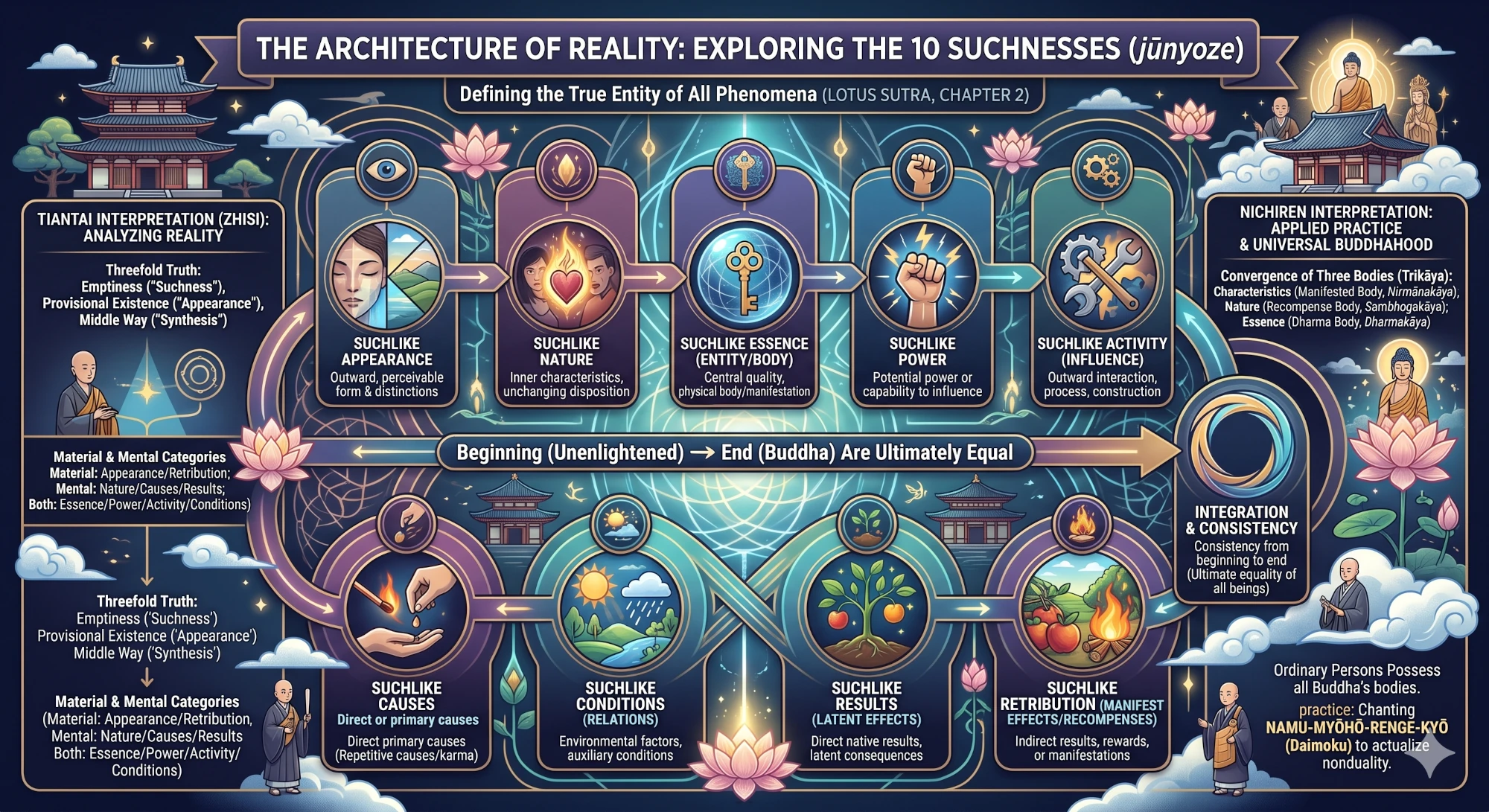
Suchlike Appearance (or Characteristics): The outward, perceivable forms and distinctions of a thing; that which is external and can be readily distinguished by sight.
Suchlike Nature: The internal, intrinsic, and unchanging characteristics or disposition dwelling quietly inside.
Suchlike Essence (or Entity/Body): The central quality or physical manifestation that constitutes the core of a thing.
Suchlike Power: The potential power, capability, or latent ability to exert an influence.
Suchlike Activity (or Influence): The outward interaction, behavior, or active process of construction.
Suchlike Causes: The direct or primary causes, which can be understood as repetitive causes or karma.
Suchlike Conditions (or Relations): The auxiliary, contributing, or environmental causes that act upon primary causes.
Suchlike Results (or Effects/Latent Effects): The direct or repetitive results produced natively by the primary causes.
Suchlike Retribution (or Recompenses/Manifest Effects): The indirect results, rewards, or retributive effects stemming from the unique combination of primary causes and environmental conditions.
Suchlike Beginning and End being ultimately the same (or Ultimate Equality from Beginning to End): The absolute integration, harmony, and consistency of the first nine factors, proving they all belong together and are ultimately equal from start to finish.
The Tiantai Meta-Framework: Categories and the Threefold Truth
The Tiantai Buddhist tradition places immense philosophical weight on this specific passage, utilizing the ten suchnesses as an analytical lens to explain the exact nature of reality. Zhiyi developed a highly structured hermeneutic by dividing these ten factors into material and mental dimensions, while mapping them directly to human existence:
Dimension of Reality
Associated Factors
Anthropological Significance
The Material Category
Appearance and Retribution
Indicates the individual’s body
The Mental Category
Nature, Causes, and Results
Indicates the individual’s mind
The Dual Category
Essence, Power, Activity, and Conditions
Indicates the totality of body and mind together
Furthermore, Tiantai philosophy applies the profound doctrine of the “Threefold Truth” to the phrasing of the text. By appropriately transposing the punctuation of the original Chinese text and reading the characters (nyoze) in three distinct “turnings,” Zhiyi demonstrated that all things simultaneously embody Emptiness, Provisional Existence, and the Middle Way:
The Truth of Emptiness (“Suchness”): Reading the text as “These their characteristics are such” indicates that all things are ultimately empty of permanent, independent existence.
The Truth of Provisional Existence: Reading it as “Their such-like characteristics” emphasizes that appearances are conventionally so-and-so, possessing temporary form, characteristics, and distinction.
The Truth of the Middle Way: Reading it as “Their characteristics are like this” reveals the synthesis where things are simultaneously empty and provisionally existent, displaying the true character of reality.
In traditional Tiantai thought, multiplying the ten realms of existence by their mutual possession and then by these ten universal suchnesses yields the “thousand suchnesses,” which serves as a core component of the totalistic worldview known as “three thousand realms in a single thought-moment” (ichinen sanzen).
Grounded Hermeneutics: The Factors in Everyday Life
While Tiantai metaphysics can feel abstract, the text fundamentally indicates that everything in existence possesses specific characteristics, a nature, a physical form, and operates on clear laws of cause and effect. As Rev. Shokai Kanai observes, we can easily see these ten factors playing out in everyday human interactions and physical phenomena:
“Consider a person you encounter: their immediate facial expression reveals their outward appearance, while their gentle or angry disposition represents their internal nature.
To look at cause and effect, imagine striking a match. The act of striking the match itself is the primary cause. However, whether you attempt to strike it in the open air or submerged under water represents the crucial environmental conditions. The harmony—or disharmony—of these conditions inevitably dictates whether fire (the effect or reward) is successfully brought into reality.”
The Nichiren Breakthrough: Universal Buddhahood and Practice
When we turn to the writings attributed to Nichiren Shonin, we find that he heavily expanded upon the intellectual scaffolding of Tiantai, infusing it with immediate soteriological urgency. Nichiren directly equated the ten suchnesses to the innate, unshakeable Buddhahood of the ordinary person.
The Convergence of the Three Bodies (Trikāya)
In a brilliant interpretive leap, Nichiren associated the first three suchnesses directly with the three bodies (trikāya) of the originally enlightened Buddha:
Characteristics corresponds to the manifested body (nirmānakāya), the truth of provisional existence, and the virtue of emancipation.
Nature corresponds to the recompense body (sambhogakāya), the truth of Emptiness, and the virtue of prajna (wisdom).
Essence corresponds to the Dharma body (dharmakāya), the truth of the Middle Way, and the essential Dharma nature.
By drawing these precise numerical correspondences, Nichiren’s thought radically denies any ontological or hierarchical distinction between the ordinary person and the Buddha. The texts assert that the three bodies of the Buddha are not distant, external entities; they exist nowhere else but within ourselves as our own immediate characteristics, nature, and essence.
Collapsing the Gap Between Ignorance and Enlightenment
To further emphasize this nonduality, Nichiren reinterpreted the tenth factor—ultimate equality from beginning to end. He posited that “beginning” represents the ten suchnesses of ordinary, unenlightened beings, while “end” represents the ten suchnesses of the fully awakened Buddhas. Their “ultimate equality” means that ordinary worldlings and the Buddha of supreme enlightenment are fundamentally identical and without distinction.
The Applied Practice: Recitation and the Daimoku
How do we actualize this realization? In terms of concrete practice, texts in the Nichiren corpus advocate a dual approach of liturgical recitation and contemplation:
The Liturgy: Practitioners are encouraged to recite the Lotus Sutra passage on the ten suchnesses three times while mindfully contemplating its threefold meaning (Emptiness, Provisional Existence, and the Middle Way). Through these three recitations, a practitioner can simultaneously realize the three truths and dynamically acquire the Buddha’s three bodies.
The Ultimate Realization: Ultimately, the Nichiren tradition equates the ten suchnesses directly with the chanting of the daimoku—Namu-myōhō-renge-kyō. The tradition asserts that all ten realms of existence and all ten suchnesses arise from a single moment of human consciousness and are perfectly, seamlessly encompassed within this single chanted title.
A Textual Enigma: The Sanskrit Discrepancy
It is vital to balance our devotional practice with historical awareness. Interestingly, the passage detailing the ten suchnesses does not appear in any existing Sanskrit manuscripts of the Lotus Sutra that survive today, such as those discovered in Nepal or Gilgit. The concept as we know it is entirely a product of Kumārajīva’s foundational Chinese translation of the text.
While contemporary scholars cannot definitively explain this discrepancy, we must recognize that surviving Sanskrit manuscripts are actually much more recent than the early Chinese translations. It is highly probable that the original Sanskrit texts Kumārajīva worked from have been completely lost to history. He may have been translating from a Sanskrit manuscript vastly different from those available to modern archeologists, or he may have translated the text very freely to elegantly convey these profound structural concepts to a Chinese audience.
Regardless of its manuscript lineage, Kumārajīva’s rendering provided the exact philosophical vocabulary required for East Asian Buddhism—and eventually Nichiren—to articulate the ultimate nonduality of our lives and the cosmos. When we chant Namu-myōhō-renge-kyō, we are activating the perfect harmony of the ten suchnesses inherent within our very breath.
In Gemini Notebook a report was generated to explain the basic 3,000 realms in a single thought moment and then show the difference between Zhiyi’s theory and the actuality created by Nichiren. This report was then taken to Gemini, where Gemini was directed to transform the report into a detailed essay suitable for publication of a Nichiren Shu website. Ask questions of these sources here.
20260530-The_Architecture_of_Awakening
For seekers of the Way, the Lotus Sutra has never been regarded as a mere historical artifact or static scriptural text. Rather, it is an interactive blueprint of the enlightened mind—a text to be “read not merely with the eyes, but with the very flesh and blood of one’s bodily life”.
To trace the lineage of this profound visual and philosophical framework is to look back upon a grand intellectual journey spanning centuries and borders. It begins with the intricate, multi-layered philosophical architecture of the Chinese Tiantai patriarch, Great Master Zhiyi (538–597). It then flows through the medieval Japanese discourses on Original Enlightenment (hongaku shisō). Finally, it finds its dynamic, concrete actualization in the prophetic realism of Nichiren Shonin (1222–1282).
This essay explores how the sublime metaphysics of ancient China evolved into a lived, immediate reality, transforming our regular world into the pristine Buddha Land.
1. Zhiyi and the Cosmic Matrix of Tiantai
At the absolute foundation of our philosophical tradition stands the Great Master Zhiyi, who systematically organized the vast corpus of Buddhist scriptures into a coherent, unified whole. Dissatisfied with the purely negative, deconstructive language (apophasis) found in some Indian Madhyamaka commentaries—which sought to describe reality only by what it was not—Zhiyi sought a more positive, affirmative articulation of ultimate truth.
He achieved this by expanding the traditional Mahayana model of the Two Truths into a dynamic, interconnected triad known as the Perfect Interfusion of the Three Truths (en’yū santai):
Emptiness (Ku): The realization that all phenomena are devoid of fixed, independent substance, existing only in a state of ontological ambiguity and fluid potential.
Provisional Positing (Ke): The recognition that despite lacking a permanent essence, things do exist conventionally, presenting themselves as temporary particulars bound by causes and conditions.
The Center or Middle Way (Chū): The simultaneous, inseparable awareness of both emptiness and provisional existence. Here, the universal and the particular are perfectly harmonized; the universal realizes its true nature in the particular, and the particular derives its meaning from the universal.
From this Threefold Truth, Zhiyi developed the crowning conceptual pillar of our school: Three Thousand Realms in a Single Thought-Moment (ichinen sanzen). This architectonic model asserts that our ordinary, fleeting mind at any given instant (ichinen) inherently contains and encompasses the entirety of the cosmos (sanzen).
This number is calculated by multiplying the Ten Worlds (the psychological and cosmological realms from Hell to Buddhahood) by their Mutual Possession (the reality that each world inherently contains the other nine), further multiplied by the Ten Suchnesses or structural factors of existence, and finally multiplied by the Three Realms of Existence:
The realm of the five aggregates (go’on seken).
The realm of living beings (shujō seken).
The realm of the environment or container world (kokudo seken).
Crucially, Zhiyi’s schema establishes that the living subject and the physical environment are fundamentally inseparable—a relationship known as the Non-duality of Primary and Dependent Recompense (eshō funi). Our surroundings are not a neutral, external stage; they are the literal shadow cast by our inner life-condition. When the mind reaches awakening, the environment itself must pervade the Dharma realm.
2. The Medieval Drift into Abstraction
As these profound doctrines traveled to Japan, they evolved into the pervasive scholastic discourse of Original Enlightenment Thought (hongaku hōmon) within the Tendai tradition. Hongaku doctrine radically inverted traditional linear paths of practice. Instead of treating Buddhahood as a distant destination to be reached through eons of merit accumulation and the systematic pruning away of defilements, it boldly asserted that all ordinary worldlings (bonbu) are fully realized Buddhas from the very outset. Radiant Buddhas with their extraordinary marks were relegated to mere provisional signs; the true Buddha was the ordinary person just as they are.
However, this absolute non-dual monism carried a dangerous, latent vulnerability: it risked slipping into a quietistic, uncritical affirmation of reality that undermined the necessity of concrete moral effort and religious practice. If an ordinary person is already identical to the ultimate reality prior to any cultivation, formal practice becomes superfluous, and the critical distinction between delusion and enlightenment is dangerously obscured.
Scholars within the traditional Tendai academies endlessly debated these points, but their realizations remained largely confined to intellectual exercises and secret oral initiations (kuden) shared among elite scholar-monks. It was a magnificent architecture of awakening, but it remained ri no ichinen sanzen—the three thousand realms as an abstract, theoretical principle.
3. Nichiren Shonin and the Shift to Actuality
This was the historical and institutional landscape that Nichiren Shonin confronted. Educated in the rich scholastic environment of Mount Hiei, Nichiren fully accepted the structural validity of ichinen sanzen and the Threefold Truth. Yet, living in a tumultuous era ravaged by earthquakes, famines, epidemics, and the terrifying specter of Mongol invasion, he recognized that an abstract philosophy could not save a desperate populace.
“When the priesthood in the Final Dharma age forgets the two great practical forces… and does nothing but preach sermons, then it becomes powerless to accomplish anything.”
Nichiren’s unique religious contribution lay in his demand for Actuality (ji). He lifted the ichinen sanzen principle out of the realm of theoretical speculation and anchored it firmly into the concrete domain of dynamic religious practice, establishing what we revere as ji no ichinen sanzen—the three thousand realms in concrete actuality.
To achieve this, Nichiren collapsed the traditional, long path of fifty-two progressive stages of bodhisattva practice into a singular, immediate point of entry: the stage of Verbal Identity (myōji-soku). This is the profound moment when an ordinary person first hears the words of the true teaching and arouses faith.
Nichiren asserted that all the unfathomable practices carried out by Shakyamuni Buddha since the remotest past (causes), and all the boundless wisdom and merits he gained in consequence (effects), are fully contained and wrapped within the five characters of the Holy Title: Myōhō-renge-kyō.
Traditional Path:
[Stage 1] ───> [Stage 2] ───> [Progressive Eons of Practice] ───> [Buddhahood]

Nichiren's Interventions (Mandalic Time):
[Myōji-soku (Verbal Identity / Faith)]
       │
       ▼ (Chanting Namu-Myōhō-renge-kyō)
[Simultaneity of Cause and Effect / Immediate Attainment]
When an ordinary person chants the Daimoku in the formula Namu-myōhō-renge-kyō, they are not striving to travel across time to reach a distant, external enlightenment. Instead, they open an immediate point of access where linear historical time intersects with the timeless, eternal realm of the primordial Buddha.
Through faith, the practitioner immediately receives the complete transfer of the Buddha’s merits, realizing the ultimate goal of “attaining Buddhahood in this very body” (sokushin jōbutsu) right in the midst of their ordinary, everyday life.
4. The Sacred Blueprint: Inscribing the Daimandara
The visual manifestation of this actualized reality is Nichiren Shonin’s calligraphic Great Mandala (Daimandara), universally revered across our lineages as the Gohonzon (the supreme object of worship).
Rather than relying on traditional anthropomorphic statues or multi-colored paintings that might encourage an ordinary viewer to perceive the Buddha as an external entity separate from their own life-essence, Nichiren chose to construct his mandala entirely out of written characters. In doing so, he preserved the absolute identity between the graphic icon and the sacred scriptural text of the Lotus Sutra.
Down the exact center of this sacred diagram, Nichiren inscribed the vertical axis of cosmic reality: Namu-myōhō-renge-kyō. Flanking this central mantra are the names of the two Buddhas, Shakyamuni and Many Treasures (Tahō), seated side by side within the floating Treasure Tower. This dynamic scene represents the perfect fusion of Objective Truth (kyō) and Subjective Wisdom (chi):
Many Treasures (Tahō) embodies the immutable, universally abiding principle of ultimate truth (kyō).
Shakyamuni represents the active, dynamic subjective wisdom (chi) that perceives and reveals that truth in human history.
                 [ Gohonzon Architecture ]

                      Tahō     Shakyamuni
                     (Truth)    (Wisdom)
                       │           │
                       ▼           ▼
               ┌───────────────────────────────┐
               │      NAMU-MYŌHŌ-RENGE-KYAO     │
               └───────────────────────────────┘
                               ▲
                               │
               ┌───────────────────────────────┐
               │    Four Leaders of Earth      │
               │   (Jōgyō, Anryūgyō, etc.)     │
               └───────────────────────────────┘
                               ▲
                               │
               ┌───────────────────────────────┐
               │ Representing All Ten Worlds   │
               │  (From Devadatta to Devas)    │
               └───────────────────────────────┘
Surrounding this central axis are the names of the four leaders of the Bodhisattvas of the Earth—headed by Jōgyō (Superior Conduct)—along with representatives of all ten realms of existence, including shifting cosmic forces, historic disciples, and even figures who traditionally epitomized deep delusion, like Devadatta.
Through the lens of ji no ichinen sanzen, none of these forces are banned or expunged. In the presence of the Central Law, every single realm is beautifully transfigured, anchored into place, and illuminated, revealing its true, enlightened nature as a necessary component of the cosmic whole.
When a follower of Nichiren sits before the Gohonzon, establishes pure faith, and raises their voice to chant the Daimoku, they are not merely looking at an external icon. They physically step into that very diagram, crossing the threshold of historical layout to take their rightful place within the eternal, un-dispersed Assembly on Vulture Peak.
5. Establishing the Pure Land in a Troubled World
Because our primary framework takes the non-duality of person and environment (eshō funi) as an absolute reality, our spiritual practice can never remain a purely private, internal pursuit.
Nichiren Shonin taught that a society that willfully ignores the true nature of reality—casting aside the ultimate vehicle of universal inclusion in favor of partial, one-sided, or otherworldly paths—will inevitably manifest that inner fragmentation as outer chaos, visible as natural calamities, social division, and widespread despair.
The message of Nichiren’s foundational treatise, the Risshō Ankoku Ron (“Establishing the True Teaching and Bringing Peace to the Land”), is a profound clarion call for social responsibility:
“Now you must quickly reform the faith that you hold in your heart and return to the single good that is the vehicle of the true teaching. Then the threefold world will all become the Buddha land…”
The transformation of our mundane world (Saha world) into the pristine Land of Tranquil Light (shaba soku jakkōdo) is achieved not by fleeing this reality after death, but by actively engraving the Wonderful Dharma into the structures of our everyday lives.
When we meet hardships, opposition, or secular uncertainties with unshakeable faith, we are following in the footsteps of Nichiren Shonin himself. We undergo our own personal “bodily reading” (shikidoku) of the scripture, transforming human suffering into a powerful, living witness to the un-destructible reality of the true aspect of all things.
Conclusion: The Lived Architecture
The architecture of awakening developed by our great ancestors is not a collection of abstract, dry academic definitions to be memorized or debated in isolation. From Zhiyi’s deep insights into ontological ambiguity and the interfusion of the truths, to the medieval understandings of our innate potential, the entire lineage finds its practical culmination when we place our hands together before the Mandala.
By chanting Namu-myōhō-renge-kyō, we take the profound theory of the universe and make it our lived, breathing reality. We awaken from the dream of false conceptualization, align our small selves with the great rhythm of the cosmos, and actively participate in the sacred task of manifesting the pristine Buddha Land right here and now, in this very body, and in this very world.

 Reconcile the theological shift from a gradual, “works-based” path to the immediate, “faith-based” nonduality of Nichiren Buddhism with Nichiren’s emphasis on strict ‘polishing’ and practice.