
 Given the importance of faith in Nichiren Buddhism, explain Nichiren’s emphasis on strict ‘polishing’ and practice.
About this Gemini Notebook article
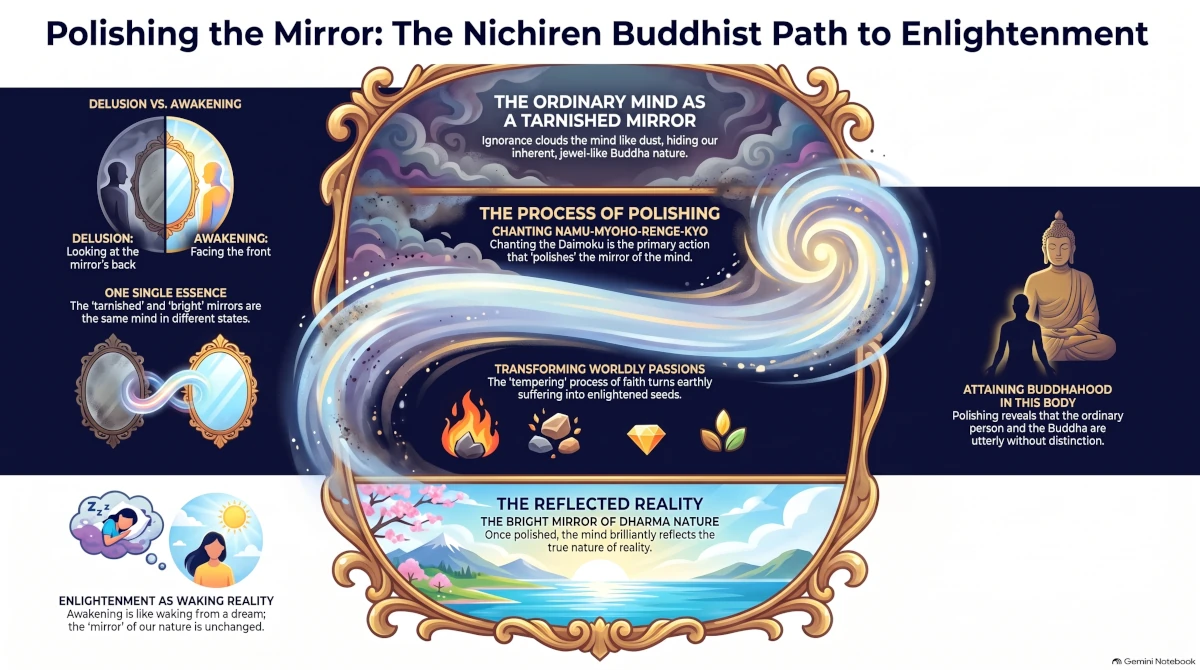
In Nichiren Buddhism, enlightenment is not a static state of intellectual understanding, but a dynamic reality that must be continuously actualized through action. While provisional teachings often encourage passive contemplation or a reliance on distant, otherworldly salvations, Nichiren places supreme weight on a highly active, rigorous, and localized discipline. To understand the depth of this practice, one must look at how the mirror of the mind is maintained, how daily life is transformed into a sacred arena, and why true practice demands a steady, uninterrupted resolve.
1. The Metaphor of the Tarnished Mirror: “Polishing” the Mind
A central pillar of this teaching is that the potential for Buddhahood is not something external to be acquired, but a reality inherently present within every individual. To explain how this innate potential is revealed, Nichiren employs the famous metaphor of the tarnished mirror:
“While deluded, one is called an ordinary worldling, and when awakened, one is called a Buddha. To illustrate, even a tarnished mirror, when polished, will appear like a jewel.”
The human mind, when clouded by fundamental ignorance, is like an unpolished mirror. Crucially, the tarnished mirror and the bright, jewel-like mirror are not two separate objects; they are the exact same entity in different states. There is no need to discard your ordinary mind. Instead, you must diligently polish it morning and evening.
When practitioners ask how this polishing is practically achieved, Nichiren’s answer is absolute:
“Simply chanting Namu-myōhō-renge-kyō is what is called ‘polishing.'”
By focusing your voice and mind on the Odaimoku, you directly wipe away the dust of delusion and allow the bright mirror of your inherent Buddha-nature to shine forth.
2. The Inseparability of Practice, Study, and Faith
For a practitioner of the Lotus Sutra, spiritual progress relies upon the balanced cultivation of faith, practice, and study (learning). These elements are not separate pathways; they are deeply intertwined components of a single spiritual life. Nichiren writes:
“Strive to carry out the two ways of practice and learning. Without practice and learning Buddhism will cease to exist. Endeavor yourself and cause others to practice these two ways of practice and learning, which stem from faith.”
Study illuminates your understanding of the Buddha’s intent, preventing your practice from drifting into blind dogmatism or shallow custom. Practice, in turn, is the active expression of your study. Without this dual commitment, faith cannot grow. Even if you can only share a single word or phrase with others, you are encouraged to actively teach and study to keep the living spirit of the Dharma alive.
3. Strict Diligence: Integrating Faith into Daily Works
Nichiren’s view of practice is famously rigorous. In his letter to Lord Toki (Tokidono Gosho), he urges followers to maintain an unwavering focus on their ultimate spiritual potential:
“Nichiren’s followers must strive to attain Buddhahood by shortening sleeping hours and by cutting the time for rest. If not, you will repent forever.”
This intensity reflects the understanding that while people routinely undergo immense hardships, make sacrifices, and lose sleep to achieve transient, worldly goals—such as passing examinations or securing business profits—the true, eternal goal of perfecting your character deserves far greater dedication.
However, this strictness does not mean turning away from the secular world to live in monastic isolation. Nichiren teaches that faith must be actively manifested in your daily work, your home, and your society. He famously advised Shijō Kingo that “the service to your lord itself is practicing the teaching of the Lotus Sutra twenty-four hours a day.”
Your profession, your family responsibilities, and your interactions with others are the very mirror reflecting your inner life and spiritual polish.
4. Upholding the “Difficult Practice” Like Flowing Water
Although chanting the Odaimoku is outwardly simple enough for anyone to perform, Nichiren strictly categorizes it as a “difficult practice.” He notes:
“To receive the Lotus Sutra is easy; to uphold it is difficult. But the realization of buddhahood lies in upholding it.”
Human nature is volatile and easily swayed by changing circumstances. It is easy to arouse a temporary, highly enthusiastic faith when first encountering the Dharma, but such a stance is like fire—it flares up brightly but is quickly extinguished when major obstacles or intellectual doubts arise. Instead, Nichiren advises Lord Matsuno to maintain a constant faith resembling flowing water. Water flows quietly, steadily, and continuously, day and night, never retreating or slackening no matter what obstacles block its path. To practice in this way is to possess a stout heart. It means refusing to compromise your devotion to the true teaching, actively rebuking error through the confrontational practice of shakubuku to protect the integrity of the Dharma, and remaining completely unmoved like a mountain of gold when facing the storms of life. By dedicating your voice, body, and mind to this continuous effort, the simple act of chanting is transformed into the most profound, direct path to supreme awakening.
Tomorrow: The Nondual Practice of Nichiren Buddhism