Today is the final day of the Higan week, the three days before the equinox and the three days after. As explained in a Nichiren Shu brochure:
For Buddhists, this period is not just one characterized by days with almost equal portions of light and dark. Rather, it is a period in which we strive to consciously reflect upon ourselves and our deeds.
The today we consider the Perfection of Wisdom. This essay was generated by Google’s Gemini Notebook and then edited for publication here. The essay is derived from the 400 or so letters written by Nichiren uploaded as source material for the Nichiren Notebook.
In the teachings of Nichiren Shōnin, ultimate wisdom (chiei) is not a secular, academic acquisition, but the profound realization of the true nature of life through the Lotus Sutra. To understand wisdom in Nichiren Buddhism, one must examine the fusion of reality and wisdom, the supreme principle of substituting faith for wisdom in this Latter Day, and how true wisdom is actively demonstrated through daily conduct.
The Buddha’s Wisdom as the Fusion of Reality and Wisdom (Kyōchi Myōgō)
Nichiren teaches that the ultimate enlightenment of the Buddha consists of two inseparable elements: reality (the objective truth) and wisdom (the subjective realization).
Reality (kyō) is the true nature of all phenomena, boundless and infinite like a vast riverbed. In the Ceremony in the Air described in the Lotus Sutra, this objective reality is represented by Many Treasures Buddha.
Wisdom (chi) is the subjective capacity to illuminate and manifest that reality, represented by Śākyamuni Buddha.
When the riverbed of reality and the water of wisdom are completely fused, one immediately attains Buddhahood in one’s present form. Nichiren teaches that the single entity uniting this reality and wisdom is the five characters of Myō-hō-ren-ge-kyō. Chanting Namu Myō-hō-ren-ge-kyō is the wonderful practice by which the water of the wisdom of the Mystic Dharma flows directly into the wasteland of daily life.
Substituting Faith for Wisdom (Ishin Daichi) in the Latter Day
For practitioners living in the Latter Day of the Dharma, Nichiren offers a highly encouraging and compassionate principle: because ordinary people lack the capacity for supreme wisdom, you can substitute faith for wisdom.
To protect beginners from being led astray by subordinate practices, the Buddha restricts those at the initial stages of practice from trying to master difficult precepts and meditation, placing all emphasis on the single factor of wisdom. Because ordinary wisdom is inadequate in this defiled age, the single character of faith is made the foundation. Disbelief is the root cause of slandering the Law and falling into hell, whereas faith is the direct source of true wisdom and the gate to entering the Buddha way.
To illustrate this, Nichiren points to the great disciples of the past:
Shāriputra, who was renowned as the foremost in wisdom among all of Śākyamuni Buddha’s disciples, was only able to gain entrance into the Lotus Sutra through faith alone, and not by the power of his own wisdom.
If even Shāriputra could not reach enlightenment through his own intellect, it is clear that ordinary people must rely entirely on faith to cultivate the seed of Buddhahood.
A person who possesses “knowledge without faith” is considered an icchantika (one of incorrigible disbelief) who will never attain the way, while a person of “faith without knowledge” can readily attain Buddhahood. Nichiren compares this to a baby drinking its mother’s milk: the infant does not understand the biological ingredients or formula of the milk, yet by drinking it, physical growth is naturally nurtured. In the same way, when you chant the Odaimoku with pure faith, the Buddha’s wisdom naturally manifests in your heart and mind, even if you do not understand the profound meaning of the sutra.
“Rely on Wisdom, Not on Knowledge”
Nichiren strongly emphasizes the four guidelines left by the Buddha on his deathbed, instructing practitioners to rely on wisdom and not on discriminative thinking or intellectual knowledge.
To rely on wisdom means to rely on the enlightened wisdom of the Buddha, which is perfectly aligned with the complete and final teachings of the Lotus and Nirvana sutras.
To not rely on discriminative thinking (or knowledge) means that you should not depend on the opinions, speculations, or oral transmissions of scholars, teachers, or even high-stage bodhisattvas who do not base themselves on the Lotus Sutra.
True wisdom is therefore anchored in the objective Dharma, not in the personal opinions of human beings.
Wisdom in Daily Behavior and Worldly Affairs
In Nichiren Buddhism, true wisdom is never an abstract concept practiced in isolation from the world. Nichiren writes:
“A person of wisdom is not one who practices Buddhism apart from worldly affairs but, rather, one who thoroughly understands the principles by which the world is governed.”
When you know the Lotus Sutra, your mind is like a clear sky that illuminates the ground, allowing you to understand the true meaning and cause of all worldly occurrences. True wisdom is the practical ability to discern what is correct and what is false, and to understand the specific needs of the country and the time in order to spread the teachings effectively.
Furthermore, a wise person is defined as one who knows the three existences—past, present, and future. Nichiren notes that a wise person in times of peace anticipates danger, and maintains a cautious, respectful heart to avoid slandering the Great Vehicle. By prioritizing faith and placing the Odaimoku at the center of your life, you allow the supreme wisdom of the Buddha to guide your daily behavior and protect your environment.
Today is the sixth day of the Higan week, the three days before the equinox and the three days after. As explained in a Nichiren Shu brochure:
For Buddhists, this period is not just one characterized by days with almost equal portions of light and dark. Rather, it is a period in which we strive to consciously reflect upon ourselves and our deeds.
The today we consider the Perfection of Meditation. This essay was generated by Google’s Gemini Notebook and then edited for publication here. The essay is derived from the 400 or so letters written by Nichiren uploaded as source material for the Nichiren Notebook.
In the teachings of Nichiren Shōnin, meditation is transformed from a silent, world-denying isolation into an active, vocal practice that directly connects you to the ultimate truth of life. While traditional schools of his time advocated for silent contemplation and the withdrawal of the senses, the teachings of Nichiren establish that the supreme and only necessary meditation for the Latter Day of the Dharma is the vocal chanting of the Odaimoku: Namu Myōhō-renge-kyō.
To understand how Nichiren reconciled the profound scholastic systems of meditation with the needs of ordinary people, you must look at his critique of silent contemplation, his interpretation of the Tiantai (Tendai) doctrine of “observing the mind,” and his revolutionary shift from “theoretical” to “actual” meditation. The Critique of Silent Contemplation
During the Kamakura period, the Zen school gained immense popularity by advocating for a “separate transmission outside the sutras” and the practice of silent, wall-gazing meditation. Nichiren severely criticized this approach, labeling it as a highly distorted doctrine of the “heavenly devil.” He presented three major objections to this form of meditation:
The Slander of the Written Dharma:
The Zen school likened the sutras to a “finger pointing at the moon,” claiming that once the “moon” of the mind’s nature is seen, the “finger” of written scripture is superfluous. Nichiren argued that this view is deeply unfilial and arrogant. He explained that the written words of the Lotus Sutra are the literal embodiment of the Buddha’s mind. Rejecting the sutras once you believe you have attained enlightenment is like discarding your own parents after birth or forgetting the physician the moment your sickness is cured.
The Error of “Facing the Wall”: He described those who sat facing the wall in silent contemplation as sitting with “an earthenware jar over their heads.”. Rather than attaining true wisdom, such practitioners “do not seek the Buddha… but enter deeply into erroneous views, hoping to shed suffering through greater suffering.”
Breath Control vs. True Wisdom: Nichiren characterized silent meditation that focuses purely on breath control as shallow, false, and fundamentally a non-Buddhist style of meditation that still retains “outflows” (delusions). True Buddhist meditation must be grounded in the correct doctrinal foundation of the Lotus Sutra.
The “Clear Mirror” of Observing the Mind (Kanjin)
Nichiren held a deep respect for the Great Teacher T’ien-t’ai (Zhiyi), who formulated the systematic meditation of Concentration and Insight (Maka Shikan). This practice is known as “observing the mind” (kanjin).
The purpose of T’ien-t’ai’s meditation was to perceive the ultimate reality of three thousand realms in a single moment of life (ichinen sanzen) within one’s own mind. Nichiren explained this through a beautiful analogy:
Ordinary people cannot see their own six sense organs (such as their own eyes or face) directly. It is only when they look into a clear mirror that they can see their reflection. Similarly, while various provisional sutras mention different realms of existence, it is only in the “clear mirror” of the Lotus Sutra and T’ien-t’ai’s writings that you can perceive the Ten Worlds and the three thousand realms inherent within your own mind.
However, Nichiren fiercely corrected the scholars of the Tendai school who had begun to assert that the practice of Concentration and Insight was superior to the Lotus Sutra itself. He maintained that the entire system of Concentration and Insight is merely a tool or a “coop” used to capture the “fish” of the Lotus Sutra’s wisdom. To value the meditation practice over the sutra is to commit a grave slander of the Dharma. Theoretical vs. Actual Ichinen Sanzen
In his letters, such as the Treatise on Healing Sickness (Chibyō-shō), Nichiren laid out a vital distinction regarding how the three thousand realms in a single moment of life are to be contemplated:
Theoretical Ichinen Sanzen (Ri-no-Ichinen-Sanzen): Practiced by Grand Masters T’ien-t’ai and Dengyō, this approach relies on a quiet, scholastic meditation of the mind based on the theoretical section (shakumon) of the Lotus Sutra.
Actual Ichinen Sanzen (Ji-no-Ichinen-Sanzen): Propagated by Nichiren, this is the concrete practice based on the essential section (honmon) of the Lotus Sutra, specifically “The Life Span of the Buddha” chapter, which reveals the Eternal Śākyamuni Buddha.
Nichiren explained that because ordinary people in the Latter Day of the Dharma are spiritually weak and burdened with heavy karma, attempting the silent, theoretical meditation of T’ien-t’ai is far too difficult and lofty. It is like a beginner trying to navigate a stormy sea in a fragile boat.
Therefore, out of supreme compassion, Śākyamuni Buddha wrapped the precious jewel of ichinen sanzen inside the five characters of Myō-hō-ren-ge-kyō and hung it around the necks of the ignorant in the Latter Day of the Dharma.
Chanting the Odaimoku: The Supreme Meditation
For practitioners in this era, chanting the Odaimoku is in itself the complete and actual practice of meditation (<shodai soku kanjin). Nichiren cited T’ien-t’ai’s Great Concentration and Insight regarding “recitation and silence,” clarifying that “recitation” refers directly to the vocal recitation of the sutra (or the title), while “silence” refers to the quietude of meditation. They are two sides of the same coin.
Crucially, you are not required to enter a forced, silent state of mental concentration to receive this benefit:
“Chant the Lotus Sutra with your ordinary distracted mind. You do not have to enter into a state of mental concentration. Whether sitting, standing, or walking, just fix your whole mind on the words of the Lotus Sutra.”
The “ordinary distracted mind” (shunjō) represents your everyday state of awareness, filled with your normal concerns and thoughts. Because all the eighty thousand teachings of the Buddha and the merits of all Buddhas throughout the universe are perfectly compressed within the Odaimoku, when you raise your voice to chant Namu Myōhō-renge-kyō, you are naturally meditating on the perfect principle and eliciting the Buddha-nature within your own body.
While wise men who possess deep capacity may practice both silent contemplation and chanting, it is sufficient and complete for lay followers to single-mindedly recite the Odaimoku. By doing so with absolute faith, the distinction between your mind and the Buddha’s mind collapses, and you immediately enter the “Pure Land of Tranquil Light.”
Today is the fifth day of the Higan week, the three days before the equinox and the three days after. As explained in a Nichiren Shu brochure:
For Buddhists, this period is not just one characterized by days with almost equal portions of light and dark. Rather, it is a period in which we strive to consciously reflect upon ourselves and our deeds.
The today we consider the Perfection of Vigor. This essay was generated by Google’s Gemini Notebook and then edited for publication here. The essay is derived from the 400 or so letters written by Nichiren uploaded as source material for the Nichiren Notebook.
In the teachings of Nichiren Shōnin, vigor and perseverance are not merely moral recommendations; they are the absolute lifeblood of Buddhist practice and the essential keys to attaining Buddhahood. In the Latter Day of the Dharma, when obstacles are frequent and slanders of the True Dharma are rampant, a follower’s spiritual progress depends entirely on cultivating a courageous, active, and unregressing spirit. Nichiren redefined traditional concepts of Buddhist diligence (shōjin) and laid out several profound principles regarding how practitioners must maintain steadfast endurance.
Redefining True Vigor: Upholding the Dharma
In gradual, traditional Buddhism, diligence was often associated with performing the five paramitas over countless eons. However, Nichiren teaches that in this era, upholding the Lotus Sutra and chanting Namu-Myōhō-renge-kyō constitutes the supreme and only necessary “observance of the precepts” and the true definition of vigor. He cites the Nirvana Sutra to explain that being diligent and non-lax in putting faith in this Great Vehicle means a practitioner is a true observer of the precepts. This diligent practice is compared to polishing a tarnished mirror; through the daily, persistent chanting of the Odaimoku, a mind clouded by innate darkness is actively restored to its original, brilliant clarity.
‘To Accept is Easy; To Continue is Difficult’
A core tenet of perseverance in Nichiren Buddhism is the understanding that starting a practice is simple, but maintaining it is where true awakening resides. Nichiren observed that many people become enthusiastic upon first hearing the teachings, but their resolve quickly cools. He contrasted two types of devotion:
Faith like Fire: Enthusiastic but brief, flaring up quickly and easily extinguished.
Faith like Water: Ceaselessly flowing, moving steadily forward without ever regressing.
You are encouraged to cultivate faith like flowing water. To illustrate the danger of stopping short, Nichiren used the metaphor of a twelve-day journey from Kamakura to Kyoto. If a traveler journeys for eleven days but stops with only one day remaining, how can they hope to admire the moon over the capital? True perseverance means maintaining your devotion until the very last moment of life.
Hardships as Fuel for Your Enlightenment
Rather than fearing or lamenting difficulties, followers of the Lotus Sutra are instructed to meet obstacles with profound joy and heightened resolve. Nichiren taught that tribulations are the very proof that one is practicing correctly. He used vivid metaphors to show how opposition actually strengthens a practitioner:
The Fire and Logs: A fire burns more briskly and higher when logs are added; similarly, the votary’s faith grows stronger when fueled by the “logs” of hardship.
The Kālakula Insect: Just as a strong wind causes the mythical kālakula insect to grow larger, persecutions only expand the life-state of the practitioner.
The Pine Tree: A pine tree lives for ten thousand years, and its branches naturally become bent and twisted by the winds. In the same way, the long-term practice of the Lotus Sutra will inevitably face great winds of opposition.
The Forging of Iron: When iron is forged, its hidden flaws are brought to the surface. Put into flames, a common rock is reduced to ashes, but gold becomes pure gold. The trials encountered in life are the fire that purges past offenses and proves faith genuine.
The Courage of the Lion King
Perseverance is impossible without absolute, unyielding courage. Nichiren writes that “it is lack of courage that prevents one from attaining Buddhahood.” He warned his followers that “a coward cannot have any of his prayers answered.”
To withstand the pressures of a hostile environment or the doubts sown by others, you must “summon up the courage of a lion king and never succumb to threats from anyone.” While those who slander the Dharma are like barking foxes, the true disciples of Nichiren are like roaring lions. When you confront the storms of life with this fearless attitude, the protective heavenly deities are bound to fulfill their vows and shield you from harm.
The Two Ways of Practice and Learning
Finally, maintaining this vigorous path requires active, daily engagement. Nichiren urged his disciples: “Strive to carry out the two ways of practice and learning. Without practice and learning Buddhism will cease to exist.” True perseverance is not a blind, passive endurance; it is an active study of the Buddha’s intent, combined with the vocal propagation of the Odaimoku. By dedicating your life to these two paths, even amidst the greatest storms of this defiled world, you are promised the eternal, supreme joy of the Land of Tranquil Light.
Today is the Fall Equinox, the middle of Higan week, the three days before the equinox and the three days after. As explained in a Nichiren Shu brochure:
For Buddhists, this period is not just one characterized by days with almost equal portions of light and dark. Rather, it is a period in which we strive to consciously reflect upon ourselves and our deeds.
This essay was generated by Google’s Gemini Notebook, drawing from the 400 or so letters written by Nichiren uploaded as source material for the Nichiren Notebook. The essay was subsequently edited for publication here. This is not unfiltered AI content.
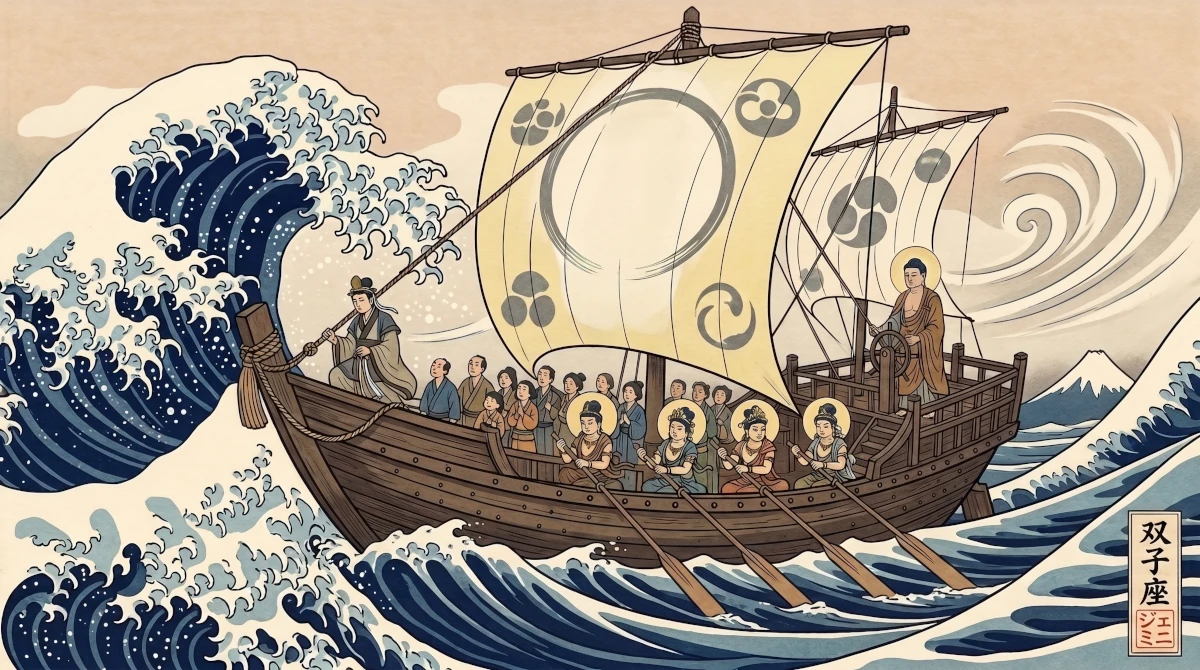
TheGreatShipofMyōhō-renge-kyō
The season of Higan arrives as a gentle reminder of the fleeting nature of this world. When the spring or autumn equinox balances day and night in perfect equilibrium, the mind naturally turns to the profound transitions of life.
In this world, the cherry blossoms that scatter in the wind will bloom again when spring returns, and the fallen autumn leaves will once more decorate the hills in their season. Yet, human lives pass with a fragile impermanence. When a beloved companion departs, never to return in this form, the heart of an ordinary person is inevitably filled with grief and longing.
Higan, meaning “the other shore,” is the time to contemplate how one might cross from shigan—this shore of birth, death, and relentless suffering—to the distant shore of perfect peace, enlightenment, and eternity. It is a sacred occasion to remember departed ancestors and to anchor your own life in the ultimate, unchanging reality of the Wonderful Dharma.
For countless eons, people have wandered through the turbulent sea of the sufferings of birth and death. In seeking liberation, many have turned to the provisional, pre-Lotus Sutra teachings, hoping to find a way across. Yet Nichiren Shōnin warns that these earlier, expedient doctrines are like rafts or small boats. While a small raft may suffice to transport a traveler from one location to another along the shallow waters of a single shore, it is entirely incapable of weathering the terrifying waves of the great ocean of birth and death.
To place faith in provisional practices—such as the Nembutsu of the Pure Land school—is to board a fragile vessel that must inevitably capsize when confronted with the immense weight of human karma and the spiritual darkness of the Latter Day of the Dharma. Relying on such teachings leaves practitioners stranded on this shore of suffering, unable to reach the Pure Land.
To safely cross the boundless ocean of suffering, you require a vessel of absolute strength and safety. Nichiren teaches that the World-Honored One of Great Enlightenment, acting as a shipbuilder of infinitely profound wisdom, has constructed such a vessel: the Great Ship of Myōhō-renge-kyō .
This magnificent craft was built by honestly discarding the provisional teachings and utilizing only the sturdy, unyielding timber of the supreme truth. Driven by the spikes of the one true teaching, it is rigged with the immense sails of the “three thousand realms in a single moment of life” and supported by the towering mast of the Middle Way. Propelled by the fair wind of “the true aspect of all phenomena,” this great ship surges ahead, effortlessly carrying all those who gain entrance through faith alone.
On this spiritual voyage, the Eternal Śākyamuni Buddha himself stands at the helm, Many Treasures Buddha secures the mooring rope, and the four great Bodhisattvas of the Earth row in perfect, joyful harmony. It is a vessel designed specifically for the ordinary, spiritually burdened people of this defiled era.
To board this great ship, no arduous or complex practices are required. Your single, supreme act of navigation is the chanting of the Odaimoku: Namu Myōhō-renge-kyō . The Great Teacher Miao-lo emphasized this truth, writing:
“Even a single phrase cherished deep in one’s heart will without fail help one reach the opposite shore. To ponder one phrase and practice it is to exercise navigation.”
When you raise your voice to chant Namu Myōhō-renge-kyō with pure faith, the distinction between your mind and the Buddha’s mind collapses.
Chanting is not a passive recitation, but the active turning of the rudder. It possesses the wondrous power to change poison into medicine, instantly transforming the three paths of earthly desires, negative karma, and suffering into the three virtues of the Dharma body, wisdom, and absolute emancipation. Through this vocal practice, the ordinary, distracted mind is aligned with the cosmic enlightened reality, and the ship of the Wonderful Dharma carries you swiftly toward the opposite shore.
In the Nichiren Shū tradition, “the other shore” is not a distant, abstract paradise located in a separate direction, nor is it a cold, silent realm of non-existence. Rather, the supreme destination is the Pure Land of Eagle Peak (Ryōjusen), where the Eternal Śākyamuni Buddha resides and expounds the Wonderful Dharma.
That Pure Land is not physically removed from your current life. Nichiren Shōnin provides the comforting assurance that although you may physically reside in this impure, troubled world, when you chant the Odaimoku your heart resides in the Pure Land of Eagle Peak with the Eternal Śākyamuni. Nichiren writes that though the moon is forty thousand yojanas high in the heavens, its reflection appears instantly in a pond on Earth. In the exact same manner, when you establish faith in the Lotus Sutra, your heart immediately dwells on Eagle Peak. Even Mount Minobu itself, where Nichiren chanted the sutra day and night, is realized as the very embodiment of this pure land—a place of the cluster of blessings where the Buddhas and bodhisattvas dwell.
For those who grieve the loss of parents, children, or spouses, Higan brings a message of profound, indestructible hope. If you nurture the same seeds of Myōhō-renge-kyō in your heart, you are guaranteed to be reborn together in the same land of Myōhō-renge-kyō . Nichiren Shōnin writes with tender compassion:
“The seeds of one kind of plant are all the same; they are different from the seeds of other plants. If all of you nurture the same seeds of Myoho-renge-kyo in your hearts, then you all will be reborn together in the same land… When you are reunited there face to face, how great your joy will be!”
When faithful practitioners of the Lotus Sutra pass from this world, their transition is not one of fear or heavy darkness. At the hour of death, their countenance becomes pure and white, and their body becomes as light as a goose feather and as soft as cotton. They are met instantly by Śākyamuni Buddha, Many Treasures Buddha, and the Buddhas of the ten directions, who seat them on their palms, pat their heads, and embrace them with infinite affection—as if welcoming a rising moon or blossoms that have just burst into bloom.
Even if separated by the temporary veil of death, you can meet your loved ones readily by using the Lotus Sutra as your guide. Even if the sun and moon should fall to the ground, or the tides cease to ebb and flow, a mother or father who chants Namu Myōhō-renge-kyō will never fail to be reunited with their beloved child at the Pure Land of Eagle Peak.
As you observe Higan, let your faith be like the ceaseless flow of water—steadily and quietly moving forward without ever regressing. Let the sound of the Odaimoku rise from your home as the ultimate offering to your ancestors, confident that its vibrations reach the ears of your departed loved ones at the eternal assembly of Eagle Peak. Trusting in the Great Ship of the Wonderful Dharma, continue your practice with courage and devotion, knowing that you are securely cradled in the compassionate mind of the Eternal Buddha, bound for the radiant shore of Tranquil Light.
This essay is available as a printable pamphlet. The PDF file is set up to print on both sides of two 8.5×11 sheets of paper.
Today is the third day of the Higan week, the three days before the equinox and the three days after. As explained in a Nichiren Shu brochure:
For Buddhists, this period is not just one characterized by days with almost equal portions of light and dark. Rather, it is a period in which we strive to consciously reflect upon ourselves and our deeds.
The today we consider the Perfection of Patience. This essay was generated by Google’s Gemini Notebook and then edited for publication here. The essay is derived from the 400 or so letters written by Nichiren uploaded as source material for the Nichiren Notebook.
In the teachings of Nichiren Shōnin, patience or forbearance (kṣānti) is not merely a passive, quietist endurance of suffering, but an active, noble virtue essential for both maintaining peace in daily life and successfully propagating the Lotus Sutra. In the Nichiren Shū tradition, this profound quality is understood as a spiritual shield—the “robe of gentleness and forbearance”—and a practical tool of wisdom that guards practitioners against both worldly conflicts and internal regression.
The Robe of Gentleness and Forbearance
Those who dedicate themselves to the Lotus Sutra are destined to encounter opposition in this troubled era. To withstand these trials, Nichiren teaches that practitioners must clothe themselves in “the robe of gentleness and patience.”
This teaching is drawn directly from the “Teacher of the Dharma” (10th) chapter of the Lotus Sutra, which instructs that any who wish to expound the sutra after the Buddha’s passing must “enter the Thus Come One’s room, put on the Thus Come One’s robe, and sit in the Thus Come One’s seat.”
The “Thus Come One’s robe” is defined as “the mind that is gentle and forbearing.” When you cultivate this gentle and patient heart, you are empowered to uphold the Dharma and face insults and slanders with absolute grace, composure, and equanimity.
The Practice of Forbearance as Your Shield
Forbearance is also a vital, practical shield in your daily life and relationships. Advising his samurai disciple, Shijō Kingo, who faced immense hostility and traps set by jealous colleagues, Nichiren emphasizes that patience is the ultimate protector.
He recounts the historical account of Emperor Sushun and Prince Shōtoku. When the emperor struggled to survive in a dangerous court, Prince Shōtoku advised him that the secular “five constant virtues” are the very same “soldiers” known in Buddhism as “the practice of forbearance.” The prince warned him that as long as he kept these “warriors” on his side, he would remain safe from harm. However, Emperor Sushun was irascible by nature; he failed to maintain his forbearance, rashly spoke of his hatred, and was ultimately assassinated.
Reflecting on this lesson, Nichiren counsels: “To avoid unforeseen troubles, it is best to endure patiently.” He instructs you to be prudent, avoid emotional outbursts, and maintain a quiet, dignified self-restraint. He urges, “Be patient, and continue in this way for the time being.”
Being Unmoved by the “Eight Winds”
True patience is demonstrated when a practitioner behaves as a sage, remaining completely unshaken by the “eight winds”: profit (prosperity), decline, disgrace, honor, praise, censure, suffering, and pleasure.
Nichiren writes that worthy persons are those who are neither elated by prosperity nor grieved by decline. When you remain unbending before these worldly winds—unmoved by greed, anger, or the desire for fame—you are guaranteed to receive the protective care of the heavenly deities.
The Ascetic Forbearance
To inspire his followers to endure hardships, Nichiren frequently points to the past-life practices of Śākyamuni Buddha. In a previous existence, the Buddha perfected this virtue as the ascetic Forbearance.
When King Kāli of Varanasi falsely accused him of seducing his female attendants and, in a fit of rage, hacked off the ascetic’s hands, feet, ears, and nose, the ascetic did not flinch or harbor even a single thought of resentment. His blood miraculously turned to milk, and his body restored itself, causing the king to repent of his ignorance.
Nichiren notes that reading about such extreme, heroic examples of endurance in the scriptures encourages rather than disheartens followers when they face the comparatively minor tribulations of this life.
Today is the second day of the Higan week, the three days before the equinox and the three days after. As explained in a Nichiren Shu brochure:
For Buddhists, this period is not just one characterized by days with almost equal portions of light and dark. Rather, it is a period in which we strive to consciously reflect upon ourselves and our deeds.
The today we consider the Perfection of Morality. This essay was generated by Google’s Gemini Notebook and then edited for publication here. The essay is derived from the 400 or so letters written by Nichiren uploaded as source material for the Nichiren Notebook.
In the teachings of Nichiren Shōnin, morality is not a set of rigid, static rules or abstract theories, but a dynamic and practical guide for daily behavior grounded in the ultimate truth of the Lotus Sutra. To understand morality in this tradition, one must look at how the secular virtues serve as a foundation for Buddhist practice, how daily conduct serves as the direct expression of your inherent Buddha-nature, and how the traditional rules of discipline are transformed in the Latter Day of the Dharma.
Secular Virtues as the Essential Foundation
For Nichiren, secular morality and humanistic codes are the starting point of a virtuous life. Before the introduction of Buddhism, ancient sages in China utilized the five constant virtues—benevolence, righteousness, propriety, wisdom, and good faith—to govern and bring order to society. The Buddha utilized these humanistic virtues to prepare the minds of the people, paving the way for the five Buddhist precepts.
Nichiren explains that those who are earnest in secular morality are already aligned with the spirit of the precepts:
Filial Piety: Approaching parents with absolute respect, never showing anger, and ensuring their physical and spiritual care.
Loyalty: Serving your lord or vocation with a clean conscience and a willing heart.
Courtesy: Greeting friends and colleagues with warmth and respect, never showing indifference.
Kindness: Treating those whose circumstances are inferior to your own with the same pity and compassion you would show to your own children.
Upholding these four secular virtues makes a person worthy to be called a human being; without them, a person lives on the level of beasts.
The Supreme Value of the ‘Treasures of the Heart’
In advising his samurai disciples, such as Shijō Kingo, Nichiren establishes a clear moral hierarchy regarding what constitutes true wealth and success. He writes that while worldly possessions represent “treasures in a storehouse,” and physical well-being constitutes “treasures of the body,” “the treasures of the heart are the most valuable of all.”
A healthy body or vast estate means nothing if your mind is impure. True moral development requires you to consistently strive to accumulate these inner treasures of faith, integrity, and character in your daily life.
“Buddhism is Found in Daily Behavior”
The very peak of moral action in Nichiren Buddhism is the realization that Buddhism does not exist separate from daily conduct. In the Sushun Tennō Gosho (The Emperor Sushun Letter), Nichiren states:
“What is called Buddhism is found in this behavior.”
The teachings instruct you to exercise extreme caution, prudence, and self-restraint, mimicking the great sages of old who reconsidered their words nine times before speaking. Ultimately, the true purpose of Śākyamuni Buddha’s appearance in this world was to teach people how to behave properly on a daily basis.
This is perfectly modeled by Bodhisattva Never Disparaging (Fukyō Bodhisatsu), who bowed to every person he met out of profound respect for their inherent Buddha-nature, even when they retaliated by cursing him and beating him with sticks and stones. Thus, true moral behavior is treating every person with the dignity that is due to a future Buddha.
The Precept of the Diamond Chalice
In traditional, gradual Buddhism, practitioners were required to strictly observe complex, separate sets of vows (such as the five, eight, ten, 250, or 500 precepts) to avoid falling into the lower realms. However, Nichiren teaches that in the Latter Day of the Dharma (mappō), when the three poisons of greed, anger, and ignorance are rampant, trying to divide your focus among these ancient rules is like trying to cross a stormy sea in a tiny, fragile boat.
Instead, the Lotus Sutra offers the “precept of the diamond chalice.” By simply accepting and chanting the five characters of Myō-hō-ren-ge-kyō, you naturally receive the complete benefits of all the precepts and causal practices ever completed by Śākyamuni Buddha.
Once a practitioner embraces this wonderful precept of the Lotus Sutra, it cannot be broken, even if one tries. It is like a golden vessel that never loses its precious value even if chipped or structurally altered, whereas the traditional Hinayana precepts are like fragile clay vessels that are rendered entirely useless once broken.
Repaying the Four Debts of Gratitude
An upright moral life is actively fueled by a sense of deep gratitude. Nichiren stresses that practitioners must understand and work to repay the four debts of gratitude: the debts owed to parents, to the sovereign or nation, to all living beings, and to the Three Treasures.
Filial piety toward parents is given paramount importance. Nichiren warns that while secular or non-Buddhist moral codes can assist parents’ physical bodies in this life, only the Lotus Sutra possesses the spiritual power to truly save their souls and lead them to Buddhahood in future existences.
Today is the first day of the Higan week, the three days before the equinox and the three days after. As explained in a Nichiren Shu brochure:
For Buddhists, this period is not just one characterized by days with almost equal portions of light and dark. Rather, it is a period in which we strive to consciously reflect upon ourselves and our deeds.
Today we consider the Perfection of Generosity. This essay was generated by Google’s Gemini Notebook and then edited for publication here. The essay is derived from the 400 or so letters written by Nichiren uploaded as source material for the Nichiren Notebook.
In the teachings of Nichiren Shōnin, the act of charity (fuse or dāna) is elevated from a simple material donation to a profound spiritual expression of a person’s very life. Building upon the principles of the Lotus Sutra, the teachings provide deep guidance on how ordinary practitioners in the Latter Day of the Dharma can engage in true charity, how its value is determined, and why its purity at the source is of paramount importance.
Offering in Actuality versus Offering in Principle
Nichiren draws a clear, compassionate distinction between the self-sacrificial acts of ancient sages and the deeds of ordinary people in the Latter Day of the Dharma.
Ancient sages practiced “offering in actuality” (ji-fuse), literally sacrificing their physical bodies for the Dharma. For instance, the boy Snow Mountains offered his body to a demon to receive a half-verse of teaching, Bodhisattva Medicine King burned his arms, Prince Shōtoku peeled off the skin of his hand to copy the Lotus Sutra, and Emperor Tenji burned his finger as an offering to the Buddha.
Because such extreme physical sacrifices are impossible for ordinary people, Nichiren explains that what is appropriate for you is “offering in principle” (ri-fuse), which is based entirely on “earnest resolve” (ichijō no kokorozashi). He writes that when one carefully considers what “earnest resolve” refers to, it is the doctrine of observing the mind, which means that offering one’s only robe to the Lotus Sutra is equivalent to peeling off one’s skin; and that in a time of famine, offering the food that is the only means for sustaining one’s life that day to the Buddha is offering one’s life to the Buddha.
Understood in this light, a material gift is not a mere object; it is the offering of your very life. Nichiren deeply comforted his disciples by assuring them that the polished rice or barley they sent was not just grain, but “life itself.” By offering what sustains your daily existence with sincere faith, the blessings you receive are in no way inferior to those of the great sages of the past.
The Great Value of Giving in Times of Adversity
In the writings of Nichiren, the spiritual value of charity is never measured by the size or monetary worth of a donation, but by the timing, the place, and the sincerity of the giver.
He reminds practitioners that a drop of water in a time of drought, or a spark of fire when one is freezing, holds incalculable value. When his young disciple Nanjō Tokimitsu sent wheat, salt, or yams to the Nichiren’s remote snowbound dwelling in Minobu during times of famine, drought, and winter isolation, Nichiren expressed deep gratitude. He wrote that in the eyes of ordinary people, these gifts appeared as grain, but in the eyes of the Buddhas, they were the very “seeds of Buddhahood.”
Furthermore, Nichiren notes that because the Lotus Sutra is the teacher of all Buddhas, making an offering to its votary or practitioner in the Latter Day of the Dharma yields benefits far greater than making offerings to the Buddha himself. He references the “Teacher of the Dharma” chapter of the Lotus Sutra to show that supporting a teacher of the Dharma who is despised, slandered, and persecuted by society brings blessings that even the Buddha’s wisdom cannot fully measure.
Purity of Charity at the Root
While the act of giving is highly praised, Nichiren insists that true charity must be pure at its root. In his letters to the lay nun of Kubo, he warns that if a person obtains wealth through evil means—such as killing living beings, stealing, waging war, or oppressing and exploiting others—and then donates that wealth to acquire merit, the offering remains an evil deed. He employs a powerful and graphic metaphor to illustrate this:
“Suppose someone dried dung, crushed it, and refined it into a piece of wood to carve a statue of a Buddha. If we burn it, it will not smell like fragrant sandalwood; it would still only smell of dung.”
Because the source is impure, such donations vanish without a trace and cannot lead the giver to Buddhahood. Sincere charity must be built upon clean, honest efforts and a heart of pure faith.
Provide the source for your statement: You do not manifest your inherent Buddha-nature simply by intellectually knowing it is there. Rather, it must be actively polished and given concrete, relational expression through your daily behavior, your faith, and your vocal practice of the Daimoku.
Here’s the response:
Nichiren_Buddhism__Theory_to_Action
While this statement is a contemporary theological synthesis of the core doctrines in the notebook, its direct claims are deeply anchored in several of Nichiren Shōnin’s authenticated letters and the scholarly analyses of his relationship to medieval Tendai philosophy.
You can trace the distinct components of this statement to the following specific sources in the library:
1. The Danger of Passive “Intellectual Knowing”
The opening of the statement—criticizing the idea that one can manifest Buddhahood simply through passive, intellectual acknowledgment—is grounded in Nichiren’s sharp warnings against “self-conceit” (arrogance).
In his letter A Reply to Lord Ueno (Ueno-dono Gohenji), Nichiren Shōnin quotes the Tendai commentator Miao-lo to warn against the spiritual traps of a purely theoretical understanding of immanent enlightenment:
“When people with evil passions are told that they will become Buddhas as they are, they will neglect to cultivate the roots of goodness or to amend their self-conceit… both are similar in assuming that the Buddha and people are the same, and they are disgraceful who do not reflect upon themselves.”
This is further supported by the historical analysis of Jacqueline I. Stone. Scholars note that while medieval Tendai original enlightenment (Hongaku) thought often remained “theoretical” and “abstract”—focusing on the first stage of the six identities, identity in principle (ri-soku)—Nichiren Shōnin insisted on a “practical Buddhism” that demanded active engagement. He shifted the focus to verbal identity (myōji-soku), which represents the actual starting point of vocal practice and faith.
As detailed in The Indestructible Vow, this active shift was a direct response to the moral laxity of the era, transforming a passive ontological status into an active, lived commitment.
2. The Necessity of Active “Polishing” and Chanting
The middle of the statement—asserting that the mind must be “actively polished” through the vocal practice of the Daimoku—comes directly from Nichiren’s famous early treatise, On Becoming a Buddha in One Lifetime (Isshō Jōbutsu Shō).
Nichiren Shōnin explains that the deluded mind and the enlightened mind are the same mirror, but the dust of fundamental ignorance must be cleared away through daily practice:
“Even right now, the deluded mind in a single thought-moment of ignorance is an unpolished mirror. But if one polishes it, it will surely become the bright mirror that is the true suchness of the Dharma nature. Profoundly arouse the mind of faith and day and night, morning and evening, polish [the mirror of the mind] without neglect. How should one polish it? Simply chanting Namu-myōhō-renge-kyō is what is called ‘polishing.’”
This insistence on active discipline is reinforced in the Shoho Jissō Shō, where the writings declare:
“Learn and practice to strengthen your faith. Without learning and practicing there is no Buddhism. To learn and to practice are a part of faith.”
3. Concrete, Behavioral, and Relational Expression
The final portion of the statement—requiring that this inherent nature be given concrete, relational expression through daily behavior—is grounded in A Reply to My Lady, the Nun Myōhō (Myōhō-ama Gozen Gohenji).
To demonstrate that enlightenment must be visible in one’s actions, Nichiren Shōnin states:
“The person who chants Namu-myōhō-renge-kyō is a Buddha. His body is the dharma-body of the Buddha; his mind, the reward-body of the Buddha; and his behavior, the manifestation-body of the Buddha.”
By identifying a practitioner’s daily behavior as the “manifestation-body” (niryāna-kāya) of the Buddha, the teachings close the loop: your inner faith is not an abstract theory, but a dynamic, compassionate force that must actively transform your conduct, your relationships, and your environment.
What’s a Buddhist practice guide without a manual. When Gemini Notebook asked, “Would you like me to compile a matching study guide summarizing the scriptural sources?” I said, sure, why not. Here’s what the Nichiren Notebook created.
Download PDF
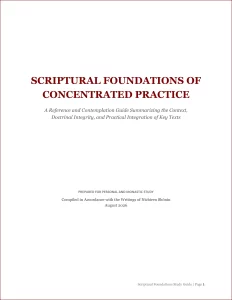
SCRIPTURAL FOUNDATIONS OF CONCENTRATED PRACTICE
A Reference and Contemplation Guide Summarizing the Context, Doctrinal Integrity, and Practical Integration of Key Texts
PREPARED FOR PERSONAL AND MONASTIC STUDY
Compiled in Accordance with the Writings of Nichiren Shōnin
August 2026
Introduction: The Shift to Concentrated Practice
A profound theological shift defines the transition from classical, gradual Mahayana self-cultivation to the immediate, nondual, effect-based path of Nichiren Buddhism. Traditional Buddhist paths present a linear framework of progression (Proceeding from Cause to Effect, or Jūin Shika), wherein a practitioner must systematically observe hundreds of prohibitive monastic rules and master the six Paramitas over countless lifetimes to build enlightenment from scratch. For practitioners in the Latter Day of the Law (Mappō), whose capacity has deteriorated in this chaotic and spiritually degraded era, attempting to climb this progressive ladder is described by Nichiren Shōnin as unsuited to the times.
To resolve this crisis of capacity, Nichiren Shōnin established the path of Proceeding from Effect to Cause (Jūka Kōin). Because Śākyamuni Buddha completed the arduous, eon-spanning journey of causal practices and obtained their resulting virtues on behalf of all beings, he encapsulated his entire cause and effect within the five characters of the title of the Lotus Sutra: Myō Hō Ren Re Kyō. When a practitioner embraces and chants Namu Myōhō Renge Kyō with single-minded faith, the Buddha spontaneously transfers the totality of his merits directly to them. This study guide compiles the scriptural backgrounds, historical contexts, and doctrinal implications of three essential texts that historically validate, reconcile, and guide this concentrated practice.
1. Isshō Jōbutsu Shō (Becoming a Buddha in One Lifetime) Historical and Manuscript Context
The Isshō Jōbutsu Shō is traditionally assigned in the Shōwa standard edition to the year Kenchō 7 (1255), when Nichiren Shōnin was thirty-four years of age and residing in Kamakura, shortly after his first public proclamation of the Daimoku at Seichō-ji in 1253. While traditional catalogues like that of Toki Jōnin do not record it, it remains one of the most treasured and beautifully written early treatises in the primary section of the canon. It addresses a fundamental question: how can an ordinary person, burdened with deluded karma, dissolve the cycle of birth and death to realize unexcelled bodhi in this very lifetime?
Core Doctrinal Principle: The Tarnished Mirror
To explain the immediacy of Buddhahood, the text utilizes the celebrated metaphor of the mirror, drawing on East Asian nondual paradigms:
“While deluded, one is called an ordinary worldling, and when awakened, one is called a Buddha. To illustrate, even a tarnished mirror, when polished, will appear like a jewel. The mind that is clouded by the illusions of the dark nature of ignorance is like a tarnished mirror, but once polished, it will surely become like a jewel, reflecting the true aspect of reality and the uncreated Dharma-nature. Simply chanting Namu-myōhō-renge-kyō is what is called ‘polishing.’”
This teaching establishes that the deluded mind (ordinary person) and the awakened mind (Buddha) are not separate, distinct entities. Rather, they are the exact same mirror viewed in different states of clarity. This concept entirely bypasses the need to eradicate thoughts or construct a new, holy state. Instead, the act of chanting Namu-myōhō-renge-kyō directly cleanses the mirror of the mind, allowing the originally inherent, uncreated Buddha-nature to shine forth.
The Transition to Concentrated Chanting
Scholars note that the Isshō Jōbutsu Shō represents a key transitional moment in the evolution of Nichiren’s teachings. While it still employs the classical language of meditative discipline—speaking of ‘observing the mind’ (kanjin) or ‘discerning the wonderful principle originally inherent in living beings’—it radically defines this contemplation. It asserts that the actual practice of observing the mind is fully achieved and completed through the single, physical act of chanting the Daimoku. This represents a movement from quietist, silent introspection to active, vocalized devotion, preparing the foundation for the exclusive practice that defines Nichiren Buddhism in the Latter Day of the Law.
2. Ueno-dono Goke-Ama Gohenji (Reply to the Widow of Lord Ueno) Historical Context and the Reality of Grief
In 1259, Nichiren Shōnin converted Nanjō Hyōe Shichirō, a samurai and personal retainer of Hōjō Tokiyori who served as the steward (jitō) of the Ueno district near Mount Fuji. Known as Lord Ueno, Hyōe Shichirō passed away in 1265. His widow, who took Buddhist vows as a nun (Ueno-ama), remained deeply devoted to Nichiren and raised her children—including her eldest son, Nanjō Tokimitsu—to be staunch pillars of the Fuji area Lotus community. The collected works include more than forty letters to the Nanjō family.
This specific letter of condolence, the Ueno-dono Goke-Ama Gohenji, is assigned to either 1265 (shortly after Lord Ueno’s death, addressing a fresh, immediate sorrow) or 1274 (post-Sado). In this letter, Nichiren reassures the grieving widow that her late husband, having been an earnest practitioner of the Lotus Sutra, undoubtedly attained Buddhahood in his very body. He does not dismiss her natural human sorrow, but rather validates her grief, noting that even the great disciples of Śākyamuni Buddha wept at his parinirvana to display the behavior of ordinary human beings.
Core Doctrinal Principle: Hell is the Land of Tranquil Light
To console the widow and explain how her late husband attained supreme awakening, Nichiren Shōnin presents a revolutionary, nondual explanation of the realms of existence:
“Now whether in the case of the Pure Land, or whether in the case of hell, neither is found outside us. They exist solely within our hearts. One awakened to this is called a Buddha. One deluded to it is called an ordinary worldling. What enables this awakening is the Lotus Sutra. And if this is so, then one who embraces the Lotus Sutra awakens to hell being precisely the Land of Tranquil Light.”
This teaching collapses the spatial distance between this suffering world (sahā) and the pure realms of the Buddhas. Because hell and the Pure Land are both manifestations of the mind, the practitioner who embraces the Lotus Sutra is empowered to transform their immediate environment. Even in the midst of the most devastating personal trials and grief, the light of original enlightenment remains fully present. The Dual Practice of Consciousness
Towards the conclusion of the letter, Nichiren Shōnin introduces a highly practical guideline for daily living, which he attributes to ‘a virtuous man of antiquity’:
“Maintain the ground of the mind in the ninth consciousness, but keep your practice in the six consciousnesses.”
The six consciousnesses govern the sensory, intellectual, and physical movements of our daily, secular lives in the world. The ninth consciousness (amala-vijñāna) represents the fundamentally pure, undefiled ground of true suchness and our inherent Buddha-nature. This guidance instructs the follower not to escape from the world, but to keep their deepest, core awareness firmly anchored in the unshakeable, eternal reality of the Daimoku (the ninth consciousness), while continuing to act with diligence, integrity, and compassion within their daily professions, families, and chores (the six consciousnesses).
3. Onkō Kikigaki (Lectures Heard and Recorded) Historical Context and Oral Transmission
The Onkō Kikigaki, also known as the Nikō ki, presents itself as a direct record of lectures on the Lotus Sutra delivered by Nichiren Shōnin to his senior disciples during his retirement on Mount Minobu. According to the introductory note, these lectures were given in succession from the nineteenth day of the third month of the first year of Kōan (1278) through the twenty-eighth day of the fifth month of the third year of the same era (1280), and were recorded by his close disciple Sado Ajari Nikō (1253-1314), the founder of the Minobu lineage.
Modern academic specializations generally classify the Onkō Kikigaki as a composite, late-medieval text (compiled c. 1500) that draws heavily on Tendai original enlightenment (hongaku) oral transmission literature. However, because the final thirty-one topics comment on Nichiren Shōnin’s personal instructions and so closely mirror the encouraging, practical tone of his authenticated letters, it is widely recognized as having successfully preserved the genuine, living voice and direct guidance of the founder.
Core Doctrinal Principle: Flowing Water versus Fire
Among the most celebrated practical instructions preserved in the Onkō Kikigaki is the crucial distinction concerning the character of a disciple’s faith:
“Of the people who put faith in the Lotus Sutra today, some have faith like fire while others have it like water. Those who have faith like fire refer to those who become enthusiastic upon listening to the preaching but their passion cools down as time goes by, and eventually forget the teaching. On the other hand, those whose faith is like water mean those whose faith is like a ceaselessly flowing water, namely those who retain their faith without retreating.”
This teaching serves as an essential warning for lay practitioners. It is easy to arouse a temporary, highly emotional faith when first encountering the Dharma, but such a stance is volatile and easily extinguished when major obstacles or intellectual doubts arise. True practice demands a quiet, steady, and persistent commitment that flows day and night, quietly moving past every barrier, never retreating or slackening. This steady, water-like practice represents the true keeping of the indestructible Diamond Chalice Precept.
4. Doctrinal Synthesis: The Core Themes of Concentrated Faith
When viewed collectively, the Isshō Jōbutsu Shō, the Reply to the Widow of Lord Ueno, and the Onkō Kikigaki provide a cohesive theological framework that fully reconciles the immediate, nondual, ‘faith-based’ nature of Nichiren Buddhism with the demand for strict, rigorous, and steady daily practice. In this nondual theology, strict practice is not a works-based means to acquire a future, distant Buddhahood. Rather, practice is the active, necessary expression and polishing of a Buddhahood that is already inherently present within your life. Through the doctrine of Juji Soku Jikai (upholding the Law is itself keeping the precepts), the ordinary devotee is fully empowered to manifest the Pure Land of Tranquil Light directly within the trials, griefs, and secular duties of the present world, keeping their faith flowing steadily like water.
Comparative Summary of Essential Texts
The following table summarizes the key historical, doctrinal, and practical dimensions of these three pivotal texts:
Essential Text
Context & Date
Core Doctrinal Principle
Practical Application
Isshō Jōbutsu Shō
(Becoming a Buddha in One Lifetime)
Kenchō 7 (1255);
Kamakura.
Recipient: Toki Jōnin.
The Tarnished Mirror:
Delusion and awakening are not separate; chanting the Daimoku is the actual act of ‘polishing’ the mind.
Polishing the mirror of the mind morning and evening through the single, active practice of the Odaimoku.
Ueno-dono Goke-Ama Gohenji
(Reply to the Widow of Lord Ueno)
Bun’ei 2 (1265) or Bun’ei 11 (1274);
Minobu.
Recipient: Widow of Lord Ueno.
Hell is the Land of Tranquil Light; maintain the ground of the mind in the ninth consciousness, but practice in the six consciousnesses.
Anchoring your deepest awareness in the pure, eternal Daimoku while executing your daily, secular labor in the physical world.
Faith Like Flowing Water versus Faith Like Fire:
Continuous, steady devotion vs. volatile, temporary enthusiasm.
Maintaining a quiet, persistent, and unyielding practice that flows continuously day and night, unaffected by obstacles.
References for Further Study
Asai Endō. Nichiren Shōnin’s View of Humanity: The Final Dharma Age and the Three Thousand Realms in One Thought-Moment. Translated by Jacqueline I. Stone. Japanese Journal of Religious Studies 26, nos. 3-4 (1999): 239–259.
Shigyō Kaishû. Jūnyoze no koto no kenkyū (A study of the ‘Jūnyoze no koto’). Seishin 26 (1941): 104–112.
Stone, Jacqueline I. Original Enlightenment and the Transformation of Medieval Japanese Buddhism. Honolulu: University of Hawai’i Press, 1999.
Stone, Jacqueline I. The Atsuhara Affair: The Lotus Sutra, Persecution, and Religious Identity in the Early Nichiren Tradition. Japanese Journal of Religious Studies 41, no. 1 (2014): 153–189.
Watson, Burton, et al., trans. Letters of Nichiren. Edited by Philip B. Yampolsky. New York: Columbia University Press, 1996.
🌿 Would you like me to construct a structured contemplation guide to help you focus on how this concentrated practice of faith can be mindfully applied throughout your daily activities?
Why, yes, I do, I said. Here’s what Gemini Notebook delivered.
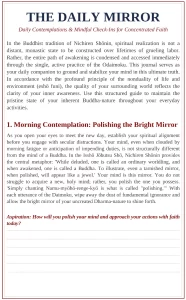
In the Buddhist tradition of Nichiren Shōnin, spiritual realization is not a distant, monastic state to be constructed over lifetimes of grueling labor. Rather, the entire path of awakening is condensed and accessed immediately through the single, active practice of the Odaimoku. This journal serves as your daily companion to ground and stabilize your mind in this ultimate truth. In accordance with the profound principle of the nonduality of life and environment (eshō funi), the quality of your surrounding world reflects the clarity of your inner awareness. Use this structured guide to maintain the pristine state of your inherent Buddha-nature throughout your everyday activities.
1. Morning Contemplation: Polishing the Bright Mirror
As you open your eyes to meet the new day, establish your spiritual alignment before you engage with secular distractions. Your mind, even when clouded by morning fatigue or anticipation of impending duties, is not structurally different from the mind of a Buddha. In the Isshō Jōbutsu Shō, Nichiren Shōnin provides the central metaphor: ‘While deluded, one is called an ordinary worldling, and when awakened, one is called a Buddha. To illustrate, even a tarnished mirror, when polished, will appear like a jewel.’ Your mind is this mirror. You do not struggle to acquire a new, holy mind; rather, you polish the one you possess. ‘Simply chanting Namu-myōhō-renge-kyō is what is called “polishing.”‘ With each utterance of the Daimoku, wipe away the dust of fundamental ignorance and allow the bright mirror of your uncreated Dharma-nature to shine forth.
Aspiration: How will you polish your mind and approach your actions with faith
today?
2. Midday Contemplation: Daily Work as Sacred Service
When you enter your workplace, home, or social responsibilities, guard against the illusion that secular labor is separate from, or a distraction to, your Buddhist path. Nichiren Shōnin famously advised the samurai Shijō Kingo: ‘Please remember that the service to your lord itself is practicing the teaching of the Lotus Sutra twenty-four hours a day.’ Your profession, your chores, and your human interactions are the very mirror reflecting your inner polish. In the perfect teaching of the Lotus Sutra, the worldly law is not merely related to the Buddhist law; rather, the worldly law is recognized as the totality of the Buddhist Law.
The Dual Practice of Consciousness
To maintain this perspective amidst the chaotic demands of midday, practitioners are encouraged to adopt a precise internal alignment, advised in Nichiren’s “Reply to the Nun, the Widow of Lord Ueno” (Ueno-dono goke-ama gohenji): ‘Maintain the ground of the mind in the ninth consciousness, but keep your practice in the six consciousnesses.’ The six consciousnesses govern your active senses, intellect, and physical movements in the secular world. The ninth consciousness (amala-vijñāna) is the pure, undefiled ground of the original Buddha-nature. By rooting your deepest awareness in the absolute, unshakeable reality of the Wondrous Dharma, you can operate dynamically and effectively within your senses and daily labor, acting with the wisdom, courtesy, and integrity of a true disciple of the Buddha.
Midday Check-In: How is your secular labor actively expressing your practice
right now?
3. Afternoon Contemplation: Moving Like Water, Standing Like a Mountain
As the day progresses, you will inevitably encounter friction—stress, negative environments, or sudden obstacles. Use these trials as the precise crucible for your spiritual refinement. Just as iron is forged into a fine sword when heated and pounded, or a mountain of gold shines brighter when brushed, your resolve is strengthened and clarified by the very obstacles that seek to obstruct it. Nichiren Shōnin warns that the Devil of the Sixth Heaven detests the true Law and will deploy obstacles to cause practitioners to regress. In response, you must cultivate the ultimate, nondual stance of the Buddha: ‘Take suffering as suffering, enjoy pleasures for what they are, and whether in suffering or joy, continue chanting Namu-myōhō-renge-kyō.’
Upholding the Precept of Flowing Water
To remain unmoved by these obstacles, the Onkō Kikigaki (“Lectures Heard and Recorded” by Nikō, the founder of the Minobu lineage) instructs you to examine the character of your faith. It distinguishes between ‘faith like fire’—which flares up brightly but is quickly extinguished when encountering doubt or difficulty—and ‘faith like flowing water.’ Your commitment must resemble water, which flows quietly, steadily, and continuously, day and night, never retreating or slackening no matter what obstacles block its course. Maintaining this steady, water-like devotion represents the true keeping of the Diamond Chalice Precept. You are protected from regression, and your simple, persistent voice of chanting is transformed into an absolute, indestructible shield of character.
Resilience: Identify a current trial. How will you respond to it with water-like
faith?
4. Evening Contemplation: The Nonduality of Self and Environment
In the quiet of the evening, as you sit in front of the Gohonzon, contemplate the profound truth of eshō funi—the oneness of life and its environment. When you purify your mind, your surrounding environment is purified as well. Nichiren Shōnin writes in the Jiri Kyuō Gosho: ‘The moon is nothing but mind, and flower is nothing but mind.’ The room or home where you sit and chant is not merely a physical space; it is instantly transformed into the Pure Land of Constantly Calm Light, a sacred platform (Kaidan) where the assembly of Eagle Peak is solemnly and permanently present. Conclude your day with profound gratitude, offering your earnest resolution (kokorozashi) as a supreme offering in principle to the Three Treasures.
The Six Daily Recollections of Concentrated Practice
♦ The Buddha: Maintaining absolute mindfulness of the enlightened life of the True Buddha.
♦ The Dharma: Firmly believing in and chanting the ultimate Law of Myōhō-Renge-Kyō.
♦ The Sangha: Practicing for the benefit of self and others, keeping the pure bond of the community.
♦ The Precepts: Observing the indestructible Diamond Chalice Precept embodied in the Daimoku.
♦ Almsgiving: Practicing active compassion by sharing the teachings to ease suffering.
♦ Heaven: Offering the flavor of your practice to the protective forces (shoten zenjin) in daily life.
By maintaining these daily reflections, your simple, consistent voice of chanting is revealed as the very mechanism that polishes the mirror of your mind. You do not practice to become a Buddha; rather, your practice is the active, glorious expression of the Buddha that you already are. Keep your faith flowing like water, and observe how the Lapislazuli purity of the Dharma realm manifests in every corner of your daily life.
And, of course, when Gemini Notebook finished with that it asked:
🎨 Would you like me to compile a matching study guide summarizing the scriptural sources of these contemplations (such as the Isshō Jōbutsu Shō, Onkō Kikigaki, and Jiri Kyuō Gosho) as an editable Word document for your notes?

 The today we consider the Perfection of Wisdom. This essay was generated by Google’s Gemini Notebook and then edited for publication here. The essay is derived from the 400 or so letters written by Nichiren uploaded as source material for the Nichiren Notebook.