🌿 Would you like me to construct a structured contemplation guide to help you focus on how this concentrated practice of faith can be mindfully applied throughout your daily activities?
Why, yes, I do, I said. Here’s what Gemini Notebook delivered.
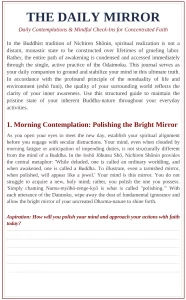
In the Buddhist tradition of Nichiren Shōnin, spiritual realization is not a distant, monastic state to be constructed over lifetimes of grueling labor. Rather, the entire path of awakening is condensed and accessed immediately through the single, active practice of the Odaimoku. This journal serves as your daily companion to ground and stabilize your mind in this ultimate truth. In accordance with the profound principle of the nonduality of life and environment (eshō funi), the quality of your surrounding world reflects the clarity of your inner awareness. Use this structured guide to maintain the pristine state of your inherent Buddha-nature throughout your everyday activities.
1. Morning Contemplation: Polishing the Bright Mirror
As you open your eyes to meet the new day, establish your spiritual alignment before you engage with secular distractions. Your mind, even when clouded by morning fatigue or anticipation of impending duties, is not structurally different from the mind of a Buddha. In the Isshō Jōbutsu Shō, Nichiren Shōnin provides the central metaphor: ‘While deluded, one is called an ordinary worldling, and when awakened, one is called a Buddha. To illustrate, even a tarnished mirror, when polished, will appear like a jewel.’ Your mind is this mirror. You do not struggle to acquire a new, holy mind; rather, you polish the one you possess. ‘Simply chanting Namu-myōhō-renge-kyō is what is called “polishing.”‘ With each utterance of the Daimoku, wipe away the dust of fundamental ignorance and allow the bright mirror of your uncreated Dharma-nature to shine forth.
Aspiration: How will you polish your mind and approach your actions with faith
today?
2. Midday Contemplation: Daily Work as Sacred Service
When you enter your workplace, home, or social responsibilities, guard against the illusion that secular labor is separate from, or a distraction to, your Buddhist path. Nichiren Shōnin famously advised the samurai Shijō Kingo: ‘Please remember that the service to your lord itself is practicing the teaching of the Lotus Sutra twenty-four hours a day.’ Your profession, your chores, and your human interactions are the very mirror reflecting your inner polish. In the perfect teaching of the Lotus Sutra, the worldly law is not merely related to the Buddhist law; rather, the worldly law is recognized as the totality of the Buddhist Law.
The Dual Practice of Consciousness
To maintain this perspective amidst the chaotic demands of midday, practitioners are encouraged to adopt a precise internal alignment, advised in Nichiren’s “Reply to the Nun, the Widow of Lord Ueno” (Ueno-dono goke-ama gohenji): ‘Maintain the ground of the mind in the ninth consciousness, but keep your practice in the six consciousnesses.’ The six consciousnesses govern your active senses, intellect, and physical movements in the secular world. The ninth consciousness (amala-vijñāna) is the pure, undefiled ground of the original Buddha-nature. By rooting your deepest awareness in the absolute, unshakeable reality of the Wondrous Dharma, you can operate dynamically and effectively within your senses and daily labor, acting with the wisdom, courtesy, and integrity of a true disciple of the Buddha.
Midday Check-In: How is your secular labor actively expressing your practice
right now?
3. Afternoon Contemplation: Moving Like Water, Standing Like a Mountain
As the day progresses, you will inevitably encounter friction—stress, negative environments, or sudden obstacles. Use these trials as the precise crucible for your spiritual refinement. Just as iron is forged into a fine sword when heated and pounded, or a mountain of gold shines brighter when brushed, your resolve is strengthened and clarified by the very obstacles that seek to obstruct it. Nichiren Shōnin warns that the Devil of the Sixth Heaven detests the true Law and will deploy obstacles to cause practitioners to regress. In response, you must cultivate the ultimate, nondual stance of the Buddha: ‘Take suffering as suffering, enjoy pleasures for what they are, and whether in suffering or joy, continue chanting Namu-myōhō-renge-kyō.’
Upholding the Precept of Flowing Water
To remain unmoved by these obstacles, the Onkō Kikigaki (“Lectures Heard and Recorded” by Nikō, the founder of the Minobu lineage) instructs you to examine the character of your faith. It distinguishes between ‘faith like fire’—which flares up brightly but is quickly extinguished when encountering doubt or difficulty—and ‘faith like flowing water.’ Your commitment must resemble water, which flows quietly, steadily, and continuously, day and night, never retreating or slackening no matter what obstacles block its course. Maintaining this steady, water-like devotion represents the true keeping of the Diamond Chalice Precept. You are protected from regression, and your simple, persistent voice of chanting is transformed into an absolute, indestructible shield of character.
Resilience: Identify a current trial. How will you respond to it with water-like
faith?
4. Evening Contemplation: The Nonduality of Self and Environment
In the quiet of the evening, as you sit in front of the Gohonzon, contemplate the profound truth of eshō funi—the oneness of life and its environment. When you purify your mind, your surrounding environment is purified as well. Nichiren Shōnin writes in the Jiri Kyuō Gosho: ‘The moon is nothing but mind, and flower is nothing but mind.’ The room or home where you sit and chant is not merely a physical space; it is instantly transformed into the Pure Land of Constantly Calm Light, a sacred platform (Kaidan) where the assembly of Eagle Peak is solemnly and permanently present. Conclude your day with profound gratitude, offering your earnest resolution (kokorozashi) as a supreme offering in principle to the Three Treasures.
The Six Daily Recollections of Concentrated Practice
♦ The Buddha: Maintaining absolute mindfulness of the enlightened life of the True Buddha.
♦ The Dharma: Firmly believing in and chanting the ultimate Law of Myōhō-Renge-Kyō.
♦ The Sangha: Practicing for the benefit of self and others, keeping the pure bond of the community.
♦ The Precepts: Observing the indestructible Diamond Chalice Precept embodied in the Daimoku.
♦ Almsgiving: Practicing active compassion by sharing the teachings to ease suffering.
♦ Heaven: Offering the flavor of your practice to the protective forces (shoten zenjin) in daily life.
By maintaining these daily reflections, your simple, consistent voice of chanting is revealed as the very mechanism that polishes the mirror of your mind. You do not practice to become a Buddha; rather, your practice is the active, glorious expression of the Buddha that you already are. Keep your faith flowing like water, and observe how the Lapislazuli purity of the Dharma realm manifests in every corner of your daily life.
And, of course, when Gemini Notebook finished with that it asked:
🎨 Would you like me to compile a matching study guide summarizing the scriptural sources of these contemplations (such as the Isshō Jōbutsu Shō, Onkō Kikigaki, and Jiri Kyuō Gosho) as an editable Word document for your notes?
Why not?
Tomorrow: Scriptural Foundations of Concentrated Practice

 After Google’s Gemini Notebook answers a question it will offer suggestions for continuing the conversation. After a long conversation about how Nichiren Buddhism is both faith-based and practice-oriented, Gemini Notebook asked: