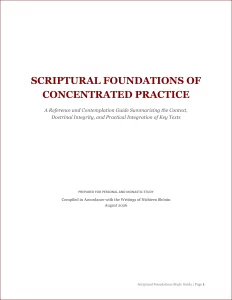
What’s a Buddhist practice guide without a manual. When Gemini Notebook asked, “Would you like me to compile a matching study guide summarizing the scriptural sources?” I said, sure, why not. Here’s what the Nichiren Notebook created.
Download PDF
SCRIPTURAL FOUNDATIONS OF CONCENTRATED PRACTICE
A Reference and Contemplation Guide Summarizing the Context, Doctrinal Integrity, and Practical Integration of Key Texts
PREPARED FOR PERSONAL AND MONASTIC STUDY
Compiled in Accordance with the Writings of Nichiren Shōnin
August 2026
Introduction: The Shift to Concentrated Practice
A profound theological shift defines the transition from classical, gradual Mahayana self-cultivation to the immediate, nondual, effect-based path of Nichiren Buddhism. Traditional Buddhist paths present a linear framework of progression (Proceeding from Cause to Effect, or Jūin Shika), wherein a practitioner must systematically observe hundreds of prohibitive monastic rules and master the six Paramitas over countless lifetimes to build enlightenment from scratch. For practitioners in the Latter Day of the Law (Mappō), whose capacity has deteriorated in this chaotic and spiritually degraded era, attempting to climb this progressive ladder is described by Nichiren Shōnin as unsuited to the times.
To resolve this crisis of capacity, Nichiren Shōnin established the path of Proceeding from Effect to Cause (Jūka Kōin). Because Śākyamuni Buddha completed the arduous, eon-spanning journey of causal practices and obtained their resulting virtues on behalf of all beings, he encapsulated his entire cause and effect within the five characters of the title of the Lotus Sutra: Myō Hō Ren Re Kyō. When a practitioner embraces and chants Namu Myōhō Renge Kyō with single-minded faith, the Buddha spontaneously transfers the totality of his merits directly to them. This study guide compiles the scriptural backgrounds, historical contexts, and doctrinal implications of three essential texts that historically validate, reconcile, and guide this concentrated practice.
1. Isshō Jōbutsu Shō (Becoming a Buddha in One Lifetime) Historical and Manuscript Context
The Isshō Jōbutsu Shō is traditionally assigned in the Shōwa standard edition to the year Kenchō 7 (1255), when Nichiren Shōnin was thirty-four years of age and residing in Kamakura, shortly after his first public proclamation of the Daimoku at Seichō-ji in 1253. While traditional catalogues like that of Toki Jōnin do not record it, it remains one of the most treasured and beautifully written early treatises in the primary section of the canon. It addresses a fundamental question: how can an ordinary person, burdened with deluded karma, dissolve the cycle of birth and death to realize unexcelled bodhi in this very lifetime?
Core Doctrinal Principle: The Tarnished Mirror
To explain the immediacy of Buddhahood, the text utilizes the celebrated metaphor of the mirror, drawing on East Asian nondual paradigms:
“While deluded, one is called an ordinary worldling, and when awakened, one is called a Buddha. To illustrate, even a tarnished mirror, when polished, will appear like a jewel. The mind that is clouded by the illusions of the dark nature of ignorance is like a tarnished mirror, but once polished, it will surely become like a jewel, reflecting the true aspect of reality and the uncreated Dharma-nature. Simply chanting Namu-myōhō-renge-kyō is what is called ‘polishing.'”
This teaching establishes that the deluded mind (ordinary person) and the awakened mind (Buddha) are not separate, distinct entities. Rather, they are the exact same mirror viewed in different states of clarity. This concept entirely bypasses the need to eradicate thoughts or construct a new, holy state. Instead, the act of chanting Namu-myōhō-renge-kyō directly cleanses the mirror of the mind, allowing the originally inherent, uncreated Buddha-nature to shine forth.
The Transition to Concentrated Chanting
Scholars note that the Isshō Jōbutsu Shō represents a key transitional moment in the evolution of Nichiren’s teachings. While it still employs the classical language of meditative discipline—speaking of ‘observing the mind’ (kanjin) or ‘discerning the wonderful principle originally inherent in living beings’—it radically defines this contemplation. It asserts that the actual practice of observing the mind is fully achieved and completed through the single, physical act of chanting the Daimoku. This represents a movement from quietist, silent introspection to active, vocalized devotion, preparing the foundation for the exclusive practice that defines Nichiren Buddhism in the Latter Day of the Law.
2. Ueno-dono Goke-Ama Gohenji (Reply to the Widow of Lord Ueno) Historical Context and the Reality of Grief
In 1259, Nichiren Shōnin converted Nanjō Hyōe Shichirō, a samurai and personal retainer of Hōjō Tokiyori who served as the steward (jitō) of the Ueno district near Mount Fuji. Known as Lord Ueno, Hyōe Shichirō passed away in 1265. His widow, who took Buddhist vows as a nun (Ueno-ama), remained deeply devoted to Nichiren and raised her children—including her eldest son, Nanjō Tokimitsu—to be staunch pillars of the Fuji area Lotus community. The collected works include more than forty letters to the Nanjō family.
This specific letter of condolence, the Ueno-dono Goke-Ama Gohenji, is assigned to either 1265 (shortly after Lord Ueno’s death, addressing a fresh, immediate sorrow) or 1274 (post-Sado). In this letter, Nichiren reassures the grieving widow that her late husband, having been an earnest practitioner of the Lotus Sutra, undoubtedly attained Buddhahood in his very body. He does not dismiss her natural human sorrow, but rather validates her grief, noting that even the great disciples of Śākyamuni Buddha wept at his parinirvana to display the behavior of ordinary human beings.
Core Doctrinal Principle: Hell is the Land of Tranquil Light
To console the widow and explain how her late husband attained supreme awakening, Nichiren Shōnin presents a revolutionary, nondual explanation of the realms of existence:
“Now whether in the case of the Pure Land, or whether in the case of hell, neither is found outside us. They exist solely within our hearts. One awakened to this is called a Buddha. One deluded to it is called an ordinary worldling. What enables this awakening is the Lotus Sutra. And if this is so, then one who embraces the Lotus Sutra awakens to hell being precisely the Land of Tranquil Light.”
This teaching collapses the spatial distance between this suffering world (sahā) and the pure realms of the Buddhas. Because hell and the Pure Land are both manifestations of the mind, the practitioner who embraces the Lotus Sutra is empowered to transform their immediate environment. Even in the midst of the most devastating personal trials and grief, the light of original enlightenment remains fully present. The Dual Practice of Consciousness
Towards the conclusion of the letter, Nichiren Shōnin introduces a highly practical guideline for daily living, which he attributes to ‘a virtuous man of antiquity’:
“Maintain the ground of the mind in the ninth consciousness, but keep your practice in the six consciousnesses.”
The six consciousnesses govern the sensory, intellectual, and physical movements of our daily, secular lives in the world. The ninth consciousness (amala-vijñāna) represents the fundamentally pure, undefiled ground of true suchness and our inherent Buddha-nature. This guidance instructs the follower not to escape from the world, but to keep their deepest, core awareness firmly anchored in the unshakeable, eternal reality of the Daimoku (the ninth consciousness), while continuing to act with diligence, integrity, and compassion within their daily professions, families, and chores (the six consciousnesses).
3. Onkō Kikigaki (Lectures Heard and Recorded) Historical Context and Oral Transmission
The Onkō Kikigaki, also known as the Nikō ki, presents itself as a direct record of lectures on the Lotus Sutra delivered by Nichiren Shōnin to his senior disciples during his retirement on Mount Minobu. According to the introductory note, these lectures were given in succession from the nineteenth day of the third month of the first year of Kōan (1278) through the twenty-eighth day of the fifth month of the third year of the same era (1280), and were recorded by his close disciple Sado Ajari Nikō (1253-1314), the founder of the Minobu lineage.
Modern academic specializations generally classify the Onkō Kikigaki as a composite, late-medieval text (compiled c. 1500) that draws heavily on Tendai original enlightenment (hongaku) oral transmission literature. However, because the final thirty-one topics comment on Nichiren Shōnin’s personal instructions and so closely mirror the encouraging, practical tone of his authenticated letters, it is widely recognized as having successfully preserved the genuine, living voice and direct guidance of the founder.
Core Doctrinal Principle: Flowing Water versus Fire
Among the most celebrated practical instructions preserved in the Onkō Kikigaki is the crucial distinction concerning the character of a disciple’s faith:
“Of the people who put faith in the Lotus Sutra today, some have faith like fire while others have it like water. Those who have faith like fire refer to those who become enthusiastic upon listening to the preaching but their passion cools down as time goes by, and eventually forget the teaching. On the other hand, those whose faith is like water mean those whose faith is like a ceaselessly flowing water, namely those who retain their faith without retreating.”
This teaching serves as an essential warning for lay practitioners. It is easy to arouse a temporary, highly emotional faith when first encountering the Dharma, but such a stance is volatile and easily extinguished when major obstacles or intellectual doubts arise. True practice demands a quiet, steady, and persistent commitment that flows day and night, quietly moving past every barrier, never retreating or slackening. This steady, water-like practice represents the true keeping of the indestructible Diamond Chalice Precept.
4. Doctrinal Synthesis: The Core Themes of Concentrated Faith
When viewed collectively, the Isshō Jōbutsu Shō, the Reply to the Widow of Lord Ueno, and the Onkō Kikigaki provide a cohesive theological framework that fully reconciles the immediate, nondual, ‘faith-based’ nature of Nichiren Buddhism with the demand for strict, rigorous, and steady daily practice. In this nondual theology, strict practice is not a works-based means to acquire a future, distant Buddhahood. Rather, practice is the active, necessary expression and polishing of a Buddhahood that is already inherently present within your life. Through the doctrine of Juji Soku Jikai (upholding the Law is itself keeping the precepts), the ordinary devotee is fully empowered to manifest the Pure Land of Tranquil Light directly within the trials, griefs, and secular duties of the present world, keeping their faith flowing steadily like water.
Comparative Summary of Essential Texts
The following table summarizes the key historical, doctrinal, and practical dimensions of these three pivotal texts:
Essential Text
Context & Date
Core Doctrinal Principle
Practical Application
Isshō Jōbutsu Shō
(Becoming a Buddha in One Lifetime)
Kenchō 7 (1255);
Kamakura.
Recipient: Toki Jōnin.
The Tarnished Mirror:
Delusion and awakening are not separate; chanting the Daimoku is the actual act of ‘polishing’ the mind.
Polishing the mirror of the mind morning and evening through the single, active practice of the Odaimoku.
Ueno-dono Goke-Ama Gohenji
(Reply to the Widow of Lord Ueno)
Bun’ei 2 (1265) or Bun’ei 11 (1274);
Minobu.
Recipient: Widow of Lord Ueno.
Hell is the Land of Tranquil Light; maintain the ground of the mind in the ninth consciousness, but practice in the six consciousnesses.
Anchoring your deepest awareness in the pure, eternal Daimoku while executing your daily, secular labor in the physical world.
Faith Like Flowing Water versus Faith Like Fire:
Continuous, steady devotion vs. volatile, temporary enthusiasm.
Maintaining a quiet, persistent, and unyielding practice that flows continuously day and night, unaffected by obstacles.
References for Further Study
Asai Endō. Nichiren Shōnin’s View of Humanity: The Final Dharma Age and the Three Thousand Realms in One Thought-Moment. Translated by Jacqueline I. Stone. Japanese Journal of Religious Studies 26, nos. 3-4 (1999): 239–259.
Shigyō Kaishû. Jūnyoze no koto no kenkyū (A study of the ‘Jūnyoze no koto’). Seishin 26 (1941): 104–112.
Stone, Jacqueline I. Original Enlightenment and the Transformation of Medieval Japanese Buddhism. Honolulu: University of Hawai’i Press, 1999.
Stone, Jacqueline I. The Atsuhara Affair: The Lotus Sutra, Persecution, and Religious Identity in the Early Nichiren Tradition. Japanese Journal of Religious Studies 41, no. 1 (2014): 153–189.
Watson, Burton, et al., trans. Letters of Nichiren. Edited by Philip B. Yampolsky. New York: Columbia University Press, 1996.
Tomorrow: The Distance from the Buddha Realm to Hell

 What’s a Buddhist practice guide without a manual. When Gemini Notebook asked, “Would you like me to compile a matching study guide summarizing the scriptural sources?” I said, sure, why not. Here’s what the Nichiren Notebook created.