
After finishing my examination of the power and purpose of the Odaimoku and exploring Gemini Notebook’s concept of what a daily practice might look like, I still had a lingering concern. We are told that we do not practice to become a Buddha; rather, the practice is the active expression of the Buddha that we already are. Is there a danger in imagining that the realm of the Buddha is always present?
I opened the Nichiren Notebook and wrote:
Assess the accuracy of this statement against the sources here. Focus on any weakness in the argument:
Hongaku (original enlightenment) presupposes that the realm of the Buddha is inherent in each moment. This is founded on the concept of 3,000 realms in a single thought moment. Since all 10 realms are present at each moment and all 10 realms are present in each realm, the realm of the Buddha is just as close as that of hell.
Here’s Gemini Notebook’s response:
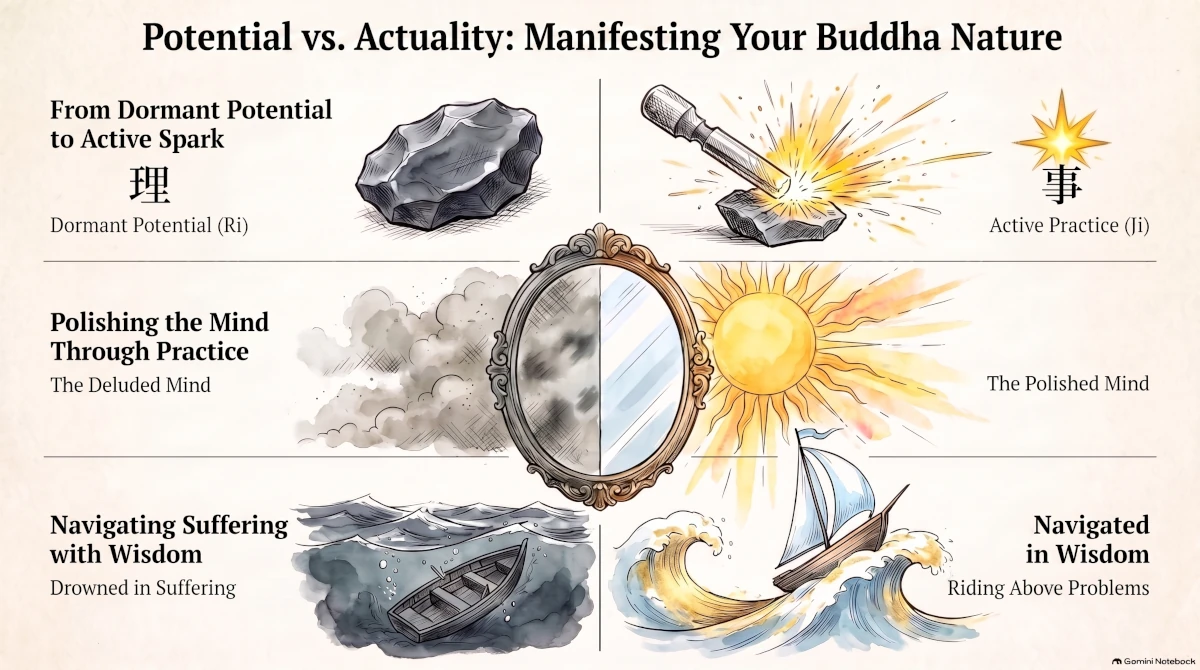
This statement carries profound theological weight and is highly accurate on an ontological level, representing the core nondual teachings of both medieval Japanese Tendai and Nichiren Shōnin. However, when viewed through the lenses of daily human experience and practical application, the argument contains crucial weaknesses and subtle traps that both historic scholars and Nichiren himself sought to resolve.
An examination of the strengths of this statement, followed by a look at the hidden weaknesses of the argument, reveals how these concepts play out in real life.
The Ontological Accuracy: Absolute nonduality
Your statement’s premises are firmly grounded in the classical metaphysics of the Lotus Sutra:
- The Inherence of Buddhahood (Hongaku): Original enlightenment thought indeed presupposes that the Buddha-realm is not a distant, supernatural goal to be constructed over lifetimes of grueling labor, but the originally inherent nature of all reality, sentient and insentient alike.
- The Foundation of Ichinen Sanzen: This immanentalist view is mathematically and philosophically modeled on the Tiantai doctrine of the three thousand realms in a single thought-moment (ichinen sanzen). This doctrine asserts that your ordinary, moment-to-moment mind and the entire physical universe are mutually encompassing.
- The Mutual Possession of the Ten Worlds (Jikkai Gogu): Because each of the Ten Worlds contains all ten within itself, the boundaries between the sacred and the profane are completely collapsed. As Nichiren Shōnin famously wrote to the wife of the Lord of Ōmonsu:
“Some sutras state that hell exists underground while others state that the Buddha exists to the west. Upon closer inspection, however, it is preached that both hell and the Buddha exist within our five-foot bodies.”
Because the hell-realm inherently contains the Buddha-realm, and the Buddha-realm inherently contains the hell-realm, the absolute nondual distance between supreme awakening and supreme torment is indeed collapsed to a single moment of consciousness.
The Hidden Weaknesses of the Argument
While ontologically flawless, a flat, unqualified acceptance of this statement introduces three significant theological and practical weaknesses:
1. The Phenomenological Asymmetry (The Experiential Gap)
The primary weakness of the argument is that it assumes ontological equidistance translates into experiential equidistance. In the everyday life of an ordinary worldling (bonbu), the realms of hell and the Buddha are not experienced as being equally close.
Delusion, anger, greed, and suffering are the default, highly active states of the human mind in this chaotic, spiritually degraded era (mappō). To experience the function of hell, you do not need to exert any spiritual effort; a single moment of rage, greed, or neglect of others immediately manifests it.
In contrast, the Buddha-realm within your mind is heavily obscured, latent, and dormant. In the Kanjin Honzon Shō, Nichiren compares the Buddha-realm in ordinary humans to fire latent within a flint. While the fire is inherently there, it remains completely invisible and inaccessible until you strike the stone. Therefore, while hell manifests spontaneously, the Buddha-realm requires an active, dynamic catalyst—specifically, the physical action of chanting Namu-myōhō-renge-kyō with faith—to be evoked into reality.
2. The Trap of Moral Laxity and Sacralizing the Status Quo
By asserting that the Buddha-realm is “just as close” and already fully present in each moment without any distinction, the argument risks falling into the ultimate historic pitfall of radical Hongaku thought.
If your ordinary, deluded thoughts and behaviors are equated with Buddhahood exactly as they are without transformation, the necessity of ethical conduct, compassion, and practice vanishes. This absolute equation historically led to moral laxity, where even defilements and harmful acts were rationalized as “the Buddha’s work”.
Nichiren strictly guarded against this quietist trap by distinguishing between:
- Ri no Ichinen Sanzen (Principle): The passive, abstract potential for Buddhahood, which is useless if it remains dormant in your mind.
- Ji no Ichinen Sanzen (Actuality): The dynamic actualization of Buddhahood.
You do not manifest your inherent Buddha-nature simply by intellectually knowing it is there. Rather, it must be actively polished and given concrete, relational expression through your daily behavior, your faith, and your vocal practice of the Daimoku.
3. The Symmetrical Fallacy of Mutual Possession
The mutual possession of the Ten Worlds is not a flat, symmetrical identity. While the Buddha-realm contains the hell-realm, and the hell-realm contains the Buddha-realm, the internal structure of these states of life is entirely different:
- In the Buddha-realm, the lower nine realms (including hell) are fully integrated and subdued under the light of supreme wisdom. The Buddha retains the capacity for hell only as a latent vehicle of compassion, allowing him to enter states of suffering to guide and save others.
- In the hell-realm of an ordinary worldling, the Buddha-nature is completely submerged and overpowered by delusions and spiritual blindness.
To say they are “just as close” overlooks this structural hierarchy. Without the guiding light of the True Dharma, the ordinary worldling remains bound by the agonizing chains of suffering, even though the key to their liberation lies within their own breast.
Tomorrow: The Call to Polish the Mirror