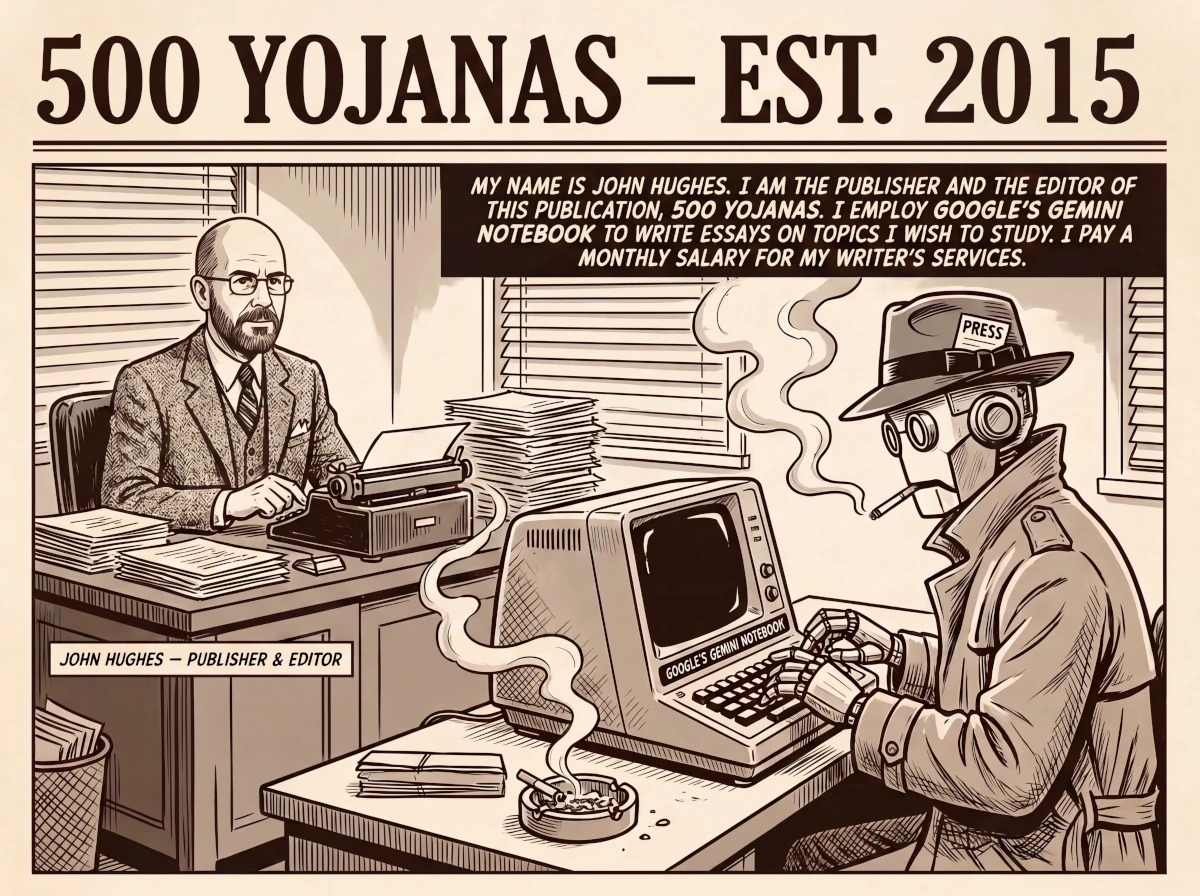
My name is John Hughes. I am the publisher and the editor of this publication, 500 Yojanas. I employ Google’s Gemini Notebook to write essays on topics I wish to study. I pay a monthly salary for my writer’s services.
The Writer, Gemini Notebook
My writer is not free to make up any story it wants. Instead, I, as the editor and publisher, select the sources it should consult. I also give guidance on the tone to be taken and the persona to be displayed in the writing. I ask the question and I judge whether the answer is complete and correct. There’s often some back-and-forth between the editor and the writer before the essay is finished. After accepting the essay, I enforce my style preferences. For example, I recently decided to strictly limit the use of “Law” as a synonym for the Dharma. References to the Latter Day of the Law, mappō, are changed to Latter Day of the Dharma. Just my current preference.
500 Yojanas also has a part-time copy editor. She has held this position for more than 36 years. It is always good to have a second set of eyes review the essays before publication. She has saved 500 Yojanas from much embarrassment caused by typos and made many of the essays much more readable with her suggestions.
Yesterday, 500 Yojanas completed its coverage of Pāramitā Week, the twice-a-year seven days during which Nichiren Buddhists mark the Equinox. The essays published this past week offer a good example of this working relationship between the editor-publisher and the writer.
My Nichiren Notebook currently has 111 sources available for the writer’s use in answering my queries. For this Pāramitā Week, I turned off all but nine of those sources. All that the writer had to work with were the letters written by Nichiren that I uploaded in batches of 50 and a collection of quotes I put together after reading the seven volumes of Nichiren Shu’s translation of these writings.
The academic papers and the brochures published by Nichiren Shu that I have uploaded the Nichiren Notebook were not available and therefore did not influence the writer’s answers. But the absence of those sources meant that modern concerns about Nichiren’s teachings were also absent.
Consider the response to the question, “What did Nichiren have to say about charity?” That essay was published on September 19 under the headline, “Nichiren Shōnin on the Essence of True Charity.”
Missing from the 800 word essay was the final point that the writer sought to make. Here’s the deleted content:
The Absolute Prohibition of Almsgiving to Slanderers of the Law
Finally, Nichiren Shōnin issues a strict warning regarding the direction of one’s charity. While you should offer alms compassionately, it is strictly forbidden to give alms or financial support to those who slander the Lotus Sutra.
Whether a priest observes the precepts, breaks them, or lacks them entirely, if that person slanders the True Dharma (such as the teachers of the Zen, True Word, or Nembutsu schools), extending support to them is highly dangerous. He compares this to planting good seeds in a bad, infertile field, which only ruins the seeds and brings loss.
Nichiren Shōnin notes that giving alms to those who distort the Buddha’s ultimate intent robs the benevolent guardian deities of the “flavor of the Law,” causing them to abandon the nation. Consequently, supporting slanderers invites the “three calamities and seven disasters” upon the land, and the person who gives such alms will surely fall into the great citadel of the hell of incessant suffering.
True charity, therefore, must always be directed toward the correct teaching and its practitioners, ensuring that the seeds of your goodness are sown in the fertile field of the Lotus Sutra.
This is a good example of where what Nichiren wrote and taught doesn’t always translate into what most modern Nichiren followers believe and teach. Limited to just Nichiren’s letters and without the historical context of The Fujufuse Controversy, the writer answered to the best of its ability. I, as the editor, decided to lop off the offending appendage rather than try to explain why this is no longer the position of most Nichiren Buddhists. (I will publish my writer’s explanation of The Fujufuse Controversy tomorrow.)
Active Compassion: Confronting Slander of the Law
Finally, Nichiren’s moral teaching establishes that passive silence in the face of spiritual error is a severe moral failure. True compassion is not a polite, non-confrontational stance that allows others to remain in delusion.
Citing the Nirvana Sutra, Nichiren Shōnin warns that if a priest or layperson sees someone destroying the Buddha’s teachings and fails to reproach, oust, or correct them, that person is actually betraying the Buddha and acting as a mortal enemy to the very people they pretend to tolerate.
Quoting the Great Teacher Chang-an, the writings assert: “One who rids the offender of evil is acting as his parent.”. Therefore, the active and courageous refutation of erroneous teachings (shakubuku) is the highest moral duty of compassion in the Latter Day of the Law, aimed at guiding people away from the heavy karmic suffering of the Avichi hell and placing them firmly on the path of immediate awakening.
Again, without access to modern academic papers or Nichiren Shu brochures, the writer accurately rendered Nichiren’s teaching. Missing is the modern context. We work and live in a much different world than 13th century Japan. After I publish the writer’s explanation of Fujufuse, I will publish the writer’s “The Evolution of Compassion in Modern Nichiren Shū Practice.”