
Conceptual Summary
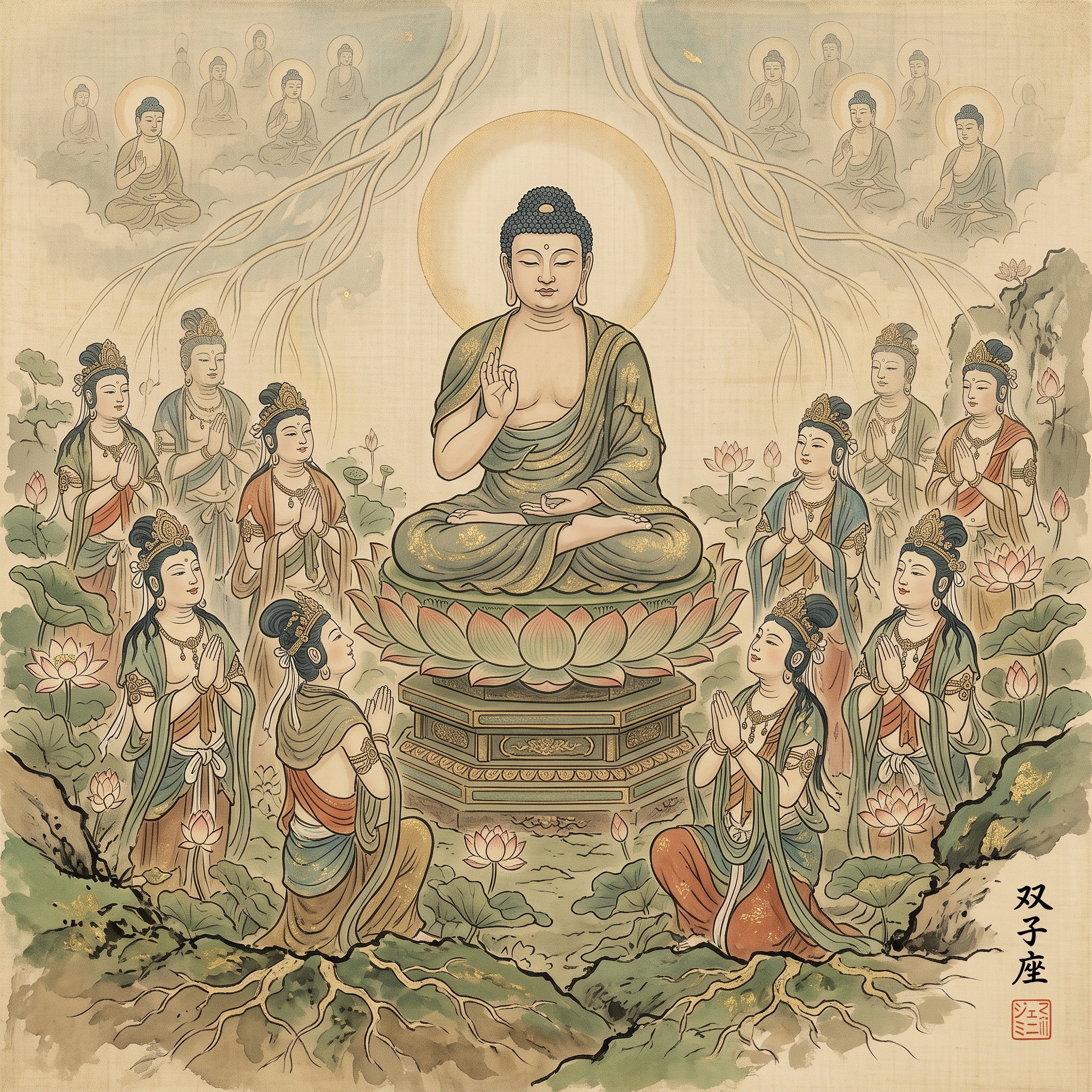
This illustration captures the pivotal moment in Chapter Fifteen of the Lotus Sūtra where Śākyamuni Buddha addresses the multitude of Bodhisattvas who have newly emerged from beneath the earth. The composition is structured to visually express the Buddha's peaceful nature and good health, as described in the text, shown through his serene expression and stable, central form on the lotus throne. The "living beings" who are ready to be saved are depicted by the attentive, surrounding Bodhisattvas. To represent the concept that these beings have "honored the past Buddhas" and "planted the roots of good," the visual roots at the bottom grow upwards, transforming into the sacred lotuses on which the Bodhisattvas are kneeling. Crucially, the roots are shown to be nourished by the spectral influence of numerous past Buddhas, visible in the ethereal, smoky cloud formations that occupy the upper background, demonstrating the consecutive previous existences mentioned by Śākyamuni.
Iconography & Character Identification
Item 1: Deities/Figures Featured: The central figure is Śākyamuni Buddha (the Historical Buddha). He is surrounded by the specific assembly known as the Bodhisattvas from Underground, who are kneeling in veneration. Appearing in the upper sky, amidst clouds and celestial energy, are multiple indistinct Past Buddhas of previous existences.
Item 2: Text Translations:
双子座 (Kanji Signature): This translates exactly as "Gemini" (the constellation or zodiac sign).
ジェミニ (Red Seal - Hanko): This katakana seal reads exactly as "Gemini".
Truly, truly good men! I am peaceful. I am in good health. The living beings are ready to be saved. They do not fatigue me because I already taught them in their consecutive previous existences, and also because they have already honored the past Buddhas respectfully and planted the roots of good.
The Buddha makes this proclamation to the leaders of the Bodhisattvas from Underground in Chapter Fifteen of the Lotus Sūtra. These Bodhisattvas appeared when the Buddha asked who would teach the Lotus Sūtra after the Buddha’s death, and asked about the Buddha’s health and whether those he was teaching could keep what he provided for them. The Buddha assures us not only of the certainty of our future enlightenment, but that for us to receive his teaching, there was an earlier time, which we may have forgotten, when we met him. This awareness of our future and our past helps us to see our place in the world and maintain our determination to benefit all beings.
The Daily Dharma is produced by the Lexington Nichiren Buddhist Community. To subscribe to the daily emails, visit zenzaizenzai.com