
Conceptual Summary
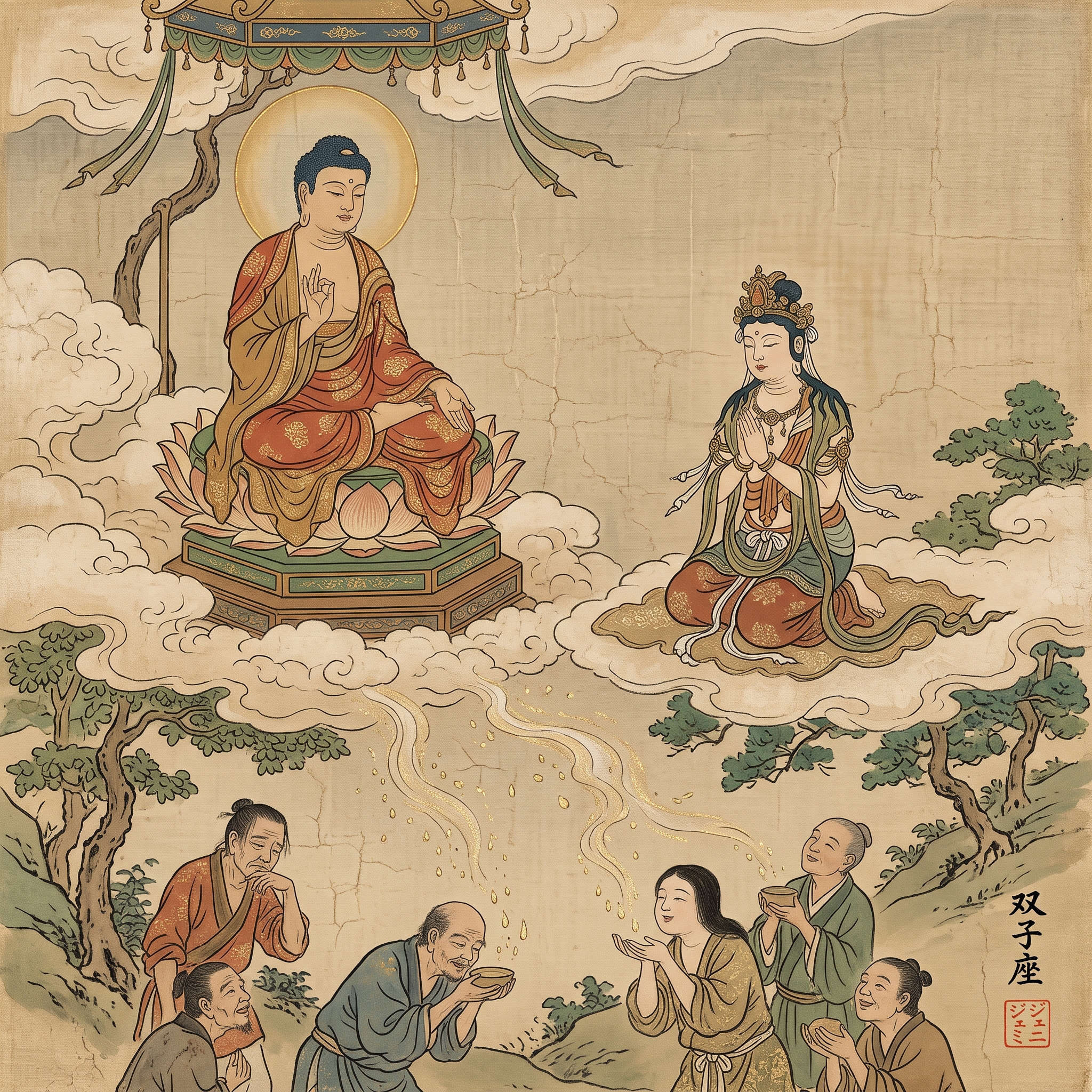
The illustration visualizes the profound teaching of the Lotus Sūtra (Chapter Nineteen) on the transformative power of spiritual realization, capturing how worldly experience and even "taste" can become as "delicious as the nectar of heaven" when perceived with an awakened mind. On the upper left, Śākyamuni Buddha is seated on a lotus throne under a celestial canopy, expounding this wisdom to the attentive Constant-Endeavor Bodhisattva (right), who represents the tireless devotion required to receive and preserve the sūtra. To highlight the passage's metaphor of taste and sensation, the lower realm depicts everyday people in natural settings experiencing the "nectar of heaven." Delicate, gold-tinted streams of celestial amrita (nectar) cascade from the clouds down to the practitioners below, who cup their hands and hold bowls to receive it, their weary and contemplative expressions transforming into peaceful joy and wonder. This imagery captures the idea that our minds alter our perception, revealing that joy and spiritual nourishment do not depend on external, capricious circumstances but on the awakened consciousness that transforms the bitter into the sweet.
Iconography & Character Identification
Item 1: Deities/Figures Featured:
Śākyamuni Buddha (Shaka Nyorai): Seated on the multi-tiered lotus throne under the ornate canopy on the upper left, depicted in traditional monastic robes with a circular golden halo, gesturing in a teaching pose (dharmachakra mudra).
Constant-Endeavor Bodhisattva (Jōgyō Bosatsu): Kneeling reverently on a cloud-like mat on the upper right, adorned with a Bodhisattva's crown, flowing scarves, and ornate jewelry, with hands in prayer (Anjali mudra) listening to the teaching.
Practitioners and Common Folk: A group of everyday individuals, monks, and seekers in the lower portion, gesturing, tasting, and receiving the descending celestial nectar in natural surroundings.
Celestial Attendants/Nectar (Amrita): The symbolic golden droplets and mist-like streams cascading down from the heavenly clouds.
Item 2: Text Translations:
Kanji Signature '双子座' (bottom right): "Gemini" (literally "the constellation of the Twins").
Red Square Seal 'ジェミニ' (hanko, bottom right): "Gemini" (written phonetically in Japanese Katakana).
Anything which tastes good, bad, delicious, distasteful, bitter or astringent, will become as delicious as the nectar of heaven and not distasteful when it is put on their tongues.
The Buddha gives this explanation to Constant-Endeavor Bodhisattva in Chapter Nineteen of the Lotus Sūtra, describing those who keep the Lotus Sūtra. In our habitual pursuit of pleasure, we often forget that what is pleasant to some people is irritating to others. This is most obvious with food. Flavors that some find delicious others find disgusting. When we understand that the things in the world are not the cause of our happiness or misery, and that our minds affect how we perceive the world, we find more joy and wonder than we thought possible, and no longer depend on this capricious existence for our happiness.
The Daily Dharma is produced by the Lexington Nichiren Buddhist Community. To subscribe to the daily emails, visit zenzaizenzai.com