Why Sakyamuni did not prevent [the 5,000 monks and lay followers] from departing [in Chapter 2, Expedients] has been discussed since ancient times. The matter should not be interpreted as a lack of mercy on the part of Sakyamuni; quite the contrary, it shows his infinite patience and compassion. The teaching of the Lotus Sutra allows everyone to become a Buddha, even heretics who oppose the right teaching. Obviously at this point the five thousand arrogant monks were heretics. They were intentionally presented here to show that even a heretic can be saved by Sakyamuni’s mercy and become a Buddha sooner or later. The Buddha does not prevent them at this time so as not to hurt their feelings; he knows that eventually they will return. At root, all people are the same, as we saw in the tenth “Suchness.” This identity, which exists along with manifold differences—as seen in the first nine Suchnesses—is called the “Void” or “Emptiness” in Buddhist philosophy.
Introduction to the Lotus SutraAuthor: John Hughes
-
Day 41 of 100

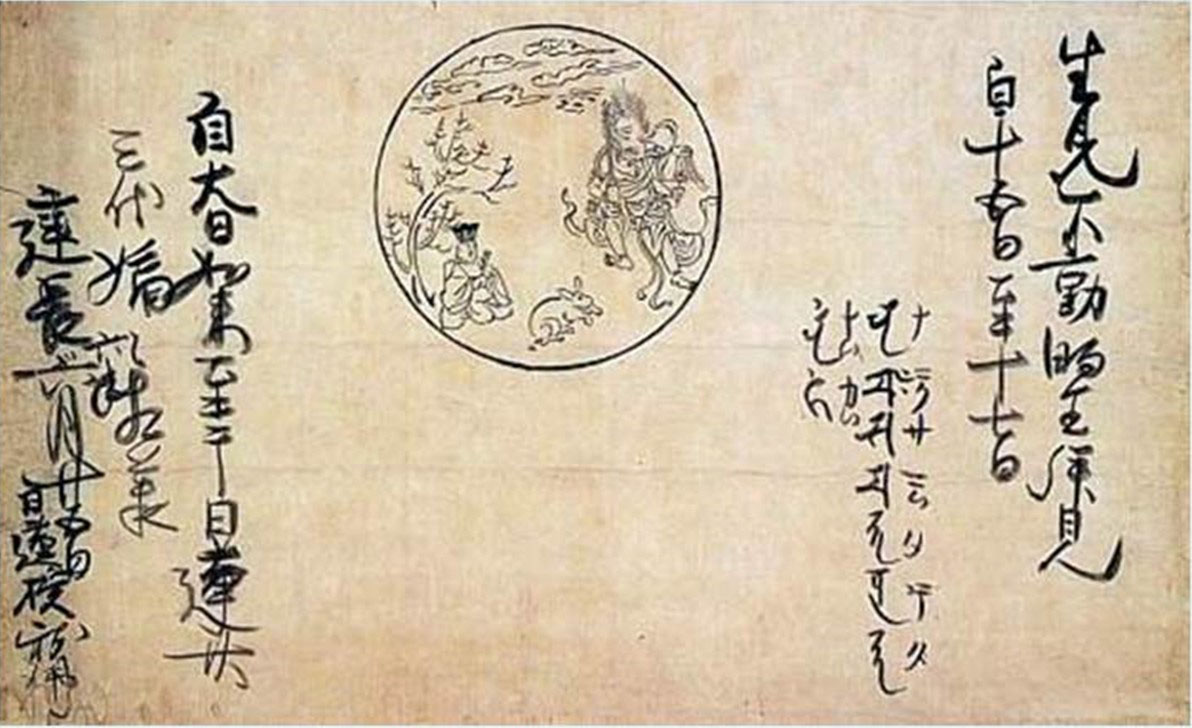
The living Aizen Myōō appeared to me in the glow of the sunset on New Year’s Day. I have become the twenty-third successor to the dharma transmitted from the Great Sun Buddha.Twenty-fifth day of the sixth month in the sixth year of Kenchō (1254)
Nichiren presents this to the New Buddha.

The living Fudō Myōō also appeared to me in the light of the full moon from the 15th through the 17th day of the same month. I have become the twenty-third successor to the dharma transmitted from the Great Sun Buddha.Twenty-fifth day of the sixth month of the sixth year of Kenchō (1254)
Nichiren presents this to the New Buddha
Fudō Aizen Kanken-ki, Record of Seeing Fudō and Aizen Myōō, Writings of Nichiren Shōnin, Biography and Disciples, Volume 5, Pages 1
I’ve included this letter from 1254 as an example of why Nichiren writes 24 years later in 1278, “Now, as far as my theology goes, I would like you to think that what I have expressed before being banished to Sado Island can be equated with the forty or so years in which Śākyamuni had taught before revealing the Lotus Sūtra (that is, the truth and true aims of the Buddha were not directly divulged in those years).” Misawa-shō, A Letter to Lord Misawa of Suruga, Writings of Nichiren Shōnin, Doctrine 2, Page 241. I will be pointing back to this when I get to the letters criticizing Kamakura Era trends in Mikkyo thought.
Needless to say, this event had a lasting impact. As the Introduction to this letter states:
The impact on Nichiren from this experience of seeing Aizen and Fudö was such that he would always inscribe Sanskrit characters representing the two divine protectors of Buddhism (seed-letters) when drawing his Mandala.
Lotus World has this to say about Aizen Myōō (Ragaraja Vidyaraja):
These esoteric deities are the kings of mystic knowledge who represent the power of the buddhas to vanquish blind craving. They are known as “kings of mystic knowledge” because they wield the mantras, mystical spells made up of Sanskrit syllables imbued with the power to protect practitioners of the Dharma from all harm and evil influences. The Vidyarajas appear in terrifying wrathful forms because they embody the indomitable energy of compassion that breaks down all obstacles to wisdom and liberation.
Achalanatha and Ragaraja are represented on the Great Mandala by the respective bijas, or “seed syllables,” that embody their essence. In this case, the seed syllables are written in Siddham, a variant of Sanskrit. They are the only parts of the Great Mandala written in the form of Sanskrit bijas.
Ragaraja Vidyaraja is the king of mystic knowledge who reigns over the passions of love and erotic desire. He is very popular in Japan with geisha, artisans, and those who are concerned with love and sensual desire. Like Achalanatha, Ragaraja Vidyaraja is a wrathful manifestation of Mahavairochana Buddha. He overcomes passion not by suppressing it but by transforming it into the compassionate aspiration to liberate all beings. Ragaraja Vidyaraja has three eyes with which he sees the realms of desire, form, and formlessness. Like Achalanatha, he is surrounded by flames that burn away karmic hindrances. His many arms represent his multitude of powers and capabilities; in them he carries such traditional Buddhist symbols as the lotus flower and vajra. Like the deity of desire known as Kama, he also bears a bow and arrow, but in this case they represent the power of concentration and penetrating insight.
Lotus World has this to say about Fudō Myōō (Acalanatha Vidyaraja):
Achalanatha Vidyaraja is the chief of the five kings of mystic knowledge in esoteric Buddhism. He is very popular in Japan as a destroyer of demons, black magic, sickness; and all forms of evil. He is also revered in Japan as the protector of the nation . According to some interpretations he represents the transmutation of the sufferings of birth and death into the bliss of nirvana.
Achalanatha Vidyaraja is considered a wrathful form or manifestation of Mahavairochana Buddha, who personifies the Dharma-body or Truth-body of the Buddha. He is shown surrounded by flames that consume all karmic obstacles. His sword of wisdom cuts through greed, anger, and ignorance. He uses his lasso to bind the forces of evil but also to catch and draw near those in need of self-control and discipline. The rock he sits on represents his overcoming of the hindrances to enlightenment but also his immovable determination to liberate all beings.
100 Days of Study
-
Daily Dharma – April 10, 2018
Many priests in the Latter Age of Degeneration do not discern the capacity of people. When it is impossible to discern the capacity of people, the true teaching should be preached vigorously.
Nichiren wrote this passage in his Treatise on Chanting the Great Title of the Lotus Sūtra (Shō Hokke Daimoku-shō). When the Buddha taught using expedient means, he could see the delusions and attachments of those whom he taught, and adjust his teachings to them for their benefit. For us who live in this time where most people are not aware of the ever-present Buddha Śākyamuni, all we need to know about those whom we wish to benefit is that they are convinced that this age is headed towards ruin. We cannot know who is ready to receive the Buddha’s highest teaching. Therefore our generosity compels us to provide the teaching that leads towards enlightenment, not merely the teaching that leads away from suffering.
The Daily Dharma is produced by the Lexington Nichiren Buddhist Community. To subscribe to the daily emails, visit zenzaizenzai.com
-
Day 11
Day 11 continues Chapter 7, The Parable of the Magic City
Having last month considered the reaction of the Brahman-heavenly-kings of the five hundred billion worlds in the east to the light generated by Great-Universal-Wisdom-Excellence Buddha when he attained Buddhahood, we consider the reaction of the Brahman-heavenly-kings of the five hundred billion worlds in the southeast.
“Bhikṣus! The great Brahman-[heavenly-]kings of the five hundred billion worlds in the southeast, who saw their palaces illumined more brightly than ever, danced with joy. They also wondered why [their palaces were so illumined]. They visited each other and discussed the reason. There was a great Brahman-heavenly-king called Great-Compassion among them. He said to the other Brahmans in gāthās:
Why is it
That we see this light?
Our palaces are illumined
More brightly than ever.Did a god of great virtue or a Buddha
Appear somewhere in the universe?
We have never seen this [light] before.
Let us do our best to find [the reason].Let us go even to the end of one thousand billion worlds,
And find the place from where this light has come.
A Buddha may have appeared somewhere in the universe
In order to save the suffering beings.“Thereupon the Brahman-heavenly-kings of the five hundred billion [ worlds] went to the northwest, carrying flower-plates filled with heavenly flowers, in order to find [the place from where the light had come]. Their palaces also moved as they went. They [reached the Well-Composed World and] saw that Great-Universal-Wisdom-Excellence Tathāgata was sitting on the lion-like seat under the Bodhi tree of the place of enlightenment, surrounded respectfully by gods, dragon-kings, gandharvas, kiṃnaras, mahoragas, men, and nonhuman beings. They also saw that the sixteen princes were begging the Buddha to turn the wheel of the Dharma. Thereupon the Brahman-heavenly-kings worshipped the Buddha with their heads, walked around him a hundred thousand times, and strewed heavenly flowers to him. The strewn flowers were heaped up to the height of Mt. Sumeru. The Brahman-heavenly-kings offered flowers also to the Bodhi-tree of the Buddha. Having offered flowers, they offered their palaces to the Buddha, saying, ‘We offer these palaces to you. Receive them and benefit us out of your compassion towards us!’ In the presence of the Buddha, they simultaneously praised him in gāthās with all their hearts:
Saintly Master, God of Gods!
Your voice is as sweet as a kalavinka’s.
You have compassion towards all living beings.
We now bow before you.
You, the World-Honored One, are exceptional.
You appear only once in a very long time.No Buddha has appeared
For the past one hundred and eighty kalpas.
The three evil regions are crowded;
And the living beings in heaven, decreasing.Now you have appeared in this world
And become the eye of all living beings.
As their refuge, you are saving them.
As their father, you are benefiting them
Out of your compassion towards them.
We are now able to see you
Because we accumulated merits
In our previous existence.“Thereupon the Brahman-heavenly-kings, having praised the Buddha with these gāthās, said, ‘World-Honored One! Turn the wheel of the Dharma and save all living beings out of your compassion towards them!’ Then they simultaneously said in gāthās with all their hearts:
Great Saint, turn the wheel of the Dharma
And reveal the reality of all things!
Save the suffering beings
And cause them to have great joy!If they hear the Dharma, some will attain enlightenment;
Others will be reborn in heaven.
The living beings in the evil regions will decrease;
And those who do good patiently will increase.“Thereupon Great-Universal-Wisdom-Excellence Tathāgata gave his tacit consent to their appeal.
-
The Future After the Buddha’s Extinction
The Lotus Sutra has teachings that prophesy the future after the Buddha’s extinction. These teachings are unique to this Sutra, and are not found in other sutras to such an extent. The prophecy [in Chapter 13, Encouragement for Keeping this Sutra,] tells us that the world after the extinction of the Buddha will be an evil place–an Age of Degeneration–in which expounders of the Lotus Sutra can expect to suffer troubles and even persecution. That they must overcome these troubles and expound the Lotus Sutra to make this Saha-world into the Pure Land of the Buddha, is not just a prophecy. It is a major teaching. The … verses recited by the never-faltering bodhisattvas represent this teaching. It is called the “Twenty Verses of Chapter Thirteen.”
These twenty verses had much influence on Nichiren. He mentions them in his treatise, Kaimokusho (“Opening the Eyes”). “If I had not been born in this country,” he says, “the twenty verses in Chapter Thirteen would not have been proven, the World-Honored One would have seemed to be a great liar, and the eighty billion nayuta of bodhisattvas would have fallen into the sin of lying, too. Just as the Lotus Sutra foretold, I was often driven out (into exile). The word ‘often’ in the Sutra came true. This word was not experienced by either Tendai (Great Master Chih-i of China) or Dengyo (Great Master Saicho of Japan), not to speak of lesser people. I, Nichiren, alone read them from experience. For I perfectly fit the Buddha’s description of the person spreading the Lotus Sutra ‘in the dreadful and evil world’ at the beginning of the Latter Age.”
That is to say, Nichiren was the only person who read, experienced, and dedicated his life to the real meanings of the verses of Chapter Thirteen.
Introduction to the Lotus Sutra
-
The True Nature of the Buddha’s Enlightened Life
Based upon his understanding of the Ceremony in the Air, Nichiren taught that we should take refuge in the Eternal Shakyamuni Buddha revealed in the Lotus Sutra as the unity of the historical, ideal, and universal aspects of Buddhahood. These are fully manifested by Shakyamuni Buddha and are also the potential that lies within all of us. The Eternal Shakyamuni Buddha, therefore, should be our focus of devotion if we want to realize for ourselves the true nature of the Buddha’s enlightened life and our own.
Lotus World: An Illustrated Guide to the Gohonzon
-
Day 40 of 100
I am grateful to have been born a human with this precious body due accumulated causes and conditions in my past existences. According to the sūtra, I must have encountered and given offerings to ten trillion Buddhas in the past. Even though I did not place my faith exclusively in the Lotus Sūtra, thus slandering the True Dharma and being born poor and lowly in this life as a result, my merit of giving offerings to the Buddhas was so great that I was born as a believer of the Lotus Sūtra.
Interpreting this, Grand Master T’ien-t’ai (sic) states, “It is like a person who falls to the ground but does not stay there and rises from the ground instead.” Those who fall to the ground get up from the ground instead. Likewise, the grand master states, slanderers of the Lotus Sūtra fall on the ground of the three evil realms and the realms of human and heavenly beings; however, due to their reverse relationship to the Lotus Sūtra they will be led by the hand of the sūtra into the realm of Buddhas.
Hokke Shōmyō-shō, Treatise on the Testimony of the Lotus Sūtra, Writings of Nichiren Shōnin, Faith and Practice, Volume 4, Pages 185
While chanting Namu Myōhō Renge Kyō I enjoy pondering how I arrived where I am today, the “accumulated causes and conditions in my past existences.” Would we learn faster if we could remember our past mistakes?
Here ends the fourth volume of the Writings of Nichiren Shōnin.
100 Days of Study
-
Daily Dharma – April 9, 2018
When they expound the Dharma to the great multitude with their tongues, they will be able to raise deep and wonderful voices, to cause their voices to reach the hearts of the great multitude so that the great multitude may be joyful and cheerful. Hearing their speeches given in good order by their deep and wonderful voices, Śakra, Brahman, and the other gods and goddesses will come and listen to them.
The Buddha declares these lines to Constant-Endeavor Bodhisattva in Chapter Nineteen of the Lotus Sūtra, describing those who keep the Lotus Sūtra. When we share the Buddha Dharma with others, it is as if the Buddha’s mind is finding voice in our words. It should then come as no surprise to us that beings of all dispositions will want to hear more of what the Buddha has taught us. When we “practice the sūtra with our bodies,” as Nichiren described, when we make this teaching a part of our lives, then we find the words we need to reach all beings and lead them to the Buddha’s enlightenment.
The Daily Dharma is produced by the Lexington Nichiren Buddhist Community. To subscribe to the daily emails, visit zenzaizenzai.com
-
Day 10
Day 10 concludes Chapter 6, Assurance of Future Buddhahood, and opens Chapter 7, The Parable of a Magic City.
Having last month heard the Assurance of Future Buddhahood for Subhūti, we hear the prediction for Great Kātyāyana.
Thereupon the World-Honored One said to the bhikṣus:
“Now I will tell you. This Great Kātyāyana will make many offerings to eight hundred thousand millions of Buddhas, attend on them, respect them, and honor them in his future life. After the extinction of each of those Buddhas, he will erect a stūpa-mausoleum a thousand yojanas high, and five hundred yojanas wide and deep. He will make it of the seven treasures: gold, silver, lapis lazuli, shell, agate, pearl and ruby. He will offer flowers, necklaces, incense to apply to the skin, incense powder, incense to burn, canopies, banners and streamers to this stūpa-mausoleum. After that he will make the same offerings to two billions of Buddhas. Having made offerings to those Buddhas, he will complete the Way of Bodhisattvas, and become a Buddha called Jambunada-Gold-Light, the Tathāgata, the Deserver of Offerings, the Perfectly Enlightened One, the Man of Wisdom and Practice, the Well-Gone, the Knower of the World, the Unsurpassed Man, the Controller of Men, the Teacher of Gods and Men, the Buddha, the World-Honored One. The ground [of his world] will be even, made of crystal, and adorned with jeweled trees. The roads will be marked off by ropes of gold, and wonderful flowers will cover the ground to purify it. Anyone will rejoice at seeing it. The four evil regions: hell, the region of hungry spirits, that of animals, and that of asuras, will not exist in that world. Many gods and men will live there. Śrāvakas and Bodhisattvas, many billions in number, also will live there to adorn that world. The duration of the life of that Buddha will be twelve small kalpas. His right teachings will be preserved for twenty small kalpas, and the counterfeit of his right teachings also will be preserved for twenty small kalpas.”
Thereupon the World-Honored One, wishing to repeat what he had said, sang in gāthās:
Bhikṣus!
Listen with one mind!
What I say
Is true, not false.This Kātyāyana
Will make
Wonderful offerings
To the Buddhas.After the extinction of each of the Buddhas,
He will erect a stūpa of the seven treasures,
And offer flowers and incense to the śarīras
[Of the Buddha enshrined in the stūpa].On the final stage of his physical existence,
He will obtain the wisdom of the Buddha
And attain perfect enlightenment.
His world will be pure.
He will save many billions of living beings.
All living beings
In the worlds of the ten quarters
Will make offerings to him.No light will surpass
The light of that Buddha.
The name of that Buddha will be
Jambu [nada]-Gold-Light.Innumerable Bodhisattvas and Śrāvakas
Will live in his world, and adorn that world.
They will have already eliminated
The bonds of existence. -
In This Very Life
[I]t would be a serious mistake to take the teaching of the “attainment of Buddhahood in this life” as meaning we can attain enlightenment without any effort. Even if we believe strongly in a religion, we must still practice it and apply its principles to our life. But by the power of their faith, ordinary people can attain the power of the Buddha without first completing difficult studies and practicing for eons and eons. This is what is meant by the “attainment of Buddhahood in this very life” [in Chapter 12, Devadatta.]
Introduction to the Lotus Sutra