
It says in the sutra, and Nichiren repeats it in his letters, it only takes one candle to instantly eliminate the darkness that has filled a cave for thousands of years. Chanting Odaimoku is like that candle. No matter how small or feeble, that one candle does begin to light up your life. That spark of hope can be the foundation of faith in your life that anything is possible to change if you follow the teachings of the Lotus Sutra.
Lecture on the Lotus SutraAll posts by John Hughes
Daily Dharma – June 21, 2017
When I saw that some people of little virtue and of much defilement were seeking the teachings of the Lesser Vehicle, I told them, ‘I renounced my family when I was young, and attained Anuttara-samyak-saṃbodhi [forty and odd years ago].’ In reality I became the Buddha in the remotest past as I previously stated. I told them so as an expedient to teach them, to lead them into the Way to Buddhahood.
In Chapter Sixteen of the Lotus Sutra, the Buddha gives this explanation of a parable he tells in Chapter Three. In that story, the foolish children of a wise man were playing in a burning house. The man tried to warn his children of the dangers of the house, but the children were so preoccupied with their games they would not leave. Only when the man promised them better toys outside would the children leave the house. The words used by the wise man were meant to get the children out of the house, even though the toys did not exist. These words were necessary to motivate the children to set aside their delusions. They were not meant to be taken literally. We learn from this explanation how the Buddha uses words, and why we formerly needed his expedient teachings.
The Daily Dharma is produced by the Lexington Nichiren Buddhist Community. To subscribe to the daily emails, visit zenzaizenzai.com
Day 6
Day 6 continues Chapter 3, A Parable
Having last month begun The Parable of the Burning House, we come to the expedient used to save the children.
“Thereupon the rich man thought, ‘This house will be burned down soon by this great fire. If they and I do not get out at once, we shall be burned. I will save them from this danger with an expedient.
“An idea came to his mind that his children would be attracted by the various toys which they wished to have. He said to them, ‘The toys you wish to have are rare and difficult to obtain. You will be sorry if you do not get them now. There are sheep-carts, deer carts, and bullock-carts outside the gate. You can play with them. Come out of this burning house quickly! I will give you any of them according to your wishes.’
“Hearing of the toys from their father, the children rushed quickly out of the burning house, pushing one another, and striving to be first, because they thought that they could get what they each wished to have. The rich man, who saw them having come out safely and sitting in the open on the crossroad with no more hindrance, felt relieved and danced with joy. They said to their father, ‘Father! Give us the toys! Give us the sheep-carts, deer-cart and bullock-carts you promised us!’
“Śāriputra! Then the rich man gave each of them a large cart of the same size. The cart was tall, wide and deep, adorned with many treasures, surrounded by railings, and having bells hanging on the four sides. A canopy adorned with rare treasures was fixed on the top of it. Garlands of flowers, tied with jeweled ropes, were hanging from the canopy. In the cart were quilts spread one on another, and a red pillow. The cart was yoked with white bullocks. The color of the skin of the white bullocks was bright; their build, beautiful and stout; and their pace, regular. They could run as swift as the wind. The cart was guarded by many attendants. [This great rich man gave one of these carts to each of his children] because his wealth was so immeasurable that his various storehouses were full [of treasures]. He thought, ‘My treasures are limitless. I should not give inferior, smaller carts to them. They are all my children. Therefore, I love them without partiality. I have a countless number of these large carts of the seven treasures. I gave one of these to each of my children equally. There should be no discrimination. The large carts are numerous enough to be given to all the people of this country. Needless to say, I can give them to my sons. [Therefore, I did.]’
As a child of the 1950s, steeped in the fear of spoiling children, I find it a measure of the Buddha’s enlightenment that he proclaims: “They are all my children. Therefore, I love them without partiality.”
Striving to Become Buddhas
Mahayana Buddhism teaches that the Buddha actually has three bodies: a historical body; an ideal body, which can only be seen by bodhisattvas; and a transcendent universal body, which is ultimate reality itself. In its highest form, Mahayana Buddhism teaches that we all have Buddha-nature and that we should all strive to become Buddhas ourselves.
Lotus Seeds
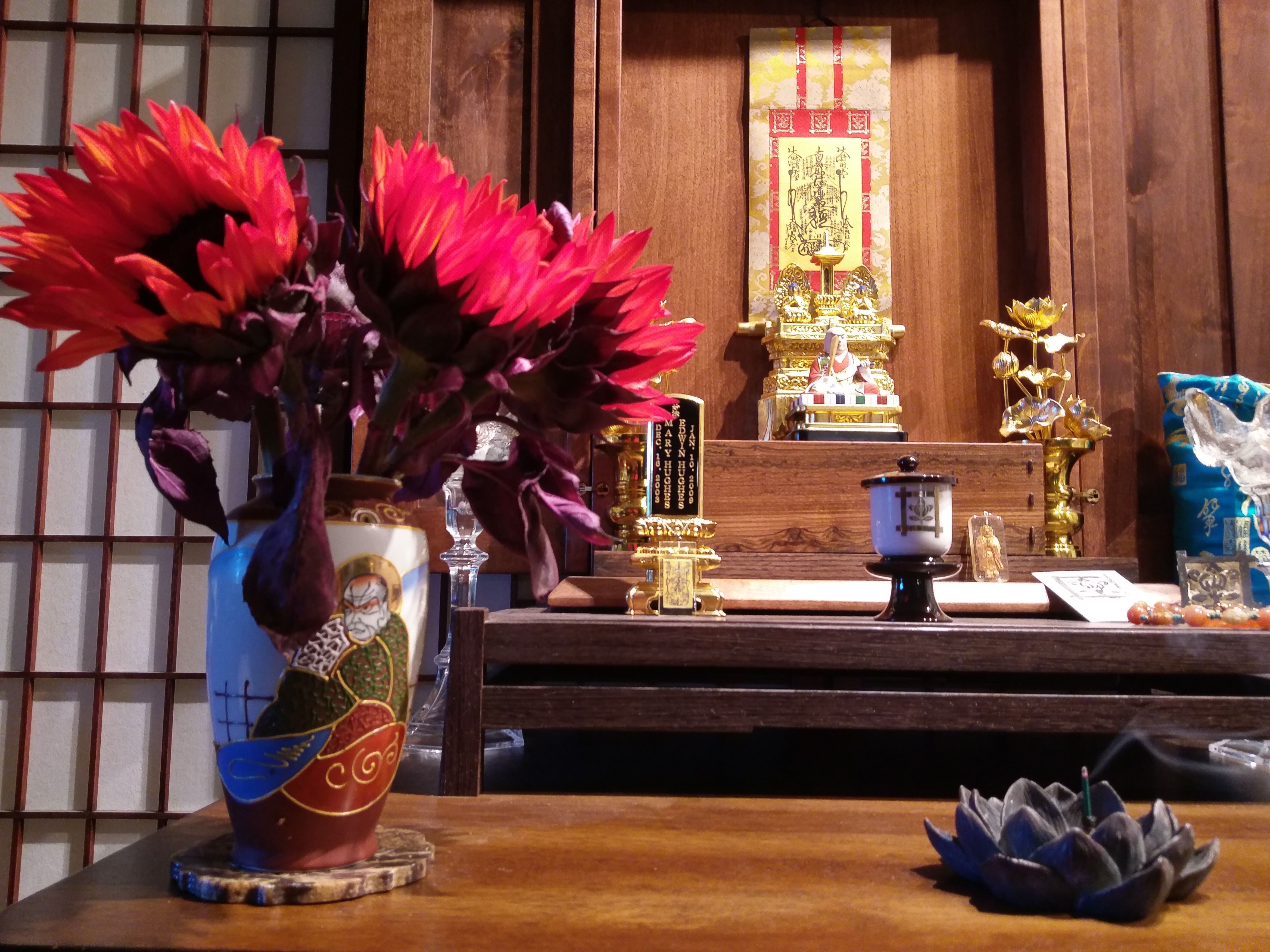
Red Sun Flowers
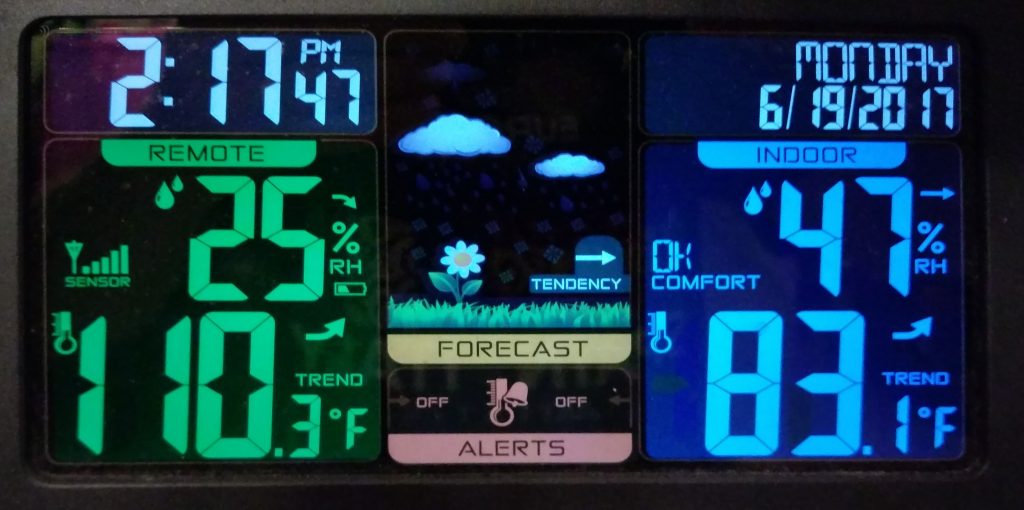
I don’t do well when it the temperature is above 105 degrees for more than three consecutive days. Yesterday reached 110 degrees in the shade on my backyard deck, after two days of 105-plus weather. The forecast predicts tomorrow will be hotter than yesterday and Thursday nearly as hot.
So maybe it was something not so subconscious that prompted me to buy fire-red sunflowers as my offering to the Sutra of the Lotus Flower of the Wonderful Dharma.
Daily Dharma – June 20, 2017
Therefore, Star-King-Flower! I will transmit this Chapter of the Previous Life of Medicine-King Bodhisattva to you. Propagate this chapter throughout the Jambudvīpa in the later five hundred years after my extinction lest it should be lost, and lest Māra the Evil One, the followers of Māra, gods, dragons, yakṣas, and kumbhāṇḍas should take advantage [of the weak points of the people of the Jambudvīpa].
The Buddha gives this explanation to Star-King-Flower Bodhisattva in Chapter Twenty-Three of the Lotus Sūtra. The Jambudvīpa is the name the Buddha gives to this world of conflict and attachment in which we live. Nichiren interprets “the later five hundred years” as the time in which we are living today. The story of Medicine-King Bodhisattva is one of a being who does not spare any part of his life to benefit others. This Bodhisattva is confident that he will become enlightened, and that whatever happens to his physical body, he will always be reborn in worlds where he has the chance to benefit others and lead them by the wisdom of the Buddha. This chapter, and all those towards the end of the Lotus Sūtra, give us examples of how to bring the teachings of the Buddha to life.
The Daily Dharma is produced by the Lexington Nichiren Buddhist Community. To subscribe to the daily emails, visit zenzaizenzai.com
Day 5
Day 5 begins Chapter 3, A Parable
Having last month learned about Śāriputra’s future Buddhahood, we begin again in gāthās.
Thereupon the World-Honored One, wishing to repeat what he had said, sang in gāthās:
Śāriputra! In your future life you will become
A Buddha, an Honorable One of Universal Wisdom,
Called Flower-Light,
And save innumerable living beings.You will make offerings to innumerable Buddhas.
You will perform the Bodhisattva practices.
You will obtain the ten powers and the other merits,
And attain unsurpassed enlightenment.The kalpa [of that Buddha] will come
after innumerable kalpas from now.
It will be called Great-Treasure-Adornment.
The world [of that Buddha] will be called Free-From-Taint.
It will be pure and undefiled.
Its ground will be made of lapis lazuli.
Its roads will be marked off by ropes of gold.
Its trees of the various colors of the seven treasures
Will always bear flowers and fruit.The Bodhisattvas of that world
Will always be resolute in mind.
They will have already obtained
The supernatural powers and the paramitas.
They will have already studied the Way of Bodhisattvas
Under innumerable Buddhas.
Those great people will be taught
By the Flower-Light Buddha.That Buddha will appear in his world at first as a prince.
The prince will give up his princeship and worldly fame.
He will renounce the world at the end of his life as a layman,
And attain the enlightenment of the Buddha.The duration of the life of Flower-Light Buddha
Will be twelve small kalpas.
The duration of the life of the people of his world
Will be eight small kalpas.After the extinction of that Buddha,
His right teachings will be preserved
For thirty-two small kalpas.
All living beings will be saved [by his right teachings].After the end of the period of his right teachings,
The counterfeit of them will last for thirty-two [small kalpas].
His śarīras will be distributed far and wide.
Gods and men will make offerings to them.These will be the deeds
Of Flower-Light Buddha.
That Honorable Biped will be
The most excellent one without a parallel.
You will be he.
Rejoice!
Last month I pondered why Śākyamuni specifies that Śāriputra will teach only the Three Vehicles, and this time I ponder the role of princes, beginning with the young Siddhartha, prince of the Shakya clan. Princes abandoning princeships occurs over and over in the Lotus Sutra. It is almost as if one must first attain the life of a prince in order to have enough elevation to step into the Buddha’s wisdom.
Daily Dharma – June 19, 2017
A bhikṣu who expounds this Sūtra
Of the Lotus Flower of the Wonderful Dharma
With patience
After my extinction,
Will be emancipated
From jealousy, anger, and other illusions,
That is to say, from all obstacles.
The Buddha sings these verses to Mañjuśrī Bodhisattva in Chapter Fourteen of the Lotus Sūtra in which he describes the peaceful practices of a Bodhisattva. We may realize that jealousy and anger are not desirable states, but only because what these states do to our moods. No matter how justified we may feel in our jealousy or anger, these are not pleasant states to be in or even to be around. The Buddha reminds us that the real problem with these states is that they keep us from seeing things as they are. Jealousy exaggerates the importance of what we want but do not have. Anger exaggerates the bad qualities of the targets of our anger. When we focus on this wonderful teaching, develop our patience, and remain determined to benefit all beings, we see things for what they are, and are liberated from illusions.
The Daily Dharma is produced by the Lexington Nichiren Buddhist Community. To subscribe to the daily emails, visit zenzaizenzai.com
Day 4
Day 4 finishes Chapter 2, Expedients, and completes the first volume of the Sūtra of the Lotus flower of the Wonderful Dharma.
Having last month reviewed of what all Buddhas teach, we come to Śākyamuni’s initial reluctance to preach the Dharma.
Śāriputra, know this!
Seeing with the eyes of the Buddha
The living beings of the six regions, I thought:
“They are poor, and devoid of merits and wisdom.
They incessantly suffer because they are taken
To the rough road of birth and death.
They cling to the five desires
Just as a yak loves its tail.
They are occupied with greed and cravings,
And blinded by them.
They do not seek the Buddha who has great power.
They do not seek the Way to eliminate sufferings.
They are deeply attached to wrong views.
They are trying to stop suffering by suffering.”My great compassion was aroused towards them.
I for the first time sat at the place of enlightenment[,]
[And attained enlightenment].
For three weeks afterwards,
I gazed on the tree,
Or walked about, thinking:
“The wisdom I obtained is
The most wonderful and excellent.
The living beings [of the six regions]
Are dull, attached to pleasures,
And blinded by stupidity.
How shall I save them?”
Nothing better describes the problems of the world than Śākyamuni’s observation: “They are trying to stop suffering by suffering.” Imagine awakening to the truth of all things and realizing, “No one is going to believe this.”
Equality Before Buddha
Ultimately, the largest treasure and most precious “benefit” one will receive is none other than the Buddha’s enlightenment. This goes without saying, that in the true spirit of the Lotus Sutra, one need not first be a holy or religious man in order to benefit from this practice. It does not matter whether one is a priest, lay person, man, woman, educated or not, employed, nonemployed, perfect, imperfect, with or without problems, etc. A human being is always a human being, and before the Buddha, all are equal. Buddhism therefore addresses all life in an entirely impartial manner. All living beings can become a Buddha, without exception.
Odaimoku: The Significance Of Chanting Namu Myoho Renge Kyo