All posts by John Hughes

This Is _Just_ My View; Nothing Official, Nothing Enlightened

This was originally part of an answer I wrote to someone who found the concept of the three bodies of the Buddha confusing.

My preference in regard to all things that appear confusing is to recall the number of times people ask questions in the Lotus Sutra. The whole purpose of the pursuit of Enlightenment is to gain the wisdom of the Buddha. Asking questions fits right in. And when there is no one to ask, I find just contemplating the question can allow me to relieve the anxiety of not knowing or, from a different perspective, release the attachment I have to needing to know everything.

The concept of the Three Bodies of the Buddha is important but more for contemplating than for actually knowing. I like to think of it this way. (And this is _just_ my view; nothing official, nothing enlightened.) The historical Buddha sat under the Bodhi tree and became enlightened. What he became enlightened to existed already much as we might say Newton discovered gravity. No one would suggest he created gravity. That pre-existing, always existing Enlightenment is one of the Buddha’s bodies in the Nichiren Shu tradition.

This concept of what it means to become enlightened is alluded to in Chapter 7 of the Lotus Sutra, The Parable of a Magic City:

The Buddha said to the bhiksus:
The duration of the life of Great-Universal-Wisdom-Excellence Buddha was five hundred and forty billion nayuta kalpas. [Before he attained Buddhahood,] he sat at the place of enlightenment and defeated the army of Mara. He wished to attain Anuttara-samyak-­sambodhi, but could not because the Dharma of the Buddhas had not yet come into his mind. He sat cross-legged without moving his mind and body for one to ten small kalpas. During all that time the Dharma of the Buddhas did not come into his mind.

I personally love the line, “the Dharma of the Buddhas did not come into his mind.” Keep trying.

Sakyamuni’s enlightenment of itself is another body. The physical body that existed in time and space is the third.

Lots of resources for Nichiren Shu doctrine are available in English. I have a personal blog — 500yojanas.org — and that includes books I’ve read and some quotes from each that I found inspiring. I strongly recommend subscribing to the Daily Dharma, which is an email list. I collect these daily emails on my website and often use them as part of my personal practice.

Here I’ll close by throwing out a couple of those quotes to consider.

From Lotus Seeds: The Essence of Nichiren Shu Buddhism:

Shakyamuni Buddha was no different than any of us, except for his extraordinary wisdom and compassion. He is known as “the” Buddha, not because he attained something that ordinary people cannot attain, but because he was the first person in recorded history to awaken to the truth and to show others how to do so. In that sense, the title “Buddha” is reserved for Shakyamuni simply because he happened to be the one to fulfill the role of teacher and model for all those who would follow his path. However, all of us have the Buddha-nature. Therefore, all of us are capable of displaying the same wisdom and compassion as Shakyamuni Buddha.

From Odaimoku: The Significance Of Chanting Namu Myoho Renge Kyo:

By embracing the faith and practice of Myoho Renge Kyo, we can revitalize our lives. In other words, regardless of the state of life in which we find ourselves at any given moment, through faith and practice we can transform any life condition (no matter how negative) into enlightenment. In this way, we can develop wisdom and a life that is no longer a slave to pain, delusion and suffering.

Again, this is _just_ my view; nothing official, nothing enlightened.
Daily Dharma – March 5, 2017

When they come to him
With good intent
In order to hear
About the enlightenment of the Buddha,
He should expound the Dharma to them
Without fear,
But should not wish to receive
Anything from them.

The Buddha makes this explanation to Mañjuśrī Bodhisattva in Chapter Fourteen of the Lotus Sūtra in which he describes the peaceful practices of a Bodhisattva. In our zeal to practice this Wonderful Dharma we may come to expect that because this is such a wonderful teaching, we deserve to be rewarded for providing it to others. With this expectation, we then lose our focus on using the Dharma to benefit others and instead use it to benefit ourselves. When we show how to give freely, without expectations, we embody generosity, the same generosity the Buddha himself demonstrated when he provided the teaching to us.

The Daily Dharma is produced by the Lexington Nichiren Buddhist Community. To subscribe to the daily emails, visit zenzaizenzai.com

Day 26

Day 26 concludes Chapter 21, The Supernatural Powers of the Tathāgatas, includes Chapter 22, Transmission, and introduces Chapter 23, The Previous Life of Medicine-King Bodhisattva.

Having last month begun Chapter 23, The Previous Life of Medicine-King Bodhisattva, it’s time to discuss what who Gladly-Seen-By-All-Beings was.

Thereupon the Buddha said to Star-King-Flower Bodhisattva:

Innumerable kalpas ago, that is as many kalpas as there are sands in the river Ganges ago, there lived a Buddha called Sun­-Moon-Pure-Bright-Virtue, the Tathagata, the Deserver of Offerings, the Perfectly Enlightened One, the Man of Wisdom and Practice, the Well-Gone, the Knower of the World, the Unsurpassed Man, the Controller of Men, the Teacher of Gods and Men, the Buddha, the World-Honored One. He was accompanied by eight thousand million great Bodhisattva-mahasattvas and also by great Sravakas numbering seventy-two times as many as there are sands in the River Ganges. The duration of his life was forty-two thousand kaipas. So were the durations of the lives of the Bodhisattvas. His world was devoid of women, hellish denizens, hungry spirits, animals and asuras. There was no calamity in his world. The ground of his world was as even as the palm of the hand. It was made of lapis lazuli, adorned with jeweled trees, and covered with a jeweled awning from which the streamers of jeweled flowers were hanging down. Jeweled vases and incense-burners were seen everywhere in that world. There was a platform of the seven treasures at the distance of a bowshot from each of the jeweled trees under which the Bodhisattvas and Sravakas were sitting. On each of the platforms of treasures, myriads of millions of gods were making heavenly music, singing songs of praise of the Buddha, and offering the music and songs to the Buddha.

Thereupon [Sun-Moon-Pure-Bright-Virtue] Buddha expounded the Sutra of the Lotus Flower of the Wonderful Dharma to Gladly­-Seen-By-All-Beings Bodhisattva, to the other Bodhisattvas, and also to the Sravakas. Gladly-Seen-By-All-Beings Bodhisattva willingly practiced austerities under Sun-Moon-Pure-Bright-Virtue Buddha. He walked about the world, seeking Buddhahood strenuously with all his heart for twelve thousand years until at last he obtained the samadhi by which he could transform himself into any other living being. Having obtained this samadhi, he had great joy.

Next month, the offering of Gladly-Seen-By-All-Beings.

Making Time

It may be very difficult for people who are extremely busy to perform Otsutome every day. They tend to have no spare time, especially in the mornings. But busy people really need to make and take time to relax and meditate, because in our busy lives and living in such a complex society, it is easy to lose sight of our own pace. We need time to recover our pace and rhythm of life.

Spring Writings

Daily Dharma – March 4, 2017

He will be able to recognize
All the sounds and voices
Inside and outside the one thousand million Sumeru-worlds,
[Each being composed of the six regions]
Down to the Avīci Hell and up to the Highest Heaven.
And yet his organ of hearing will not be destroyed.
He will be able to recognize everything by hearing
Because his ears are sharp.

The Buddha sings these verses in Chapter Nineteen of the Lotus Sūtra about those who practice the Buddha Dharma. We may believe that a spiritual practice leads us to “otherworldly” experiences that allow us to escape the problems we find in the world around us. These verses remind us that the teachers of the Dharma become more engaged with the world around us rather than becoming separate from it. It is through our right practice of the Lotus Sūtra that we become aware of the world as it is, and our place in making it better.

The Daily Dharma is produced by the Lexington Nichiren Buddhist Community. To subscribe to the daily emails, visit zenzaizenzai.com

Day 25

Day 25 covers all of Chapter 20, Never-Despising Bodhisattva, and opens Chapter 21, The Supernatural Powers of the Tathāgatas.

Having last month meet Never-Despising Bodhisattva, we learn of his abuse and his reward.

Some of the four kinds of devotees had impure minds. They got angry, spoke ill of him and abused him, saying, ‘Where did this ignorant bhiksu come from? He says that he does not despise us and assure us that we will become Buddhas. We do not need such a false assurance of our future Buddhahood.’ Although he was abused like this for many years, he did not get angry. He always said to them, ‘You will become Buddhas.’

When he said this, people would strike him with a stick, a piece of wood, a piece of tile or a stone. He would run away to a distance, and say in a loud voice from afar, ‘I do not despise you. You will become Buddhas.’ Because he always said this, he was called Never-Despising by the arrogant bhiksus, bhiksunis, upasakas and upasikas. When he was about to pass away, he heard [from a voice] in the sky the twenty thousand billion gathas of the Sutra of the Lotus Flower of the Wonderful Dharma, which had been expounded by the Powerful-Voice-King Buddha. Having kept all these gathas, he was able to have his eyes, ears, nose, tongue, body and mind purified as previously stated. Having his six sense-organs purified, he was able to prolong his life for two hundred billion nayuta more years. He expounded this Sutra of the Lotus Flower of the Wonderful Dharma to many people [in his prolonged life]. The arrogant bhiksus, bhiksunis, upasakas and upasikas, that is, the four kind of devotees who had abused him and caused him to be called Never-Despising, saw that he had obtained great supernatural powers, the power of eloquence, and the great power of good tranquility. Having seen all this, and having heard the Dharma from him, they took faith in him, and followed him.

This Bodhisattva also taught thousand of billions of living beings, and led them into the Way to Anuttara-samyak-sambodhi. After the end of his prolonged life, he was able to meet two hundred thousand million Buddhas, all of them being called Sun-Moon­light. He also expounded the Sutra of the Lotus Flower of the Wonderful Dharma under them. After that, he was able to meet two hundred thousand million Buddhas, all of them being called Cloud­Freedom-Light-King. He also kept, read and recited this sutra, and expounded it to the four kinds of devotees under those Buddhas so that he was able to have his natural eyes, ears, nose, tongue, body and mind purified and to become fearless in expounding the Dharma to the four kinds of devotees.

The Daily Dharma from Jan. 9, 2017, offers this:

Although he was abused like this for many years, he did not get angry, He always said to them, ‘You will become Buddhas.’

The Buddha tells this story of Never-Despising Bodhisattva in Chapter Twenty of the Lotus Sūtra. This Bodhisattva did not read or recite sutras. His practice was simply to tell all those whom he encountered, “I respect you deeply. I do not despise you.” Despite his pure intentions, the deluded minds of those who heard him caused them to be angry with him, beat him, and chase him away. While he did not stand fast and endure their abuse, he did not lose his respect for them. This is an example for us who aspire to practice the Wonderful Dharma to show us how we can learn to treat all beings.

The Daily Dharma is produced by the Lexington Nichiren Buddhist Community. To subscribe to the daily emails, visit zenzaizenzai.com

Dividing the Lotus Sutra

The most important and frequently sited way of dividing up the Lotus Sutra is into two sections, one being the Provisional section, Shakumon, and the other the Essential, or Hammon. Chapters 1 through 14 are considered to be the Provisional teachings in the Lotus Sutra. Chapters 15 through 28 are the Essential portions of the Lotus Sutra.

One way of understanding this division is to think of the Provisional section as containing the causes for attaining the supreme enlightenment of Buddhas, whereas the Essential section contains the benefit or the result of the practices of the Provisional section.

Lecture on the Lotus Sutra

Daily Dharma – March 3, 2017

Let us go even to the end of one thousand billion worlds,
And find the place from where this light has come.
A Buddha may have appeared somewhere in the universe
In order to save the suffering beings.

These verses are sung by the Brahma King Great Compassion in Chapter Seven of the Lotus Sūtra. He invites his fellow Brahma Kings, creators of entire worlds, to leave the luxury of their palaces to find a Buddha who is leading all beings to enlightenment. They value the Buddha’s words more than anything that they have created for themselves, and know how rare it is to encounter an enlightened being. These kings give us an example of how we can learn to treasure the Buddha Dharma.

The Daily Dharma is produced by the Lexington Nichiren Buddhist Community. To subscribe to the daily emails, visit zenzaizenzai.com

Merits

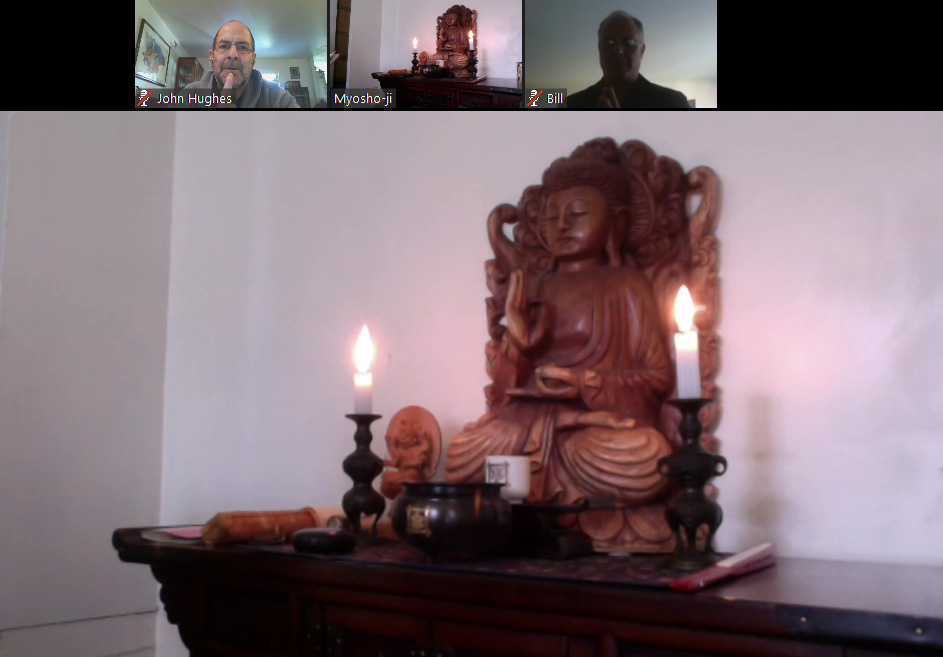
Screengrab from first service with Ryusho Shonin from Myosho-ji Temple since the move to Syracuse on Feb. 26, 2017.

Feb. 26, 2017, service at Sacramento Nichiren Buddhist Church

I don’t normally attend the Myosho-ji services when there is a local service, but being the first from Ryusho Shonin‘s new home in Syracuse, N.Y., I felt compelled. Why not.

This post is prompted by yesterday’s reading from The Merits of a Person Who Rejoices at Hearing This Sutra.

Suppose a man rejoices at hearing this sutra
Or at hearing even a gatha of it
In a congregation,
And expounds it to a second person.

The second person expounds it to a third person.
In this way it is heard by a fiftieth person.
Now I will tell you of the merits
Of the fiftieth person. …

The merits of the [fiftieth] person
[Who hears this sutra] are immeasurable.
Needless to say, so are the merits of the first person
Who rejoices at hearing it in the congregation.

In all of the time I was a member of Nichiren Shoshu and, after the split, Soka Gakkai, I never was comfortable expounding my Buddhist beliefs. That all changed when I came to Nichiren Shu and began my study of the Lotus Sutra. I’m both the 50th person and the first.

Today I had an email exchange with a man who asked, “What is the eternal Buddha?”

I suggested reading Chapter 16, The Duration of the Life of the Tathāgata, but the guy said he had read that and needed it broken down in layman’s terms. So I offered this:

Are you familiar with the three bodies of the Buddha? In the Lotus Sutra Sakyamuni represents all three, not just the historical Buddha who lived 3000 or so years ago. All other Buddhas are emanations of the eternal Buddha (as explained in Chapter 11, Beholding the Stūpa of Treasures). For Nichiren Buddhists the eternal Sakyamuni Buddha and the Bodhisattvas he has been teaching since the remotest past (see Chapter 15, The Appearance of Bodhisattvas from Underground) are the focus of devotion. Nichiren Buddhists believe that each person has an inherent Buddha nature (and all of the other 9 natures or worlds from hell to Bodhisattva) at any given moment. (See http://fraughtwithperil.com/ryuei/2010/06/18/chapter-10-ichinen-sanzen/)

All of this is gathered together and enclosed within the title of the sutra, Myoho-Renge-Kyo. Chanting devotion to the sutra – Namu-Myoho-Renge-Kyo – is the principle practice for this age and allows the individual to awaken this Buddha nature.

The question of how to describe Nichiren Buddhism is something I’ve been puzzling over recently. It was after I sent this email that I did evening gonyo and read today’s section from the Lotus Sutra, the conclusion of The Merits of the Teacher of the Dharma.

He will be able to expound the Dharma
With tens of millions of skillful words
Because he keeps
The Sutra of the Lotus Flower of the Wonderful Dharma.

Maybe not yet, but in time, yes.

Day 24

Day 24 concludes Chapter 19, The Merits of the Teacher of the Dharma and closes the Sixth Volume of the Sutra of the Lotus Flower of the Wonderful Dharma.

Having last month covered the merits of the mind in prose, we conclude this the chapter in gathas.

Thereupon the World-Honored One, wishing to repeat what he had said, ang in gathas:

Their minds will become pure, clear, keen and undefiled.
They will be able to recognize with their wonderful minds
The superior, mean and inferior teachings.
When they hear even a gatha [of this sutra],
They will be able to understand
The innumerable meanings of [this sutra].

When they expound [this sutra]
In good order according to the Dharma
For a month, four month or a year,
They will be able to understand at once
The thoughts of gods, dragons, men, yakisas, demigods,
And of all the other living beings
Inside and outside this world
Composed of the six regions
Because they keep
The Sutra of the Lotus Flower of the Wonderful Dharma.

They also will be able to hear and keep
The Dharma expounded to all living beings
By the innumerable Buddhas of the worlds
of the ten quarters
Who are adorned with the marks of one hundred merits.

When they think over the innumerable meanings [of this sutra],
And endlessly repeat the expounding of those meanings,
They will not forget or mistake the beginnings and ends of quotations
Because they keep the Sutra of the Lotus Flower of the Wonderful Dharma.

They will see the reality of all things.
Knowing the position [of this sutra in the series of sutras],
And the names and words [of this sutra],
according to the meanings of it,
They will expound [this sutra] as they understand it.

They will expound the Dharma
Already taught by the past Buddhas.
Therefore, they will be fearless
Before the multitude.

Anyone who keeps the Sutra of the Lotus Flower of the Wonderful Dharma
Will have his mind purified as previously stated.
Although he has not yet obtained the [wisdom-]without-asravas,
He will be able to obtain [these merits of the mind].

When he keeps this sutra,
He will be able to reach a rare stage.
He will be joyfully loved and respected
By all living beings.

He will be able to expound the Dharma
With tens of millions of skillful words
Because he keeps
The Sutra of the Lotus Flower of the Wonderful Dharma.

[Here ends] the Sixth Volume of the Sotra of the Lotus Flower of the Wonderful Dharma.

The Daily Dharma from Aug. 5, 2016, offers this:

They will see the reality of all things.
Knowing the position [of this sūtra in the series of sūtras],
And the names and words [of this sūtra], according to the meanings of it,
They will expound [this sūtra] as they understand it.

The Buddha sings these verses to Constant-Endeavor Bodhisattva in Chapter Nineteen of the Lotus Sūtra, describing those who keep the Lotus Sūtra. In our practice of the Wonderful Dharma, we may be able to enjoy the circumstances of being able to spend lots of time studying the Lotus Sūtra and the guidance given by our leader in this age of degeneration, Nichiren Shonin. But even if we do not have that luxury of time, as long as we remember how the Lotus Sūtra uses expedients to lead all beings to enlightenment, that the goal of this sūtra is not just to end suffering, we can teach it using our own capacities, however limited those may be. Each word of the sūtra is an embodiment of the Buddha. When we share these words with others, we share the Buddha.

The Daily Dharma is produced by the Lexington Nichiren Buddhist Community. To subscribe to the daily emails, visit zenzaizenzai.com