All posts by John Hughes

Day 15

Day 15 concludes Chapter 10, The Teacher of the Dharma, and opens Chapter 11, Beholding the Stūpa of Treasures.

Having last month completed Chapter 10, the Teacher of the Dharma, it’s time to introduce Chapter 11, Beholding the Stupa of Treasures.

Thereupon a stupa of the seven treasures sprang up from underground and hung in the sky before the Buddha. The stupa was five hundred yojanas high and two hundred and fifty yojanas wide and deep. It was adorned with various treasures. It was furnished with five thousand railings and ten million chambers. It was adorned with innumerable banners and streamers, from which jeweled necklaces and billions of jeweled bells were hanging down. The fragrance of tamalapattra and candana was sent forth from the four sides of the stupa to all the corners of the world. Many canopies, adorned with streamers, and made of the seven treasures-gold, silver, lapis lazuli, shell, agate, pearl and ruby­were hanging in the sky [one upon another from the top of the stupa] up to the [heaven of the] palaces of the four heavenly-kings. The thirty-three gods offered a rain of heavenly mandarava-flowers to the stupa of treasures. Thousands of billions of living beings, including the other gods, dragons, yaksas, gandharvas, asuras, garudas, kimnaras, mahoragas, men and nonhuman beings, also offered flowers, incense, necklaces, streamers, canopies and music to the stupa of treasures, venerated the stupa, honored it, and praised it.

Here is an interesting discussion of the arrival of the Stupa of Treasures from the Lecture on the Lotus Sutra:

There are two causes at work when the Stupa of Treasures appears that are stated in Many Treasures original vow. In other words there are two things that make the appearance of Many Treasures and his stupa possible. The first cause, or the first requirement was the original vow of Many Treasures. By making his vow originally he set into motion the actualization of it happening. In our own lives it would be comparable to making a determination to do something. Because of our promise or determination we put into motion the actualization of that thing we determined. This is one reason why I feel that when we take vows to practice Buddhism it is so important to really understand the significance of making that promise. We should become people of our word, doing what we promise to do, in all situations.

The second cause, which enabled Many Treasures Buddha to appear, was the supernatural powers he obtained as the result of his own practice of the Lotus Sutra. In other words Many Treasures Buddha made a vow, which he could carry out because of his accumulated benefit of practicing the Lotus Sutra. Many Treasures Buddha, wishing to repay his gratitude for the many benefits he had obtained, promised to appear whenever the Lotus Sutra was taught, and he was able to do this because he received the merit and made the promise.

In our own lives, we have the hidden treasure, the gem of Buddhahood, which we can ignore and let lay dormant. On the other hand we can choose to make a vow, or a determination, to manifest and then carry out the necessary activities to actualize the vow to manifest our Buddhahood. All this we can do through our faith in the Lotus Sutra.
Lecture on the Lotus Sutra

Daily Dharma – Dec. 19, 2016

When the Buddha expounded this Chapter of Wonderful-Voice Bodhisattva, the eighty-four thousand people, who had come accompanying Wonderful-Voice Bodhisattva, obtained the ability to practice the samādhi by which they could transform themselves into other living beings. Innumerable Bodhisattvas of this Sahā-World also obtained the ability to practice this samādhi.

This description comes at the end of Chapter Twenty-Four of the Lotus Sūtra. In the story, Wonderful-Voice Bodhisattva had come to our world of conflict and delusion from his perfect world to hear the Buddha teach the Wonderful Dharma. The Bodhisattvas in this world asked the Buddha about the transformations Wonderful-Voice made to benefit others. This chapter shows how those beings who have vowed to benefit us appear in ways we may not recognize right away. It also shows us the capability we have as Bodhisattvas to transform ourselves for the benefit of others.

The Daily Dharma is produced by the Lexington Nichiren Buddhist Community. To subscribe to the daily emails, visit zenzaizenzai.com

Sacramento Mochi Weekend

Sunday, Dec. 18, 2016, service

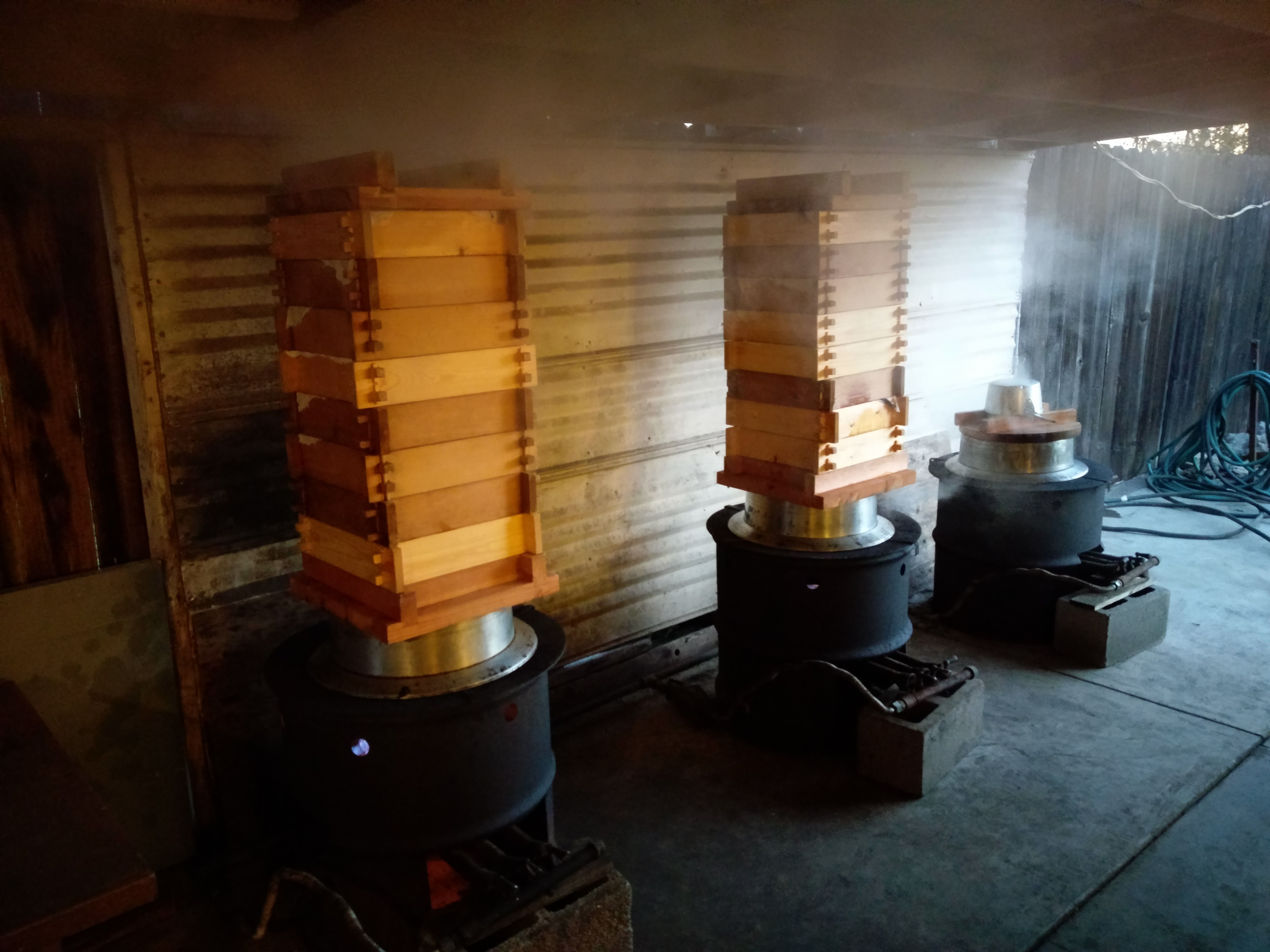
Mochi CookSunday’s Kaji Kito service concluded three days of work for the final fund-raiser of the year, the Mochi Sale. This is the second year I’ve helped out in the preparation of the pounded rice concoction that is molded into patties and sold by the pound. On Friday I helped set up all of the equipment and tables needed and on Saturday morning I was back at the church.

For the second year I helped with steaming the rice.

Rich Steamers

This is a fascinating system for cooking the rice. At the bottom are gas-fired cauldrons of boiling water. (The cauldron on the right heats replacement water that is transferred to the working cauldrons as needed.) Atop the cauldron is a wood plank with a single half-inch diameter hole in the center. All of the heat from the boiling cauldron is jetted through this hole into the trays of rice above.

Inside each tray a bamboo mat rests on crossbeams with a cotton cloth on top of the mat. Several cups of rice are heaped on the cloth and spread out to fill the bottom of the tray.

Trays are stacked eight high with a final board on top holding the steam in. (Years ago, this system used just four trays each but that took all day to cook the 200-pounds of rice needed. A craftsman church member doubled the number of trays and made it possible to cook all of the rice in less than four hours.)

The trays of rice are removed from the bottom first – one worker lifts the stack of seven trays while another worker (me) removes the bottom tray. The tray of cooked rice is then dumped into a grinder that extrudes a smooth rice paste that is formed into the mochi. Empty trays are then filled with new rice and placed on the top of the stack under the top board.

The trays themselves are marvels of Japanese construction. There are no nails. The side slats have wooden pins that hold the pieces together.

Below is a slideshow of photos I took of the process.

Day 14

Day 14 covers all of Chapter 9, The Assurance of Future Buddhahood of the Śrāvakas Who Have Something More to Learn and the Śrāvakas Who Have Nothing More to Learn, and opens Chapter 10, The Teacher of the Dharma.

Having last month covered how anyone who keeps this sutra in the future should be considered to have been dispatched by Sakyamuni, I conclude the day’s reading with the need to withhold criticism of those who follow this most excellent sutra.

Whoever for as long as a kalpa,
With evil intent and flushed face,
Speaks ill of me,
Will incur immeasurable retributions.
Whoever for even a moment
Reproaches those who read, recite and keep
The Sutra of the Lotus Flower of the Wonderful Dharma
Will incur even more retributions.

Whoever for as long as a kalpa
Joins his hands together towards me
And praises me with innumerable gathas
In order to attain the enlightenment of the Buddha,
Will obtain innumerable merits
Because he praises me.
Whoever praises the keeper of this sutra
Will obtain even more merits.

For eight thousand million kalpas
Offer to the keeper of this sutra
The most wonderful things to see,
Hear, smell, taste and touch!

If you make these offerings,
And hear [this sutra] even for a moment,
You will rejoice and say,
“Now I have obtained great benefits.”

Medicine-King! I will tell you.
The Sutra of the Lotus Flower of the Wonderful Dharma
Is the most excellent sutra
That I have ever expounded.

The Daily Dharma from May 6, 2016, offers this:

Medicine-King! I will tell you.
The Sūtra of the Lotus Flower of the Wonderful Dharma
Is the most excellent sūtra
That I have ever expounded.

The Buddha sings these verses to Medicine-King Bodhisattva in Chapter Ten of the Lotus Sūtra. Our founder Nichiren explained that the superiority of the Lotus Sūtra lay not in its being more powerful than other Sūtras, but that it leads all beings, without exception, to the Buddha’s own enlightenment. Other teachings distinguish between those who can follow the Buddha Dharma and those who cannot. But this teaching assures everyone who hears it that they will become enlightened.

The Daily Dharma is produced by the Lexington Nichiren Buddhist Community. To subscribe to the daily emails, visit zenzaizenzai.com

The Burning Quest for Material Gain

The quest for material gain, fueled by craving leads to suffering, or as the Buddha says: “You will be burned by them.” In the case of the Parable of the Burning house the children inside were so busy engrossed in their games, in their play, in their pursuit of happiness that they failed to notice the house was on fire and they were in great danger. If we approach our Buddhist practice as a way to gain benefit and not as a way to become enlightened then we will continue the cycles of suffering, of getting burned. Instead we should approach Buddhism as a way to become enlightened.

Lotus Path: Practicing the Lotus Sutra Volume 1

Daily Dharma – Dec. 18, 2016

How good it is to see a Buddha,
To see the Honorable Saint who saves the world!
He saves all living beings
From the prison of the triple world.

The Brahma Heavenly-Kings of the Zenith sing these verses in Chapter Seven of the Lotus Sūtra. They gave up their kingdoms, their subjects and their homes to travel across innumerable worlds to hear the Wonderful Dharma. They inspire our devotion by showing how important this teaching is to them. For us who know of the Ever-Present Buddha Śākyamuni, we recognize that the Buddha exists everywhere, even in our triple world of form, formlessness and desire. When let go of the delusions that imprison us, and recognize this Buddha in our midst, we find ourselves in the Buddha’s pure land.

The Daily Dharma is produced by the Lexington Nichiren Buddhist Community. To subscribe to the daily emails, visit zenzaizenzai.com

Day 13

Day 13 covers all of Chapter 8, The Assurance of Future Buddhahood of the Five Hundred Disciples.

Having last month covered the importance of Purna and his hidden role, we come now to prediction of Purna’s future Buddhahood and the nature of the world of that Buddha.

Bhiksus! Purna was the most excellent expounder of the Dharma under the seven Buddhas. He is the same under me. He will be the same under the future Buddhas of this Kalpa of Sages. He will protect the teachings of those Buddhas and help them propagate their teachings. After the end of this kalpa also he will protect the teachings of innumerable Buddhas, help them propagate their teachings, teach and benefit innumerable living beings, and cause them to aspire for Anuttara-samyak-sarmbodhi He will always make efforts to teach all living beings strenuously so that the worlds of those Buddhas may be purified. He will perform the Way of Bodhisattvas step by step for innumerable, asamkhya kalpas, and then attain Anuttara-samyak-sambodhi in this world. He will be called Dharma-Brightness, the Tathagata, the Deserver of Offerings, the Perfectly Enlightened One, the Man of Wisdom and Practice, the Well-Gone, the Knower of the World, the Unsurpassed Man, the Controller of Men, the Teacher of Gods and Men, the Buddha, the World-Honored One. The world of that Buddha will be composed of one thousand million Sumeru-worlds, that is, as many Sumeru-worlds as there are sands in the River Ganges. The ground [of that world] will be made of the seven treasures. It will be as even as the palm of a hand. There will be no mountains nor ravines nor ditches. Tall buildings adorned with the seven treasures will be seen everywhere in that world, and the palaces of gods of that world will hang so low in the sky that gods and men will be able to see each other. There will be no evil regions nor women. The living beings of that world will be born without any medium. They will have no sexual desire. They will have great supernatural powers, emit light from their bodies, and fly about at will. They will be resolute in mind, strenuous, and wise. They will be golden in color, and adorned with the thirty-two marks. They will feed on two things: the delight in the Dharma, and the delight in dhyana. There will be innumerable, asamkhya Bodhisattvas, that is, thousands of billions of nayutas of Bodhisattvas. They will have great supernatural powers and the four kinds of unhindered eloquence. They will teach the living beings of that world. There will also be uncountable Sravakas there. They will have the six supernatural powers including the three major supernatural powers, and the eight emancipations. The world of that Buddha will be adorned with those innumerable merits. The kalpa [in which Purna will become that Buddha] will be called Treasure­Brightness; and his world, Good-Purity. The duration of the life of that Buddha will be innumerable, asamkhya kalpas, and his teachings will be preserved for a long time. After his extinction, stupas of the seven treasures will be erected [in his honor] throughout that world.

I’m fascinated by the descriptions of the worlds to be governed by future Buddhas. Purna’s is especially pleasing with “no evil regions nor women. The living beings of that world will be born without any medium. They will have no sexual desire. They will have great supernatural powers, emit light from their bodies, and fly about at will. They will be resolute in mind, strenuous, and wise.”

The footnote explains that being born without any medium means to be “born not through the medium of a mother or an egg or moisture but by their own karmas. It is held that those who are born without any medium appear in a moment in their adult forms.”

From one world to the next, perhaps not unlike O-Kay.

The Buddha’s Medicine Is Always Available

It may be that some will refuse the medicine, or that others will stop taking the medicine before being fully cured. It happens in life that way. There is no expiration date on the medicine the Buddha leaves for us. The medicine the Buddha leaves us in the Lotus Sutra is always good and is always available, even if it appears the physician has died and left us. The medicine, and through the medicine the Buddha, is always available for us to take and benefit from.

Physician's Good Medicine

Daily Dharma – Dec. 17, 2016

Today we are not what we were then.
We have obtained
What we did not expect
To obtain
Just as the poor son obtained
The innumerable treasures.

Subhūti, Mahā-Kātyāyana, Mahā-Kāśyapa, and Mahā-Maudgalyāyana, all disciples of the Buddha, speak these lines in Chapter Four of the Lotus Sūtra as they explain their story of the wayward son. They compare the father’s treasure house in the story to the Buddha’s enlightenment. Until they had been led by the Buddha’s expedient teachings, they could not even imagine themselves as enlightened, any more than the wayward son in the story could imagine the contents of his father’s treasure house.

The Daily Dharma is produced by the Lexington Nichiren Buddhist Community. To subscribe to the daily emails, visit zenzaizenzai.com

Day 12

Day 12 concludes Chapter 7, The Parable of the Magic City, and completes the Third Volume of the Sutra of the Lotus Flower of the Wonderful Dharma.

Having last month covered Great-Universal-Wisdom-Excellence Tathagata emerging from his samadhi after practicing dhyana-concentration for eighty-four thousand kalpas, we move on to Sakyamuni’s big reveal about the sixteen princes who became Bodhisattvas.

The Buddha said to the bhiksus:

These sixteen Bodhisattvas willingly expounded the Sutra of the Lotus Flower of the Wonderful Dharma. Each of them taught six hundred billion nayutas of living beings, that is, as many living beings as there are sands in the River Ganges. Those living beings were always accompanied by the Bodhisattva[, by whom they were taught,] in their consecutive existences. [In each of their consecutive existences,] they heard the Dharma from him, and understood it by faith. By the merits [they had thus accumulated], they were given a privilege to see four billion Buddhas, that is, four billion World­-Honored Ones. They have not yet seen all of them.

Bhiksus! Now I will tell you. The sixteen sramaneras, who were the disciples of that Buddha, have already attained Anuttara­-samyak-sambodhi. They now expound the Dharma in the worlds of the ten quarters. They have many hundreds of thousands of billions of attendants consisting of Bodhisattvas and Sravakas. Two of the sramaneras are now Buddhas in the east. One of them is called Aksobhya. He is in the World of Joy. The other is called Sumeru-Peak. Another couple of the sramaneras are now Buddhas in the southeast, called Lion-Voice and Lion-Form. Another couple of them are now Buddhas in the south, called Sky-Dwelling and Eternal-Extinction. Another couple of them are now Buddhas in the southwest, called Emperor-Form and Brahma-Form. Another couple of them are now Buddhas in the west, called Amitayus and Saving-All-Worlds-From-Suffering. Another couple of them are now Buddhas in the northwest, called Tamalapattracandana­Fragrance-Supernatural-Power and Sumeru-Form. Another couple of them are now Buddhas in the north, called Cloud-Freedom and Cloud-Freedom-King. One of the remaining two is now a Buddha in the northeast called Eliminating-Fear-Of-All-Worlds. The other one, that is, the sixteenth sramanera is I, Sakyamuni Buddha. I attained Anuttara-samyak-sambodhi in this Saha-World.

And my mind wanders and wonders where is the the Saha World in a firmament in which two buddhas are each in the East, Southeast, South, Southwest, West, Northwest and North and one is in the Northeast? Is the Saha World of the 16th prince, Sakyamuni Buddha, in the Northeast with Eliminating-Fear-Of-All-Worlds Buddha or in the nadir or the zenith or, for that matter, the center of the universe?