All posts by John Hughes

Day 25

Day 25 covers all of Chapter 20, Never-Despising Bodhisattva, and opens Chapter 21, The Supernatural Powers of the Tathāgatas.

Having last month covered the demonstration of the Buddhas’ supernatural powers, it is time to finish up with the response from the gods outside the gathering on the Saha World:

At that time the gods in the skies [of the worlds of the ten quarters] said loudly:

There is a world called Saha beyond a distance of many hundreds of thousands of billions of asamkhyas of worlds. In that world lives a Buddha called Sakyamuni. He is now expounding to Bodhisattva-mahasattvas a sutra of the Great Vehicle, called the ‘Lotus Flower of the Wonderful Dharma, the Dharma for Bodhisattvas, the Dharma Upheld by the Buddhas.’ Rejoice from the bottom of your hearts! Bow and make offerings to Sakyamuni Buddha!

Having heard their voice from the skies, the living beings of those worlds joined their hands together toward the Saha­World, and said, “Namah Sakyamunaye Buddhaya, namah Sakyamunaye Buddhaya.” Then they strewed various flowers, various kinds of incense, various necklaces, streamers, canopies, personal ornaments, treasures, and other wonderful things to the Saha-World from afar.

The strewn things came from the worlds of the ten quarters like gathering clouds and changed into a jeweled awning over the Saha-World. The awning extended over the Buddhas staying in this world. At that time the worlds of the ten quarters became passable through each other without hindrance as if they had been a single Buddha-world.

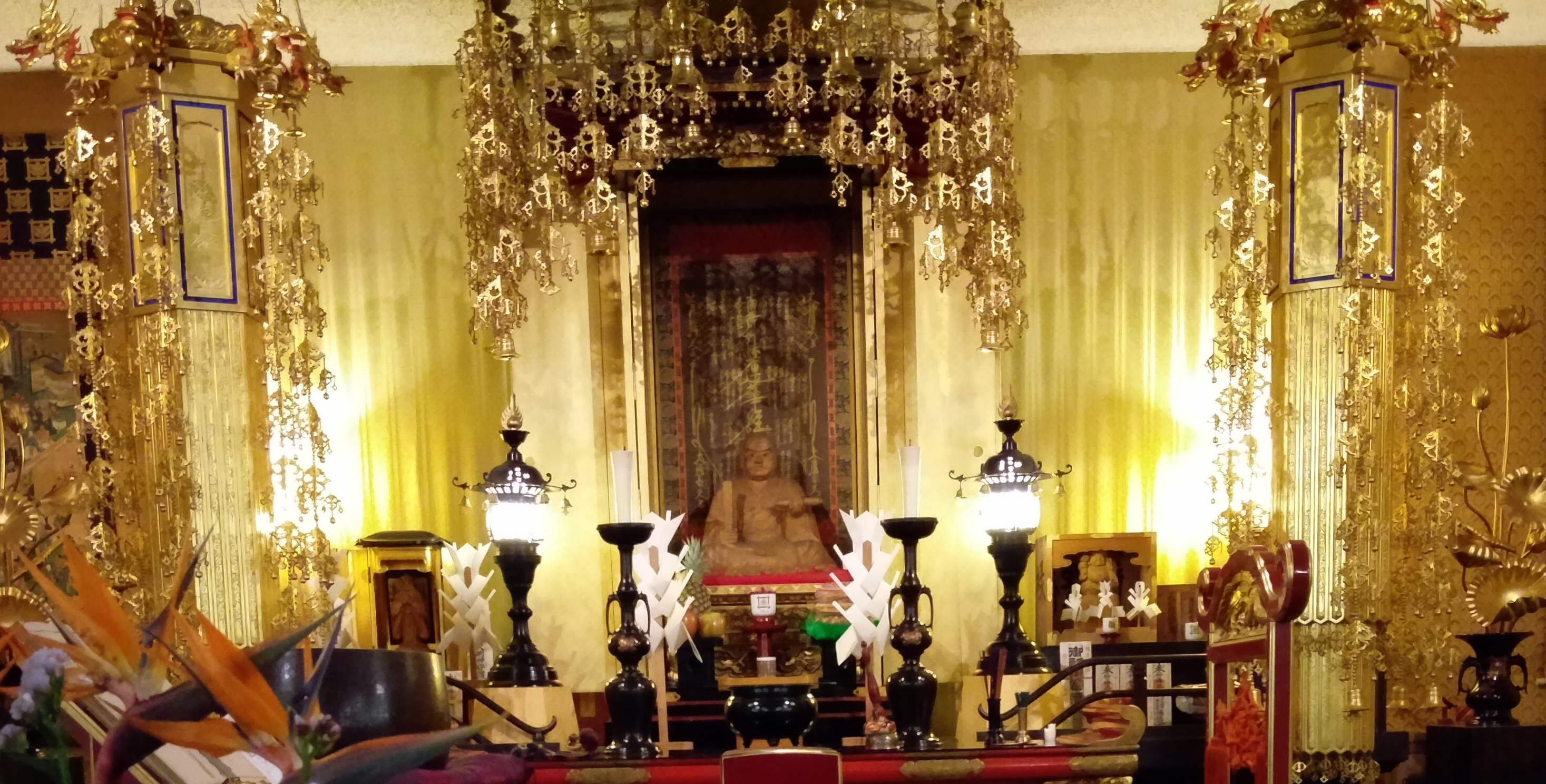
When I read that the offerings gathered like clouds and changed into a jeweled awning, I’m reminded on the decorations that frame the altar at the Sacramento Nichiren Buddhist Church.

Decorations framing the altar at the Sacramento Nichiren Buddhist Church

Study, Prayer and Action

If study is not followed with prayer and prayer not followed by action then the study is merely an intellectual indulgence. If the only response to our study is to hold that information inside, keeping solely for one’s own benefit, then the message of the Lotus Sutra has not fully been realized. The Buddha says teach others, cause others to experience joy and benefit them. How is it possible to say one believes in the Lotus Sutra and then not be moved to action?

Physician's Good Medicine

Daily Dharma – Nov. 27, 2016

You, the World-Honored One, are exceptional.
You reminded me of the teachings
Of innumerable Buddhas in the past
As if I had heard them today.

Ānanda, the Buddha’s cousin and one of his leading disciples, sings these verses in Chapter Nine of the Lotus Sūtra. In the Story, Ānanda had just been personally assured by the Buddha that he would become a Buddha himself in a future life. All the teachings of the Buddha across all time are always available to us. What prevents us from hearing them and putting them into practice is nothing more than our own attachment to our suffering and our doubts about our capacity for wisdom and compassion. When we take to heart the assurance that we and all beings can become enlightened, it clears away our delusion and allows to see the Buddha teaching us in all aspects of our lives.

The Daily Dharma is produced by the Lexington Nichiren Buddhist Community. To subscribe to the daily emails, visit zenzaizenzai.com

Day 24

Day 24 concludes Chapter 19, The Merits of the Teacher of the Dharma and closes the Sixth Volume of the Sutra of the Lotus Flower of the Wonderful Dharma.

Last month dealt with the merits of the nose and now we review the merits of the tongue:

Furthermore, Constant-Endeavor! The good men or women who keep, read, recite, expound or copy this sutra, will be able to obtain twelve hundred merits of the tongue. Anything which tastes good, bad, delicious, distasteful, bitter or astringent, will become as delicious as the nectar of heaven and not distasteful when it is put on their tongues. When they expound the Dharma to the great multitude with their tongues, they will be able to raise deep and wonderful voices, to cause their voices to reach the hearts of the great multitude so that the great multitude may be joyful and cheerful. Hearing their speeches given in good order by their deep and wonderful voices, Sakra, Brahman, and the other gods and goddesses will come and listen to them. In order to hear the Dharma, dragons, dragons’ daughters, yaksas, yaksas’ daughters, gandharvas, gandharvas’ daughters, asuras, asuras’ daughters, garudas, garudas’ daughters, kimnaras, kimnaras’ daughters, mahoragas, and mahoragas’ daughters also will come to them, respect them, and make offerings to them. Bhiksus, bhiksunis, upasakas, and upasikas; and kings, princes, ministers, and their attendants [also will come and hear the Dharma]. The wheel-turning­[holy-] kings of small [countries], and the wheel-turning-[holy-] kings of great [countries, each of whom has the] seven treasures and one thousand children, also will come with their [treasures, children and] internal and external retinues, riding in their [movable] palaces, and hear the Dharma. These [good men or women, that is,] Bodhisattvas will expound the Dharma so well that the brahmanas, householders, and people of their country will, throughout their lives, attend on them, and make offering to them. The Sravakas, Pratyekabuddhas, Bodhisattvas, and Buddhas also will wish to see them. [These good men or women] will expound the Dharma in the places which the Buddhas will face. They will keep all the teaching of the Buddha and raise deep and wonderful voices of the Dharma.

Thereupon the World-Honored One, wishing to repeat what he had said, sang in gathas:

Their tongues will be purified.
Their tongues will not receive anythjng bad.
Anything they at will become
As delicious as nectar.

When they expound the Dharma to the great multitude
And lead them
By telling them the stories of previous lives, parables, and similes
With their deep, pure and wonderful voices,
The hearers will rejoice
And make excellent offerings to them.

All gods, dragons,
Yaksas and asuras
Will come together
And hear the Dharma respectfully.

Anyone who expounds the Dharma, if he wishes,
Will be able to cause the living beings
Of the one thousand million Sumeru-worlds
To hear his wonderful voice.

The wheel-turning-kings of great and small [countries],
Who have each one thousand children,
Will come with their children and attendants,
And join their hands together respectfully to hear the Dharma.
Gods, dragons, yaksas,
Raksasas and pisacakas
Also will come joyfully,
And make offerings to him.

The Brahman-Heavenly-King,
King Mara, Freedom [God],
Great-Freedom [God],
And the other gods also will come to him.

The Buddhas and their disciples who hear
The voice of the expounder of the Dharma,
Will think of him, protect him,
And sometimes appear before him.

The Daily Dharma from Feb. 8, 2016, offers this tasty advice:

Their tongues will be purified.
Their tongues will not receive anything bad.
Anything they eat will become
As delicious as nectar.

The Buddha sings these verses to Constant-Endeavor Bodhisattva in Chapter Nineteen of the Lotus Sūtra, describing those who keep the Lotus Sūtra. With food and drink it is easy to see how different people will find the same food either delicious or disgusting. Our experience and beliefs shape what we are comfortable putting into our bodies, and whether we do so for the sake of our health or the pleasure that comes from experiencing their flavor. But when we find that something with good flavor is bad for our health, or vice versa, we can change our tastes. This is another example of how the Lotus Sūtra teaches us how to live in the world. We learn to embrace situations we once found frightening or intolerable. We increase our capacity with our focus on benefiting others. As a wise teacher once said, we learn to enjoy problems the way we enjoy ice cream.

The Daily Dharma is produced by the Lexington Nichiren Buddhist Community. To subscribe to the daily emails, visit zenzaizenzai.com

Daily Dharma – Nov. 26, 2016

World-Honored One! I bring you a message from Pure-Flower-Star-King-Wisdom Buddha. [He wishes to say this.] Are you in good health? Are you happy and peaceful or not? Are the four elements of your body working in harmony or not? Are the worldly affairs bearable or not? Are the living beings easy to save or not? Do they not have much greed, anger, ignorance, jealousy, stinginess and arrogance, or do they? Are they not undutiful to their parents, or are they? Are they not disrespectful to śramaṇas, or are they? Do they not have wrong views, or do they? Are they not evil, or are they? Do they not fail to control their five desires, or do they?

The passage above is how Wonderful-Voice Bodhisattva greets Śākyamuni Buddha in Chapter Twenty-Four of the Lotus Sūtra. This Bodhisattva asks not only about the Buddha, but about those whom the Buddha benefits with his teaching. The Buddha answers that those he teaches have prepared through innumerable lives to receive his wisdom. The questions of Wonderful-Voice show how we obscure the teaching through our delusion and attachments.

The Daily Dharma is produced by the Lexington Nichiren Buddhist Community. To subscribe to the daily emails, visit zenzaizenzai.com

Day 23

Day 23 covers all of Chapter 18, The Merits of a Person Who Rejoices at Hearing This Sutra, and opens Chapter 19, The Merits of the Teacher of the Dharma.

Last month I started making my way through the Merits of the Teacher of the Dharma. Now I move from eyes to the ears.

Furthermore, Constant-Endeavor! The good men or women who keep, read, recite, expound or copy this sutra, will be able to obtain twelve hundred merits of the ear. With their pure ears, they will be able to recognize all the various sounds and voices inside and outside the one thousand million Sumeru-worlds, [each of which is composed of the six regions] down to the Avici Hell and up to the Highest Heaven. They will be able to recognize the voices of elephants, horses and cows; the sounds of carts; cryings and sighings; the sounds of conch-shell horns, drums, gongs and bells; laughter and speech; the voices of men, women, boys and girls; meaningful voices, meaningless voices; painful voices, delightful voices; the voices of the unenlightened ones, the voices of the enlightened ones; joyful voices, joyless voices; the voices of gods, dragons, yaksas, gandharvas, asuras, garudas, kimnaras and mahoragas; the sounds of fire, water and wind; the voices of hellish denizens, animals and hungry spirits; and the voices of bhiksus, bhisunis, Sravakas, Pratyekabuddhas, Bodhisattvas and Buddhas. In a word, with their pure and natural ears given by their parents, they will be able to recognize all the sounds and voices inside and outside the one thousand million Sumeru-worlds, although they have not yet obtained heavenly ears. Even when they recognize all these various sounds and voices, their organ of hearing will not be destroyed.

Thereupon the World-Honored One, wishing to repeat what he had said, sang in gathas:

Their ears given by their parents will be purified, not defiled.
With their natural ears,
They will be able to recognize the sounds of voices
Of the one thousand million Sumeru-worlds.

They will be able to recognize
The voices of elephants, horses and cows;
Th ounds of carts, gongs, bells, conch-shell horns,
And of drums, lyres, harps, reed-pipes and flutes.
Although they recognize pure and sweet songs,
They will not be attached to them.
They also will be able to recognize
The countless kinds of voices of men.

They will be able to recognize
The voices of gods,
The wonderful songs [of gods],
And the voices of men, women, boys and girls.
They will be able to recognize
The songs of kalavitikas, of jivakajivakas,
And of the other birds in mountains,
And on rivers and ravines.

The expounder of the Dharma
Will be able to recognize from afar,
While he is staying in the world [of men],
The cryings and shriekings
Of the denizens in hell,
The shoutings of hungry and thirsty spirits
Who are seeking food and drink,
And the voices of asuras
Bellowing to each other
[As they pound] on the seacoasts.
Even when he recognizes all this by hearing,
His organ of hearing will not be destroyed.

The expounder of the Dharma will be able to recognize,
While he is staying [in this world],
The voices of birds and animals calling each other
In the worlds of the ten quarters.

The teacher of the Dharma will be able to recognize,
While he is staying [in the world of men],
The voices of the gods of the heavens
Above the Heaven of Brahman,
[That is,] of the Light-Sound Heaven,
Of the Universal-Pure Heaven, and of the Highest Heaven.

The teacher of the Dharma
Will be able to recognize,
Without moving about,
The voices of the bhiksus and bhiksunis
Who read or recite sutras
Or expound them to others.

He will be able to recognize
The voices of the Bodhisattvas
Who read or recite sutras
Or expound the meanings
Of quotations from them
To others.

Anyone who keeps this Sutra
Of the Lotus Flower of the Wonderful Dharma
Will be able to recognize the voices of the Buddhas,
That is, the voices of the Great Honorable Saints
Who teach all living beings,
And who expound the Wonderful Dharma in great congregations.

He will be able to recognize
All the sounds and voices
Inside and outside the one thousand million Surneru-worlds,
[Each being composed of the six regions]
Down to the Avici Hell and up to the Highest Heaven.
And yet his organ of hearing will not be destroyed.
He will be able to recognize everything by hearing
Because his ears are sharp.

Anyone who keeps
This Sutra of the Lotus Flower of the Wonderful Dharma
Will be able to obtain these merits with his natural ears Although he has not yet obtained heavenly ears.

The Daily Dharma of Aug. 12, 2015, offers this explanation:

The Buddha gives this explanation to Constant-Endeavor Bodhisattva in Chapter Nineteen of the Lotus Sūtra, describing those who keep the Lotus Sūtra. As we shed our delusions and see the world more for what it is, we begin to see and understand things not visible or comprehensible to those still mired in their suffering and attachment. Knowing the suffering we have left behind, we may be lured into abandoning this world and those in it. In this chapter, the Buddha shows that all of the sense organs we have in this life, sight, hearing, smell, taste, touch and thought, all of these can be used either to increase our delusion or bring us towards awakening. The Buddha reached enlightenment in this world, and so do we.

The Daily Dharma is produced by the Lexington Nichiren Buddhist Community. To subscribe to the daily emails, visit zenzaizenzai.com

The Realm

Another group of categories, to explain life in group (dhdtu) is threefold: the stage on which a certain group of beings play their role and manifest their nature; the constituents which supply materials and components to the stage; and the individuals making up the realm.

Nichiren, The Buddhist Prophet

Daily Dharma – Nov. 25, 2016

The merits of the [fiftieth] person
[Who hears this sūtra] are immeasurable.
Needless to say, so are the merits of the first person
Who rejoices at hearing it in the congregation.

The Buddha sings these verses to Maitreya Bodhisattva in Chapter Eighteen of the Lotus Sutra. This chapter includes a story of a person who hears the Wonderful Dharma, then explains it to the best of their ability to someone else. In this way there is a chain of fifty people who hear versions of this teaching modified by the capacities of those transmitting it. The effectiveness of this teaching does not depend on who delivers it. No matter what our capacity, any of us can teach the Lotus Sutra and practice it in our lives.

The Daily Dharma is produced by the Lexington Nichiren Buddhist Community. To subscribe to the daily emails, visit zenzaizenzai.com

Day 22

Day 22 covers all of Chapter 17, The Variety of Merits.

Last month I discussed the Buddha’s Pure Land. This time through I’m not speaking ill of this sutra, but rejoicing.

Furthermore, the good men or women who do not speak ill of this sutra but rejoice at hearing it after my extinction, should be considered, know this, to have already understood my longevity by firm faith. It is needless to say this of those who [not only rejoice at hearing this sutra but also] read recite and keep it. They also should be considered to be, carrying me on their heads. Ajita! They need not build a stupa or a monastery in my honor, or make the four kinds of offerings to the Samgha because those who keep, read and recite this sutra should be considered to have already built a stupa or a monastery or made offerings to the Samgha. They should be considered to have already erected a stupa of the seven treasures tall enough to reach the Heaven of Brahman, the upper part of the stupa being the smaller. They should be considered to have already equipped the stupa with streamers, canopies and jeweled bells, and enshrined my sariras therein. They also should be considered to have already offered flowers, incense, necklaces, incense powder, incense applicable to the skin, incense to burn, drums, music, reed pipes, flutes, harps, various kinds of dances, and songs of praise sung with wonderful voices [to the stupa] continuously for many thousands of billions of kalpas.

Daily Dharma from Sept. 13, 2016, adds this:

The Buddha makes this declaration to his disciple Maitreya in Chapter Seventeen of the Lotus Sūtra. After learning the merits of understanding the ever-present nature of the Buddha, Maitreya hears that this understanding is present in anyone who finds joy in this sūtra. From the parables told earlier in the sūtra, we know that this joy is not the same as the joy that comes from ending suffering. It is the joy in our awakening Buddha nature.

The Daily Dharma is produced by the Lexington Nichiren Buddhist Community. To subscribe to the daily emails, visit zenzaizenzai.com

Daily Dharma – Nov. 24, 2016

Good men! I think that the Buddha, the World-Honored One, wishes to expound a great teaching, to send the rain of a great teaching, to blow the conch-shell horn of a great teaching, to beat the drum of a great teaching, and to explain the meaning of a great teaching.

Mañjuśrī declares this to Maitreya and all others gathered to hear the Buddha teach in Chapter One of the Lotus Sūtra. The Buddha had just produced the light from between his eyebrows illuminating the worlds of the ten directions, a sight none but Mañjuśrī had experienced. The great teaching the Buddha was about to expound is the Lotus Sutra. This statement awakens our interest and shows us how to listen to this teaching, as if it were a great cooling rain or the loud call of a conch-shell or drum.

The Daily Dharma is produced by the Lexington Nichiren Buddhist Community. To subscribe to the daily emails, visit zenzaizenzai.com