All posts by John Hughes

Day 27

Day 27 concludes Chapter 23, The Previous Life of Medicine-King Bodhisattva.

Last month, I looked at the saving power of the Sutra of the Lotus Flower of the Wonderful Dharma. The month before, I focused on the position of the Lotus Sutra in comparison with all of the other sutras.

Eventually I’ll deal with Gladly-Seen-By-All-Beings Bodhisattva’s penchant for fiery demonstrations of his devotion to Sun-Moon-Pure-Bright-Virtue Buddha, but before that I want to discuss the final message of Chapter 23, The Previous Life of Medicine-King Bodhisattva.

Chapter 23 opens with this question:

Star-King-Flower Bodhisattva said to the Buddha: “World-Honored One! Why does Medicine-King Bodhisattva walk about this Saha-World? World-Honored One! This Medicine-King Bodhisattva will have to practice hundreds of thousands of billions of nayutas of austerities in this world. World-Honored One! Tell me why!

Chapter 23 ends with this:

When the Buddha expounded this chapter of the Previous Life of Medicine-King Bodhisattva, eighty-four thousand Bodhisattvas obtained the dharanis by which they could understand the words of all living beings. Many-Treasures Tathagata in the stupa of treasures praised Star-King-Flower Bodhisattva, saying:

Excellent, excellent, Star-King-Flower! You obtained inconceivable merits. You asked this question to Sakyamuni Buddha, and benefited innumerable living beings.

Question Authority was the motto of my generation. In discussing faith in Buddhism, Rev. Ryusho Jeffus from Myosho-ji, Wonderful Voice Buddhist Temple, Charlotte, NC, underscores the need to continue to question:

Questioning the teaching helps to lead to further study and exploration of life, which leads to firmer and stronger faith. In Buddhism faith is actually enhanced by questions and practicing. Faith is one part questioning and another part practicing and applying. I personally believe that we should flee from anyone or any teaching that tries to lie outside the realm of questions. Refusing to answer questions or implying that questioning is wrong or unfaithful should be an automatic warning that something just isn’t quite right.

Lecture on the Lotus Sutra

Question Authority button

Daily Dharma – June 22, 2016

It cannot be that the good man or woman who obtained merits [by understanding my longevity by faith even at a moment’s thought] falters in walking the Way to Anuttara-samyak-saṃbodhi.”

The Buddha makes this declaration to the Bodhisattva Maitreya in Chapter Seventeen of the Lotus Sūtra. We all have experiences that take a long time either to understand or to realize what affect they have had on our lives. We may even forget the experience and not be able to connect it with a present situation. This is also true with the experience of hearing the Buddha teach. We hear him declare that he is ever-present, always leading us to enlightenment. Then the memory of that teaching becomes obscured by our daily pursuits and attachments. By reminding ourselves and each other of this highest teaching, we regain our right minds and walk confidently on the path to the Buddha’s own enlightenment (Anuttara-samyak-saṃbodhi).

The Daily Dharma is produced by the Lexington Nichiren Buddhist Community. To subscribe to the daily emails, visit zenzaizenzai.com

Day 26

Day 26 concludes Chapter 21, The Supernatural Powers of the Tathāgatas, includes Chapter 22, Transmission, and introduces Chapter 23, The Previous Life of Medicine-King Bodhisattva.

Having discussed the benefits of keeping this sutra and the merits of this sutra to those to whom this sutra is to be transmitted from Chapter 21, it is time to move on to the actual transmission of the Sutra of the Lotus Flower of the Wonderful Dharma to the Bodhisattvas who had sprung up from underground.

Thereupon Sakyamuni Buddha rose from the seat of the Dharma, and by his great supernatural powers, put his right hand on the heads of the innumerable Bodhisattva-mahasattvas, and said:

For many hundreds of thousands of billions of asamkhyas of kalpas, I studied and practiced the Dharma difficult to obtain, and [finally attained] Anuttara-samyak-sambodhi. Now I will transmit the Dharma to you. Propagate it with all your hearts, and make it known far and wide!

He put his [right] hand on their heads twice more, and said:

For many hundreds of thousands of billions of asamkhyas of kalpas, I studied and practiced the Dharma difficult to obtain, and [finally attained] Anuttara-samyak-sambodhi. Now I will transmit [the Dharma] to you. Keep, read, recite and expound [this sutra in which the Dharma is given], and cause all living beings to hear it and know it! Why is that? It is because I have great compassion. I do not begrudge anything. I am fearless. I wish to give the wisdom of the Buddha, the wisdom of the Tathagata, the wisdom of the Self-Existing One, to all living beings. I am the great almsgiver to all living beings. Follow me, and study my teachings without begrudging efforts!

Underline I have great compassion. I do not begrudge anything. I am fearless. I wish to give the wisdom of the Buddha, the wisdom of the Tathagata, the wisdom of the Self-Existing One, to all living beings.

Sakyamuni Buddha continues:

In the future, when you see good men or women who believe in the wisdom of the Tathagata, you should expound this Sutra of the Lotus Flower of the Wonderful Dharma to them, and cause them to hear and know [this sutra] so that they may he able to obtain the wisdom of the Buddha. When you see anyone who does not receive [this sutra] by faith, you should show him some other profound teachings of mine, teach him, benefit him, and cause him to rejoice. When you do all this, you will be able to repay the favors given to you by the Buddhas.

The Daily Dharma for Oct. 25, 2015, said of this final point:

Even though they may not be ready to hear the Wonderful Dharma, we can use the Expedient Teachings to prepare them for the Buddha’s highest teaching. When we are assured that countless beings are helping us all to become enlightened, we are less likely to be disappointed in the progress that we see.

The Daily Dharma is produced by the Lexington Nichiren Buddhist Community. To subscribe to the daily emails, visit zenzaizenzai.com


Daily Dharma – June 21, 2016

Please remember that the service to your lord itself is practicing the teaching of the Lotus Sutra. Interpreting the scriptural statement in the Lotus Sutra, Grand Master T’ien-t’ai, therefore, states in his Great Concentration and Insight: “All the activities and daily work of the people in the secular world do not contradict the truth preached by the Buddha.” Please contemplate the spirit of this scriptural statement again and again.

Nichiren wrote this passage in his Response to a Follower (Dannotsu Bō Gohenji). In our frustration with this world of conflict, we may think it best to remove ourselves from those who are increasing the delusions of others. In this letter, Nichiren reminds us that the relationships we have in our lives are important. Service to others does not necessarily mean giving them what they ask for. It means wishing that they lose their delusions and nourishing the Buddha nature within them.

The Daily Dharma is produced by the Lexington Nichiren Buddhist Community. To subscribe to the daily emails, visit zenzaizenzai.com

Day 25

Day 25 covers all of Chapter 20, Never-Despising Bodhisattva, and opens Chapter 21, The Supernatural Powers of the Tathāgatas.

Having put off discussing Never Despising Bodhisattva last month and the month before, I begin here:

There lived arrogant bhiksu in the age of the counterfeit of the right teachings of the first Powerful-Voice-King Tathagata, that is, after the end of the age of his right teachings which had come immediately after his extinction. [Those arrogant bhiksus] were powerful. At that time there lived a Bodhisattva called Never­Despising. He took the form of a bhiksu.

A Bodhisattva who took the form of a bhiksu. That’s an important fact that underscores the Bodhisattva vow: Sentient beings are innumerable; I vow to save them all. In this case, by choosing to be a bhiksu and suffering the abuse of powerful foes.

Great-Power-Obtainer! Why was this bhiksu called Never-­Despising? lt was because, every time he saw bhiksus, bhiksunis, upasakas or upasikas, he bowed to them and praised them, saying, ‘I respect you deeply. I do not despise you. Why is that? It is because you will be able to practice the Way of Bodhisattvas and become Buddhas.’

He did not read or recite sutras. He only bowed to the four kinds of devotees. When he saw them in the distance, he went to them on purpose, bowed to them, and praised them, saying, ‘I do not despise you because you can become Buddhas.’

The headquarters of Nichiren Shu in Japan is preparing for the 800th anniversary of his birth in 2022 and recently unveiled a very Never-­Despising greeting for visitors to their website.

Here’s my adaptation of the greeting:

Revelations

Chapter XVI is the most important part of the Lotus Sutra for in this chapter is revealed the idea that Buddha is not a person of historical significance. The Buddha is not tied to a physical body who lived and died some twenty-five hundred years ago. The Buddha is not limited to this realm. The Buddha is not the possession of one person only. What is revealed is the eternal nature, the eternally existing, the eternally residing aspect of the Buddha, or as we abbreviate it, the Eternal Buddha. This is not understood in any rational way. It is actually quite unbelievable and, truth be told, logically impossible. Our ever-so-clever minds actually limit our ability to transcend all of this and approach understanding by faith. I believe that understanding the Eternal Buddha is experiential, and that words only talk around the idea. The words in Chapter XVI can lead us to that idea and can help to open the door to understanding by faith because they challenge us to set aside all the rational stuff we are attached to. The words challenge us to, even if for a moment, open ourselves up to connecting with life in a way no book, no computer, no TV show, no sexual experience, or what have you is able to.

Lecture on the Lotus Sutra

Daily Dharma – June 20, 2016

World-Honored One, know this!
Evil bhikṣus in the defiled world will not know
The teachings that you expounded with expedients
According to the capacities of all living beings.

In Chapter Thirteen of the Lotus Sūtra, innumerable Bodhisattvas sing these verses before the Buddha from whom they had come to hear the Wonderful Dharma. They realized that due to their attachment and delusions, beings in this world would see us who keep and practice the Lotus Sūtra as the source of their unhappiness. When we uphold the Buddha’s teaching, and know the true purpose of that teaching, we can see even those beings who cause great harm as opportunities for all of us to become enlightened rather than enemies that we must destroy.

The Daily Dharma is produced by the Lexington Nichiren Buddhist Community. To subscribe to the daily emails, visit zenzaizenzai.com

Day 24

Day 24 concludes Chapter 19, The Merits of the Teacher of the Dharma and closes the Sixth Volume of the Sutra of the Lotus Flower of the Wonderful Dharma.

Of all the merits – eight hundred merits of the eye, twelve hundred merits of the ear, eight hundred merits of the nose, twelve hundred merits of the tongue, eight hundred merits of the body, and twelve hundred merits of the mind – the good men or women who keep, read, recite, expound or copy this sutra will be able to obtain, it’s the merits of the nose that I’d love to have.

Seriously. Just imagine:

He will be able to know by smell
Whether an unborn child is a boy or a girl,
Or a child of ambiguous sex,
Or the embryo of a nonhuman being.

He will be able to know by smell
Whether a woman is an expectant mother,
Or whether she will give an easy birth
To a happy child or not.

He will be able to know by smell
What a man or a woman is thinking of,
Or whether he or she is greedy, ignorant or angry,
Or whether he or she is doing good.

He will be able to recognize by smell
The gold, silver, and other treasures
Deposited underground,
And the things enclosed in a copper box.

He will be able to know by smell
The values of various necklaces,
And the deposits of their materials,
And also to locate the necklaces [ when they are lost].

Back to the serious merits next month.

Father’s Day, 2016

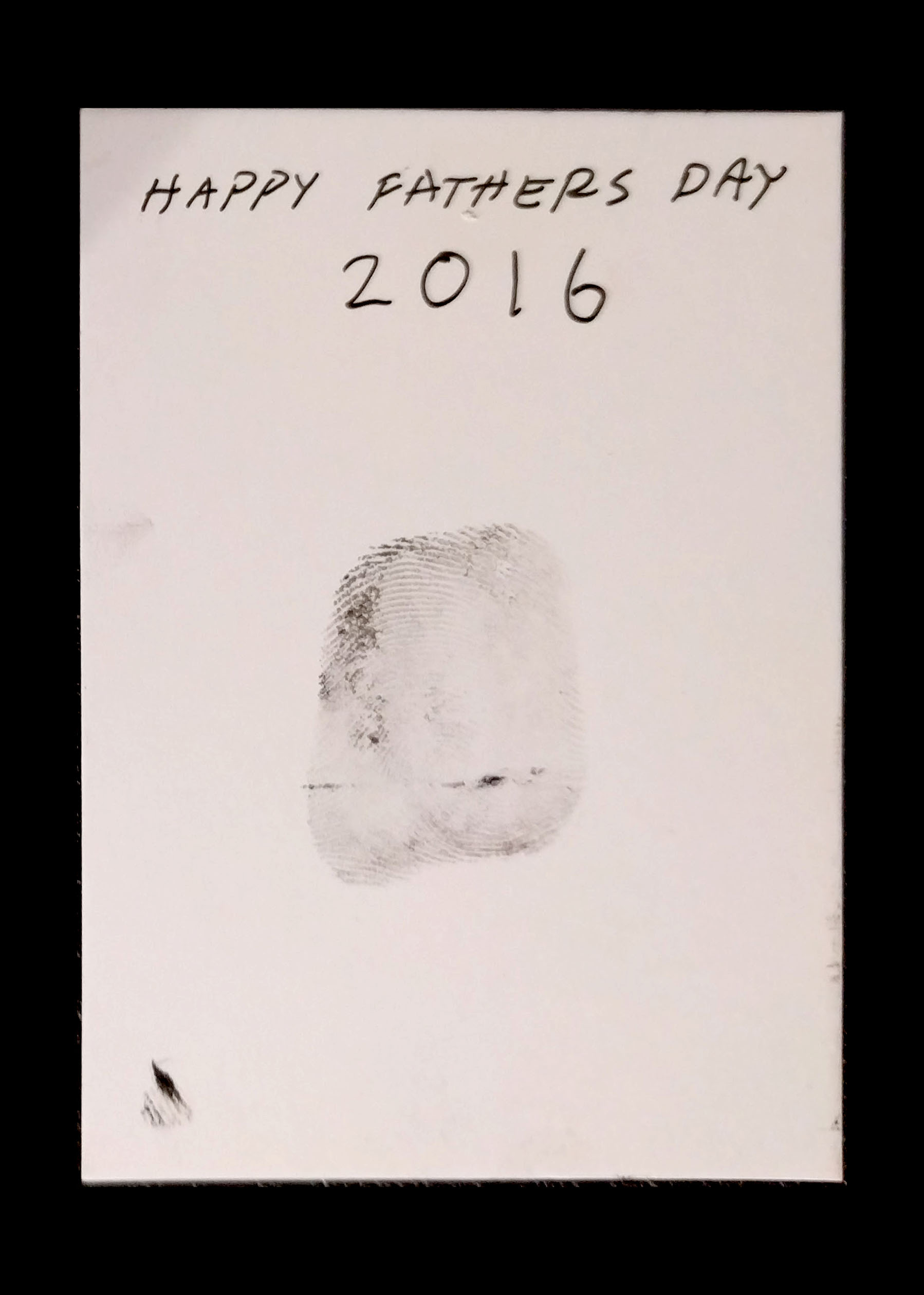
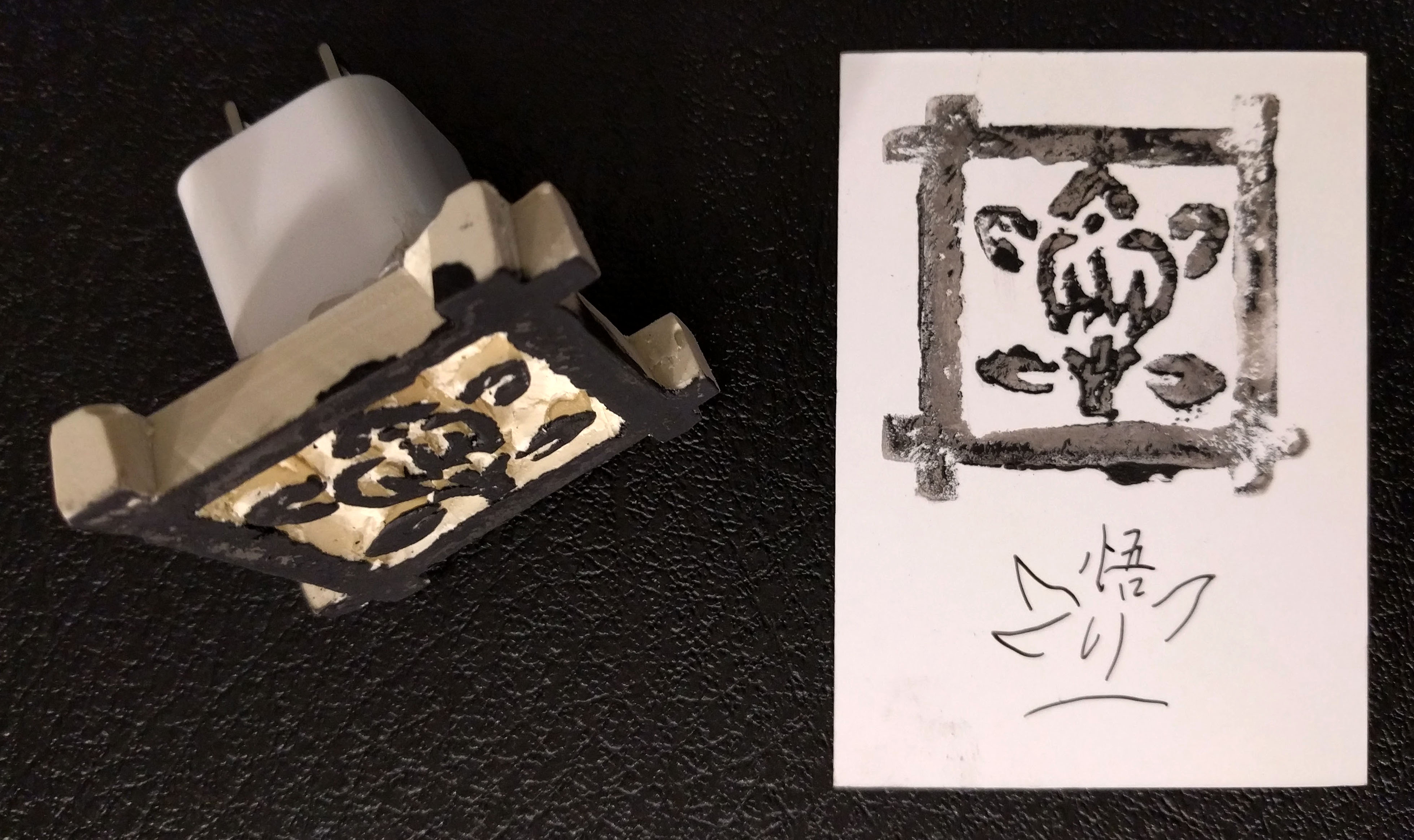
Stamp and card print
Hand-carved rubber stamp and Father’s Day card created by my son, Richard

The back of the stamped card

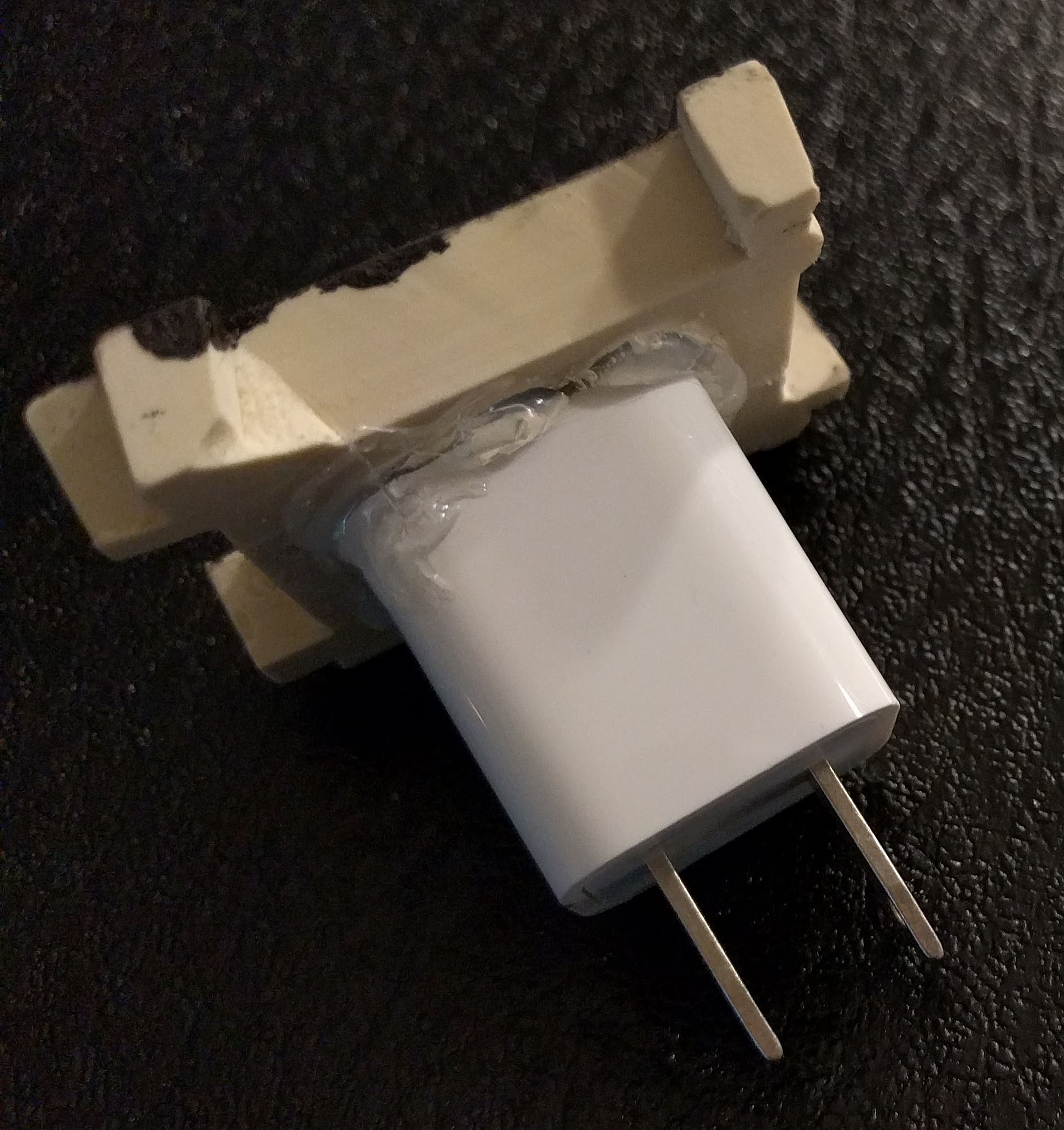
Stamp is glued to surplus USB charger

Some time last night or early this morning I awoke long enough to recognize that my son was walking out of my bedroom. Not expected but not surprising. I went back to sleep and awoke when my alarm went off at 5:30am.

This is a Sunday in which my local temple, the Sacramento Nichiren Buddhist Church, is not holding services. As an alternative, I planned to participate in the online service hosted by Rev. Ryusho Jeffus from Myosho-ji, Wonderful Voice Buddhist Temple, Charlotte, NC.

On these alternative Sundays, I rise early enough to do my recitation of the Lotus Sutra (32 Days of the Lotus Sutra) and then set up my computer in front of my altar and “attend” the Charlotte service, which is scheduled to begin at 7 am my time.

It was after the Charlotte service was over at 8:30 am that my wife came out and asked me what “that thing” was on my bedside table.

And that’s how I received the hand-carved rubber stamp mounted on a surplus USB charger and a personalized Father’s Day card.

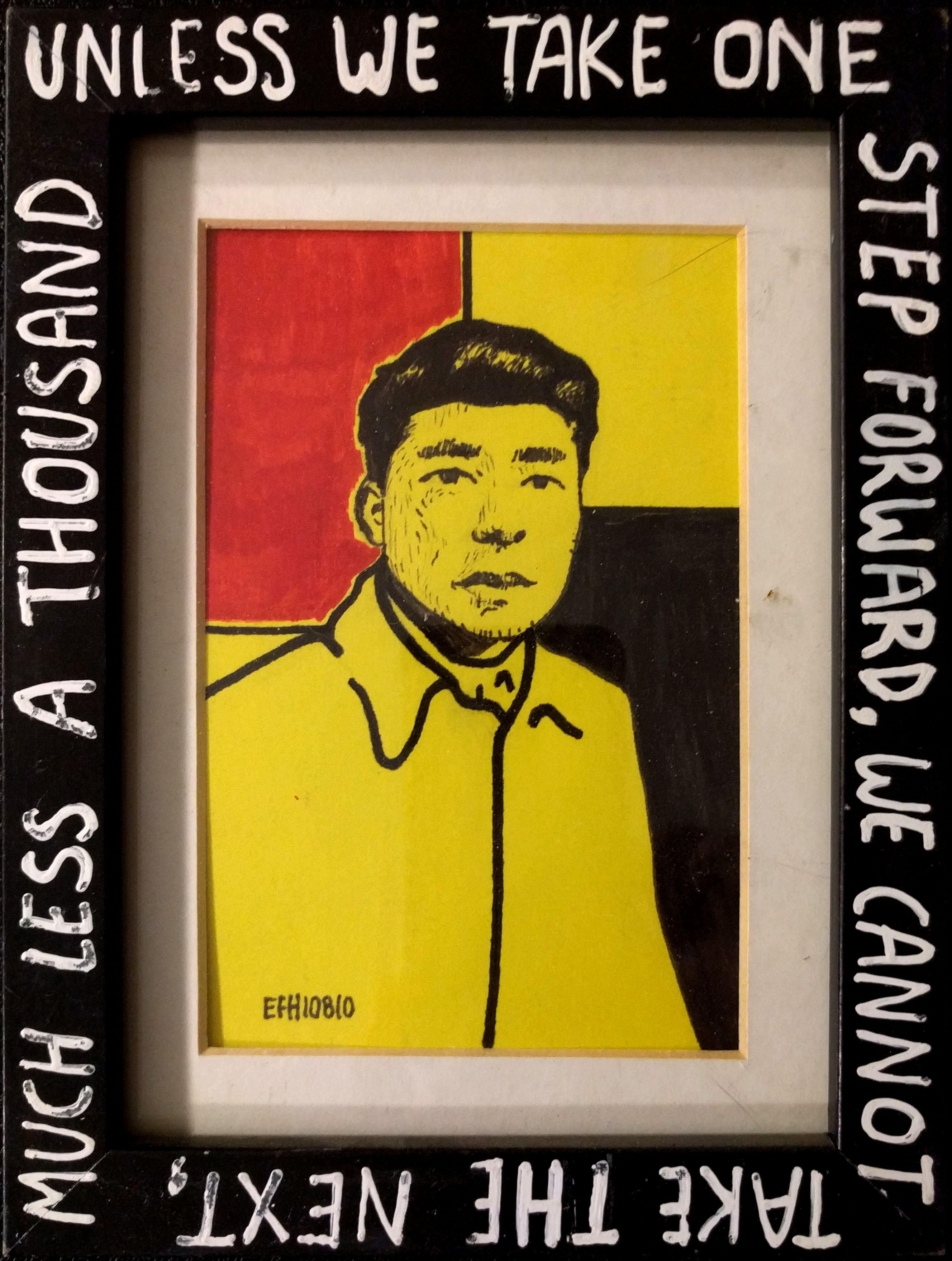
This is not the first Buddhist-themed Father’s Day artwork. In 2010, my son offered this Human Revolution-themed framed drawing.

2010 Father's Day Gift

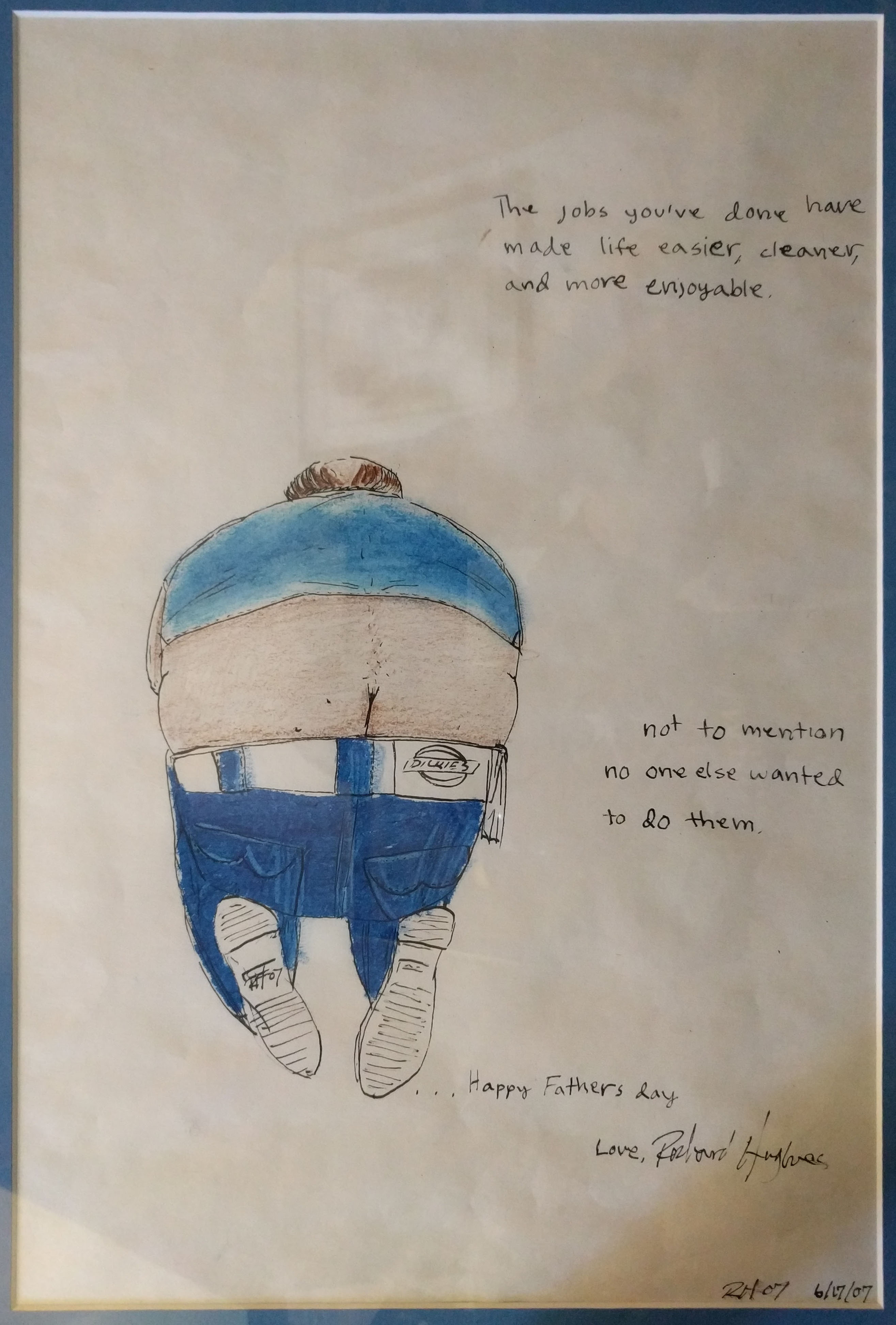
Having an artistic son, I have quite a collection of framed Father’s Day artwork. One of my favorites is this 2007 drawing, which I have on my home-office wall.

Father's Day, 2007
Father’s Day, 2007

It is now after 10:30 am and my son is still sleeping. I’m promised a Father’s Day breakfast. When I do get to eat, I’ll ask my son where he got the idea to use the Nichiren Shu logo for the stamp. I was really surprised by both the gift and the thoughtfulness it represents.

I have the stamp and the card on my altar for now.

Studying the Lotus Sutra

From Ryusho Shonin's blog post: "In both of my art pieces for [Chapter 4] I used translucent layers in a variety of ways.  The idea was to show how even though our appearance or behavior at times seems to not be that of the Buddha or of the teachings of the Lotus Sutra, underneath however because of our practice we are changing.  Underlying the outward appearance is the emerging manifestation of Enlightenment.
From Ryusho Shonin’s blog post: “In both of my art pieces for [Chapter 4] I used translucent layers in a variety of ways. The idea was to show how even though our appearance or behavior at times seems to not be that of the Buddha or of the teachings of the Lotus Sutra, underneath however because of our practice we are changing. Underlying the outward appearance is the emerging manifestation of Enlightenment.

This blog post was originally published Feb. 15, 2016. Since I need a place in which to track Ryusho Shonin‘s Lotus Sutra project, I’m going to periodically update this blog post and re-date it so that it appears in the Blog queue in its most recent position.

Last updated, June 19, 2016:

I’m excited about Ryusho Shonin‘s new project in which he will examine one chapter of the Lotus Sutra each month.

In my daily reading of 1/32nd of the Lotus Sutra – eight scrolls, each divided into four parts – I’m writing down a summary of what I read and what on each day’s reading stands out or seems new or remarkable.

One aspect of Ryusho Shonin’s writing that I have loved in all of his books is his focus on bringing the Lotus Sutra to life. As he explains in this new project:

“[T]his is not a retelling of the Lotus Sutra as it appears on paper in books. We are not replacing someone else’s words with your own in this study; it isn’t paraphrasing. I hope doing this will reveal to you the Lotus Sutra as it has manifested in your life, your life activities, your life experiences. This is not an exercise of expressing your agreement with the ideas or concepts in the Lotus Sutra. I invite you on a journey into what the Lotus Sutra would look like if you told it from your life.”

My daily retelling of what I read lacks this, and I’ve felt that dissatisfaction on occasion.  I can see in  “The Story of the Lotus Sutra of Your Life”  great potential for me and for my understanding and, most important, for my appreciation of the Lotus Sutra in my daily life.

Illustration from Ryusho Shonin's The Lotus Sutra of Your Life
Illustration from Ryusho Shonin’s The Lotus Sutra of Your Life