
All posts by John Hughes

Day 12

Day 12 concludes Chapter 7, The Parable of the Magic City, and completes the Third Volume of the Sutra of the Lotus Flower of the Wonderful Dharma.

Last month, I promised to touch on the debt owed to the 16 young sramanera bodhisattvas, who convinced the Buddha to expound the teaching of Anuttara-samyak-sambodhi.

The Buddha assented to the appeal of the sramaneras, but it was twenty thousand kalpas afterwards that he expounded to the four kinds of devotees the sutra of the Great Vehicle called the ‘Lotus Flower of the Wonderful Dharma, the Dharma for Bodhisattvas, the Dharma Upheld by the Buddhas.’

When the Buddha completed the expounding of this sutra, the sixteen sramaneras kept, recited and understood this sutra in order to attain Anuttara-samyak-sambodhi. The sixteen sramaneras, [ who were] Bodhisattvas, received this sutra by faith. Some Sravakas understood it by faith, but the other Sravakas and other living beings, thousands of billions in number, doubted it.

It took the Buddha eight thousand kalpas to complete the expounding of this sutra. During that time he did not take a rest. Having completed the expounding of this sutra, the Buddha entered a quiet room and practiced dhyana-concentration for eighty-four thousand kalpas. Seeing him practicing dhyana­concentration quietly in the room, the sixteen Bodhisattva­sramaneras each sat on a seat of the Dharma, expounded the Sutra of the Lotus Flower of the Wonderful Dharma to the four kinds of devotees for eighty-four thousand kalpas, and saved six hundred billion nayutas of living beings, that is, as many living beings as there are sands in the River Ganges. They showed them the Way, taught them, benefited them, caused them to rejoice and to aspire for Anuttara-samyak-sambodhi.

And most important, Sakyamuni was one of the srameaneras.

Bhiksus! When we were sramaneras, we each taught many hundreds of thousands of billions of living beings, that is, as many living beings as there are sands in the River Ganges. Those living beings who followed me, heard the Dharma from me in order to attain Anuttara-samyak-sambodhi. Some of them are still in Sravakahood. I now teach them the Way to Anuttara-samyak­sambodhi. They will be able to enter the Way to Buddhahood by my teaching, but not immediately because the wisdom of the Tathagata is difficult to believe and difficult to understand. Those living beings as many as there are sands in the River Ganges, whom I taught [ when I was a sramanera], included you bhiksus and those who will be reborn as my disciples in Sravakahood after my extinction. My disciples who do not hear this sitra or know the practices of Bodhisattvas, after my extinction will make a conception of extinction by the merits they will have accumulated by themselves, and enter into Nirvana as they conceive it. At that time I shall be a Buddha of another name in another world. Those who will enter into Nirvana as they conceive it will be able [to be reborn] in the world I shall live in, seek the wisdom of the Buddha, and hear this sutra. They will be able to attain [true] extinction only by the Vehicle of the Buddha in that world because there is no other vehicle except when the Tathagatas expound the Dharma with expedients.
Daily Dharma – June 7, 2016

The Buddha said to the rākṣasīs: “Excellent, excellent! Your merits will be immeasurable even when you protect the person who keeps only the name of the Sūtra of the Lotus Flower of the Wonderful Dharma.”

The Buddha declares these lines in Chapter Twenty-Six of the Lotus Sūtra. The rākṣasīs are violent, bloodthirsty demons whose nature is to satisfy their own cravings at the expense of beings weaker than themselves. In the Lotus Sūtra, they learn of their capacity to use their strength to protect others and vow to the Buddha to defend anyone who keeps this sūtra. They understand that when they dedicate their strength to caring for other beings rather than destroying them, they gain the merit which will bring them closer to enlightenment. We learn from this example about our own natures, and that of the beings we share this world with.

The Daily Dharma is produced by the Lexington Nichiren Buddhist Community. To subscribe to the daily emails, visit zenzaizenzai.com

Day 11

Day 11 continues Chapter 7, The Parable of the Magic City

Today’s section of the Lotus Sutra is all about the light that accompanies the enlightenment of Great-Universal-Wisdom-Excellence Buddha:

When Great-Universal-Wisdom-Excellence Buddha attained Anuttara-samyak-sambodhi, five hundred billion Buddha-worlds in each of the ten quarters quaked in the six ways, and all those worlds, including those intercepted from the brilliant rays of light of the sun and the moon by the neighboring worlds, were illumined [by great rays of light], and the living beings of those worlds were able to see each other for the first time. They said to each other, ‘How did you appear so suddenly?’ The palaces of the gods of those worlds, including the palace of Brahmans, also quaked in the six ways. The great rays of light which illumined all those worlds were brighter than the rays of light emitted by those gods.

The Brahman-heavenly-kings of each of the 10 directions react to this sudden illumination. Today, I’ll single out the reaction of the Brahman-­heavenly-king called Great-Compassion of the five hundred billion worlds in the southeast. Great-Compassion and the other Brahman-heavenly-kings went to the northwest, carrying flower-plates filled with heavenly flowers. Their palaces also moved as they went.

After greeting the Buddha and offering the flowers and their palaces, the Brahman-heavenly-kings of the southeast sang in gathas:

Saintly Master, God of Gods!
Your voice is as sweet as a kalavinka’s.
You have compassion towards all living beings.
We now bow before you.
You, the World-Honored One, are exceptional.
You appear only once in a very long time.

No Buddha has appeared
For the past one hundred and eighty kalpas.
The three evil regions are crowded;
And the living beings in heaven, decreasing.

Now you have appeared in this world
And become the eye of all living beings.
As their refuge, you are saving them.
As their father, you are benefiting them
Out of your compassion towards them.
We are now able to see you
Because we accumulated merits
In our previous existence.

This gathering of Brahman-heavenly-kings is the only one to call the Buddha “God of gods.” More traditional is the description of the Buddha as “Most Honorable of Gods and Men.”

Daily Dharma – June 6, 2016

Kāśyapa, and all of you present here! It is an extraordinarily rare thing to see that you have understood, believed and received the Dharma which I expounded variously according to the capacities of all living beings because it is difficult to understand the Dharma which the Buddhas, the World-Honored Ones, expound according to the capacities of all living beings.

The Buddha makes this declaration to his disciple Kāśyapa and all those gathered to hear him teach in Chapter Five of the Lotus Sūtra. The Buddha knows how hard it is to set aside our delusions and understand what he is teaching us. When the Buddha teaches with expedients, he lets us stay in the comfort of our own minds. With the Wonderful Dharma of the Lotus Sūtra, he takes us into the unfamiliar areas of his own mind. Only when we gain confidence in the Buddha as our guide can we stay with this teaching and not regress to the contentment of our attachments.

The Daily Dharma is produced by the Lexington Nichiren Buddhist Community. To subscribe to the daily emails, visit zenzaizenzai.com

Day 10

Day 10 concludes Chapter 6, Assurance of Future Buddhahood, and opens Chapter 7, The Parable of a Magic City.

Last month, and the month before, I’ve skipped over the conclusion of Chapter 6, Assurance of Future Buddhahood, in order to delve into the much more interesting, Chapter 7, Parable of the Magic City.

So it is time to say at least something more about the assurance of future Buddhahood given by Sakyamuni to Subhuti, Great Katyayana, Great Maudgalyayana.

After assuring Subhuti, Great Katyayana and Great Maudgalyayana, Sakyamuni says:

The five hundred disciples of mine’
Are powerful and virtuous.
They also shall be assured
Of their future Buddhahood.
They will become Buddhas
In their future lives.

The importance of this chapter is explained in the Daily Dharma from April 26, 2016:

We know the defects of the Lesser Vehicle.
But we do not know how to obtain
The unsurpassed wisdom of the Buddha.

The Buddha’s disciples Maudgalyāyana, Subhūti and Mahā-Kātyāyana sing these verses in Chapter Six of the Lotus Sūtra. They have heard the Buddha teach that the expedient teachings about Suffering are incomplete. However they still have not yet embraced the One Vehicle teaching of the Lotus Sūtra which leads all beings to enlightenment. Nichiren explained, in his Treatise on Opening the Eyes of Buddhist Images, how teachings that came before the Lotus Sūtra were based on the mind of the hearer, where the Wonderful Dharma is itself the mind of the Buddha. When we read, recite, copy and expound the Lotus Sūtra, we are becoming of one mind with the Buddha.

The Buddha knew the mind of the “men living the life of wisdom” and offered the assurance they felt they needed in order to partake of the meal of the True Dharma. Today, we have joy and confidence, having always had the assurance of future Buddhahood of all who read, recite, copy and expound the Lotus Sūtra.

Previous Existences

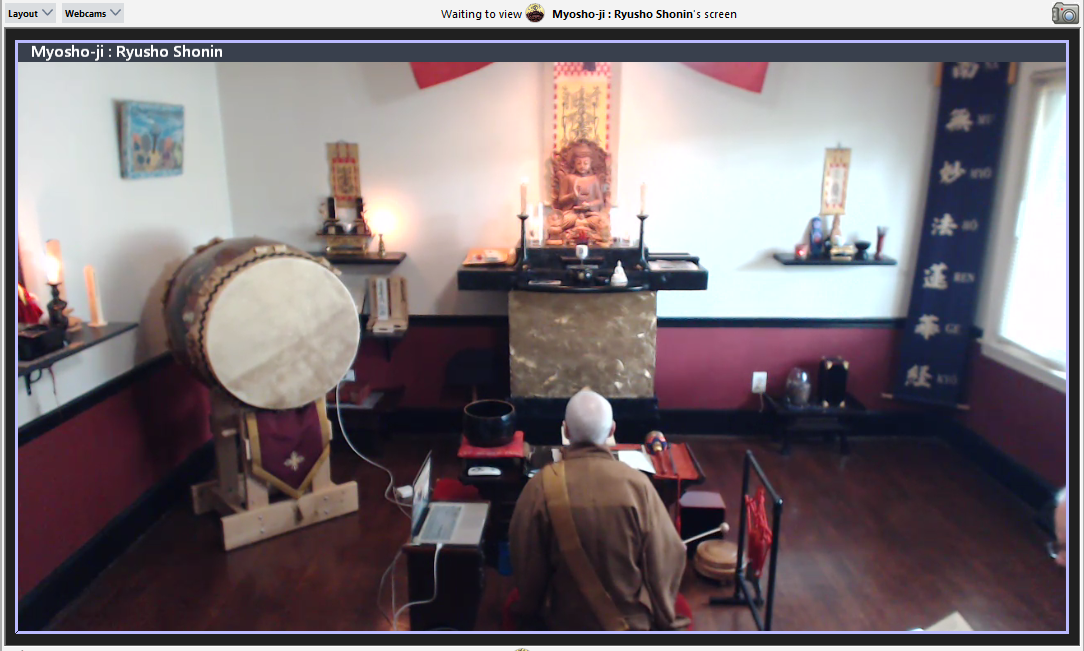
Rev. Ryusho Jeffus leading Sunday service June 5, 2016, at  Myosho-ji, Wonderful Voice Buddhist Temple, Charlotte, NC.
Rev. Ryusho Jeffus leading Sunday service June 5, 2016, at Myosho-ji, Wonderful Voice Buddhist Temple, Charlotte, NC.

Attended Sunday services online with Myosho-ji, Wonderful Voice Buddhist Temple, Charlotte, NC. Rev. Ryusho Jeffus has been working on a project where he takes one chapter of the Lotus Sutra each month and creates illustrations and then writes a commentary. I keep a directory of this project here.

Following the service, Ryusho Shonin showed off one of his illustrations for Chapter 4, Understanding by Faith, and then discussed this quote from the conclusion of the chapter:

Some living beings planted the roots of good
In their previous existence.

A core concept of Nichiren Buddhism is Ichinen Sanzen, or 3,000 Worlds Contained in One Thought.

In each moment of our existence, we have the potential to manifest any of the 10 worlds, including the world of the Buddha.

From Rev. Ryuei McCormick’s book “Lotus Seeds“:

Before Nichiren Shonin, Ichinen Sanzen was a theory that Buddhist practitioners attempted to understand through meditation. Nichiren Shonin, however, taught that Ichinen Sanzen could be realized through faith in the Odaimoku. At the very end of the Kanjin Honzon-sho, he wrote:

“For those who are incapable of understanding the truth of the ‘3,000 worlds contained in one thought,’ Lord Shakyamuni Buddha, with his great compassion, wraps this jewel with the five characters of Myo, Ho, Ren, Ge, and Kyo and hangs it around the necks of the ignorant in the decadent Latter age of the dharma.”

As a Nichiren Shu practitioner I chant Namu Myoho Renge Kyo with the goal of manifesting my Buddha nature.

Each moment is unique. What I do in each moment plants seeds that grow and eventually bear fruit.

Today’s quote from Ryusho Shonin’s “Lecture on the Lotus Sutra” underscores everything I’ve come to appreciate about this practice:

When it comes to the reward of practicing Buddhism, it lies solely in the change that takes place first in our own lives and then manifests in our environment. Buddhism is not about being rewarded with riches or material goods; those things are temporary and destructible. What we seek in our Buddhist practice is the indestructible enlightenment of the Buddha; something that the Lotus Sutra teaches us is possible.

As Ryusho Shonin explains in the video above, I am not the same person I was yesterday, of last year. Each day is a new existence. Each moment I plant the roots of good for my next existence.

Daily Dharma – June 5, 2016

Those who seek the enlightenment of the Buddha
Are as various as previously stated.
A kalpa will not be long enough
To describe the variety of them.

The Buddha speaks these verses in Chapter Three of the Lotus Sūtra. We may believe that only some kinds of people will hear the teaching of the Buddha. In this passage the Buddha reminds us that we cannot predict who will be able to join us in our practice and who will not. This is why it is so important to maintain our vow as Bodhisattvas to benefit all beings.

The Daily Dharma is produced by the Lexington Nichiren Buddhist Community. To subscribe to the daily emails, visit zenzaizenzai.com

Day 9

Day 9 covers Chapter 5, The Simile of Herbs, and introduces Chapter 6, Assurance of Future Buddhahood.

Since I’m self-limiting myself to a single topic each time through, it is time to leave aside the Simile of Herbs for at least one time to mention the opening of Chapter 6, Assurance of Future Buddhahood.

In Chapter 3, Sakyamuni offers the Parable of the Burning House to explain the need for expedients. In Chapter 4, the “men living the life of wisdom” offer the Parable of the Rich Man and His Poor Son as their perception of why it was necessary to use expedients to raise people up to understand they are worthy to be Buddhas. Chapter 5’s Simile of the Herbs clarifies that the Dharma is the same and that it is the variety among the plant life that explains the variety in the fruits of enlightenment.

And this brings us back to those “men living the life of wisdom,” the elders of the voice hearers.

The chapter opens with Sakyamuni telling Maha-Kasyapa that he will eventually become a Buddha called Light in a world called Light-Virtue and the kalpa in which he will become a buddha, Great-Adornment.

In response, Great Maudgalyayana, Subhuti and Maha-Katyayana plead to be assured of their future Buddhahood, explaining:

Suppose a man came
From a country suffering from famine.
Now he saw the meal of a great king.
He did not partake of it in doubts and fears.
After he was told to take it by the king,
He took it at once.
We are like that man.
We know the defects of the Lesser Vehicle.
But we do not know how to obtain
The unsurpassed wisdom of the Buddha.

Although we hear you say [to us],
“You will become Buddhas,”
We are still in doubts and fears about it,
Just as that man was about the meal.
If you assure us of our future Buddhahood,
We shall be happy and peaceful.

You, the Great Hero, the World-Honored One,
Wish to give peace to all the people of the world.
If you assure us of our future Buddhahood, we shall be
Like the man who was permitted to take the meal.

Daily Dharma – June 4, 2016

The good men or women who keep, read, recite, expound or copy this Sūtra of the Lotus Flower of the Wonderful Dharma, will be able to obtain eight hundred merits of the eye, twelve hundred merits of the ear, eight hundred merits of the nose, twelve hundred merits of the tongue, eight hundred merits of the body, and twelve hundred merits of the mind.

The Buddha gives this teaching in Chapter Nineteen of the Lotus Sūtra. This is another reminder that the practice of the Wonderful Dharma does not take us out of the world of conflict we live in. Instead, it helps us to use the senses we have, in ways we did not think were possible, to see the world for what it is. Merits in this sense are not status symbols. They are an indication of clarity, of our faculties not being impeded by anything that blocks their capacity.

The Daily Dharma is produced by the Lexington Nichiren Buddhist Community. To subscribe to the daily emails, visit zenzaizenzai.com

Day 8

Day 8 concludes Chapter 4, Understanding by Faith, and closes the second volume of the Sutra of the Lotus Flower of the Wonderful Dharma.

The first encounter of the son and his father in the The Parable of the Rich Man and His Poor Son tells us a great deal:

“Seeing the exceedingly powerful father, the poor son was frightened. He regretted that he had come there. He thought, ‘Is he a king or someone like a king? This is not the place where I can get something by labor. I had better go to a village of the poor, where I can work to get food and clothing easily. If I stay here any longer, I shall be forced to work.’

“Having thought this, the poor son ran away. The rich man, who was sitting on the lion-like seat, recognized him at first sight as his son. He was delighted. He thought, ‘Now I have found the person to whom I can transfer my treasures and storehouses. I have been thinking of my son all this time, but I have had no way to find him. Now he has come by himself all of a sudden. This is just what I wanted. I am old, but not too old to lose any attachment [to my treasures].’

“He immediately despatched a man standing beside him to quickly bring back the poor son. The messenger ran up to the poor son and caught him. The poor son was frightened. He cried, ‘You Devil! I have done nothing wrong. Why do you catch me?’

“The messenger pulled him by force. The poor son thought, ‘I am caught though I am not guilty. I shall be killed.’ More and more frightened, the poor son fainted and fell to the ground. Seeing all this in the distance, the father said to the messenger, ‘I do not want him any more. Do not bring him forcibly! Pour cold water on his face and bring him to himself! Do not talk with him any more!’

“The father said this because he had realized that his son was too base and mean to meet a noble man [like his father]. He knew that the man was his son, but expediently refrained from telling to others that that was his son. [The messenger poured water on the son. The son was brought to himself.] The messenger said to him, ‘Now you are released. You can go anywhere you like.’

“The poor son had the greatest joy that he had ever had. He stood up and went to a village of the poor to get food and clothing.

It is so telling that the son’s escape from salvation, from the rescue of his father and his return to his familiar meager subsistence existence is celebrated with “the greatest joy that he had ever had.”

This is the very definition of delusion.