
All posts by John Hughes

Day 9

Day 9 covers Chapter 5, The Simile of Herbs, and introduces Chapter 6, Assurance of Future Buddhahood.

The Parable of the Burning House explained the need for expedients from the Buddha’s perspective. The Parable of the Rich Man and His Poor Son told the value of expedients from the perspective of “men of wisdom” who did not believe they could attain the wisdom of the Buddha. Today, the Buddha uses the Simile of the Herbs to illustrate that – expedients or not – there is only one Dharma.

“Kasyapa, know this! I, the Tathagata, am like the cloud. I appeared in this world just as the large cloud rose. I expounded the Dharma to gods, men and asuras of the world with a loud voice just as the large cloud covered all the one thousand million Sumeru-worlds. I said to the great multitude, ‘I am the Tathagata, the Deserver of Offerings, the Perfectly Enlightened One, the Man of Wisdom and Practice, the Well-Gone, the Knower of the World, the Unsurpassed Man, the Controller of Men, the Teacher of Gods and Men, the Buddha, the World-Honored One. I will cause all living beings to cross [the ocean of birth and death] if they have not yet done so. I will cause them to emancipate themselves [from suffering] if they have not yet done so. I will cause them to have peace of mind if they have not yet done so. I will cause them to attain Nirvana if they have not yet done so. I know their present lives as they are, and also their future lives as they will be. I know all. I see all. I know the Way. I have opened the Way. I will expound the Way. Gods, men and asuras! Come and hear the Dharma!’

“Thereupon many thousands of billions of people came to hear the Dharma from me. Having seen them, I knew which were clever, which were dull, which were diligent, and which were lazy. Therefore, I expounded to them an innumerable variety of teachings according to their capacities in order to cause them to rejoice and receive benefits with pleasure. Having heard these teachings, they became peaceful in their present lives. In their future lives, they will have rebirths in good places, enjoy pleasures by practicing the Way, and hear these teachings again. After hearing these teachings again, they will emancipate themselves from all hindrances, practice the teachings according to their capacities, and finally enter the Way, just as the grasses and trees in the thickets and forests, which were watered by the rain from the same large cloud, grew differently according to their species.

The various teachings I expound are of the same content, of the same taste. Those who emancipate themselves [from the bonds of existence,] from illusions, and from birth and death, will finally obtain the knowledge of the equality and differences of all things.

The impartiality of the Dharma:

I see all living beings equally.
I have no partiality for them.
There is not ‘this one’ or ‘that one’ to me.
I transcend love and hatred.

I am attached to nothing.
I am hindered by nothing.
I always expound the Dharma
To all living beings equally.
I expound the Dharma to many
In the same way as to one.

I always expound the Dharma.
I do nothing else.
I am not tired of expounding the Dharma
While I go or come or sit or stand.
I expound the Dharma to all living beings
Just as the rain waters all the earth.

I am not tired of giving
The rain of the Dharma to all living beings.
I have no partiality for them,
Whether they are noble or mean,
Whether they observe or violate the precepts,
Whether they live a monastic life or not,
Whether they have right or wrong views,
Whether they are clever or dull .

Those who hear the Dharma from me
Will reach various stages
[Of enlightenment]
According to their capacities.

The varied species and various fruits:

Although my teachings are of the same content to anyone
Just as the rain is of the same taste,
The hearers receive my teachings differently
According to their capacities
Just as the plants receive
Different amounts of the rain water.
I now expediently reveal the Dharma with this simile.
I expound one truth with various discourses.

This simile is only one of the expedients
Employed by my wisdom,
Just as a drop of sea water is
Part of the great ocean.

Though I water all living beings of the world
With the same rain of the Dharma,
They practice the teachings
Of the same taste differently
According to their capacities,
Just as the herbs and trees
In thickets and forests
Grew gradually according to their species.

The Buddhas always expound
The teachings of the same taste
In order to cause all living beings of the world
To understand the Dharma.
Those who practice the teachings continuously
Will obtain [ various fruits of] enlightenment.

In Chapter 6, Assurance of Future Buddhahood, Maha-Kasyapa is assured of his future Buddhahood, which prompts Great Maudgalyayana, Subhuti and Maha-Katyayana to ponder what it would mean to them were they, too, to be assured of future Buddhahood:

Suppose a man came
From a country suffering from famine.
Now he saw the meal of a great king.
He did not partake of it in doubts and fears.
After he was told to take it by the king,
He took it at once.
We are like that man.
We know the defects of the Lesser Vehicle.
But we do not know how to obtain
The unsurpassed wisdom of the Buddha.

Although we hear you say [to us],
“You will become Buddhas,”
We are still in doubts and fears about it,
Just as that man was about the meal.
If you assure us of our future Buddhahood,
We shall be happy and peaceful.
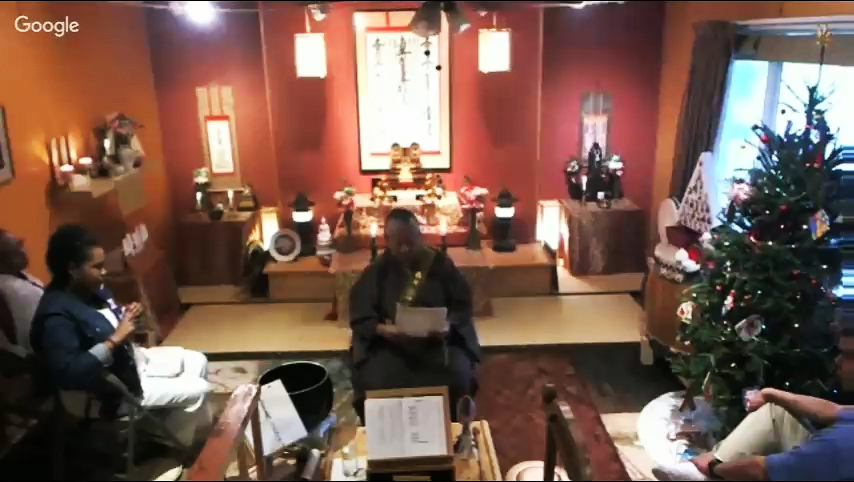
Sunday Gosho Lesson from Houston

Myoken-ji Houston, Dec. 27, 2015
Myokei Caine-Barrett, Resident Priest at Myoken-ji, reads the New Year’s Gosho following service Dec. 27, 2015

Set my computer up in front of my altar and “attended” the Sunday service and Gosho lecture at Myoken-ji in Houston. I recorded the lecture but the sound quality is so bad that it wouldn’t be worthwhile to post. Instead, I’ll post a copy of the New Year’s Gosho here.

New Year’s Gosho

I have received a hundred slabs of steamed rice cake and a basket of fruit. New Year’s Day marks the first day, the first month, the beginning of the year, and the start of spring.1 A person who celebrates this day will accumulate virtue and be loved by all, just as the moon becomes full gradually, moving from west to east,2 and as the sun shines more brightly, traveling from east to west.

First of all, as to the question of where exactly hell and the Buddha exist, one sutra states that hell exists underground, and another sutra says that the Buddha is in the west. Closer examination, however, reveals that both exist in our five-foot body. This must be true because hell is in the heart of a person who inwardly despises his father and disregards his mother. It is like the lotus seed, which contains both blossom and fruit. In the same way, the Buddha dwells within our hearts. For example, flint has the potential to produce fire, and gems have intrinsic value. We ordinary people can see neither our own eyelashes, which are so close, nor the heavens in the distance. Likewise, we do not see that the Buddha exists in our own hearts. You may question how it is that the Buddha can reside within us when our bodies, originating from our parents’ sperm and blood, are the source of the three poisons and the seat of carnal desires. But repeated consideration assures us of the truth of this matter. The pure lotus flower blooms out of the muddy pond, the fragrant sandalwood grows from the soil, the graceful cherry blossoms come forth from trees, the beautiful Yang Kuei-fei was born of a woman of low station, and the moon rises from behind the mountains to shed light on them. Misfortune comes from one’s mouth and ruins one, but fortune comes from one’s heart and makes one worthy of respect.

The sincerity of making offerings to the Lotus Sutra at the beginning of the New Year is like cherry blossoms blooming from trees, a lotus unfolding in a pond, sandalwood leaves unfurling on the Snow Mountains, or the moon beginning to rise. Now Japan, in becoming an enemy of the Lotus Sutra, has invited misfortune from a thousand miles away. In light of this, it is clear that those who now believe in the Lotus Sutra will gather fortune from ten thousand miles away. The shadow is cast by the form, and just as the shadow follows the form, misfortune will befall the country whose people are hostile to the Lotus Sutra. The believers in the Lotus Sutra, on the other hand, are like the sandalwood with its fragrance. I will write you again.

Nichiren

Daily Dharma – Dec. 27, 2015

The son thought: “I was poor, base and mean.
Now I have obtained
The treasures, houses,
And all the other things
From my father.
Never before
Have I been so happy.”

These verses are part of the story of the Wayward Son told by Subhūti, Mahā-Kātyāyana, Mahā-Kāśyapa, and Mahā-Maudgalyāyana in Chapter Four of the Lotus Sūtra. The son in the story has come into his inheritance after years of training and preparation by his father. The story explains the disciples’ understanding of how the Buddha uses expedients over time to prepare us for enlightenment. When we are not ready for the Buddha’s wisdom, he teaches to the capacity of our own minds. Now that we are ready for his highest teaching, he reveals his own mind in the Lotus Sutra.

The Daily Dharma is produced by the Lexington Nichiren Buddhist Community. To subscribe to the daily emails, visit zenzaizenzai.com

Day 8

Day 8 concludes Chapter 4, Understanding by Faith, and closes the second volume of the Sutra of the Lotus Flower of the Wonderful Dharma.

Today covers the Parable of the Rich Man and His Poor Son in which the “men living the life of wisdom” tell the story of a young boy who ran away from his father and lived a life of poverty, searching for a day’s pay. The father sought to help the son but the son was “too base and mean” to realize he was the rich man’s son. Even when he became an employee of the rich man and progressively earned more responsibility in running the rich man’s house, he could not give up the thought that he was base and mean. The son finally realizes his place when the father, now an old man on his deathbed, announced, “This is my son. I am his father. All my treasures are his. He knows what has been taken in and what has been paid out.”

World-Honored One! We once had many troubles sufferings. We were so distracted and so ignorant that we clung to the teachings of the Lesser Vehicle. At that time you caused us to think over all things and to clear away the dirt of fruitles discussions about them. We made strenuous efforts according to the teachings [of the Lesser Vehicle] and attained Nirvana as a day’s pay. Having attained it, we had great joy, and felt satisfied [with the attainment of it]. We said, ‘We have obtained much because we made efforts according to the teachings of the Buddha.’ But when you saw that we clung to mean desires and wished to hear only the teachings of the Lesser Vehicle, you left us alone. You did not tell us that we had the treasure-store, that is, the insight of the Tathagata. You expounded the wisdom of the Buddha[, that is, the Great Vehicle] with expedients, but we did not aspire for that vehicle because, when we had obtained the day’s pay of Nirvana from the Buddha, we thought that we had already obtained enough. We did not wish to have what you had showed and expounded to the Bodhisattvas by your wisdom. You expounded the Dharma to us with expedients according to our capacities because you knew that we wished to hear the teachings of the Lesser Vehicle. We did not know that we were your sons. Now we know that you do not grudge your wisdom to anyone. Although we were your sons then as we are now, we wished to hear only the teachings of the Lesser Vehicle.

And in gathas:

We did not wish to have the treasure-store
Of the teachings of the Buddhas
Although we expounded it [to the Bodhisattvas].
We were satisfied with the elimination
Of illusions within ourselves.
What we accomplished was that elimination.
We did nothing more.

You told us
To purify the world of the Buddha
And teach all living beings.
We heard this, but did not wish to do so
Because we had already attained the truth:
“All things are void and tranquil.
Nothing appears or disappears.
Nothing is larger or smaller.
Nothing has asravas.
Nothing is subject to cause and effect.”
Having thought this, we did not wish
To do [the Bodhisattva practices].

In the long night
We did not care
For the wisdom of the Buddha.
We did not wish to have it.
We thought:
“The Dharma we attained is perfect.”

… Although we expounded to the sons of the Buddha
The teachings for Bodhisattvas in order to cause them
To seek the enlightenment of the Buddha,
We did not wish to attain
The same enlightenment for ourselves.
You, our Leader, left us alone because you knew this.
You did not persuade us
To seek the enlightenment of the Buddha.
You did not say
That we should be able to have real benefits.

The rich man knew
That his son was base and mean.
Therefore, he made him nobler
With expedients,
And then gave him
All his treasures.

Today we are not what we were then.
We have obtained
What we did not expect
To obtain
Just as the poor son obtained
The innumerable treasures.

Daily Dharma – Dec. 26, 2015

Of the people who put their faith in the Lotus Sutra today, some have faith like fire while others have it like water. Those who have faith like fire refer to those who become enthusiastic upon listening to the preaching, but their passion cools down as time goes by, and eventually forget the teaching. On the other hand, those whose faith is like water mean those whose faith is like a ceaselessly flowing water, namely those who retain their faith without retreating. You have constantly sent me donations and asked me questions about the way of faith. Your faith is like water, is it not? How precious you are!

Nichiren wrote this passage in his Reply to Lord Ueno (Ueno-dono Gohenji). To those who stayed with Nichiren and this teaching, despite all difficulties, his gratitude was boundless. We too are capable of this gratitude, not just towards the Buddha and Nichiren, but towards all those who practice the Buddha Dharma with us, and, most importantly, towards those still caught up in the mesh of suffering.

The Daily Dharma is produced by the Lexington Nichiren Buddhist Community. To subscribe to the daily emails, visit zenzaizenzai.com

Day 7

Day 7 concludes Chapter 3, A Parable, and opens Chapter 4, Understanding by Faith.

The origin of the expedient teachings and the power of this parable.

This triple world
Is my property.
All living beings therein
Are my children.

There are many sufferings
In this world.
Only I can save
[All living beings].

I told this to all living beings.
But they did not believe me
Because they were too much attached
To desires and defilements.

Therefore, I expediently expounded to them
The teaching of the Three Vehicles,
And caused them to know
The sufferings of the triple world.
I opened, showed, and expounded
The Way out of the world.

Those children who were resolute in mind
Were able to obtain
The six supernatural powers
Including the three major supernatural powers
Or never-faltering Bodhisattvas.

Sariputra!
With this parable I expounded
The teaching of the One Buddha-Vehicle
To all living beings.
All of you will be able to attain
The enlightenment of the Buddha
If you believe and receive
These words of mine.

I’ll skip over the wondrous salesman’s pitch about the greatness of this Great Vehicle, with merits piled on merits. Instead, I’ll underline this fact:

The Bodhisattvas in this multitude
Should hear
With one mind
The true teaching of the Buddhas.

The Buddhas, the World-Honored Ones,
Say only expediently [that some are not Bodhisattvas]
To tell the truth,
All living beings taught by them are Bodhisattvas.

The progression from expedients to the Unsurpassed Enlightenment:

[I said:]
“To those who have little wisdom,
And who are deeply attached to sensual desires,
The Buddhas expound the truth that all is suffering.
Those [who hear this truth]
Will have the greatest joy that they have ever had.
The statement of the Buddhas that all is suffering
Is true, not false.

To those who are ignorant
Of the cause of all sufferings,
And who are too deeply attached
To the cause of suffering
To give it up even for a moment,
The Buddhas expound
The [eight right] ways as expedients.

The cause of suffering is greed.
When greed is eliminated,
There is nothing to be attached to.
The extinction of suffering
Is called the third truth.
In order to attain this extinction,
The [eight right] ways must be practiced.
Freedom from the bonds of suffering[,]
[That is, from illusions] is called emancipation.”

From what illusions can one be emancipated, however,
[By the practice of the eight right ways]?
He can be emancipated only from unreal things
[That is, from the five desires] thereby.
He cannot be emancipated from all illusions.
The Buddhas say
That he has not yet attained
The true extinction
Because he has not yet attained
Unsurpassed enlightenment.
I also do not think that I have led him
To the [true] extinction thereby.

I am the King of the Dharma.
I expound the Dharma without hindrance.
l appeared in this world
In order to give peace to all living beings.

In the opening of Chapter 14, Understanding By Faith, we meet “men living the life of wisdom,” who admittedly are old and decrepit and “did not wish to perform the Bodhisattva practices, that is, to purify the world of the Buddha and to lead all living beings [to Buddhahood] by displaying supernatural powers because you had already led us out of the triple world and caused us to attain Nirvana.”

They set the stage for the Parable of the Father and His Poor Son by saying:

We have the greatest joy that we have ever had. We have never expected to hear such a rare teaching all of a sudden. How glad we are! We have obtained great benefits. We have obtained innumerable treasures although we did not seek them.

Daily Dharma – Dec. 25, 2015

World-Honored One! It is by my supernatural powers, know this, that a Bodhisattva can hear these dhāraṇīs. Anyone who keeps the Sūtra of the Lotus Flower of the Wonderful Dharma [while it is] propagated in the Jambudvīpa, should think, ‘I can keep [this sūtra] only by the supernatural powers of Universal-Sage.’

Universal-Sage Bodhisattva (Fugen, Samantabhadra) makes this declaration to the Buddha in Chapter Twenty-Eight of the Lotus Sūtra. The supernatural powers of this Bodhisattva are beyond the perception of our human senses: sight, hearing, touch, taste, smell and thought. When we hear thunder, we know something causes it whether or not we understand that cause. In the same way, when we are practicing this Wonderful Dharma, we know it is because of the great help we receive from innumerable beings, even if we do not understand the powers they use to reach us.

The Daily Dharma is produced by the Lexington Nichiren Buddhist Community. To subscribe to the daily emails, visit zenzaizenzai.com

Day 6

Day 6 continues Chapter 3, A Parable

Yesterday concluded with Sariputra telling the Buddha that his doubts were gone but others who had practiced the ways to emancipation were perplexed by what they had learned was only an expedient. Today opens with the Buddha reminding Sariputra that all Buddhas expound the Dharma with expedients. He then offers the Parable of the Burning House. When finished he asks Sariputra if the father who lured his children away from danger by promising toys and, once they were safe, gave them large carts of treasures was guilty of telling a falsehood with his expedient. Sariputra says no.

So it is, so it is. It is just as you say. Sariputra! The same can be said of me. [I thought, ‘] I am the father of the world. I eliminated fear, despondency, grief, ignorance and darkness. I obtained immeasurable insight, powers and fearlessness. I have great supernatural powers, the power of wisdom, the paramita of expedients, the paramita of wisdom, great compassion, and great loving-kindness. I am not tired of seeking good things or of benefiting all living beings. I have appeared in the triple world, which can be likened to the rotten and burning house, in order to save all living beings from the fires of birth, old age, disease, death, grief, sorrow, suffering, lamentation, stupidity, darkness, and the three poisons, to teach all living beings, and to cause them to attain Anuttara-samyak-sarnbodhi. I see that all living beings are burned by the fires of birth, old age, disease, death, grief, sorrow, suffering and lamentation. They undergo various sufferings because they have the five desires and the desire for gain. Because they have attachments and pursuits, they have many sufferings in their present existence, and will suffer in hell or in the world of animals or in the world of hungry spirits in their future lives. Even when they are reborn in heaven or in the world of humans, they will still have many sufferings such as poverty or parting from their beloved ones or meeting with those whom they hate. Notwithstanding all this, however, they are playing joyfully. They are not conscious of the sufferings. They are not frightened at the sufferings or afraid of them. They do not dislike them or try to get rid of them. They are running about this burning house of the triple world, and do not mind even when they undergo great sufferings.

The Buddha also realizes that, while he wants to eliminate the suffering of his children, he can’t just do it for them. He needs to lure them, to cause to make the effort needed.

Sariputra! The rich man did not save his children by his muscular power although he was strong enough. He saved them from the burning house with a skilful expedient and later gave them each a large cart of treasures.

It is the same with the expedients:

Sariputra! The rich man persuaded his children to come out at first by promising them the gifts of the three kinds of carts. But the carts which he gave them later were the largest and most comfortable carts adorned with treasures. In spite of this, the rich man was not accused of falsehood. Neither am I. I led all living beings at first with the teaching of the Three Vehicles. Now I will save them by the Great Vehicle only. Why is that? It is because, if I had given them the teaching of the Great Vehicle at first directly from my store of the Dharma in which my immeasurable wisdom, powers and fearlessness are housed, they would not have received all of the Dharma. Sariputra! Therefore, know this! The Buddhas divide the One Buddha-Vehicle into three by their power to employ expedients.

Daily Dharma – Dec. 24, 2015

When the sun shines brightly in the sky, everything is made clearly visible on the earth. In the same manner, when one knows the teachings of the Lotus Sutra, one will understand the meaning of occurrences in the world.

Nichiren wrote this passage in his great work, Spiritual Contemplation and the Object of Devotion (Kanjin Honzon Shō). When we awaken to our nature as Bodhisattvas who have chosen our lives to benefit others and improve the world, we are freed from the confusion and anxiety around us. By keeping the Dharma of the Lotus Sutra, and following the guidance of Nichiren’s writings, we see what to do to make the world we live in now better for everyone.

The Daily Dharma is produced by the Lexington Nichiren Buddhist Community. To subscribe to the daily emails, visit zenzaizenzai.com

Day 5

Day 5 begins Chapter 3, A Parable.

Sariputra is happy. Really happy. Dancing with joy happy.

Now I have heard from you the Dharma that I had never heard before. I have removed all my doubts. I am now calm and peaceful in body and mind. Today I have realized that I am your son, that I was born from your mouth, that I was born in [the world of] the Dharma, and that I have obtained the Dharma of the Buddha.

And in gathas:

I once was attached to wrong views,
And became a teacher of the aspirants for the teaching of Brahman.
You expounded to me the teaching of Nirvarana,
And removed my wrong views because you understood me.
I gave up all those wrong views,
And attained the truth that nothing is substantial.

At that time I thought
That I had attained extinction.
But now I know
That the extinction I attained is not the true one.
When I become a Buddha in the future,
I shall be adorned with the thirty-two marks,
And respected
By gods, men, yaksas, and dragons.
Only then I shall be able to say
That I have eliminated all [illusions].

In the midst of the great multitude,
You said to me, “You will become a Buddha.”
Hearing this truthful voice,
All my doubts are gone.

The Buddha explains to Sariputra that this is not the first he’s heard of the Great Dharma:

Sariputra! I caused you to aspire for the enlightenment of the Buddha in your previous existence. You forgot all this, and thought that you had already attained extinction. In order to cause you to remember the Way you practiced under your original vow, I now expound to the Sravakas this sutra of the Great Vehicle called the ‘Lotus Flower of the Wonderful Dharma, the Dharma for Bodhisattvas, the Dharma Upheld by the Buddhas.’

News that Sariputra in a future life will become a Buddha called Flower-Light sets off a huge celebration:

At that time the great multitude included bhiksus, bhiksunis, upasakas and upasikas, that is, the four kinds of devotees; and gods, dragons, yaksas, gandharvas, asuras, garudas, kimnaras and mahoragas. When they saw that Sariputra was assured of his future attainment of Anuttara-samyak-sambodhi by the Buddha, they danced with great joy. They took off their garments and offered them to the Buddha. Sakra-Devanam-Indra, the Brahman Heavenly King, and innumerable other gods also offered their wonderful heavenly garments and the heavenly flowers of mandaravas and maha-mandaravas to the Buddha. The heavenly garments, which had been released from the hands of the gods, whirled in the sky. The gods simultaneously made many thousands of millions of kinds of music in the sky, and caused many heavenly flowers to rain down.

The gods voice their joy:

The Buddha turned the wheel of the teaching of the Four Truths
At Varanasi a long time ago.
He taught that all things are composed of the five aggregates
And that they are subject to rise and extinction.

Now he turns the wheel of the Dharma,
The most wonderful, unsurpassed, and greatest.
The Dharma is profound.
Few believe it.
So far we have heard
Many teachings of the World-Honored One.
But we have never heard
Such a profound, wonderful, and excellent teaching as this.
We are very glad to hear this
From the World-Honored One.