Category Archives: Gemini Notebook

Content related to or generated by Google’s Gemini Notebook

Nichiren Shu’s Modernization and Global Reach

This is the second of two essays written by Google’s Gemini. Gemini was told to write this from the perspective of a Nichiren Shu scholar priest. That’s why you see “we” and “our” throughout. Gemini was directed to base the essay on the source material found in this Notebook.


protect-the-dharma-movement


As we established in our previous analysis, the postwar landscape of Japan was one of shattered financial foundations and spiritual disorientation. Faced with the decay of the Danka system and the aggressive expansion of lay-led New Religions, the leadership of Nichiren Shū recognized that a passive “funeral business” model would no longer suffice. In 1966, the 18th Sectarian Assembly inaugurated the Protect the Dharma Movement (Gohō Undō). This was not merely an administrative reorganization; it was a profound theological and practical revolution designed to turn institutional crisis into a global spiritual force.

I. Theological Shifts: Defining a Modern Identity

To differentiate our sect from the confrontational image of groups like the Soka Gakkai, we strategically embraced a theology of “deep humanism” and social engagement.

  • From “Parishioner” to “Follower”: We moved to replace “parishioner consciousness” (danka ishiki), rooted in social obligation and death rites, with a “follower” (shinto) identity. We sought to empower laypeople as “Bodhisattvas of the Earth” who held a personal, active mission to spread the Dharma.
  • Gentle Persuasion (Shōju) over Confrontation (Shakubuku): While our Founder utilized shakubuku to break false views, we explicitly denounced forced conversions through intimidation. We clarified that true shakubuku requires strict self-discipline first. In a modern pluralistic society, we pivoted toward shōju – a gentler method of persuasion adapted to individual circumstances.
  • The Nonduality of Self and Environment (Eshō Funi): To reclaim our doctrine from pre-war militaristic associations, we grounded our peace efforts in eshō funi. This asserts that protecting the Dharma within one’s own heart is inextricably linked to creating peace in the external world. Only by overcoming individual egotism can true societal peace (Ankoku) be realized.

II. Practical Initiatives: The Mechanics of Renewal

The movement was executed in distinct phases, transitioning from organizational mobilization to internal spiritual unification.

  • Quantitative Growth (1966–1970): The early phase focused on structural modernization leading up to the 750th anniversary of Nichiren’s birth. We dispatched “Goho Missionaries” to host large conventions and established Maintenance Associations (Goji-kai) to formalize lay support.
  • The Shingyō Hikkei and Unified Faith (1971–1978): Realizing that participation was often still perfunctory, Chief Administrator Watanabe Kōin shifted the focus to “Unified Faith” (Gohō Tōnitsu Shingyō). In 1972, we published the Shingyō Hikkei (Handbook of Faith and Practice) to standardize liturgy and daily chanting across the globe.
  • Synchronized Global Prayer: To foster unity, the handbook instituted global morning prayers at 8:00 AM, directing the hearts of all followers toward Mt. Minobu, the spiritual home of our Founder.

III. Turning Global: The Linguistic Bridge

A critical turning point occurred in 1978 when, urged by Chief Administrator Matsumura Juken, Rev. Kyotsu Hori published the English translation of the Shingyō Hikkei.

  • The Global Mandate: This translation provided the linguistic bridge to export our unified system to overseas missions in North America, Brazil, Europe, and Southeast Asia.
  • Fulfilling the Vow: This expansion fulfilled Nichiren Daishonin’s mandate to spread the Lotus Sutra worldwide (ittenshikai kaiki myoho). It transformed the Nichiren Shū from a purely Japanese cultural religion into a global faith dedicated to interfaith dialogue and peace advocacy.

Conclusion: The Legacy of Protection

The Protect the Dharma Movement reached its organizational peak in 1981, the 700th memorial of Nichiren’s passing. Its legacy continues today through current initiatives like the “Inochi ni Gassho” (Palm to Palm with All Life) slogan, which expands the concept of protection to include environmental conservation and universal inclusion.

By synthesizing the militant energy of Nichiren’s medieval mission with the humanistic values of the postwar era, we created a sustainable model for institutional survival. We proved that the protection of the Dharma is not an act of exclusion, but an effort to build a “bright and secure” world through the practice of the Lotus Sutra.

Nichiren Shū’s Postwar Crisis and Reform

This is the first of two essays written by Google’s Gemini. Gemini was told to write this from the perspective of a Nichiren Shu scholar priest. That’s why you see “we” and “our” throughout. Gemini was directed to base the essay on the source material found in this Notebook.


shingyo-hikkei-postwar-trouble


As we look back upon the landscape of 1945, a year etched in fire and ash, one might be forgiven for thinking the Latter Day of the Law (Mappō) had arrived in its most literal sense. For the leadership of the Nichiren Shū, the smoke clearing from the ruins of our cities revealed more than just physical destruction; it exposed an unprecedented existential crisis that threatened the very survival of our traditional temple network.

The following analysis examines the cascade of intersecting historical changes that shattered our institutional foundations and forced us into a period of deep, often painful, self-reflection.

1. The Collapse of Financial Foundations

Historically, many of our Buddhist temples were sustained by the income generated from vast, independent agricultural estates. However, in the immediate postwar years, the Japanese government instituted sweeping agrarian land reforms.

  • Financial Ruin: These reforms stripped temples of their traditional landholdings, delivering a massive financial blow to the clergy.
  • The Stigma of “Funeral Buddhism”: Deprived of independent revenue, temples were forced to rely almost entirely on performing hereditary funeral and memorial rites to survive. This led to a spiritual stagnation where the Sangha was increasingly criticized as a mere “funeral business,” lacking relevance for the living.

2. Urbanization and the Decay of the Danka System

Simultaneously, the traditional family system (ie), which had functioned as a cohesive patriarchal unit for centuries, began to disintegrate. This social shift triggered a mass migration from rural communities to urban centers.

  • Membership Decline: As families moved to the cities, they left their ancestral temples behind.
  • Systemic Collapse: This caused a drastic decline in the Danka membership base – the hereditary parishioner system – that rural temples relied upon for their very existence. The bond between the people and the Dharma was no longer a matter of community, but a fading memory of the countryside.

3. Social Anxiety and “Spiraling Egotism”

The postwar environment was characterized by defeat, grinding poverty, and the loss of traditional values. Citizens were surrounded by modern anxieties: inflation, industrial pollution, and the terrifying specter of nuclear war – particularly after the 1954 Bikini Atoll hydrogen bomb tests.

Nichiren Shū leaders observed that these societal strains were fostering a culture of “spiraling egotism”. Individuals became increasingly self-centered, prioritizing worldly desires and personal survival over community welfare and mutual help. The heart of the nation was becoming fragmented.

4. The Rise of New Religious Movements

The vacuum left by traditional Buddhism’s stagnation was quickly filled by “new religions” such as the Soka Gakkai, Reiyukai, and Rissho Kosei-kai. These movements appealed directly to the disenfranchised urban worker by offering a practical, lay-led application of faith that promised health and wealth in the present life.

  • Aggressive Proselytization: The Soka Gakkai, in particular, utilized a confrontational method called shakubuku.
  • A “Wake-Up Call”: This aggressive expansion poached countless passive Nichiren Shū parishioners. To our leadership, this was a glaring signal that the traditional temple structure was inadequate for the modern “thought war”.

Conclusion: The Path to Reform

By the early 1960s, it was clear that piecemeal efforts – such as the Nichiren Shu Reform Alliance or the anti-nuclear World Rissho Peace Movement – were not enough to stem the tide of decline.

The leadership realized that institutional survival depended on a radical transformation: they had to convert their passive “parishioners” into dedicated, active “followers”. We could no longer be a religion of the dead; we had to become a movement for the living.

This realization culminated in the 1966 inauguration of the Protect the Dharma Movement (Gohō Undō), a sweeping, sect-wide campaign to modernize our identity and reclaim the humanistic heart of Nichiren Daishonin’s mission.

In my next essay, I shall detail the specific theological shifts and practical initiatives of this movement, and how they sought to turn a crisis into a global spiritual force.


Tomorrow: Nichiren Shu’s Modernization and Global Reach

Chanting Namu-Myoho-Renge-Kyo Every Morning at 8am

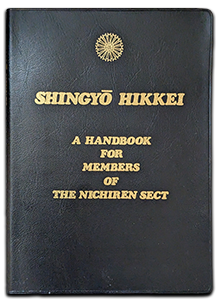
Shingyo-Hikkei-book-cover218x300In November 2023 I wrote about the Shingyō Hikkei, A Handbook for Members of the Nichiren Sect, which was the product of Nichiren Shu’s “Protect the Dharma Movement.” I had found the black, leatherbound pocketbook on a dusty shelf in an unused classroom at the Sacramento Nichiren Buddhist Church.

Given that (before I published this article) a Google search for “Protect the Dharma Movement” would get you exactly zero articles, one can assume the movement fizzled out. Whether Nichiren Shu headquarters lost interest, or the overseas ministers dropped the ball, the result is the same.

That’s unfortunate.

While I have many doctrinal arguments with Nichiren Shoshu and Soka Gakkai, one cannot fault the top-down direction of this global organization that focuses members on their practice. Go to any group meeting at a home or a chapter session at a community center and you feel right at home. It’s like going to Starbucks. No matter where you go, you know you’re in Starbucks and you know what you’ll get.

That’s not what you get with the confederation of temples that is Nichiren Shu. Less like Starbucks, the temples in America (the only ones I have experience with) are more like independent Italian restaurants. The restaurants are recognizable as Italian, but each has a different focus and flavor. The shami who left to strike out on his own focusing solely on Shodaigyo services has established the first pizzeria of the bunch.

The assumption I made at the time – that the “Protect the Dharma Movement” had fizzled out – was wildly off the mark. The Nichiren Shu headquarters had not lost interest, nor had the overseas ministers dropped the ball.

Today when you Google search “Protect the Dharma Movement” you still only get blog posts here and articles on the Sacramento Nichiren Buddhist Church website. The only other citation is for a Harvard study of Religion and State in Meiji Japan, which discusses conditions a century before the 1966 Nichiren Shu project.

The fact that Google search results are still so sparse is a measure of how far Google’s AI efforts have progressed. When you use Google’s Gemini Notebook and ask it to do deep research on the “Protect the Dharma Movement” you get a much different result.

Launched in 1966, the Protect the Dharma Movement (Gohō Undō) was a radical revitalization campaign designed to save Nichiren Shū Buddhism from a severe postwar institutional crisis. Facing a deteriorating reputation as spiritually stagnant “funeral Buddhism” and rapidly losing members to aggressive new religious movements, the sect needed a total paradigm shift.

The core mission of the movement was to transform passive, hereditary “parishioners” participating out of social obligation into active, dedicated “followers” who viewed themselves as Bodhisattvas with a personal spiritual mission.

To achieve this, the movement functioned like a unified public education system for the religion. It forged global unity through the 1972 publication of the Shingyō Hikkei (Handbook of Faith and Practice), which established a shared curriculum of standardized chanting methods, unified ethical guidelines, and synchronized daily global prayers directed toward Mt. Minobu.

Theologically, the movement explicitly rejected the confrontational and exclusionary conversion tactics used by rival sects. Instead, it embraced a theology of “deep humanism” and gentle persuasion (shōju). Inspired by Bodhisattva Never-Disparaging, the movement taught followers to combat modern “spiraling egotism” by bowing in absolute respect to the inherent Buddha-nature within every person.

Ultimately, the movement successfully modernized Nichiren Shū, transitioning it from a traditional Japanese cultural institution into a globally unified spiritual force dedicated to establishing world peace through internal spiritual discipline.

What became of the “Protect the Dharma Movement”?

The Protect the Dharma Movement did not fade away; rather, it reached its planned organizational culmination in 1981, aligning with the 700th memorial anniversary of Nichiren Shonin’s passing.

By successfully mobilizing followers, renovating temple infrastructure, and standardizing global practices through the Shingyō Hikkei, the movement set a new precedent for the sect. Following its conclusion, Nichiren Shū transitioned this momentum into a series of highly organized, multi-decade propagation campaigns driven by major historical anniversaries:

  • The Odaimoku General Propagation Movement (1985–2002): After the Protect the Dharma Movement achieved its internal goal of unifying the faith of its followers, this 18-year successor campaign shifted the sect’s focus outward. Designed to culminate with the 750th anniversary of the sect’s founding in 2002, it aimed to spread the merits of the Odaimoku to the broader public while structurally enriching the sect through grants and commemorative projects.
  • The Risshō Ankoku Odaimoku Kechien Campaign (2007–2021+): Initiated to commemorate the 750th anniversary of the submission of the Risshō Ankoku Ron (2009) and the 800th anniversary of Nichiren’s birth (2021), this campaign operates under the slogan “Inochi ni Gassho” (Palm to Palm with All Life). It builds upon the Protect the Dharma Movement’s call for social engagement by actively addressing modern societal crises—such as isolation, poverty, environmental degradation, and climbing suicide rates—through the bodhisattva ideal of absolute respect for life.

Ultimately, the Protect the Dharma Movement permanently transformed Nichiren Shū from a traditional Japanese institution reliant on hereditary parishioners into a globally unified spiritual network, laying the groundwork for all of the sect’s contemporary propagation efforts.

The Shingyo-Hikkei which the Protect the Dharma Movement created calls for a daily prayer for the protection of the Dharma.

Eight O’clock Every Morning is the Time for the Prayer for the Protection of the Dharma

At eight o’clock every morning we, members of the Nichiren Sect, wherever we are and whatever we are doing, should direct our hearts towards Lord Śākyamuni Buddha and Nichiren Shonin, who reside on Mt. Minobu, and recite the Odaimoku and say a prayer for the protection of the Dharma. Let us all practice this prayer and encourage our neighbors to join us.

The way you recite the Odaimoku is up to you. It may be voiced or silent; it may be said three times or ten times. The point is for everybody, no matter where he lives, to say a prayer at the same time in one mind.

Back in 2023 I whined:

If Nichiren Shu in America is going to continue to act as independent Italian restaurants, it would be nice if they could settle on a single act such as the Protect the Dharma Movement prayer to establish a little more itai doshin.

Rather than continue whining, I want to cheer on everyone to face Mt. Minobu and chant Namu-Myoho-Renge-Kyo. Here in American we can do it at 8 in the morning local time or in the morning Tokyo time, which here in Sacramento is 4pm. Of course Europe doesn’t have it as easy since 8am in Tokyo is midnight in London and 1am in Paris. Still, there’s always 8am local time.

I’ve set a daily timer on my phone for 4pm. Mt. Minobu is west-northwest from Sacramento.

My Gemini Notebook research is publicly available. You are welcome to explore the Nichiren Shu propagation efforts from 1966 to today. Click here.

I’ve used Google’s Gemini to review the content in the notebook and to write two articles. One discusses the situation Nichiren Shu faced in Postwar Japan and the other details the efforts to counter the  Postwar threats.

Tomorrow: Nichiren Shū’s Postwar Crisis and Reform

Learning About Nichiren Buddhism

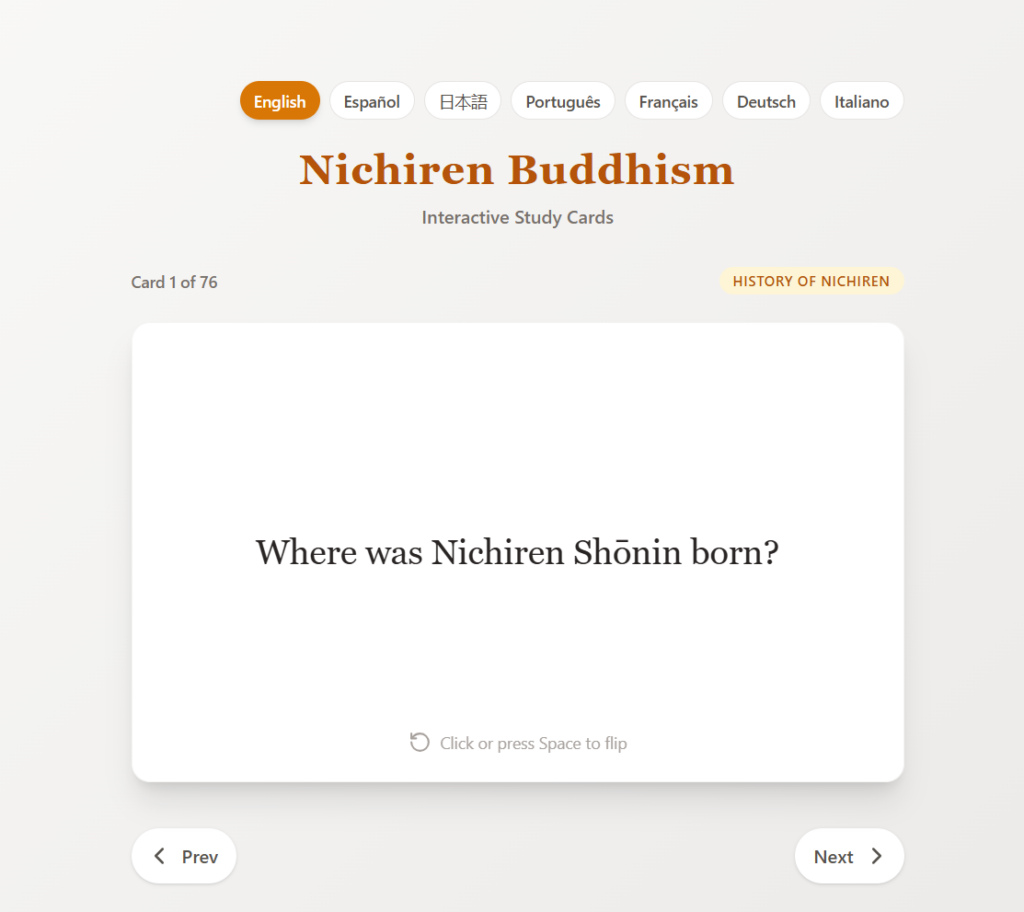
For years, the Sacramento Nichiren Buddhist Church has shared a collection of 21 brochures and pamphlets from Nichiren Shu. To help people dive deeper into these teachings, I am working on a new Interactive Flashcard Study Tool.

Flashcards demoDeveloped using Google’s Gemini Notebook, these flashcards offer a way to engage with the Nichiren Shu brochures and pamphlets. Unlike standard AI, Gemini Notebook works strictly within the 21 specific brochures provided to it. This ensures that every answer is accurate, faithful to the source material, and free from outside interference.

Key Features of the Tool:

  • Deep Insights: Each card includes a question, a concise answer, and a detailed explanation.
  • Direct Sourcing: Every card provides a link back to the original brochure for further reading.
  • Global Reach: The tool is available in Spanish, Japanese, Portuguese, French, German, and Italian.

You can explore the prototype at: https://500yojanas.org/brochureFC/

Since this tool is still in its prototype phase, I would love feedback. I’m particularly interested in the accuracy of the foreign language versions. The translations were created by Google’s Gemini Pro.

Eventually this will be embedded into the Sacramento Nichiren Buddhist Church website. I have an example of how it might look on this page.

Illustrating the Four Factors of the Six Pāramitās

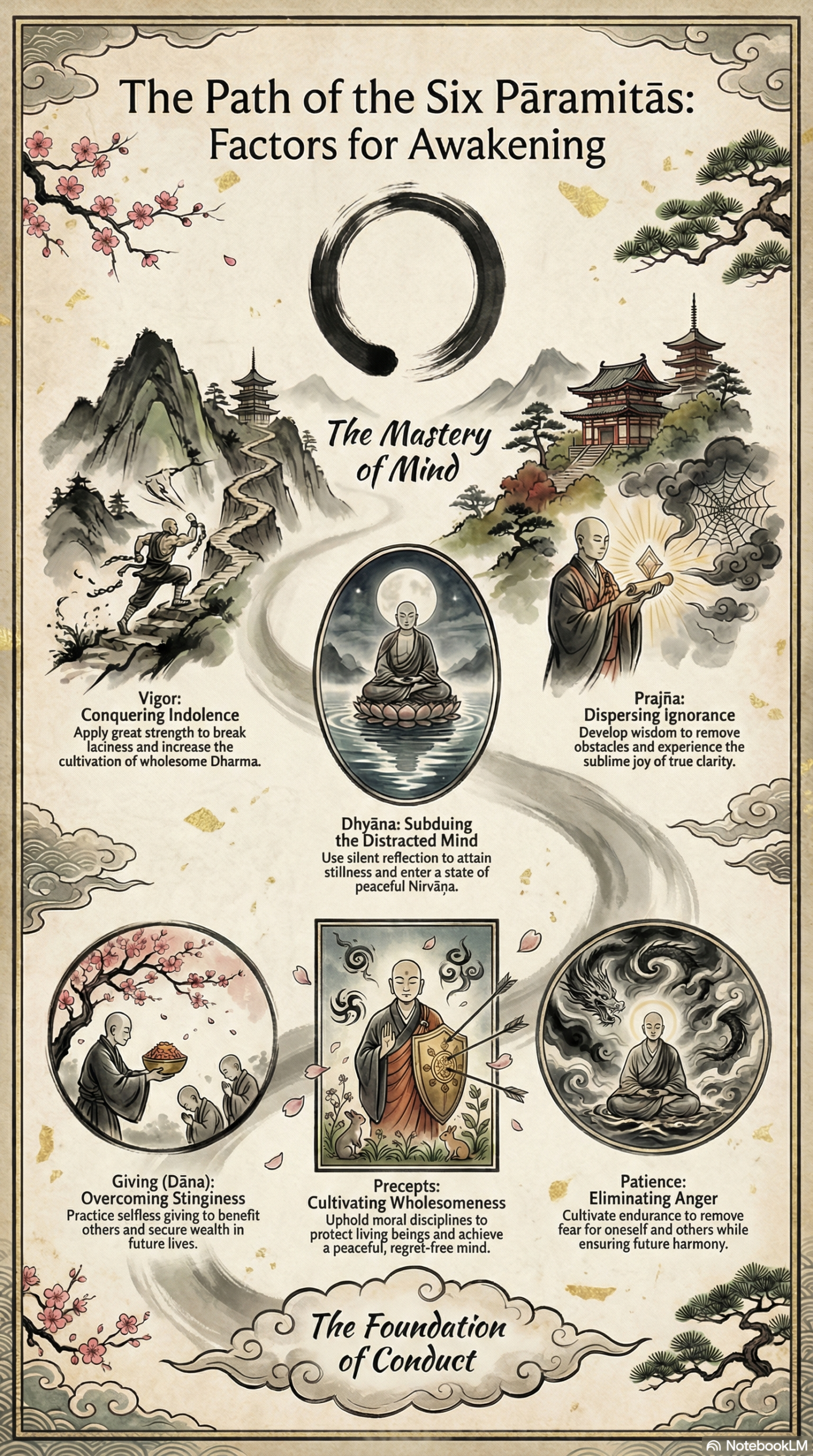
For Higan week I’m using quotes from Chinese Master Hsuan Hua’s commentary on the Lotus Sutra. Each pāramitā and its corresponding four factors is illustrated by a slide created by Google’s Gemini Notebook.

While discussing the Devadatta chapter of the Lotus Sutra, Hsuan Hua outlined four corresponding factors that are related to each of the six pāramitās. I copied this text, which runs from page 185 in volume 8 to page 189, and used it as the source material in Gemini Notebook. One of the features of Gemini Notebook is its ability to create slides based on the source material. I gave Gemini Notebook this prompt:

Create a deck suitable for religious instruction on the Six Paramitas and the Four Factors for each.

This slideshow is the result:

202603_The_Six_Pāramitās_Page_01
previous arrow
next arrow


Gemini Notebook can also create Infographics. I asked Gemini Notebook to “Use Japanese iconography from medieval Japan to illustrate this infographic.” Here’s the result:

six-paramitas-four-factors-poster

AI Magic

Going forward I intend to use Google’s AI tools to create illustrations for text. All of these illustrations will be categorized as AI Contribution. The illustration for today’s Daily Dharma is one example, but I want to explore other opportunities.

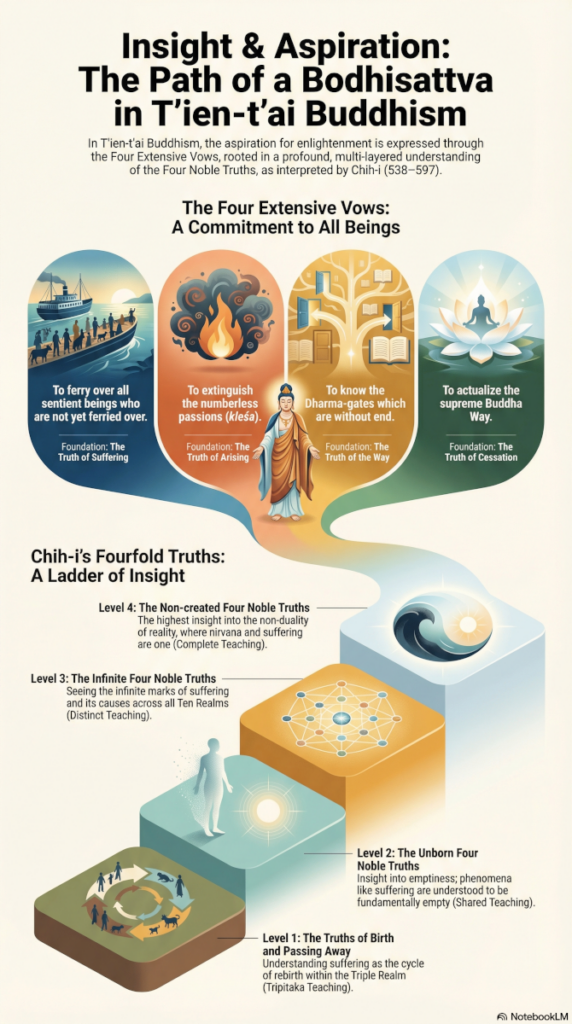
For example, I have a 1983 PDF document by Robert F. Rhodes entitled The Four Extensive Vows and Four Noble Truths in T’ien-t’ai Buddhism. I uploaded this to Google’s Gemini Notebook and asked it to produce an infographic based on the contents of the PDF document. Here’s the result:

four-vows-four-truths-illustration-web
Click to view PDF of image

Ānanda’s Trial

I’ve reached the final volume of Chinese Master Hsuan Hua’s 14-volume commentary on the Lotus Sutra and the final chapter of the sutra. Still don’t have any idea what I’m going to do with the material I set aside, but the year-long journey has been entertaining.

While I’ve learned a lot from Hsuan Hua’s commentary, my self-exploration has had some interesting results. The best example of this happened the other day when I was reading his explanation of the Dharma Ages.

The first five hundred years [after the Buddha’s parinirvāṇa] are [part of] the Proper Dharma Age, during which people are determined to attain liberation and many achieve it. During the second five-hundred-year period, people focus on meditative concentration practices. What happens in the third five-hundred-year period? People focus on building stūpas and monasteries. This is the Semblance Dharma Age. During the fourth five-hundred-year period, people have a strong desire for knowledge. They learn many sūtras, but they’re not interested in cultivation. They think that comprehension is enough, so they don’t practice what they learn; in this way, they’re just like Ānanda.

Hsuan Hua Lotus Sutra Commentary, v14, ch28, p98-99

Just like Ānanda? That seemed harsh. In Chapter 9 of the Lotus Sutra a bunch of newbie Bodhisattvas whine about the prophecy of Ānanda’s future Buddhahood. As the Buddha explains in Chapter 9:

“Good men! Ānanda and I resolved to aspire for Anuttara-samyak-saṃbodhi under the Void-King Buddha at the same time [in our previous existence]. At that time Ānanda always wished to hear much while I always practiced strenuously. Therefore, I have already attained Anuttara-samyak-saṃbodhi[, but he has not yet]. Now he protects my teachings. He also will protect the store of the teachings of future Buddhas, teach Bodhisattvas, and cause them to attain [Anuttara-samyak-saṃbodhi], according to his original vow. Therefore, now he has been assured of his future Buddhahood.”

That’s from Senchu Murano’s translation. As I explained in “Ānanda’s Vow”, all of the other translations of Kumarajiva’s Chinese version of the Lotus Sutra generally agreed that Ānanda was deficient in his  application of what he learned. But not H. Kern. His translation of an 11th century Nepalese Sanskrit version of the Lotus Sutra offered a different view of why Ānanda had lagged behind. Kern’s translation says:

Young men of good family, I and Ānanda have in the same moment, the same instant conceived the idea of supreme and perfect enlightenment in the presence of the Tathāgata Dharmagahanābhyudgatarāja, the Arhat. At that period, young men of good family, he (Ānanda) constantly and assiduously applied himself to great learning, whereas I was applying myself to strenuous labor. Hence I sooner arrived at supreme and perfect enlightenment, whilst Ānanda Bhadra was the keeper of the law-treasure of the Lords Buddhas; that is to say, young men of good family, he made a vow to bring Bodhisattvas to full development.

Fulfilling a vow to bring others to enlightenment before he himself seeks it sounds a lot better than Hsuan Hua’s declaration that Ānanda just didn’t practice what he learned. This led me to ask Google’s Gemini AI to explain the criticism of Ānanda.

I’ve uploaded the full response from Gemini: The Treasurer of Dhamma and the Primacy of Realization.   Since that article is more than 3,000 words, I uploaded the text to Google’s Gemini Notebook and asked it to create a Video Overview.  For those subject to TL:DR, here’s a seven minute explanation.

While I have several complaints about the artwork the AI created to illustrate the talk, the video does a nice job of summarizing the issues surrounding the criticism of Ānanda.

FAQ: The Lotus Sutra and the Daimoku

After gathering the promises of the Lotus Sutra and Nichiren’s encouragement so that I could publish a daily promise here, I took that content and submitted it to Google’s Gemini Notebook, an AI assistant that analyzes texts and answers questions based on the content of those texts.

Here’s the Frequently Asked Questions generated by Gemini Notebook’s AI assistant based on those promises.

What is the significance of the daimoku, “Namu-myoho-renge-kyo,” in relation to the Lotus Sutra?
The daimoku encapsulates the essence of the entire Lotus Sutra. Just as the name “Japan” represents all its provinces, people, and resources, the daimoku embodies the entirety of the sutra’s teachings. It signifies the principle of “3,000 existences in one thought,” meaning that all phenomena, from hell to Buddhahood, are interconnected and inherently possess the potential for enlightenment. Chanting the daimoku allows individuals to tap into this potential and manifest their Buddhahood.
Why is chanting the daimoku considered more important than contemplating the “3,000 existences in one thought”?
While contemplating the “3,000 existences” is valuable, Nichiren emphasizes the power of chanting the daimoku as a direct path to Buddhahood. Just as a lotus flower blossoms in response to sunlight, chanting the daimoku provides the necessary life force for spiritual growth and transformation. The daimoku is considered the “actual” doctrine of “3,000 existences in one thought,” making it the most effective practice for the Latter Day of the Law.
What is the meaning of “Myoho-Renge-Kyo”?
“Myoho-Renge-Kyo” is the Japanese pronunciation of the Chinese title of the Lotus Sutra, meaning “The Sutra of the Lotus Flower of the Wonderful Dharma.”

  • Myoho represents the Mystic Law, the underlying principle of the universe that governs life and death, cause and effect. It signifies the interconnectedness of all things and the potential for Buddhahood inherent in all beings.
  • Renge refers to the lotus flower, a symbol of purity and enlightenment. The lotus blooms in muddy water, demonstrating that enlightenment can emerge from the challenges of daily life.
  • Kyo means sutra, the teachings of the Buddha.

Together, the five characters encapsulate the profound teachings of the Lotus Sutra, which reveal the path to enlightenment for all people.

What are the benefits of chanting the daimoku?

Chanting the daimoku offers numerous benefits, including:

  • Purification of karma: The daimoku is compared to a rhinoceros horn or sandalwood leaf that repels negativity and purifies one’s karma.
  • Protection and support: Chanting invokes the protection of the Buddhas and protective forces.
  • Spiritual awakening: It cultivates wisdom, compassion, and courage.
  • Attainment of Buddhahood: The Lotus Sutra states that anyone who chants “Namu-myoho-renge-kyo” even once will eventually attain Buddhahood.
Can anyone chant the daimoku and receive benefits?
Yes, the Lotus Sutra emphasizes that the path to Buddhahood is open to all people, regardless of gender, social status, or past actions. Even those traditionally considered incapable of attaining enlightenment, such as women and those who have committed grave offenses, are embraced by the Lotus Sutra’s teachings and can achieve Buddhahood through chanting the daimoku.
Is it necessary to chant the entire Lotus Sutra to receive benefits?
No, the Lotus Sutra states that even chanting one phrase, one sentence, or even one character of the sutra holds immense merit. Chanting the daimoku is considered the most direct way to access the sutra’s power and benefits in the Latter Day of the Law.
What is the difference between the theoretical and essential teachings of the Lotus Sutra?
The theoretical teachings, found in the first fourteen chapters, focus on the concept of “3,000 existences in one thought” from a philosophical perspective. The essential teachings, revealed in the latter fourteen chapters, reveal the Buddha’s true identity as the Eternal Buddha and emphasize the practical application of “3,000 existences in one thought” through chanting the daimoku. Nichiren bases his teachings on the essential doctrine, considering it the most relevant and powerful for achieving Buddhahood in the present age.
How does the Lotus Sutra differ from other Buddhist teachings?
The Lotus Sutra is considered the culmination of the Buddha’s teachings. While other sutras teach different paths to enlightenment based on individual capacity, the Lotus Sutra reveals the One Buddha Vehicle, asserting that everyone can attain Buddhahood. It surpasses previous teachings by emphasizing the possibility of achieving enlightenment in this lifetime and revealing the inherent Buddha nature within all beings.

Edward Conze’s View of Nichiren

Before the year ends I want to put this topic to rest.

While wandering through used bookstores during a visit to Rochester, New York, this year I purchased a copy of Edward Conze’s “Buddhism; It’s Essence and Development.” The book I picked up was published by the Philosophical Library of New York.

In my readings on Buddhism Conze’s name has come up often in the footnotes, a source of information other authors relied on. What sort of information?

Consider this from page 206:

It is customary to reckon the sect of Nichiren (1222-1282) as one of the schools of Amidism. It would be more appropriate to count it among the offshoots of nationalistic Shintoism. Nichiren suffered from self-assertiveness and bad temper, and he manifested a degree of personal and tribal egotism which disqualify him as a Buddhist teacher. He did not only convince himself that he, personally, was mentioned in the Lotus of the Good Law, but also that the Japanese were the chosen race which would regenerate the world. The followers of the Nichiren sect, as Suzuki puts it: even now are more or less militaristic and do not mix well with other Buddhists.”

Let’s break this down:

  1. It is customary to reckon the sect of Nichiren (1222-1282) as one of the schools of Amidism.
  2. more appropriate to count [Nichiren Buddhism] among the offshoots of nationalistic Shintoism
  3. Nichiren suffered from self-assertiveness and bad temper, and he manifested a degree of personal and tribal egotism which disqualify him as a Buddhist teacher.
  4. He did not only convince himself that he, personally, was mentioned in the Lotus of the Good Law, but also that the Japanese were the chosen race which would regenerate the world.
  5. The followers of the Nichiren sect, as Suzuki puts it: even now are more or less militaristic and do not mix well with other Buddhists.”

None of this is excusable for a man who is described as a scholar, but perhaps we can at least offer the suggestion that his view of Nichiren was influenced by his times.

According to Conze’s “Author’s Note,” he gave a series of lectures on Buddhism at Oxford’s St. Peter’s Hall in the early 1940s. In 1948 he was encouraged to create “a work covering the whole range of Buddhist thought.” The first edition of his book was published in 1951.

The Buddhism of Nichiren was very different in the years immediately before and during World War II, when Chigaku Tanaka’s influence held sway.

As Edwin B. Lee explains, Tanaka synthesized Nichiren Buddhist doctrines with Shinto traditions to create a unique form of Japanese nationalism, “Nichirenism,” which intertwined religious and political goals.

This is not unlike Junjiro Takakusu’s unkind view of Nichiren, which was also the product of the pre-war Japan.

Like Takakusu, Conze takes Nichiren’s assertiveness in declaring the supremacy of the Lotus Sutra as “bad tempered.” I disagree and we’ll just have to leave it at that.

One assumes Conze’s statement that Nichiren convinced himself that “he, personally, was mentioned in the Lotus of the Good Law” is a reference to Bodhisattva Jōgyō, Superior Practice, one of the four leaders of the Bodhisattvas who emerged from underground in Chapter 15 of the Lotus Sutra and who is given the task of spreading the sutra in the latter days of the law. Nichiren wondered if he were Bodhisattva Jōgyō. Many of Nichiren’s followers today assume he was. But whether or not he was, that was not a primary feature of Nichiren’s teachings.

What Nichiren did recognize of himself in the Lotus Sutra was the persecutions and harassment predicted for those who attempt to spread the sutra. If Conze considers Nichiren’s view that Chapter 13, Encouragement for Keeping this Sutra, spoke to his life experience as “egotism which disqualify him as a Buddhist teacher,” then, again, I have to disagree.

Finally, there is Conze’s declaration that Nichiren taught just another form of Amidism.

Conze’s book defines Amidism as:

  • It is a kind of totalitarianism of faith in which faith is all-powerful regardless of moral conduct.
  • It is a religion accessible to everyone.
  • It rejects hardships, austerities, and even the mild asceticism of monastic life.
  • All people, good or bad, are admitted to Amitabha’s Pure Land.
  • Faith in Amitabha’s grace is the sole condition for admission to the Pure Land.
  • Amitabha is a compassionate god who, unlike the Christian God, is not a judge.

(This summary is provided by Gemini Notebook. A PDF of the book is available here if you want a quick AI assistant review.)

The only point of intersection between Conze’s Amidism and Nichiren’s devotion to the Lotus Sutra is that it is a religion accessible to everyone.

I am unapologetic in my admiration for Nichiren and the Lotus Sutra.

In 2025 I will underscore this by publishing daily a short example of the promise of the Lotus Sutra.

Next: The Next 10 Years.

The Meaning of Li

Before exploring Tao-sheng and his commentary on the Lotus Sūtra it is necessary to define the meaning of the Chinese word li 理. In his commentary, Tao-sheng repeatedly references li, but what exactly is he pointing at?

The original doctoral thesis upon which Young-Ho Kim’s book, “A Study and Translation: Tao-sheng’s Commentary on the Lotus Sūtra” is based is available for download. (PDF). In addition, Walter Liebenthal published a biography of Tao-sheng in Monumenta Nipponica in October 1955. This too is available for download. (PDF)

I took both PDFs and uploaded them to Google’s Gemini Notebook. This service allows the user to have an AI assistant analyze specific texts and answer questions based on the content of those texts, which ensures that the answers are limited to the facts at hand and not based on wider and perhaps unreliable sources. I’ve tested this before. See Understanding Kaji Kito.

Tao-sheng’s commentary on Kumārajīva’s translation of the Lotus Sutra was completed in 432 CE, two years before he died. Kumārajīva completed his translation in 406 CE. Tao-sheng’s commentary is the earliest one to survive to this date.

How does Tao-sheng’s philosophy differ from the Chinese Taoist and New Taoist philosophy of his day?

The Gemini Notebook offered this bottom line:

Overall, Tao-sheng’s philosophy represents a unique synthesis of Buddhist thought with elements of Chinese philosophical language and concepts. While he borrows from the vocabulary of Taoism and Neo-Taoism, his system ultimately centers on the Buddhist goal of enlightenment and universal salvation, differentiating him from the dominant philosophical trends of his day.

On the question of li, Gemini Notebook summarizes Tao-sheng’s perspective saying:

Tao-sheng’s definition of li is not presented as a clear-cut definition but emerges from his application of the term in his commentary on the Lotus Sutra. He sees li as the underlying principle of Buddhist teachings, the object of enlightenment, and a reality that is both particular and universal. He associates li with profoundness, transcendence, and omnipresence. While advocating sudden enlightenment, he also acknowledges the possibility of a gradual process of realization. His use of li reflects a sophisticated attempt to synthesize Buddhist teachings with Chinese philosophical concepts.

When asked “What is li?”, Gemini Notebook responded:

Li in Tao-sheng’s Commentary on the Lotus Sutra
The term li 理 is central to Tao-sheng’s commentary on the Lotus Sutra, appearing 139 times throughout the text. It’s a complex concept with a range of meanings, reflecting both Buddhist teachings and Tao-sheng’s engagement with Chinese philosophy, particularly Neo-Taoism. The sources suggest that Tao-sheng does not offer a concise definition of li. Instead, its significance unfolds through how he employs the term to illuminate the Lotus Sutra.

Li as a Tool for Understanding

  • Li acts as a lens through which to understand the deeper meaning and intent behind the Buddha’s words in the Lotus Sutra.
  • Tao-sheng uses li to reveal the essential principles and truths embedded within the text, emphasizing that comprehending li is crucial for attaining enlightenment.

Li as the Underlying Reality

  • Tao-sheng portrays li as a profound, often elusive, reality that underlies the world of appearances.
  • He suggests li is both particular and universal, echoing the Neo-Taoist thinkers Wang Bi and Guo Xiang.
    • Just as Wang Bi recognized a universal li and Guo Xiang focused on the particular li of individual things, Tao-sheng seems to bridge these two perspectives.
  • In the context of the Lotus Sutra, li signifies the ultimate reality that encompasses and harmonizes the seemingly diverse teachings of the Buddha, representing the unity of the three vehicles and the One Vehicle.
  • Tao-sheng also connects li with the Buddhist concept of the Dharma-kāya, suggesting its omnipresent and formless nature.

Li and Language

  • Given the profound nature of li, Tao-sheng acknowledges the limitations of language in fully expressing it.
  • He compares words to “fishnets and traps,” useful for guiding people towards li but ultimately discarded once the goal is reached.
  • Despite their limitations, words and symbols remain essential, particularly for those who have yet to realize li.

Li as the Object of Enlightenment

  • Tao-sheng directly links the realization of li with enlightenment, distinguishing his view from Neo-Taoism, where li may be a philosophical principle but not necessarily the target of spiritual practice.
  • He uses terms like “perceive,” “trace to the end,” “know,” “penetrate,” and “comprehend” to describe the process of realizing li.
  • This suggests a noetic path to enlightenment, involving both understanding and direct experience.

Li and the Path to Enlightenment

  • While Tao-sheng is known for his advocacy of sudden enlightenment, his commentary on the Lotus Sutra reveals a more complex perspective.
  • He acknowledges that grasping li may involve a gradual process of refining one’s understanding and purifying the mind.
  • This apparent contradiction might reflect Tao-sheng’s attempt to harmonize the Lotus Sutra’s teachings on both gradual cultivation and sudden insight with the philosophical context of his time.

Key Characteristics of Li in Tao-sheng’s Commentary

  • Underlying Principle: Li represents the essence of the Buddha’s teachings in the Lotus Sutra.
  • Ultimate Reality: Li points to a profound reality that underlies the world of appearances.
  • Both Particular and Universal: Li encompasses both specific truths and a unifying principle.
  • Object of Enlightenment: Realizing li is equivalent to attaining enlightenment.
  • Beyond Language: Li cannot be fully captured by words, yet language serves as a provisional guide.
  • Path to Enlightenment: Grasping li can involve both sudden insight and gradual cultivation.

Tao-sheng’s use of li showcases his skill in weaving together Buddhist concepts with existing Chinese philosophical language to make the teachings of the Lotus Sutra accessible and meaningful for a Chinese audience.

As I incorporate Tao-sheng’s commentary into my annotations on the Lotus Sutra, I will link each occurrence of the word li back to the above explanation.

Next: Li and Sudden Enlightenment