
[A]mong Saichō’s later followers, the traditional T’ien-t’ai “perfect teaching” (engyō) based on the Lotus Sūtra was fused with Mikkyō in the “one great perfect teaching.” Their writings recapitulate Saichō’s move to incorporate all teachings within the Lotus, but in esoteric terms. That is, rather than encompassing Mikkyō within the framework of the one vehicle of the Lotus as Saichō had intended, Taimitsu developed an esoteric reading of the one vehicle that tended to subsume the Lotus within Mikkyō, a tendency especially evident in Annen’s writings. In any event, the two traditions became inseparably intertwined and came to share a common vocabulary. Medieval Tendai hongaku thought would emerge in large part as an attempt to reinterpret traditional T’ien-t’ai/Tendai doctrines through the lense of an esotericized sensibility. (Page 24)
Original Enlightenment and the Transformation of Medieval Japanese BuddhismAll posts by John Hughes
Mind Stupidity
[Chih-i] contemplates the Twelvefold Causality by viewing ignorance (āvidya) as only the product of a stupid mind. Chih-i describes how various conditions arouse various links in the Twelvefold Causality, and how the Three Virtuous Qualities of Buddhahood (i.e., perfect wisdom, liberation, and Dharmabody) can be attained when the Threefold Course of Ignorance (i.e., suffering, karman and affliction) is extinguished:
“Ignorance is just mind stupidity. If the mind is at the state of stupidity, it arouses affliction [kleśa]. From affliction, various kinds of karman rise. From karman, various types of suffering [cluḥkha] rise.”126 If ignorance is destroyed, prajn͂ā is manifested. If karman is destroyed, liberation is manifested. If consciousness, and name-and-form are destroyed, the dharmakāya is manifested.” (Vol. 2, Page 150)
The Profound Meaning of the Lotus Sutra: Tien-tai Philosophy of BuddhismDay 30
Day 30 covers all of Chapter 26, Dhāraṇīs
Having last time received Medicine-King Bodhisattva’s dhārāni spells and Śākyamuni Buddha’s response, we greet Brave-In-Giving Bodhisattva and receive his dhārāni spells.
Thereupon Brave-In-Giving Bodhisattva said to the Buddha:
“World-Honored One! I also will utter dhārānis in order to protect the person who reads, recites and keeps the Sūtra of the Lotus Flower of the Wonderful Dharma. If he keeps these dhārānis, this teacher of the Dharma will not have his weak points taken advantage of by any yakṣa, rākṣasa, pūtana, kṛtya, kumbhāṇḍa or hungry spirit.”
Then he uttered spells before the Buddha:
“Zarei (1), makazarei (2), ukki (3), mokki (4), arei (5), arahatei (6), netsureitei (7), netsureitahatei (8), ichini (9), ichini (10), shichini(11), netsureichini (12), netsurichihachi (13).”
[He said to the Buddha:]
“World-Honored One! These dhārānis, these divine spells, have already been uttered by as many Buddhas as there are sands in the River Ganges. Those Buddhas uttered them with joy. Those who attack and abuse this teacher of the Dharma should be considered to have attacked and abused those Buddhas.”
Nichiren offers this on the Dhārāṇi chapter:
The Dhārāṇi chapter states that two bodhisattvas, two heavenly kings and ten female rākṣasa demons will protect the practicer of the Lotus Sūtra. The two bodhisattvas are the Bodhisattva Medicine King and the Bodhisattva Brave Donor. The two heavenly kings are Vaiśravaṇa and Dhṛtarāṣṭra. The ten female rākṣasa demons are ten great demons, mothers of all demons in the four quarters of the world. Their mother is Hāriti.
They eat men after the custom of demons. A man’s body is composed of thirty-six substances such as excrement, urine, spittle, flesh, blood, skin, bone, five viscera and six entrails, hair, breath, and spirit. Inferior demons feed on excrement and the like. Mediocre demons feed on bones and the like. Superior demons feed on spiritual essence. The ten female rākṣasa demons have supreme qualities and thus feed on man’s spiritual essence. They are the great demons of epidemic.
Nichinyo Gozen Gohenji, A Response to My Lady Nichinyo, Writings of Nichiren Shōnin, Volume 4, Faith and Practice, Page 134
Letting Go
Remember, though, that we are not letting go just for the sake of letting go. If we cling to the concept of letting go then we are not letting go, we are not freeing ourselves, and we will not feel peace. … Freeing the mind frees ourselves and then we can act in a less stressful way. It is how we respond to things as they arise around us that determines our state of mind; it isn’t the things themselves. Remember we need to do something; we need to think something in order to become angry or sad or any other emotion. Chanting the Odaimoku and meditating on the Lotus Sutra enables us to develop a state of mind that is free from clinging, and one that recognizes that we are already Buddhas, even if we are unaware at the moment.
Lotus Path: Practicing the Lotus Sutra Volume 1Daily Dharma – Dec. 8, 2018
The Bodhisattva-mahāsattva also should know the following truth. All things are insubstantial. They are as they are. Things are not perverted. They do not move. They do not go. They do not turn. They have nothing substantial just as the sky has not. They are inexplicable. They are not born. They do not appear. They do not rise. They are nameless. They are formless. They have no property. They are immeasurable and limitless. They have no obstacle or hindrance. He should see all this. Things can exist only by dependent origination. Only perverted people say, ‘Things are permanent and pleasant.’ This truth is the second thing he should approach.
The Buddha gives this explanation to Mañjuśrī in Chapter Fourteen of the Lotus Sūtra in which he describes the peaceful practices of a Bodhisattva. The Buddha does not see the world as we do. This section explains how changing our view changes the world. When we no longer see beings with power to overwhelm us, and see beings in whom delusions have been created, we see our abilities to cut the root of those delusions and benefit them. These passages are what make the Lotus Sutra difficult to believe and understand, since they go against our habits of manipulating the world to become happy. As we learn to work with our minds, then we truly change the world.
The Daily Dharma is produced by the Lexington Nichiren Buddhist Community. To subscribe to the daily emails, visit zenzaizenzai.com
Funeral Service
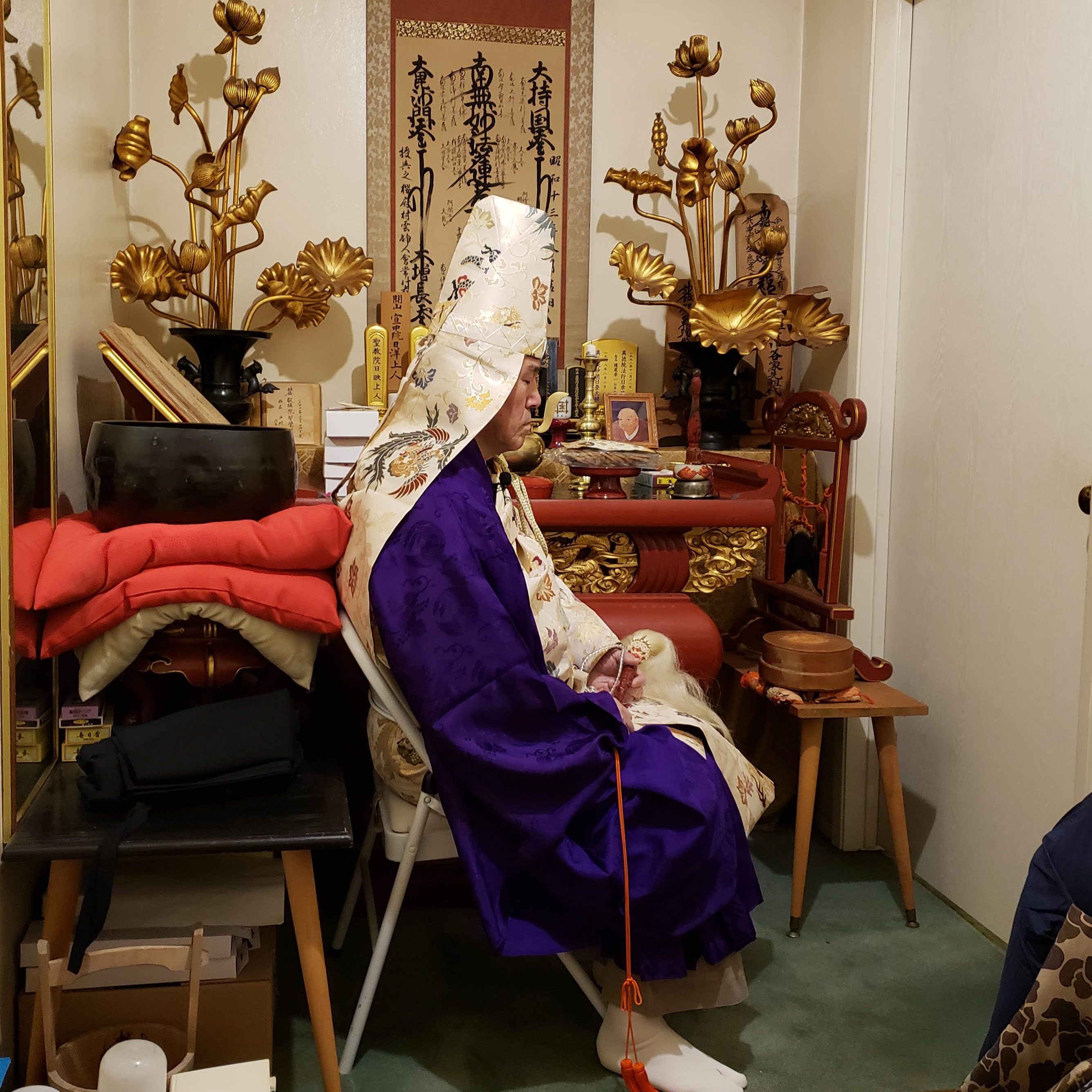
When Rev. Igarashi has a big funeral service he invites me to help. Ten minutes before the start of the service I light the candles on the altar and light the charcoal for the powdered incense offering. Then, two minutes before the scheduled start, I strike the church bell, starting slowly and then progressively faster and then progressively slower until I conclude with two quick strikes.
Today’s service was for Masanao Okamoto, the husband of Fusako. Mr. Okamoto is a former president of the church board. His wife is very active in the church. The two met in the Tule Lake internment camp during World War II and were married in 1947. The couple had been married 71 years when Mr. Okamoto died.
The photo above captures Rev. Igarashi in quiet contemplation prior to the service in a small room adjacent to the altar.
Each time I help out at a funeral, Rev. Igarashi tells me the same thing. He doesn’t like funerals. In the 30 years he has been the chief priest at the Sacramento Nichiren Buddhist Church he’s done a lot of funerals. More and more often now the services are for men and women whom he has worked with for many years.
Taimitsu and Tōmitsu
Saichō did not live long enough to work out a thorough synthesis of esoteric Buddhism and the one-vehicle teaching of the Lotus Sūtra, and the task would be carried on by his disciples. The integration of Tendai/Lotus doctrine and the esoteric teachings (enmitsu itchi) would become a major feature distinguishing Taimitsu—the Mikkyō that developed within Tendai—from that of Tōmitsu, the Mikkyō of Kūkai’s Shingon tradition, and was essential to the development of medieval Tendai hongaku thought. (Page 21)
Original Enlightenment and the Transformation of Medieval Japanese BuddhismKnowledge of the Perfect Teaching
The knowledge of the Perfect Teaching represents the Buddha-vehicle and is obtained by the bodhisattva of supreme faculties. As the perfect knowledge of the Buddha, the contemplation of the Middle Way is superior to the previous one. This means that the Middle Way is reached by affirming both emptiness and existence. Seeing that emptiness is provisional existence and the provisional existence is of empty nature, emptiness and provisional are identical to each other. The contemplation of the Threefold Truth practiced in the Perfect Teaching is perfect and merging, by which all dharmas are identified to be nothing but the manifestation of the Middle Way. The bodhisattva of the Perfect Teaching is capable of knowing that it is the mind that acts to distinguish things. Without the manipulation of the mind, all dharma are actually non-distinction and are of one entity. Upon the realization that there is neither distinction between the concept of affliction and bodhi-wisdom, nor distinction between life-death and Nirvāṇa, one does not need to seek bliss by departing from suffering (as affliction is bodhi). The state of non-distinction of the mind leads to spontaneity and the display of the true nature of dharmas as it is (i.e., no-function), by which the Buddha-nature inherent in all sentient beings can be revealed, and Buddhahood can be attained. (Vol. 2, Page 144)
The Profound Meaning of the Lotus Sutra: Tien-tai Philosophy of BuddhismDay 29
Day 29 covers all of Chapter 25, The Universal Gate of World-Voice-Perceiver Bodhisattva.
Having last time learned some of the reasons to call the name of World-Voice-Perceiver Bodhisattva, we consider more ways in World-Voice-Perceiver helps those who call his name.
“Those who have much lust will be saved from lust if they constantly think of World-Voice-Perceiver Bodhisattva and respect him. Those who have much anger will be saved from anger if they constantly think of World-Voice-Perceiver Bodhisattva and respect him. Those who have much stupidity will be saved from stupidity if they constantly think of World-Voice-Perceiver Bodhisattva and respect him. Endless-Intent! World-Voice-Perceiver Bodhisattva has these great supernatural powers. He gives many benefits to all living beings. Therefore, they should constantly think of him.
“A woman who, wishing to have a boy, bows and makes offerings to World-Voice-Perceiver Bodhisattva, will be able to give birth to a boy endowed with merits, virtues and wisdom. [A woman] who, wishing to have a girl, [does the same,] will be able to give birth to a beautiful girl who will be loved and respected by many people because of the roots of virtue which the [newly-born] girl planted in her previous existence. Endless-Intent! Because World-Voice-Perceiver Bodhisattva has these powers, the merits of those who respect him and bow to him will not be fruitless. Therefore, all living beings should keep the name of World-Voice-Perceiver Bodhisattva.
The Daily Dharma from Oct. 6, 2018, offers this:
Those who have much lust will be saved from lust if they constantly think of World-Voice-Perceiver Bodhisattva and respect him. Those who have much anger will be saved from anger if they constantly think of World-Voice-Perceiver Bodhisattva and respect him. Those who have much stupidity will be saved from stupidity if they constantly think of World-Voice-Perceiver Bodhisattva and respect him.
The Buddha gives this description of World-Voice-Perceiver Bodhisattva (Kannon, Kanzeon, Avalokitesvara) to Endless-Intent Bodhisattva in Chapter Twenty-Five of the Lotus Sūtra. World-Voice-Perceiver is the embodiment of compassion for all beings, the wish that all beings be freed from suffering and realize the enlightenment of the Buddha. This compassion is the antidote to the three poisons of lust, anger and stupidity. By aspiring to the example of World-Voice-Perceiver and awakening our own compassion, we can overcome these poisons and bring benefits to all beings.
The Daily Dharma is produced by the Lexington Nichiren Buddhist Community. To subscribe to the daily emails, visit zenzaizenzai.com
A Graphic Representation of the ‘Supreme Being’
In brief, his exile of three years in Sado was the climax of his life, and during this time he achieved what he deemed to be the pivot of his work, a graphic representation of the “Supreme Being.”
History of Japanese Religion