
With regard to the truth itself, the common view held by Buddhists is that it is indescribable and inexpressible and can only be reached by intuitive insight through contemplation. What is the point then for the Buddha to teach truth? Chih-i argues that the Buddha’s teaching is necessary for the sake of liberating sentient beings. Truth has to be delivered when there is need for it, namely, living beings have a need to hear the teachings in order to eliminate suffering and attain liberation.
The Profound Meaning of the Lotus Sutra: Tien-tai Philosophy of BuddhismAll posts by John Hughes
Making Things Thus
Buddhism teaches that we must begin by properly understanding the way things are; from this, we know the way things should be; and then we throw ourselves into the practice to make things thus.
Basic Buddhist Concepts
Daily Dharma – Oct. 11, 2018
Offer him heaps of the treasures of heaven! Why is that? It is because, while he is expounding the Dharma with joy, if you hear it even for a moment, you will immediately be able to attain Anuttara-samyak-saṃbodhi.
The Buddha gives this instruction to Medicine-King Bodhisattva at the beginning of Chapter Ten of the Lotus Sūtra. In Chapter Twenty-Three, the Buddha tells of all the hardships Medicine-King endured to practice the Wonderful Dharma. This Bodhisattva knows all the difficulties we face because he has experienced them himself. When anyone sees us practicing, living and sharing the Dharma with others, they will see the joy we have and want to experience it for themselves. The treasures of heaven we receive from Medicine-King are not like the pleasures and comforts we find in the world. They are the assurance we have of our enlightenment and that of all beings.
The Daily Dharma is produced by the Lexington Nichiren Buddhist Community. To subscribe to the daily emails, visit zenzaizenzai.com
The Mind as the Foundation
The folding of mind is to take mind as the foundation. For Chih-i,
contemplating mind is to regard “the mind as the foundation for all dharmas” (Hsin-shih Chu-fa Chih-pen). This is because it is the mind in activity that generates karman (deeds), from which suffering arises. It is also the mind that embraces all dharmas or entities. In Chih-i’s system, the Ten Suchnesses and the Ten Dharma-realms represent all entities. Since the Ten Dharma-realms are the representation of the whole universe and they are embraced by the mind, mind can be taken as the universe. (Vol. 2, Page 31)
Facing Dificulties
When we face difficulty or suffering, maybe we should consider whether such difficulty or suffering is advice from the Buddha calling for our reflection. Could such difficulty or suffering be an advance warning to avoid a major incident? Is this a hurdle to overcome on the road to self-improvement or development? Is this experience needed to make us examine our lives more deeply? In any event, this is a compassionate test given by the Buddha to us to improve ourselves.
Buddha Seed: Understanding the OdaimokuDaily Dharma – Oct. 10, 2018
Just as a reflection is seen
In a clear mirror,
All things in the world will be reflected
On the pure body of this [person, that is, of this] Bodhisattva.
No one but he
Will be able to see all things clearly.
The Buddha declares these lines to Constant-Endeavor Bodhisattva in Chapter Nineteen of the Lotus Sūtra, describing those who keep the Lotus Sūtra. When we encounter other beings in this world of conflict, we tend to filter our experience through our expectation. If it is a friend, we expect them to care about us and treat us well; an enemy, to harm us and treat us badly; a stranger, we compare them to other beings like them and expect them to be the same. When we use the Buddha Dharma to look for the complexity of all beings, and look for how we can bring out their ability to benefit and protect others, then we reflect back to them their true natures, rather than the clouds of their delusions.
The Daily Dharma is produced by the Lexington Nichiren Buddhist Community. To subscribe to the daily emails, visit zenzaizenzai.com
Chih-i’s Unfolding of Mind
The unfolding of mind is to take mind as the substance, the gist, and the function. In Chih-i’s view, there are three types of mind: (i) the mind of affliction (Fan-nao Hsin) which includes three links: ignorance (Ch., Wu-ming; Skt., avidyā), desire (Ch., Ai; Skt., tṛṣṇā), and attachment (Ch., Ch’ü; Skt., upādāna), (ii) the mind of suffering as effect (K’u-kuo Hsin) which includes seven links: consciousness (Ch., Shih; Skt., vijn͂āna), name-and-form (Ch., Ming-se; Skt., nāmarūpa), the six senses (Ch., Liu-ju; Skt., ṣaḍāyatana), contact (Ch., Ch’u; Skt., sparśa), sensation (Ch., Shou; Skt., vedanā), rebirth (Ch., Sheng; Skt.,jāti), and old age-and-death (Ch., Lao-ssu; Skt.,jarāmarava), and (iii) the mind of karman (Yeh Hsin) which includes two links: volitional activity (Ch., Hsing; Skt., saṃskāra), and existence (Ch., Yu; Skt., bhava). When these three types of mind are identified with the Dharma-body, perfect wisdom, and liberation, they are taken as the Substance, the Gist, and the Function. Chih-i says that if the mind of suffering is identical to the dharmakāya (Dharma-body), the mind is taken as the Substance (Hsin-t’i). If the mind of affliction is identical to prajn͂ā (perfect wisdom), the mind is taken as the Gist (Hsin-tsung). If the mind of karman is identical to liberation, the mind is taken as the Function (Hsin-yung). The “Characteristics of the Teaching” that concerns mind is the overview of both “unfolding” and “folding”. When mind differentiates (i.e., the aspect of unfolding) with regard to the Twelvefold Causality (Ch., Shih-erh Yin-yüan; Skt., dvādaśāṅgaprat̄tyasamupāda), six worlds (hell-dwellers, hungry ghosts, animals, asuras, humans, and heavenly beings) arise. This is because the mind differentiation is a result of one’s ignorance that generates the twelve links of dependent origination, and keeps one in the cycle of the six worlds. Only if the mind is put to rest and no longer differentiates (i.e., the aspect of folding), can one depart from ignorance. Subsequently, the four levels of sages (i.e., śrāvakas, pratyekabuddhas, bodhisattvas, and Buddhas) arise. (Vol. 2, Page 31)
The Profound Meaning of the Lotus Sutra: Tien-tai Philosophy of BuddhismThe Miraculous Oral Discipline in Our Sect
All we have to do is to open our eyes and look at the Truth; then, in spite of our anger and fury we shall experience peace and happiness, we shall be able to establish equality and impartiality between ourselves and others, and attain to that state of content and pleasure which they and we shall enjoy together. What possible reason is there against our succeeding to become Buddhas, except our continuance under the spell of anger and fury, unless we reduce ourselves to emptiness and annihilation? Even ignorant men and women who can neither read nor write may surely attain the Buddhahood, if they will but sincerely repeat the Daimoku Na-mu Myo Ho Ren-ge Kyo. This is the miraculous oral discipline in our Sect.
Doctrines of Nichiren (1893)Attaining Enlightenment Just As We Are
Sometimes we think of Buddhism and think we need to be just like the Buddha. We may even think that we need to sit under a tree and be peaceful like we imagine the Buddha. But I think we miss the point sometimes by wishing to become exactly like the Buddha and fail to realize our goal is to attain enlightenment just as we are.
Lotus Path: Practicing the Lotus Sutra Volume 1Two Perspectives on Doctrine of Ichinen Sanzen
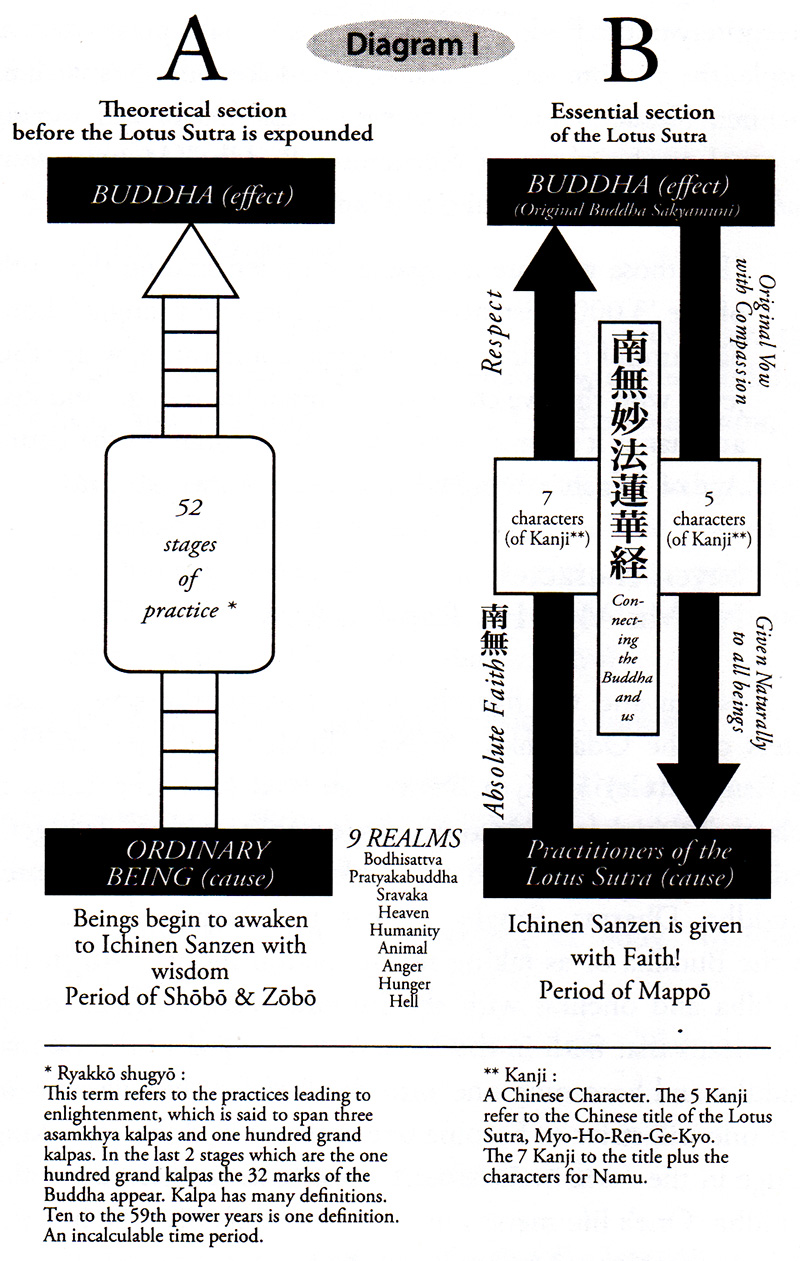
The doctrine of Ichinen Sanzen must be considered from two perspectives: the doctrine as taught in the theoretical section (shakumon) of the Lotus Sutra and the doctrine as taught in the essential section (honmon) of the Lotus Sutra. Simply speaking, the theoretical section refers to the first 14 chapters of the Lotus Sutra, which is the realm of the historical Buddha, while the essential section refers to the latter 14 chapters, which is the realm of the Eternal Śākyamuni Buddha who is eternally engaged in the activities of saving living beings. The theoretical section is known as the “Ichinen Sanzen of Ri, ‘ while the essential section is known as “Ichinen Sanzen of Ji