Because they did sinful karmas,
They lose pleasures and the memory of pleasures.
They are attached to wrong views.
They do not know how to do good.
They are not taught by a Buddha;
Therefore, they fall into the evil regions.
The Heavenly-King Brahmas from the zenith sing these verses to Great-Universal-Wisdom-Excellence Buddha in Chapter Seven of the Lotus Sūtra. They describe how beings live in a world in which they can find no Buddha, their joy that Great-Universal-Wisdom-Excellence Buddha has appeared, and their hope that this Buddha will lead all beings from the regions of difficulties. When these Brahmas speak of pleasure, it is not what comes from getting what we want. It is the pleasure of the Dharma, the pleasure enjoyed by all Buddhas when they become enlightened, and the pleasure available to us when we resolve to benefit all beings and practice the Buddha Dharma as Bodhisattvas.
The Daily Dharma is produced by the Lexington Nichiren Buddhist Community. To subscribe to the daily emails, visit zenzaizenzai.com
In view of the three teachings (Tripitaka, Common, and Separate), compared with the Perfect Teaching that represents the ultimate teaching, they are considered to be the relative teachings leading to the final teaching of the Perfect. Thus, they are coarse. However, the relative teachings are not only determined as relative, they can have different meanings depending on whether or not they are integrated with the ultimate teaching the Lotus Sūtra represents. If they are not converged into the Lotus teaching, they are relative. At the moment when they are looked at in the context of opening the Relative and revealing the Ultimate, they become ultimate. This is because, in the Lotus Sūtra, all teachings are said to contain the real intention of the Buddha for all beings to attain Buddhahood. Therefore, there is no more difference between the relative and the ultimate teachings, in a sense that the relative teachings are one with the ultimate teaching. In actuality, the relative teachings are not only ultimate when they are converged, but the relative teachings themselves are also considered to be ultimate, from the perspective that they are the indispensable steps in leading living beings to reach the final goal of the ultimate teaching. For example, in his discussion of the importance of the relative position, Chih-i gives an analogy comparing the positions of the three teachings with the positions of the Perfect Teaching by asserting:
“The relative [positions] in the past contain the ultimate [positions]. This is like the [lotus] flower that contains the seedpod. To open the Relative and to reveal the Ultimate resembles the blooming of the flower, and the seedpod is manifested, Apart from this flower, there is no other seedpod that can be displayed. Likewise, apart from the coarse [positions], there are no other subtle [positions] that can be revealed. Why does it need to destroy the coarse [positions] in order to attain the subtle positions? Only by opening the relative positions, the subtle positions can be at once manifested.”
On his way from Benares to Uruvela in Magadha, Shakyamuni entered a quiet forest and began seated meditation. At that time, thirty young men of royal blood, all but one with their young wives, were enjoying themselves in the woods. One of the young men was unmarried, and a harlot had been procured for him. As the others were lost in their amusements, the harlot stole their gold, silver, and jewels and ran away. When they saw what had happened, the young men and women hastened in search of her. Coming upon Shakyamuni seated in a grove, they asked if he had seen the woman. He replied by asking why they were looking for her. After hearing their reason, he asked, “Which is more important, to seek that woman or to seek yourselves?” They answered that seeking themselves was more important. Whereupon Shakyamuni said, “Sit there, and I will teach you the Law whereby to seek yourselves.” They then listened to his sermon.
Following his usual custom, Shakyamuni taught first the triple doctrine of almsgiving to the poor and holy people, abiding by the moral precepts, and the assurance that good acts are rewarded by rebirth in a blessed state. From this he gradually moved to the Four Noble Truths. Upon hearing his words, the young men came to understand the true nature of human life throughout the world and attained the pure and spotless Eye of the Law. They requested to be allowed to abandon the secular world and were accepted as members of the Order.
Day 16 concludes Chapter 11, Beholding the Stūpa of Treasures, and completes the Fourth Volume of the Sūtra of the Lotus Flower of the Wonderful Dharma.
Having last month concluded Chapter 11, Beholding the Stūpa of Treasures, we return to the top and the Buddhas of the worlds of the ten quarters announcing their plans to go to Śākyamuni Buddha of the Sahā-World.
Thereupon each of the Buddhas of the [worlds of the] ten quarters said to the Bodhisattvas under him, “Good men! Now I will go to Śākyamuni Buddha of the Sahā-World. I also will make offerings to the stūpa of treasures of Many-Treasures Tathāgata.”
At that instant the Sahā-World was purified. The ground of the world became lapis lazuli. The world was adorned with jeweled trees. The eight roads were marked off by ropes of gold. The towns, villages, cities, oceans, rivers, mountains, forests and thickets were eliminated. The incense of great treasures was burned; mandārava flowers, strewn over the ground; and jeweled nets and curtains with jeweled bells, hung over the world. The gods and men were removed to other worlds except those who were in the congregation.
At that time each of the Buddhas was accompanied by an attendant who was a great Bodhisattva. Some of the Buddhas came under the jeweled trees in the Sahā-World. The jeweled trees were five hundred yojanas tall, and adorned with branches, leaves, flowers and fruits. Under the jeweled trees were lion-like seats five yojanas tall, adorned with great treasures. The Buddhas sat cross-legged on the seats [under the jeweled trees]. The seats [under the jeweled trees] in the [Sahā-World composed of] one thousand million Sumeru-worlds were, however, too few to receive all the Buddhas of Śākyamuni Buddha’s replicas who were to come from the worlds even of one of the ten quarters. [Seeing this,] Śākyamuni Buddha purified two hundred billion nayuta worlds of each of the eight quarters [neighboring the Sahā-World] to receive all the Buddhas of his replicas. The hells, the regions of hungry spirit , the regions of animals, and the regions of asuras [of those worlds] were eliminated; and the gods and men [of those worlds] were removed to other worlds. The ground of those purified world became lapis lazuli. The worlds were adorned with jeweled trees five hundred yojanas tall. The trees were adorned with branches, leaves, flowers and fruits. Under the trees were lion-like seats of treasures five yojanas tall, adorned with various treasures. The great oceans, rivers, the Mucilinda Mountains, the Maha-Mucilinda Mountains, the Surrounding Iron Mountains, the Great Surrounding Iron Mountains, the Sumeru Mountains, and all the other great mountains [of those worlds] were eliminated, and all those worlds were amalgamated into one Buddha-world [that is, into the world of Śākyamuni Buddha). The jeweled ground of this [expanded] world was even. Jeweled curtains and canopies adorned with streamers were hung over this [expanded] world; the incense of great treasures, burned; and jeweled flowers of heaven, strewn over the ground.
The main point of the Lotus Sutra is this: all Buddhas, whatever names they may use, are temporary manifestations of this Eternal Buddha. He appears in other forms in order to lead people to enightenment. However, these Buddhas are limited. They are provisional, only a reflection of the true form of the Eternal Buddha Sakyamuni in a given time and place.
The fact that Nichiren became enlightened proves that even the multitude, in these Last Days of the Great Law, can get free from all evils and reach the self-same goal. Indeed, to attempt to be a Nichiren and a Sakyamuni should be the first motive of all who believe in our doctrines, and carry their self-reliance to the furthest possible point.
We may get tired or discouraged along the way, but remember the story of the magic city. The Buddha assures us, we have his promise that we cannot fail if we continue to exert ourselves.
If we continue to practice the Lotus Sutra we can establish within our lives the indestructible condition of enlightenment just as we are.
Provisional teachings today are enemies of the True Dharma. If provisional teachings stand in your way as you try to spread the One Vehicle teaching of the Lotus Sutra, you should thoroughly refute them. Of the two ways of propagation, this is the aggressive way of the Lotus Sutra.
Nichiren wrote this passage in his Treatise on the True Way of Practicing the Teaching of the Buddha (Nyosetsu Shugyō-shō). We notice in this passage that his instruction is to refute the provisional teachings and not attack those who are attached to them. Even if those whose teachings we challenge become angry and violent, we can understand that we did not cause this reaction. This is one reason the Lotus Sūtra is so difficult. By keeping a mind of compassion we can maintain our respect for others even when we disagree with them. They too are going to become Buddhas, and we are benefiting them, even if they reject our help.
The Daily Dharma is produced by the Lexington Nichiren Buddhist Community. To subscribe to the daily emails, visit zenzaizenzai.com
It has taken me a week to go through the hour-long recording of last week’s adult study class and the sermon that followed the service. While that does disappoint me, the purpose here is to make the information available. Even a week later.
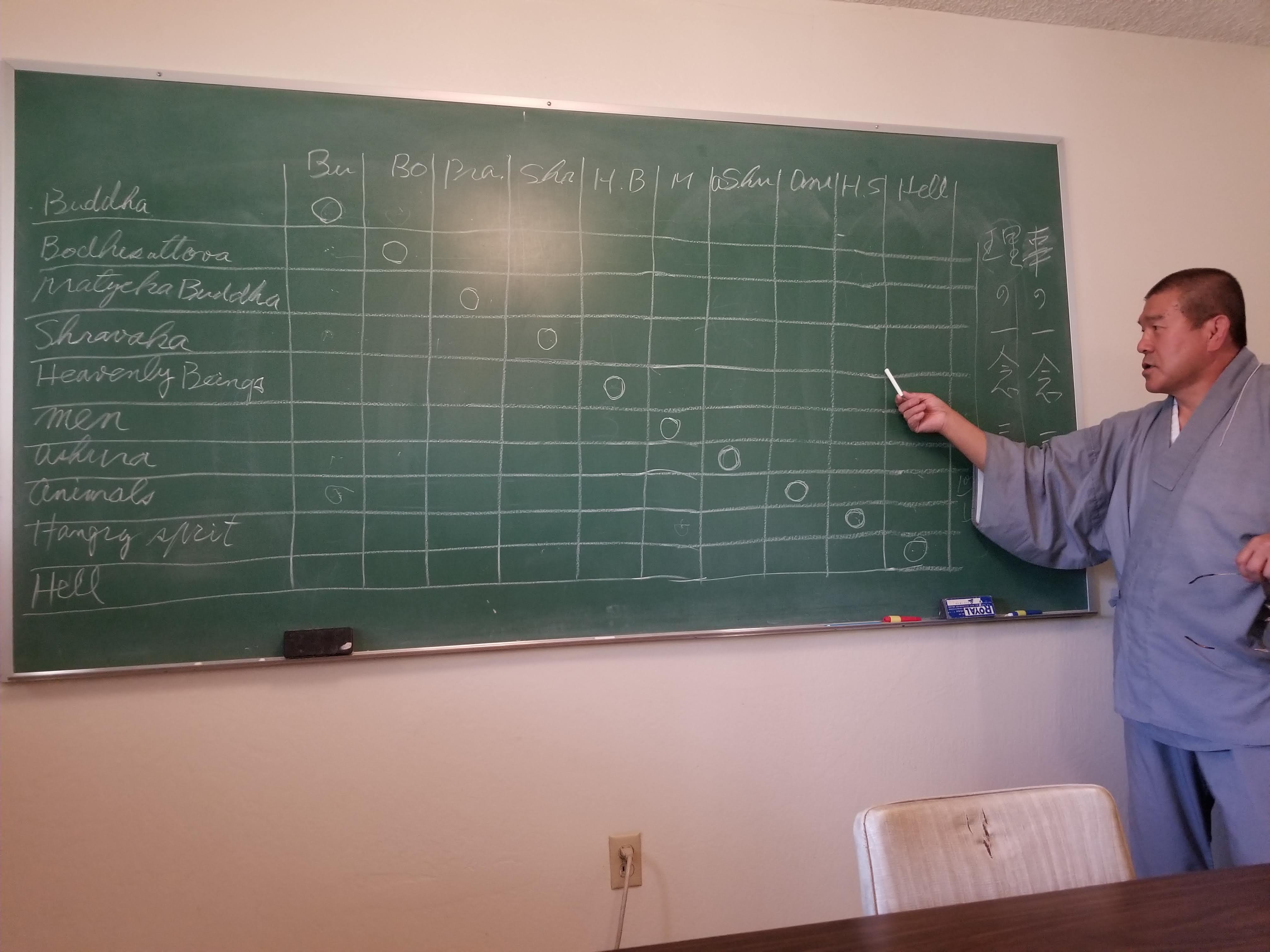
Ven. Kenjo Igarashi explains the logic of 3000 realms in a single moment.
I have seen many diagrams of the concept of Ichinen Sanzen (this, for example) but Rev. Igarashi’s offered an excellent starting place for what he described as “The logic of Ichinen Sanzen. The theory of Ichinen Sanzen. Noumenon. A kind of study.” It was not, he stressed, a deep exploration of the topic.
“Today I just explain the logic of Ichinen Sanzen,” Rev. Igarashi begain. “We already know the 10 realms – Buddha, Bodhisattva, Pratyekabuddha, Śrāvaka, Heavingly Beings, Man, Asura, Animals, Hungry Spirits, and Hell. So this is the 10 realms.”
He then walked though the chart showing how each realm contains the other realms.
“The Buddha – his mind, his spirit, his action – all the time everything is in Buddha,” he explained. “Nichiren Shonin, his actions all the time Bodhisattva. He has Buddha nature too. The Pratyekabuddha — also Engaku — he is walking all the time in Pratyekabuddha mind and action. Also Śrāvaka walking all the time in Śrāvaka world, Śrāvaka spirit. These are the four enlightened worlds. Before Lotus Sutra the Pratyekabuddha and Śrāvaka they never become Buddha. Then in the Lotus Sutra they also are kind of enlightened people. That’s why some day they are going to get enlightenment in the Buddha world.”
The grid of 10 realms by 10 realms creates a 100-realm matrix. Within each of these 100 realms, are the 10 suchnesses outlined in Chapter 2 of the Lotus Sutra:
Nyoze-sō, or appearances as such,
Nyoze-Shō, or natures as such,
Nyoze-tai, or entities as such,
Nyoze-riki, or powers as such,
Nyoze-sa, or activities as such,
Nyoze-in, or primary causes as such,
Nyoze-en, or environmental causes as such,
Nyoze-ka, or effects as such,
Nyoze-hō, or rewards and retributions as such,
Nyoze-honmatsu-kukyō-tō, or equality as such despite these differences.
“So we develop in the mother’s body we make forms little by little,” Rev. Igarashi explained. “Little by little make forms. Then born from the mother. At that time their nature already exists as humans. After growing the body like humans – embodiment. If body growning and got muscle. If we have got muscle we can do anything. You want to do anything. Then make functions notions. This is very important because if you make functions and our actions make cause. Cause makes condition. And condition make effect. If you make good action then you get good retribution.”
Applying the 10 suchnesses to the 100 realms produces 1000 things at any single moment.
“These 1000 things are not limited to only humans,” Rev. Igarashi explained.
At this point I’m going to borrow from the Lotus Seeds explanation of how these 1000 things are universally applicable:
The 1,000 worlds resulting from the multiplication of the one hundred worlds with the ten factors are made universal by the Three Realms. The Three Realms consist of the individual, who is composed of the Five Aggregates (form, feeling, perception, mental formations, and consciousness); the community of all beings, who are transmigrating through the Ten Worlds; and the land in which they all live. These Three Realms show that the one thousand worlds are present in and manifest themselves through all things without exception. That is, the possibilities that they point to are possessed by individuals, societies, and even non-human and inanimate phenomena.
“Everything has 3000 things,” said Rev. Igarashi. “So that’s why we have to worry about our actions. We are men. Or spirit is men. But we also find some time we’ll make an action in anger, or like hungry spirit – wanting more, more, more, or our actions will be like hell. That’s why we have to be careful. We try to make our actions like a Bodhisattvas or Buddha. If our action is Buddha or Bodhisattvas we can make good actions. That’s why Nichiren Shonin said, If you want to know your future life watch your present life. If you want to know your previous life, watch your present life because your present life makes your future life and your previous life makes your present life. …
“This is only the logic of the 3000 realms, the logic of Ichinen Sanzen, only study. Nichiren Shonin said that the phenomena of Ichinen Sanzen is Namu Myoho Renge Kyo. Everything is contained in Namu Myoho Renge Kyo. That’s why if you chant Namu Myoho Renge Kyo your spirit already understand Ichinen Sanzen. When we chant Namu Myoho Renge Kyo our actions automatically become good actions. …
“The logic of Ichinen Sanzen comes from Tendai. But we need to more than just understand. You must understand in your life, in your practice. Your practice is more important.
“This is not deep. This is just a shallow study. If everyone understand fine. So if you only understand a little bit that’s fine. Only chant Namu Myoho Renge Kyo. The phenomenon of Ichinen Sanzen is more important.”
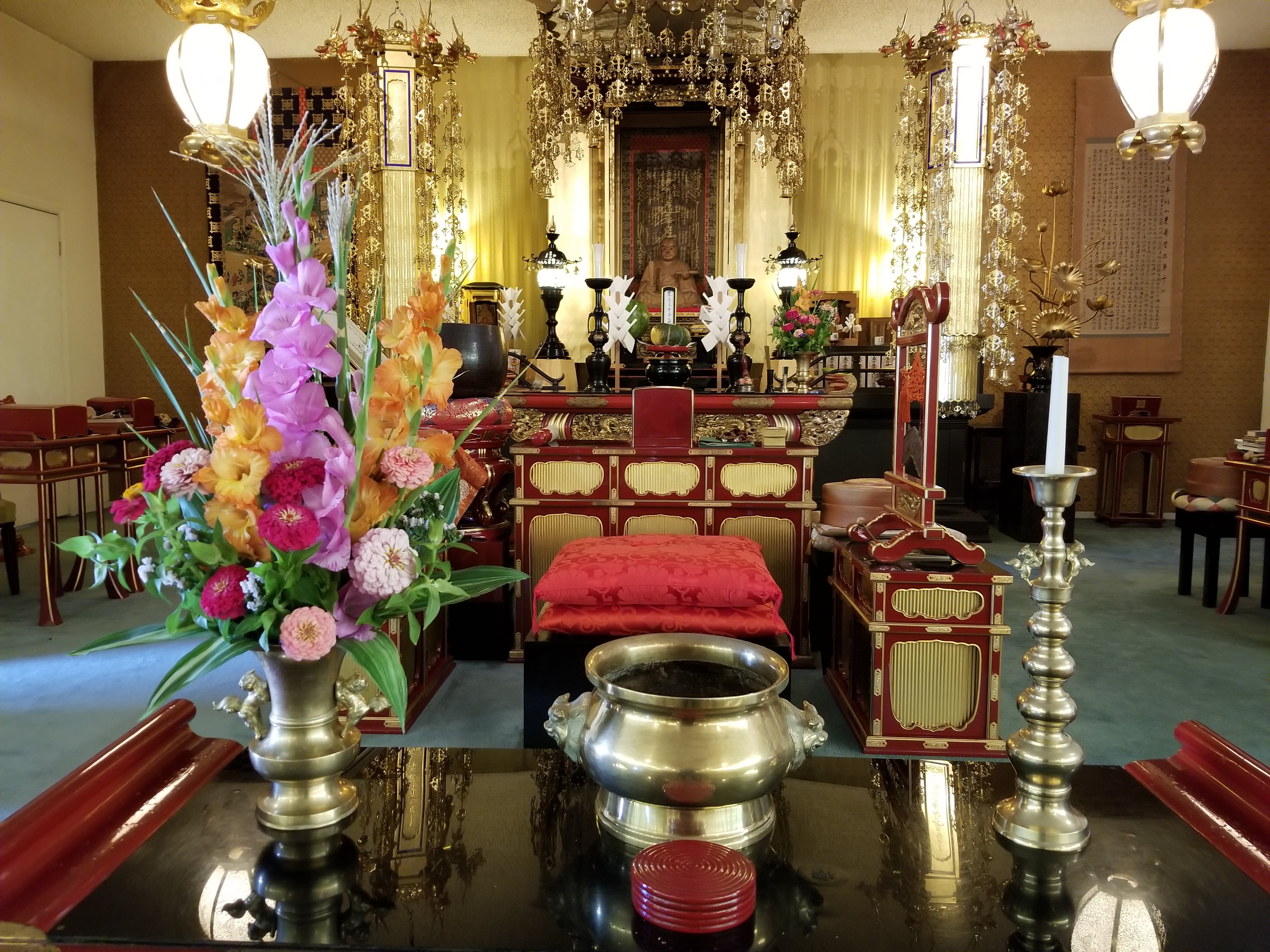
The Aug. 12, 2018, beautiful floral offering.
Rev. Igarashi’s sermon was in response to the passing of a priest who had returned to secular life.
Rev. Igarashi explained that he came from a lay family. He’s explained before that many young priests are the children of priests and have been raised to be priests. He, instead, had to study and pray.
“I asked Nichiren Shonin to please give me a minister’s job. When I was at Minobusan College student I visited Nichiren Shonin’s grave site all the time and prayed and chanted Namu Myoho Renge Kyo every day. Then after that I transferred to Rissho University and graduated. Then I joined the 100-day ascetic practice.
“During the ascetic practice the first time it’s very hard. No sleeping time. No food. No clothes. Almost nothing. And it is held during the wintertime so it’s very cold. Only food twice a day. Only rice porridge and some pickles. Everybody hungry. Everyone kind of like hungry spirit. For 100 days I just pray the same thing: If I can continue to minister job, please give me a minister’s job, otherwise if I change mind to turn to a secular life, please take my life during ascetic practice 100 days. …
“After 80 days I had fasted for one week. No food. Only water. So it’s very hard because I have to do everything with the other ministers – chanting, pouring water seven times a day. No sleeping time. …
When Rev. Igarashi found himself still alive after a week’s fasting, he took it as a sign.
“So that’s why I thought maybe I had some kind of minister’s job. Then after that I finished my 100 days ascetic practice. …
“Someone told me, Why don’t you go overseas? At the time my master was still young so that’s why I thought I would go overseas to the United States for three or four years. I told my master that after three or four years I would come back to Japan and help him.
A lot of things happened in California that prevented his return to Japan.
“So that’s why my master get angry,” he said. “So that’s why I was excommunicated.”
Rev. Igarashi began this sermon mentioning that he came to Los Angeles and something happened, and so he moved to San Francisco. Something happened there but he stayed there until he finally came to Sacramento. Always in his mind was the thought that he would return to Japan and return to secular life.
“I had a lot of chances to return to secular life, but I did not. I became a minister and I prayed, Give me my missionary job. I thought this is my missionary job. That’s why I just continued my missionary work. …
“So that’s why I have been here for over 43 years in the United States. Otherwise I think I’d return to secular life like other ministers. It’s a bit hard. The missionary job in the United States. But I pray and maybe Nichiren Shonin, and Śākyamuni Buddha and the protective Deities all the time support me. That’s why I’m here. …
“Please continue to pray. If you pray all the time Śākyamuni Buddha and Nichiren Shonin and the Deities will guide you and protect you. So please continue your practice of Nichiren Buddhism.”
Day 15 concludes Chapter 10, The Teacher of the Dharma, and opens Chapter 11, Beholding the Stūpa of Treasures.
Having last month concluded today’s portion of Chapter 10, The Teacher of the Dharma, we witness the arrival of the Stupa of Treasures.
Thereupon a stupa of the seven treasures sprang up from underground and hung in the sky before the Buddha. The stupa was five hundred yojanas high and two hundred and fifty yojanas wide and deep. lt was adorned with various treasures. It was furnished with five thousand railings and ten million chambers. It was adorned with innumerable banners and streamers, from which jeweled necklaces and billions of jeweled bells were hanging down. The fragrance of tamalapattra and candana was sent forth from the four sides of the stupa to all the corners of the world. Many canopies, adorned with streamers, and made of the seven treasures-gold, silver, lapis lazuli, shell, agate, pearl and ruby were hanging in the sky [one upon another from the top of the stupa] up to the [heaven of the] palaces of the four heavenly-kings. The thirty-three gods offered a rain of heavenly mandārava-flowers to the stupa of treasures. Thousands of billions of living beings, including the other gods, dragons, yakṣas, gandharvas, asuras, garuḍas, kiṃnaras, mahoragas, men and nonhuman beings, also offered flowers, incense, necklaces, streamers, canopies and music to the stupa of treasures, venerated the stupa, honored it, and praised it.
Thereupon a loud voice of praise was heard from within the stupa of treasures:
“Excellent, excellent! You, Śākyamuni, the World-Honored One, have expounded to this great multitude the Sūtra of the Lotus Flower of the Wonderful Dharma, the Teaching of Equality, the Great Wisdom, the Dharma for Bodhisattvas, the Dharma Upheld by the Buddhas. So it is, so it is. What you, Śākyamuni, the World-Honored One, have expounded is all true.”
Thereupon a loud voice of praise was heard from within the stūpa of treasures: “Excellent, excellent! You, Śākyamuni, the World-Honored One, have expounded to this great multitude the Sūtra of the Lotus Flower of the Wonderful Dharma, the Teaching of Equality, the Great Wisdom, the Dharma for Bodhisattvas, the Dharma Upheld by the Buddhas. So it is, so it is. What you, Śākyamuni, the World-Honored One, have expounded is all true.”
This declaration comes from Many-Treasures Buddha (Tahō, Prabhutaratna) at the beginning of Chapter Eleven of the Lotus Sūtra. In the story, Many-Treasures came from a world far away from this world of conflict when he heard the Buddha giving his highest teaching and appeared in a tower (stūpa) of wonderful treasures to confirm the truth of this teaching. By the Teaching of Equality, he means that all beings can become enlightened through this teaching. By the Great Wisdom, he means that the teaching is the same as the Buddha’s own mind. By the Dharma for Bodhisattvas, he means that to receive this teaching we awaken to our natures to benefit all beings. And by the Dharma Upheld by the Buddhas, he means that all Buddhas in all worlds encourage and help those who practice this sūtra.
The Daily Dharma is produced by the Lexington Nichiren Buddhist Community. To subscribe to the daily emails, visit zenzaizenzai.com
Chih-i’s endeavor to judge the coarse or the subtle is seen in every part of his discussion of the Four Teachings. However, one ought not to mistake the means as the end. The distinction of the coarse and the subtle is the means for Chih-i to confirm various types of the teaching of the Buddha as legitimate and coherent. This is because, Chih-i repeatedly claims that regardless of whether it is coarse or subtle teaching, all of the teachings of the Buddha are suitable to the circumstances and to the capabilities of listeners with the real intention of the Buddha to enlighten all sentient beings. Given that Chih-i never dwells on any fixed view (which reflects the flexible and comprehensive nature of his perfect and harmonizing philosophy) while confirming the existence of all types of the teaching of the Buddha, Chih-i also vehemently stresses the superiority of the subtle teaching of the Perfect in relation to the other coarse teachings, so that the Ultimate Truth can be eventually realized through the Perfect Teaching. (Page 65)