The first half of the Lotus Sutra (Shakumon) expounds the teaching of the One Vehicle. The several schools of Buddhism, which are divided roughly into three types (Sravaka-Vehicle, Pratyekabuddha-Vehicle, and Bodhisattva-Vehicle), are unified in the one single teaching of the One Vehicle. Since the number three represents all the various Buddhist Teachings, “three” here implies “many” or “all.”
Introduction to the Lotus SutraAuthor: John Hughes
-
Self-Work Is Critical and Fundamental to Buddhism
Until a person works on his individual enlightenment and self-improvement, the ability to fulfill our bodhisattva vow to enable all others to attain enlightenment will remain out of reach. It will continue to be a challenge to show the benefit of practice to others if the benefit isn’t manifest in one’s life. Self-work is critical and fundamental to Buddhism.
Physician’s Good Medicine
-
Realization of Buddhahood
KANJIN HONZON SHO
The Saha-world is the world of the Original Buddha and is the eternal Pure Land, which is free from the three calamities and the four kalpa. In this eternal world, the Buddha never disappeared in the past, nor is He to appear in the future. In consequence, all living beings under the Buddha in the Saha-world are one with Him and eternal. It is because those who believe in the Lotus Sutra, live in the land where they have united themselves with the Buddha and attained the truth of “the three thousand existences in one thought.”
(Background : April 25, 1273, 51 years old, at Sado, Showa Teihon, p.712)
Explanatory note
The world of the Original Buddha Sakyamuni is permanently peaceful and blissful without the traumas of birth and death. Contrarily, in the Saha-world of human beings, there are various sufferings and anxieties caused by three calamities of fire, flood, and storms; and the four types of transitions (Four kalpa): origination, duration, destruction, and annihilation.
In fact, in the realm of the Original Buddha, all existences are absolutely pure and tranquil. The Buddha himself with all other existences has never disappeared in the past nor will He appear in the future. The Buddha and all His disciples are equally enlightened by the glory of the sacred power of Odaimoku.
All beings have already been saved by the Original Buddha and are identified as one with the Buddha.
Despite the Buddha-land being perfect and beautiful, many people still have perverted views in which everything is still burning by the fire of illusions.
Nichiren Daishonin has found truth in the Lotus Sutra which is neither extreme idealism nor extreme realism. According to his teaching, the Buddha-land is not different from the human world. This land is the Buddha-land because it is where the Buddha is expounding the Lotus Sutra.
We, human beings, are the real disciples of the Original Buddha Sakyamuni, and had been taught by Him and have accomplished the Supreme Enlightenment.
This is the sacred relationship between the Original Buddha and the human beings in the Latter Age of the Declining Law. While we believe in the Lotus Sutra and recite Odaimoku, we can recognize our own existence and be able to realize our own divine Buddhahood.
Rev. Syaku
Phrase A Day
-
Daily Dharma – Jan. 31, 2018
The father thought, ‘These sons are pitiful. They are so poisoned that they are perverted. Although they rejoice at seeing me and ask me to cure them, they do not consent to take this good medicine. Now I will have them take it with an expedient.’
The Buddha gives this description as part of the Parable of the Wise Physician in Chapter Sixteen of the Lotus Sūtra. In the story, the physician’s children have mistakenly taken poison, yet refuse the remedy their father provides for them. The children are just like us as we cling to our attachments and delusions and refuse the good medicine of the Buddha Dharma. This refusal can be for many reasons. The children may think the remedy is worse than the poison. They may be holding out for another remedy that may be even more pleasant. They may enjoy being poisoned. They may not trust that their father can cure them. As the father in the story faked his death to bring the children to their right minds, the Buddha seems to disappear from our lives so that we may learn to accept the teaching he provides for us. And as the father reappeared to the children once they took the remedy, the Buddha reappears to us when we practice his teaching.
The Daily Dharma is produced by the Lexington Nichiren Buddhist Community. To subscribe to the daily emails, visit zenzaizenzai.com
-
Day 6
Day 6 continues Chapter 3, A Parable
Having last month heard in gāthās the house was so dangerous, so dreadful, we learn of the denizens of the house.
This old and rotten house
Was owned by a man.
Shortly after he went out
To a place in the neighborhood,
Fires broke out suddenly
In the house.Raging flames came out
Of all sides at the same time.
The ridges, rafters,
Beams and pillars
Burst, quaked, split, broke and fell.
The fences and walls also fell.All the demons yelled.
The eagles, crested eagles,
And other birds, and kumbhandas
Were frightened and perplexed.
They did not know
How to get out of the house.
The wild beasts and poisonous vermin
Hid themselves in holes.In that house also lived
Demons called pisacakas.
Because they had few merits and virtues,
They suffered from the fire.
They killed each other,
Drank blood, and ate flesh.The small foxes were
Already dead.
Large wild beasts
Rushed at them and ate them.
Ill-smelling smoke rose
And filled the house.The centipedes, millipedes,
And poisonous snakes
Were driven out of their holes
By the fire,
And eaten
By the kumbhanda demons.The hair of the hungry spirits caught fire.
With hunger, thirst and burning,
The spirits ran about
In agony and dismay.The house was so dreadful.
[In that house] there were
Poisonings, killings and burnings.
There were many dangers, not just one. -
An Image of the Buddha’s Personality
[The Parable of the Burning House] presents the Buddha as a concerned parent, and so brings an intimacy into the relationship between the Buddha and us ordinary people. On our part, the Buddha appears like a father to be loved and trusted in faith. On the Buddha’s part, living beings like us are his children to be saved with compassion. In all of Buddhist literature, there is no other example quite as vivid as this one in the Lotus Sutra, which presents the Buddha as the Savior of suffering humanity. Here in the Lotus Sutra the Buddha touches our hearts with a clear-cut image of his personality.
Introduction to the Lotus Sutra
-
Exploring A Dharma Club
Drove a little more than hour Monday evening to attend the Niagara County Dharma Club meeting at Singer Farm Naturals in Appleton, New York. The Dharma Club is run by Nichiren Shu Shami Kanjo Grohman and his wife, Kristin.
My trip to Upstate New York was made in order to help care for my brother-in-law after a scheduled surgery. When the surgery was postponed it left me with plenty of time to explore the region’s Nichiren Shu sanghas.
The trip to the Dharma Club capped a week of attending activities in Rochester at the Enkyoji Buddhist Temple, which was founded by Nichiren Shu Shami Kanyu Kroll. (The fact that the temple is on the 4th floor of an arts complex in a refurbished factory building only adds to the great atmosphere.)
While I knew of the Buffalo (also served by Shami Kanjo) and Rochester Nichiren Shu sanghas, it was after meeting Kanjo and Kanyu at the Enkyoji Buddhist Network 2017 Summer Retreat at the Choeizan Enkyoji Nichiren Buddhist Temple in Seattle that I was inspired to visit them.
I was particularly interested in the Dharma Club because I feel there is a great need for outreach in the region served by the Sacramento Nichiren Buddhist Church. Nothing is done now to invite people to learn about Nichiren Shu or Nichiren or even Buddhism in general. Yes, everyone is welcomed with smiling faces and encouragement when they attend, but if they know nothing about what happens at a Nichiren Shu service they will get nothing from the service other than befuddlement.
The Dharma Club meeting was very interesting. The discussion led by Kanjo generated a relaxed discussion. And it was over all too soon.
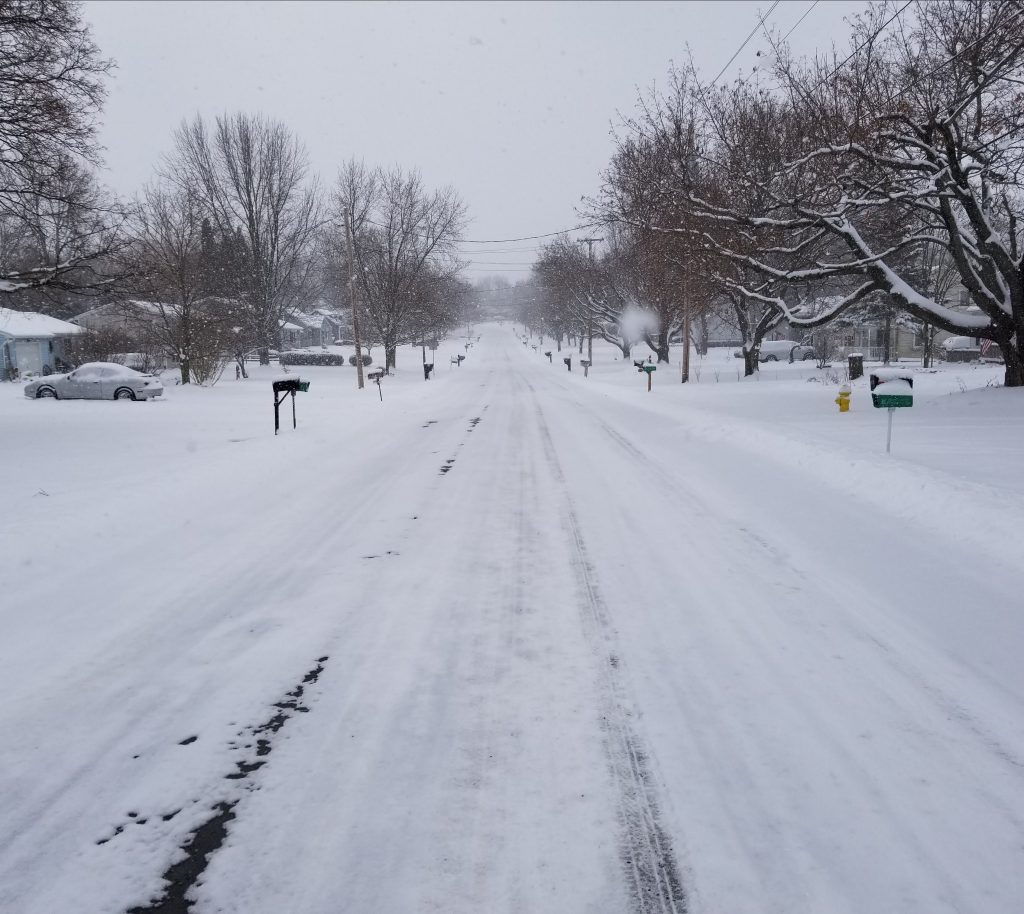
It had been snowing lightly on the way to the meeting, and by the time to drive home it was blowing hard. I enjoy driving in snow in much the way grandparents enjoy grandchildren: Play with them until they become fussy and then return them to their parents. For me, the hour-long drive home was a nice snowy adventure before flying home to snowless Sacramento.
Snow day 
-
Great Compassion
HO-ON JO
I, Nichiren, believe my compassion is boundless because I am devoting myself to salvation of all mankind, overcoming many persecutions. Therefore, “Namu Myoho Renge Ryo,” the teaching for the people in the Latter Age of the Declining Law, will spread forever beyond the ten-thousand-year period. It has the merit of curing the (religious) blindness of all people and blocks the way to hell. This merit is superior to those of Dengyo of Japan, T’ien-t’ai of China, Nagarjuna of India, and Kasyapa, who was the Buddha’s disciple.
Therefore, the practice for a hundred years in the peaceful Pure Land is not worth the merit of chanting Odaimoku for one day in this defiled world. Propagation of the Lotus Sutra in the two-thousand-year period following the death of the Buddha does not give benefit as much as spreading Odaimoku for a while in the Latter Age of the Declining Law. This is not due to my wisdom; it is solely due to the time of the Latter Age in which I live.
(Background ; July 21, 1276, 54 years old, at Minobu, Showa Teihon, p.1248)
Explanatory note
What is the truth of humankind? This has been a long quest in human history. The development of human society was only possible through this quest, and our ancestors had sought the fundamental truth by physical and spiritual training. In other words, the history of humankind is the history of seeking happiness. Civilization has proved that happiness could be attained not by satisfaction of one’s own self but by faith in truth.
However, the quick development of the modern science made us forget this fundamental spirit of humankind, and the civilization that our ancestors have built up is in danger of being corrupted because modern people became more selfish and forgot to work together with others in harmony.
Buddhism also has tried to find true nature of humankind which Buddha taught us. In this modern age, we, Buddhists, should not neglect to find the true spirit of Buddhism and the true mind of the Buddha Sakyamuni.It is easy to chant “Namu Myoho Renge Kyo.” But it is difficult to understand and believe it, unless we find the true teaching and salvation of the Lotus Sutra, which the Buddha Sakyamuni revealed to us. “Namu Myoho Renge Kyo” was what the Buddha had kept deep in the sutra, and Nichiren Daishonin has revealed it for the first time in the thirteenth century. Nichiren believed that Odaimoku was the most important virtue he could leave behind for us in Buddhist history and proudly announced it to people. He said that it is most important for us to have faith in the teaching and practice in this real world, rather than to practice it in the Pure Land.
Although we read this “Ho-on Jo” quite often without thinking deeply, we must think of the true meaning of the words which Nichiren showed us.
We receive Odaimoku and preserve it in our bodies. At the same time we attain Buddhahood as a natural result of accepting and maintaining the “Namu Myoho Renge Kyo. ”Rev. Akahoshi
Phrase A Day
-
Daily Dharma – Jan. 30, 2018
He should expound the Dharma to them,
Wishing only two things:
To attain the enlightenment of the Buddha
And also to cause them to do the same.
This is a peaceful offering to them.
This offering will bring them a great benefit.The Buddha sings these verses to Mañjuśrī Bodhisattva in Chapter Fourteen of the Lotus Sūtra. In our desire to benefit others, we often have expectations for how they should change in response to what we give them. The Buddha reminds us to abandon these expectations. People will make changes and progress towards enlightenment based on their own capacities rather than what we want for them. When we stay focused on the goal of awakening, both for ourselves and others, then we can keep the perspective of the Buddha and see things for what they are.
The Daily Dharma is produced by the Lexington Nichiren Buddhist Community. To subscribe to the daily emails, visit zenzaizenzai.com
-
Day 5
Day 5 begins Chapter 3, A Parable
Having last month heard in gāthās Śāriputra’s realization, we hear Śāriputra’s acceptance of the Buddha’s explanation of his expedient teaching.
When I had heard this from you,
I was much frightened and perplexed; I thought:
“The Buddha troubles me.
Isn’t he Mara in the form of a Buddha?”You skillfully expound the Dharma with various parables and similes,
And with various stories of previous lives.
Now my mind is as peaceful as the sea.
Hearing you, I have removed the mesh of doubts.You said:
“The innumerable Buddhas in the past
Expounded the Dharma with expedients.
The numberless Buddhas at present
Also expound the Dharma
With expedients.
So will the countless Buddhas
In the future.”You appeared in this world,
Left your home, attained enlightenment,
And now turn the wheel of the Dharma,
Also with expedients.You expound the true teaching;
Papiyas does not.
Therefore, I know
That you are not a transformation of Mara.
I thought that the Dharma was expounded by Mara
Because I was in the mesh of doubts.I hear your gentle voice.
Your voice is deep and wonderful.
You expound the Pure Dharma.
My heart is filled with great joy.
All my doubts are gone.
I have obtained true wisdom.I shall become a Buddha without fail.
I shall be respected by gods and men.
I will turn the wheel of the unsurpassed Dharma,
And teach Bodhisattvas.