
This story in the Simile of the Herbs of the rain of the Dharma falling equally on all the various plants and herbs equally benefiting all according to their unique capacity also highlights the equality and inclusivity of the Lotus Sutra teaching. The teaching of Buddhism can benefit all beings and it does so without either diminishing the teaching or devaluing or diminishing those who apply it to their lives. There is no loss of the value of practice and faith regardless of our inner capacity or our physical ability. The Dharma looses no value and neither do we.
Lecture on the Lotus SutraAll posts by John Hughes
Daily Dharma – Dec. 18, 2017
When they come to him
With good intent
In order to hear
About the enlightenment of the Buddha,
He should expound the Dharma to them
Without fear,
But should not wish to receive
Anything from them.
The Buddha makes this explanation to Mañjuśrī Bodhisattva in Chapter Fourteen of the Lotus Sūtra in which he describes the peaceful practices of a Bodhisattva. In our zeal to practice this Wonderful Dharma we may come to expect that because this is such a wonderful teaching, we deserve to be rewarded for providing it to others. With this expectation, we then lose our focus on using the Dharma to benefit others and instead use it to benefit ourselves. When we show how to give freely, without expectations, we embody generosity, the same generosity the Buddha himself demonstrated when he provided the teaching to us.
The Daily Dharma is produced by the Lexington Nichiren Buddhist Community. To subscribe to the daily emails, visit zenzaizenzai.com
Day 26
Day 26 concludes Chapter 21, The Supernatural Powers of the Tathāgatas, includes Chapter 22, Transmission, and introduces Chapter 23, The Previous Life of Medicine-King Bodhisattva.
Having last month concluded Chapter 22, Transmission, we begin Chapter 23, The Previous Life of Medicine-King Bodhisattva.
Thereupon Star-King-Flower Bodhisattva said to the Buddha:
“World-Honored One! Why does Medicine-King Bodhisattva walk about this Sahā-World? World-Honored One! This Medicine-King Bodhisattva will have to practice hundreds of thousands of billions of nayutas of austerities in this world. World-Honored One! Tell me why! Not only the gods, dragons, yakṣas, gandharvas, asuras, garuḍas, kiṃnaras, mahoragas, men and nonhuman beings but also the Bodhisattvas who have come from the other worlds’ and the Śrāvakas present here will be glad to hear the reason.”
Thereupon the Buddha said to Star-King-Flower Bodhisattva:
“Innumerable kalpas ago, that is, as many kalpas as there are sands in the River Ganges ago, there lived a Buddha called Sun-Moon-Pure-Bright-Virtue, the Tathāgata, the Deserver of Offerings, the Perfectly Enlightened One, the Man of Wisdom and Practice, the Well-Gone, the Knower of the World, the Unsurpassed Man, the Controller of Men, the Teacher of Gods and Men, the Buddha, the World-Honored One. He was accompanied by eight thousand million great Bodhisattva-mahāsattvas and also by great Śrāvakas numbering seventy-two times as many as there are sands in the River Ganges. The duration of his life was forty-two thousand kalpas. So were the durations of the lives of the Bodhisattvas. His world was devoid of women, hellish denizens, hungry spirits, animals and asuras. There was no calamity in his world. The ground of his world was as even as the palm of the hand. It was made of lapis lazuli, adorned with jeweled trees, and covered with a jeweled awning from which the streamers of jeweled flowers were hanging down. Jeweled vases and incense-burners were seen everywhere in that world. There was a platform of the seven treasures at the distance of a bowshot from each of the jeweled trees under which the Bodhisattvas and Śrāvakas were sitting. On each of the platforms of treasures, myriads of millions of gods were making heavenly music, singing songs of praise of the Buddha, and offering the music and songs to the Buddha.
Medicine-King’s samadhi
The story of Medicine-King Bodhisattva begins with an explanation of his accomplishments in a previous life. In Chapter Ten, the “Teacher of the Law,” Medicine-King represented eighty thousand Bodhisattvas who heard Sakyamuni teach. In this chapter, Sakyamuni tells a Bodhisattva by the name of Star-King-Flower about the Medicine-King.
A long time ago, there was a Buddha called Sun-Moon-Pure-Bright-Virtue Tathagata. Among his many disciples, there was one named Gladly-Seen-By-All-Beings Bodhisattva. He studied the Lotus Sutra under this Buddha, and underwent difficult practices for many years until he attained the samadhi by which he could transform himself into any other living being (p. 299-300).
The samadhi by which he could transform himself into any other living being is the samadhi (the power of concentration) that is the ability to show an appropriate physical form according to the person’s capacity to whom he preaches the dharma.
Introduction to the Lotus SutraCleanup
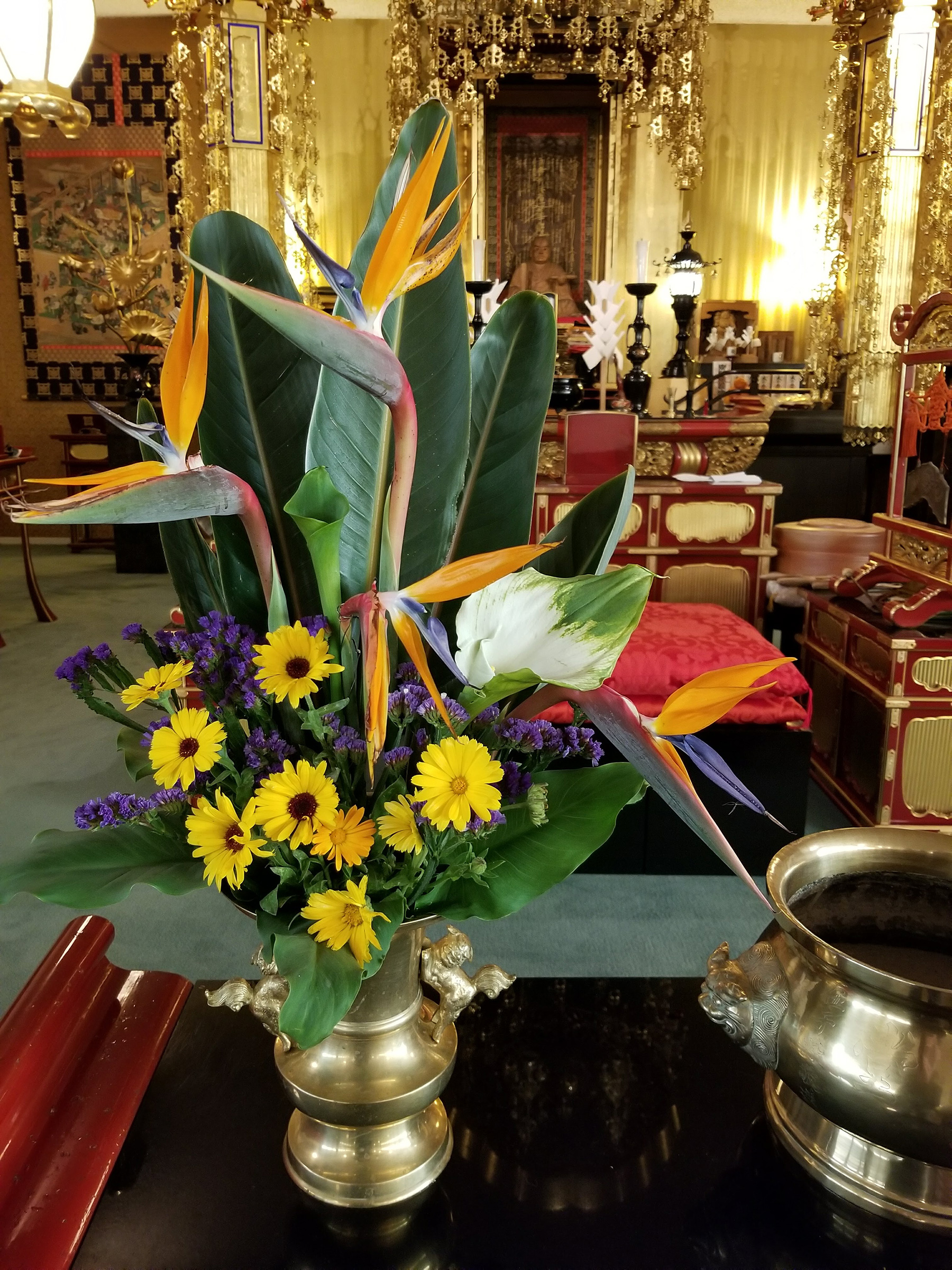
When Rev. Igarashi first became a minister his master would constantly tell him just clean up — clean up the temple, clean up the altar, clean up everything first. That’s how you practice. Chanting the sutra is very important but cleaning the temple, cleaning the altar and cleaning everything is the first practice. That’s why all the time I just clean up everywhere.
When Rev. Igarashi first arrived in Sacramento, it was a tradition that male members of the church would get together monthly to clean the grounds around the temple. But they just complained and complained, and so, little by little, Rev. Igarashi took over the gardening and cleanup of the grounds by himself. One day, long after the tradition of having men clean the grounds was abandoned, a church member commented to Rev. Igarashi that the church had a pretty good gardener and a pretty good janitor.
“So that’s why I’m a pretty good janitor or a gardener than a good minister,” he said, laughing. “That’s alright. It’s just my practice is to clean up everything.”
This isn’t just trash, he explained. It’s a treasure mountain. There is a lot of treasure to be found in cleaning up. That’s why practicing and cleanup is very important.
“Now I am giving you purification — kaji kito. I’m cleaning up your mind and your spirit too, not just the temple,” he said. “I clean up your spirit and mind all the time.”
Rev. Igarashi then told the story of Ksudrapanthaka, one of the Buddha’s disciples. Ksudrapanthaka had joined with his brother, but unlike his brother Ksudrapanthaka just couldn’t remember anything he was taught. Not even the simplest verse. Eventually his brother grew angry and told Ksudrapanthaka to get out of the sangha. Sakyamuni found Ksudrapanthaka outside the monk’s quarters crying and asked him what was wrong. Ksudrapanthaka explained he couldn’t remember anything.
Sakyamuni gave Ksudrapanthaka a broom and told him to just remember “This is broom” as he cleaned up the temple. Ksudrapanthaka cleaned and chanted “This is broom” finally he remembered and developed strong faith. (See this explanation of Ksudrapanthaka’s realization.)
Rev. Igarashi also offered a little Japanese side note explaining why eating Japanese ginger is considered to make you forgetful. It turns out that when Ksudrapanthaka was buried Japanese ginger sprouted atop the grave.
As the Ministry of Agriculture, Forestry and Fisheries of Japan explains in a Facebook post:
We have a saying in Japan, “You become forgetful if you eat myoga (Japanese ginger).” Do you know why? … A long time ago, one of the Buddha’s disciples was so virtuous that he became enlightened but, at the same time, he was extremely forgetful. Often, he even forgot his own name, so he hung a nameplate around his neck, but he was never able to remember his name for his entire life. After his death, the unknown plant that sprouted from his grave was given the name “myoga,” which means “bearing a name.”
Rev. Igarashi encouraged everyone, “At the end of this year, please clean up your spirit and clean up everything.”
The Empty Table
Everything that we can point to or name exists only for as long as other things come together in a certain way to support its existence. A table, for instance, is only a temporary meeting of an uncountable number of atoms working together for a certain period of time. Another example is the human body, which is a changing process that requires a constant supply of new material in the form of air, food, and water to sustain itself, and which is constantly expelling waste material. Even consciousness is not a static thing, but a perpetually changing stream of thoughts and impressions that also depends upon constant input of new material in the form of ideas and sensations.
Lotus SeedsDaily Dharma – Dec. 17, 2017
What do you think of this? Gladly-Seen-By-All-Beings Bodhisattva was no one but Medicine-King Bodhisattva of today. He gave up his body in this way, offered it [to the Buddha], and repeated this offering many hundreds of thousands of billions of nayutas of times [in his previous existence]. [He knows that he can practice any austerity in this Sahā-World. Therefore, he does not mind walking about this world.]
The Buddha gives this explanation to Star-King-Flower Bodhisattva in Chapter Twenty-Three of the Lotus Sūtra. The story of the previous life of Medicine-King Bodhisattva shows us the capacities we have already developed and are not aware of. When we see ourselves as choosing to come into this world of conflict to benefit all beings, rather than stuck where we do not want to be and just making the best of it, then it is much easier to let go of our delusions.
The Daily Dharma is produced by the Lexington Nichiren Buddhist Community. To subscribe to the daily emails, visit zenzaizenzai.com
Day 25
Day 25 covers all of Chapter 20, Never-Despising Bodhisattva, and opens Chapter 21, The Supernatural Powers of the Tathāgatas.
Having last month been introduced to Never-Despising Bodhisattva, we encounter the arrogant bhikṣus.
“There lived arrogant bhikṣus in the age of the counterfeit of the right teachings of the first Powerful-Voice-King Tathāgata, that is, after the end of the age of his right teachings which had come immediately after his extinction. [Those arrogant bhikṣus] were powerful. At that time there lived a Bodhisattva called Never-Despising. He took the form of a bhikṣu.
“Great-Power-Obtainer! Why was this bhikṣu called Never-Despising? It was because, every time he saw bhikṣus, bhikṣunīs, upāsakās or upāsikās, he bowed to them and praised them, saying, ‘I respect you deeply. I do not despise you. Why is that? It is because you will be able to practice the Way of Bodhisattvas and become Buddhas.’
“He did not read or recite sūtras. He only bowed to the four kinds of devotees. When he saw them in the distance, he went to them on purpose, bowed to them, and praised them, saying, ‘I do not despise you because you can become Buddhas.’
Age of Counterfeit Teachings
The terms, “Age of Right Teachings” and “Age of Counterfeit Teachings,” express the Buddhist view of history. It is believed that for a while after a Buddha has entered Nirvana, people will remember his teachings correctly, put them into practice, and attain enlightenment. However, as time passes, those teachings will become mere academic formalities. People will know about them and be able to discuss them, but they will no longer practice them diligently and attain enlightenment. This second period is called the Age of Counterfeit Teachings. Finally, the teachings will decay altogether. People will neither practice them, understand them, nor attain enlightenment. This is the Age of Degeneration, when Buddhism declines and finally fades away. It is believed by most scholars that the first and second periods last for a thousand years each. The Age of Degeneration can drag on for as long as 10,000 years. In any case, Never-Despising Bodhisattva lived during the second of these three periods, an Age of Counterfeit Teachings.
Introduction to the Lotus SutraDaily Dharma – Dec. 16, 2017
This sūtra opens the gate of expedients and reveals the seal of the truth. The store of this Sūtra of the Lotus Flower of the Wonderful Dharma is sound and deep. No one can reach its core. Now I show it to the Bodhisattvas in order to teach them and cause them to attain [Anuttara-samyak-saṃbodhi].
The Buddha declares these lines to Medicine-King Bodhisattva in Chapter Ten of the Lotus Sūtra. At the beginning of the sūtra, the Buddha declared that he was no longer preparing those who hear him to receive his highest wisdom. The purpose of his instruction was always to lead all beings to unsurpassed enlightenment, even though it seemed that he was ending their suffering. When later the Buddha revealed his true existence as constantly present in our world, he showed that this teaching is not just something he did 2500 years ago. He is teaching this Wonderful Dharma for the benefit of all beings right now, today.
The Daily Dharma is produced by the Lexington Nichiren Buddhist Community. To subscribe to the daily emails, visit zenzaizenzai.com