
All posts by John Hughes

Lessons in Four Great Persecutions

Ven. Kenjo Igarashi’s lesson Sunday, Nov. 12, 2017

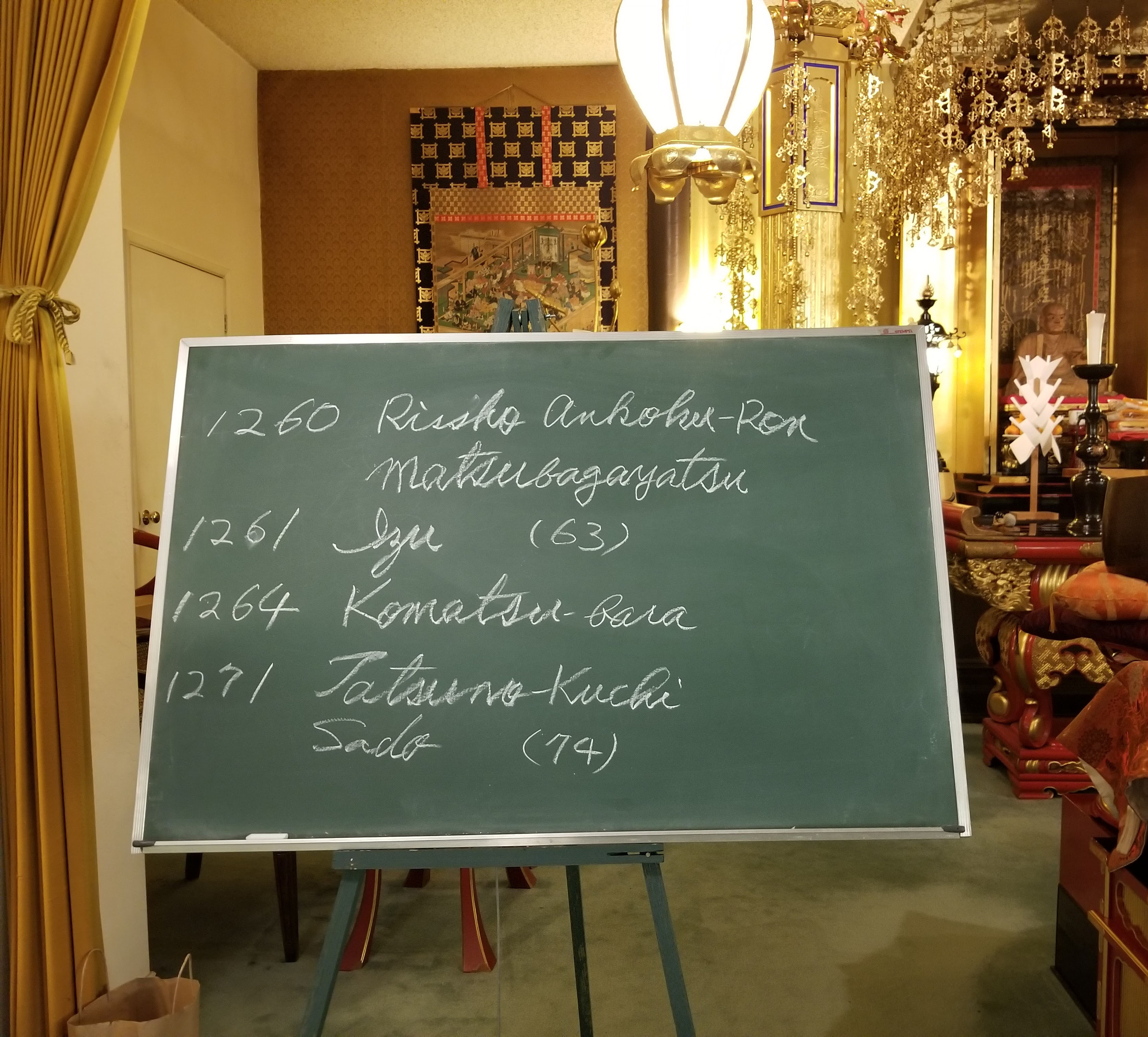
Attended the Sacramento Nichiren Buddhist Church Komatsubara Persecution Service on Sunday. Ven. Kenjo Igarashi‘s gosho covered the four great persecutions that followed Nichiren’s submission of the Rissho Ankoku-Ron.

As explained by Rev. Igarashi:

Nichiren Shonin used “strong words” in establishing the supremacy of the Lotus Sutra and Sakyamuni Buddha because he was trying to save the suffering people of Japan. But those strong words provoked many people to attack Nichiren Shonin.

Today we don’t use shakubuku to break people’s ideas and then teach them the correct view. Now we teach using shoju to lead and convince them by respectfully, accepting and understanding their viewpoints and situations.

In Nichiren’s time, however, the calamities and unhappiness were seen as the consequence of failing to embrace the Lotus Sutra and Sakyamuni. Strong words were necessary to break the wrong views and to enable the embracing of the supreme teaching of the Lotus Sutra. Only then would the protective deities return to Japan and make peace for the people.

Today many people don’t care. They’re just living day to day. But all life is the result of your cause and condition. That’s why you must extinquish your bad karma otherwise you can’t be happy, you won’t have deities protecting you. You have to chant all of the time. Then you will be happy and then the whole world will be at peace.

Nichiren Shonin was Jogyo Bodhisattva, who was one of Sakyamuni’s original disciples. He could have become Buddha but instead he chose to be born in this world in order to save suffering people. That’s why Nichiren never stopped his propagation.

If everyone follows Nichiren Shonin, then Sakyamuni Buddha and the deities are going to protect us all the time. Then we will be happy. Then we will have world peace.
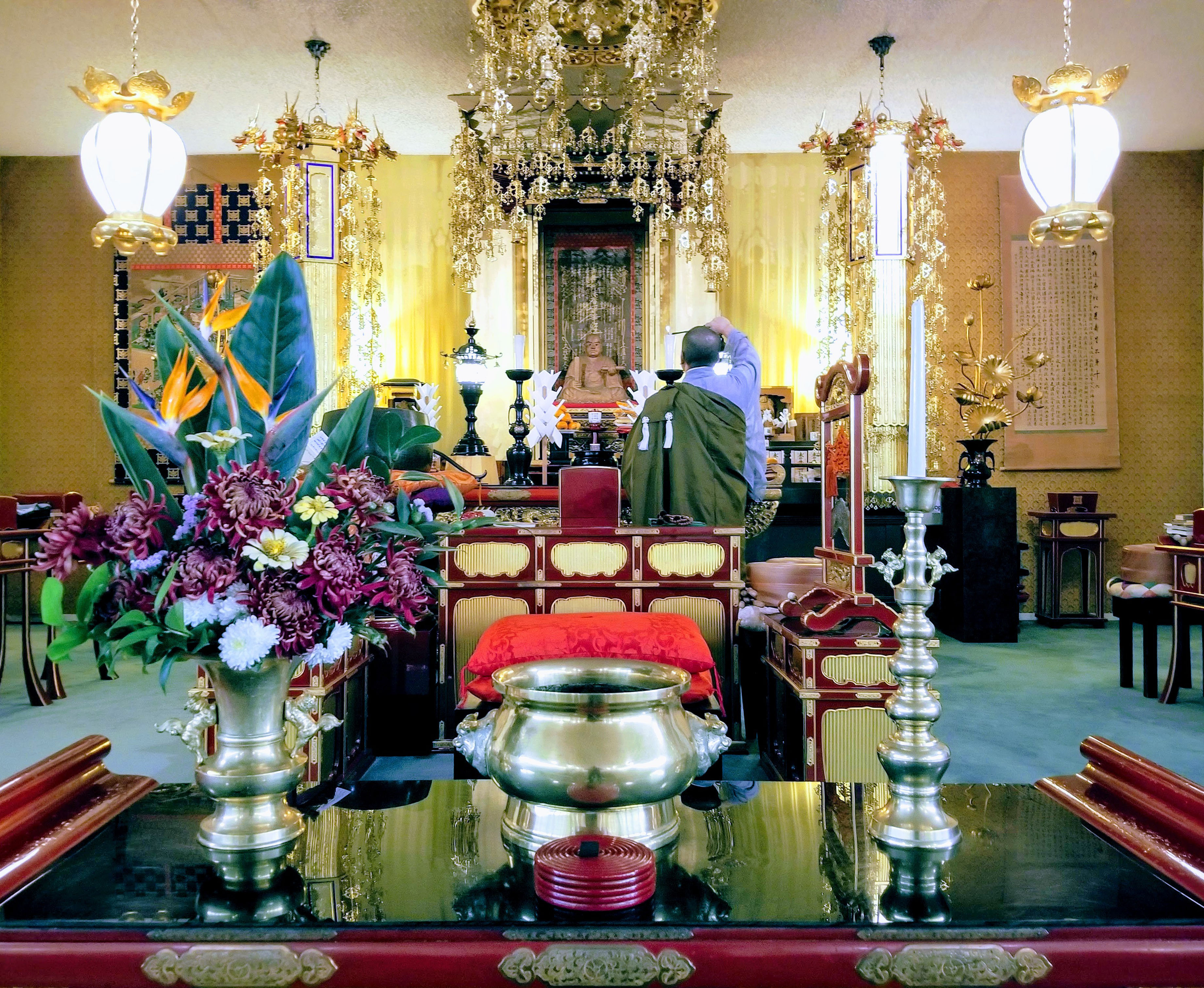
Ven. Kenjo Igarashi lighting candles before the service.

A Lifelong Application of a Spiritual Practice

The practice of Buddhism is not a guarantee of a life of complete ease and trouble-free living. To believe that is to believe in a fantasy. Buddhism is a lifelong application of a spiritual practice, one of awakening by degrees. The practice of Buddhism is working to overcome obstacles that test us and then making changes we would otherwise overlook. This is why the medicine of the Lotus Sutra sometimes does not appear to be of good flavor. The taste of practice and devotion is not always sweet, even though the outcome tastes of nectar, of ambrosia.

Physician's Good Medicine

Truth and Law

Montgomery (July 24, 1986)
What would you say about saying, “the highest Truth,” instead of the highest Law? I know this raises a lot of questions, so I will not pursue it further. “Truth,” to the modern ear, is something absolutely sacred and inviolable; a law, on the other hand, can be broken. In the Christian New Testament, the Law is always inferior to the Truth.

Murano (August 31, 1988)
I follow the example of the Four Noble Truths, and interpret a truth as a countable common noun, and treat the Law as the collective name for the various truths. This may be different from the usage of the Christian concepts.

Questions and Answers on Nichiren Buddhism

Daily Dharma – Nov. 12

Thereupon Cloud-Thunderpeal-Star-King-Flower-Wisdom Buddha said to King Wonderful-Adornment, ‘So it is, so it is. It is just as you say. The good men or women who plant the roots of good will obtain teachers in their successive lives. The teachers will do the work of the Buddha, show the Way [to them], teach them, benefit them, cause them to rejoice, and cause them to enter into the Way to Anuttara-samyak-saṃbodhi (Perfect Enlightenment). Great King, know this! A teacher is a great cause [of your enlightenment] because he leads you, and causes you to see a Buddha and aspire for Anuttara-samyak-saṃbodhi.

These lines are part of a story told by the Buddha in Chapter Twenty-Seven of the Lotus Sūtra. The Buddha uses this story to remind us of how much benefit we get from our teachers. When we see the world with the eyes of the Buddha, and know that he is always thinking of how to lead us, we can find innumerable teachers, and know to show our gratitude to them.

The Daily Dharma is produced by the Lexington Nichiren Buddhist Community. To subscribe to the daily emails, visit zenzaizenzai.com

Day 22

Day 22 covers all of Chapter 17, The Variety of Merits.

Having last month considered those who do not speak ill of this sūtra but rejoice at hearing, the merits of those who keep or copies it or causes others to copy it after my extinction.

“Ajita! Anyone who, after hearing this sūtra, keeps or copies it or causes others to copy it after my extinction, should be considered to have already built many hundreds of thousands of billions of monasteries, that is to say, innumerable monasteries, each of which was installed with thirty-two beautiful halls made of red candana, eight times as tall as the tala-tree, and spacious enough to accommodate one hundred thousand bhikṣus. He also should be considered to have already furnished [those monasteries] with gardens, forests, pools for bathing, promenades, and caves for the practice of dhyāna, and filled [those monasteries] with clothing, food, drink, bedding, medicine, and things for amusements, and offered [those monasteries] to me and to the Saṃgha of bhikṣus in my presence. Therefore, I say, ‘Anyone who keeps, reads or recites this sūtra, expounds it to others, copies it, causes others to copy it, or makes offerings to a copy of it after my extinction, need not build a stupa or a monastery, or make offering to the Saṃgha.’ Needless to say, anyone who not only keeps this sūtra but also gives alms, observe the precepts, practices patience, makes endeavors, concentrates his mind, and seeks wisdom, will be able to obtain the most excellent and innumerable merits. His merits will be as limitless as the sky is in the east, west, south, north, the four intermediate quarters, the zenith, and the nadir. These innumerable merits of his will help him obtain the knowledge of the equality and differences of all things.

See Hearing and Accepting by Faith

Hearing and Accepting by Faith

The previous chapter, “The Duration of the Life of the Tathagata,” explained that the Buddha’s life span is eternal. This teaching is the most important of the Lotus Sutra. Therefore, the merits or benefits which the teaching brings us must be immeasurably great. That indeed is the case. This chapter, the “Variety of Merits,” minutely delineates the benefits coming to anyone who hears Chapter Sixteen and accepts it by faith. The “variety” referred to means classifying and explaining those benefits in detail.

Introduction to the Lotus Sutra

One Million Daimoku

Maltz (September 6, 1996)
Jeffrey Hunter wrote a long thesis on the founder of the Fujufuse Sect, Busshoin Nichio (1565-1630). Nichio wrote the Goengi (Fortuitous vow) in 1608. It is a companion book to another, written earlier by Nichio, entitled Shodai Kambotsu Sho (Encouraging the chanting of the title of the Lotus Sutra). The Goengi is a vow to recite the Daimoku one million times. What do you know about this book? I am curious to understand what the significance of chanting one million daimoku was to Nichio.

Murano (October 26, 1996)
Chanting the Nembutsu one million times was recorded in Japan at the beginning of the eleventh century. Tens of men and women get together and chant every day for one week makes one million chantings. It was not so difficult as we imagine. Chionji of the Jodo Sect in Kyoto is nicknamed Hyakumanben (One Million Times) because the chief priest of the temple officiated at the Hyakumanben Ceremony at the Imperial Court in 1473. Chanting the Nembutsu or Daimoku one million times was not regarded as a special practice in the time of Nichio.

Questions and Answers on Nichiren Buddhism

Daily Dharma – Nov. 11, 2017

Only I see clearly and without hindrance that they are at various stages [of enlightenment]. I know this, but they do not know just as the trees and grasses including herbs in the thickets and forests do not know whether they are superior or middle or inferior.

The Buddha makes this declaration in Chapter Five of the Lotus Sūtra, as he explains the simile of herbs. This is a good reminder for us on the Bodhisattva path of how important it is to have respect for all beings. We can believe we know whether someone else is less enlightened than we are, or even more enlightened than we are. But for Bodhisattvas, this belief is irrelevant. Only the Buddha knows who is where on the path. We do not need to know. We just need to find ways to benefit others, no matter how close they may be to enlightenment.

The Daily Dharma is produced by the Lexington Nichiren Buddhist Community. To subscribe to the daily emails, visit zenzaizenzai.com

Day 21

Day 21 covers all of Chapter 16, The Duration of the Life of the Tathāgata.

Having last month heard Śākyamuni explain why he disappears, we learn about the pure land.

I can do all this by my supernatural powers.
I live on Mt. Sacred Eagle
And also in the other abodes
For asaṃkhya kalpas.

The [perverted] people think:
“This world is in a great fire.
The end of the kalpa [of destruction] is coming.”
In reality this world of mine is peaceful.
It is filled with gods and men.
The gardens, forests and stately buildings
Are adorned with various treasures;
The jeweled trees have many flowers and fruits;
The living beings are enjoying themselves;
And the gods are beating heavenly drums,
Making various kinds of music,
And raining mandārava-flowers on the great multitude and me.

[This] pure world of mine is indestructible.
But the [perverted] people think:
“It is full of sorrow, fear, and other sufferings.
It will soon burn away.”

Because of their evil karmas,
These sinful people will not be able
To hear even the names of the Three Treasures
During asaṃkhya kalpas.

To those who have accumulated merits,
And who are gentle and upright,
And who see me living here,
Expounding the Dharma,
I say:
“The duration of my life is immeasurable.”
To those who see me after a long time,
I say, “It is difficult to see a Buddha.”

See This Pure Land

This Pure Land

[I]t is important that the Pure Land should not be thought of as some faraway place. It should be manifested right here. Ideas can be realized (made real) only by us, the people of this world. Here in the Lotus Sutra, it is taught that the Pure Land should be realized in this Saha-world. An important teaching of the Lotus Sutra is that “the World of Endurance is itself the Pure Land.”

Introduction to the Lotus Sutra