One of my favorite expressions is “nothing remains unchanged forever.” Every situation, every person, every everything is constantly in flux, is constantly changing. Our own lives are ever moving towards eventual death and decay. Along that journey we may be joyful or we may be in agony. It is our Buddhist practice that can assist in being able to experience the joy amidst the uncertainty, loss, and change.
The Magic City: Studying the Lotus SutraAuthor: John Hughes
-
Daily Dharma – Dec. 25, 2017
If you hear his name, and see him,
And think of him constantly,
You will be able to eliminate all sufferings.The Buddha gives this description of World-Voice-Perceiver Bodhisattva (Kannon, Kanzeon, Avalokitesvara) to Endless-Intent Bodhisattva in Chapter Twenty-Five of the Lotus Sūtra. World-Voice-Perceiver is the embodiment of compassion. The power of World-Voice-Perceiver is the power of compassion.World-Voice-Perceiver is also known as the one who brings fearlessness. When we can face up to the suffering in the world, both our own and that of others, we can see it for what it is. Then we are no longer afraid of suffering. What else is there to be afraid of?
The Daily Dharma is produced by the Lexington Nichiren Buddhist Community. To subscribe to the daily emails, visit zenzaizenzai.com
-
Day 1
Day 1 covers the first half of Chapter 1, Introductory
Having last month concluded today’s portion of Chapter 1, we return to the top.
Thus have I heard. The Buddha once lived on Mt. Gṛdhrakūṭa in the City of King-House. He was accompanied by twelve thousand great bhikṣus. They were Arhats. They had already eliminated āsravas, and had no illusions. They had already benefited themselves, broken off the bonds of existence [in the world of birth and death], and obtained liberty in their minds. They included Ājñāta-Kauṇḍinya, Mahā-Kāśyapa, Uruvilvā-Kāśyapa, Gaya-Kāśyapa, Nadi- Kāśyapa, Śāriputra, Great Maudgalyāyana, Mahā-Kātyāyana, Aniruddha, Kapphina, Gavampati, Revata, Pilindavatsa, Bakkula, Maha-Kausthila, Nanda, Sundarananda, Pūrṇa who was the son of Maitrāyanī, Subhūti, Ananda, and Rahula. They were great Arhats well known to the multitude.
There were also two thousand [Śrāvakas], some of whom had something more to learn while others had nothing more to learn. Maha-Prajapati Bhikṣunī was present with her six thousand attendants. Yasodhara Bhikṣunī, the mother of Rahula, was also present with her attendants.
There were also eighty thousand Bodhisattva-mahāsattvas. They never faltered in [seeking] Anuttara-samyak-saṃbodhi. They had already obtained dharanis, turned the irrevocable wheel of the Dharma with eloquence according to the wishes [of all living beings], made offerings to many hundreds of thousands of Buddhas, and planted the roots of virtue under those Buddhas, by whom they had always been praised. They had already trained themselves out of their compassion towards others, entered the Way to the wisdom of the Buddha, obtained great wisdom, and reached the Other Shore so that their fame had already extended over innumerable worlds. They had already saved many hundreds of thousands of living beings. They included Mañjuśrī Bodhisattva, World-Voice-Perceiver Bodhisattva, Great-Power-Obtainer Bodhisattva, Constant-Endeavor Bodhisattva, Never-Resting Bodhisattva, Treasure-Palm Bodhisattva, Medicine-King Bodhisattva, Brave-In-Giving Bodhisattva, Treasure-Moon Bodhisattva, Moon-Light Bodhisattva, Full-Moon Bodhisattva, Great-Power Bodhisattva, Immeasurable-Power Bodhisattva, Transcending-Triple-World Bodhisattva, Bhadrapala Bodhisattva, Maitreya Bodhisattva, Accumulated-Treasure Bodhisattva, and Leading-Teacher Bodhisattva. Eighty thousand Bodhisattva-mahāsattvas such as these were present.
-
Thus Have I Heard
“Thus have I heard,” literally means, “I have heard the Buddha’s teachings in this way.” But it also implies that others might have interpreted them in some other way. Sakyamuni employed an expedient method of preaching so that he could be understood by the individual listener in his or her particular situation. For this reason, the interpretations of his teachings varied among the believers. Thus a large number of sutras were created over the years, and they did not always agree in their details. The meaning of the Lotus Sutra, however, cannot be interpreted differently, because, unlike the others, it is not a mere expedient for some listeners only, but the final teaching for everyone. Therefore, this sutra expects us to read the opening words as, “I have heard THIS,” emphasizing that everyone surely hears and understands it the same way.
Introduction to the Lotus Sutra
-
Mandala Gohonzon

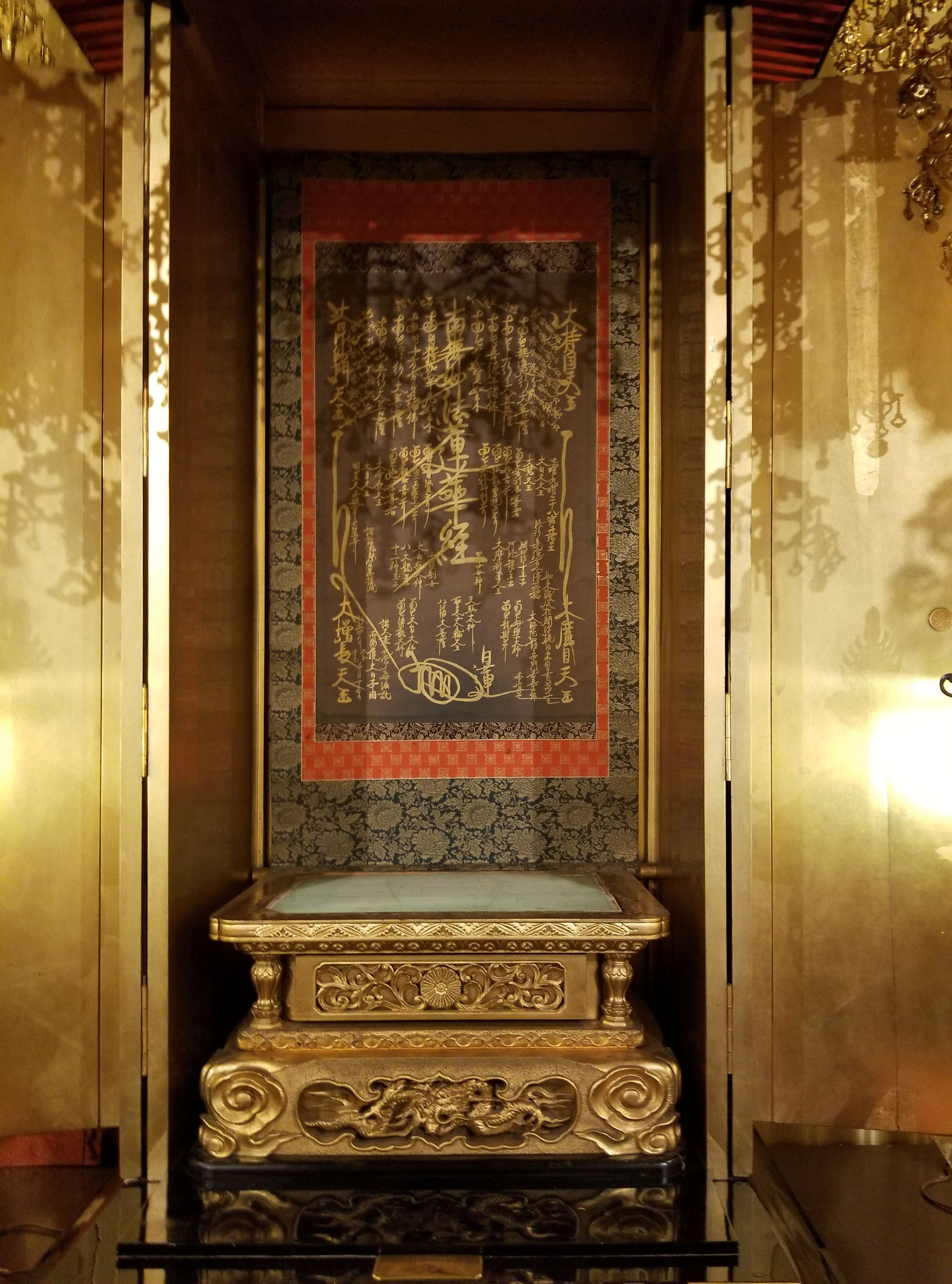
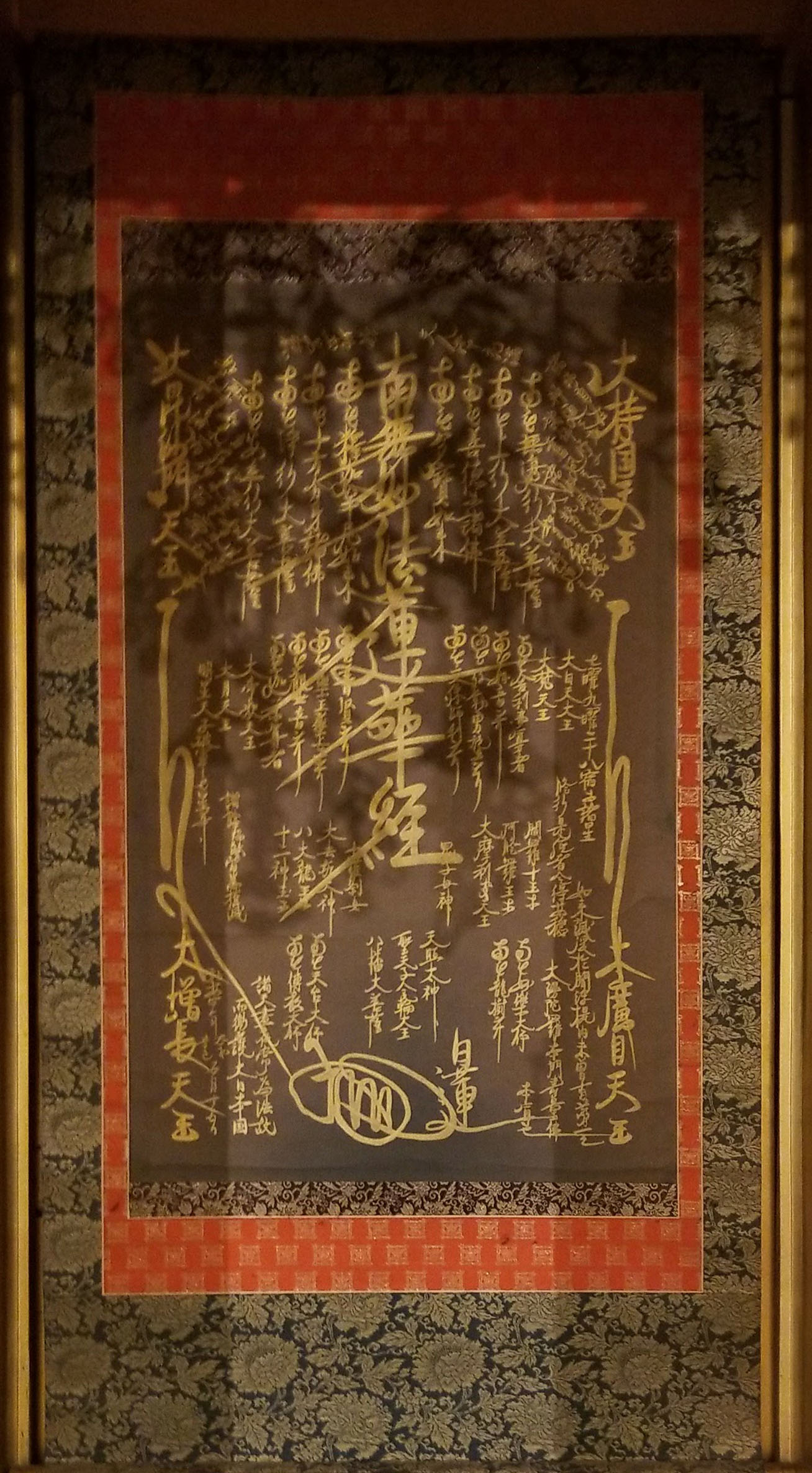
Rare view of the full Mandala Gohonzon at the Sacramento Nichiren Buddhist Church 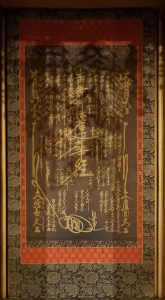
Mandala Gohonzon at Sacramento Nichiren Buddhist Church
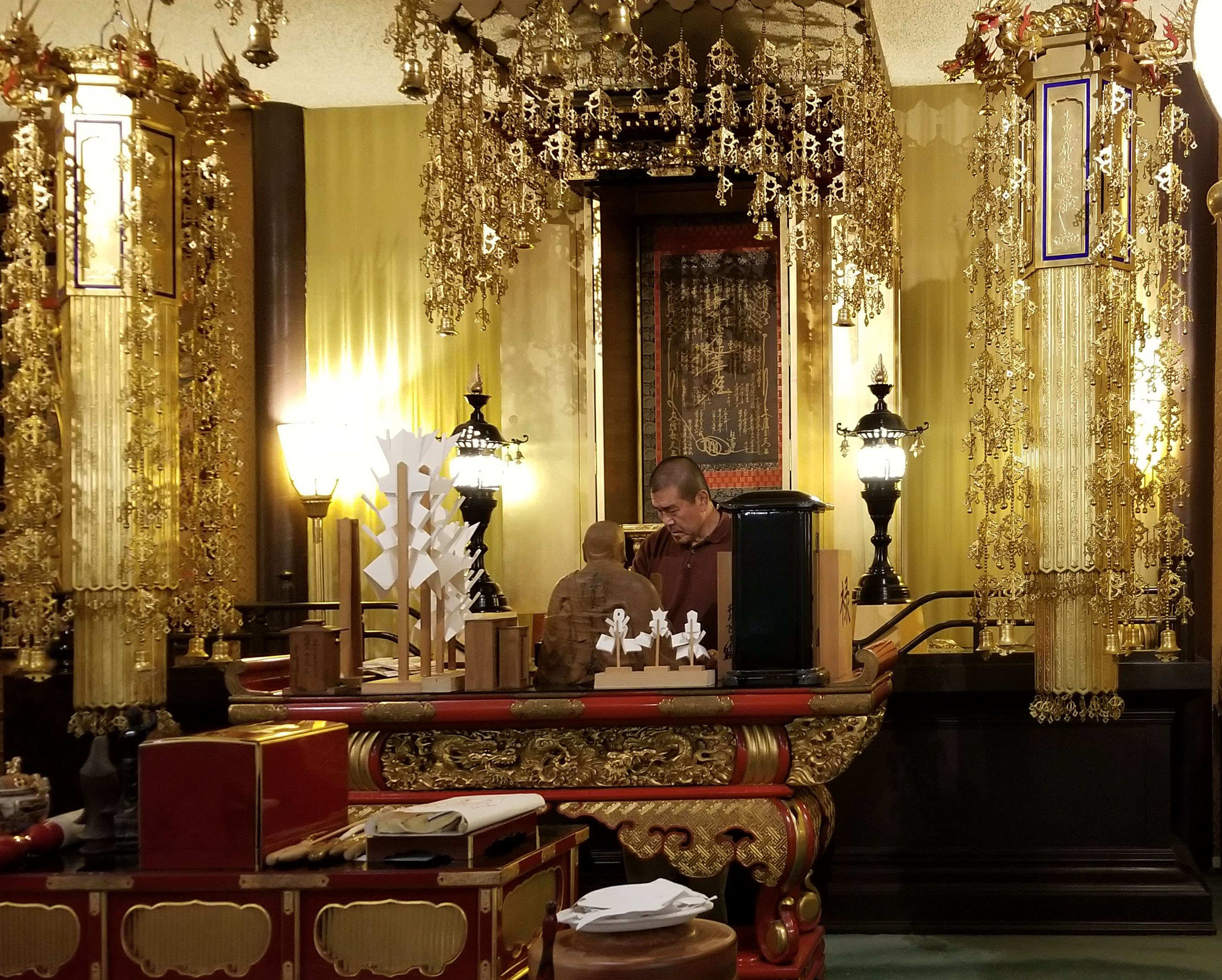
The third Sunday of December is designated as the day to do a thorough cleaning of the temple. At the Sacramento Nichiren Buddhist Church this is a rare opportunity to see the full Mandala Gohonzon. Normally, the statue of Nichiren obscures the bottom third.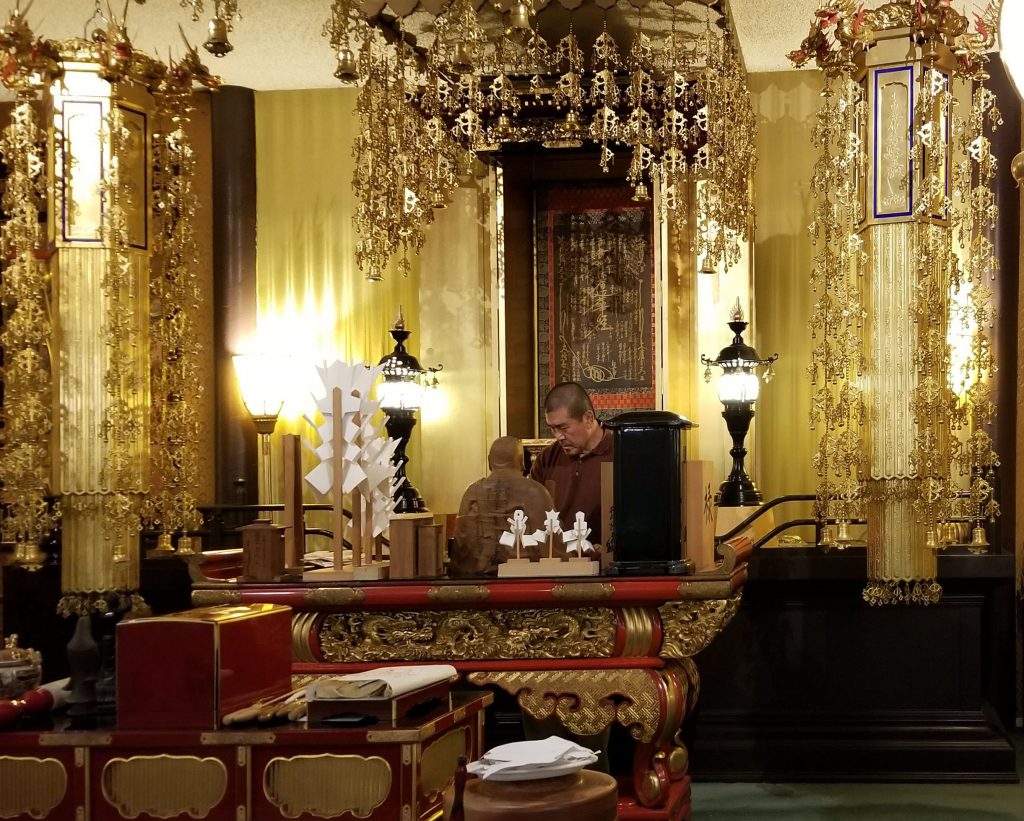
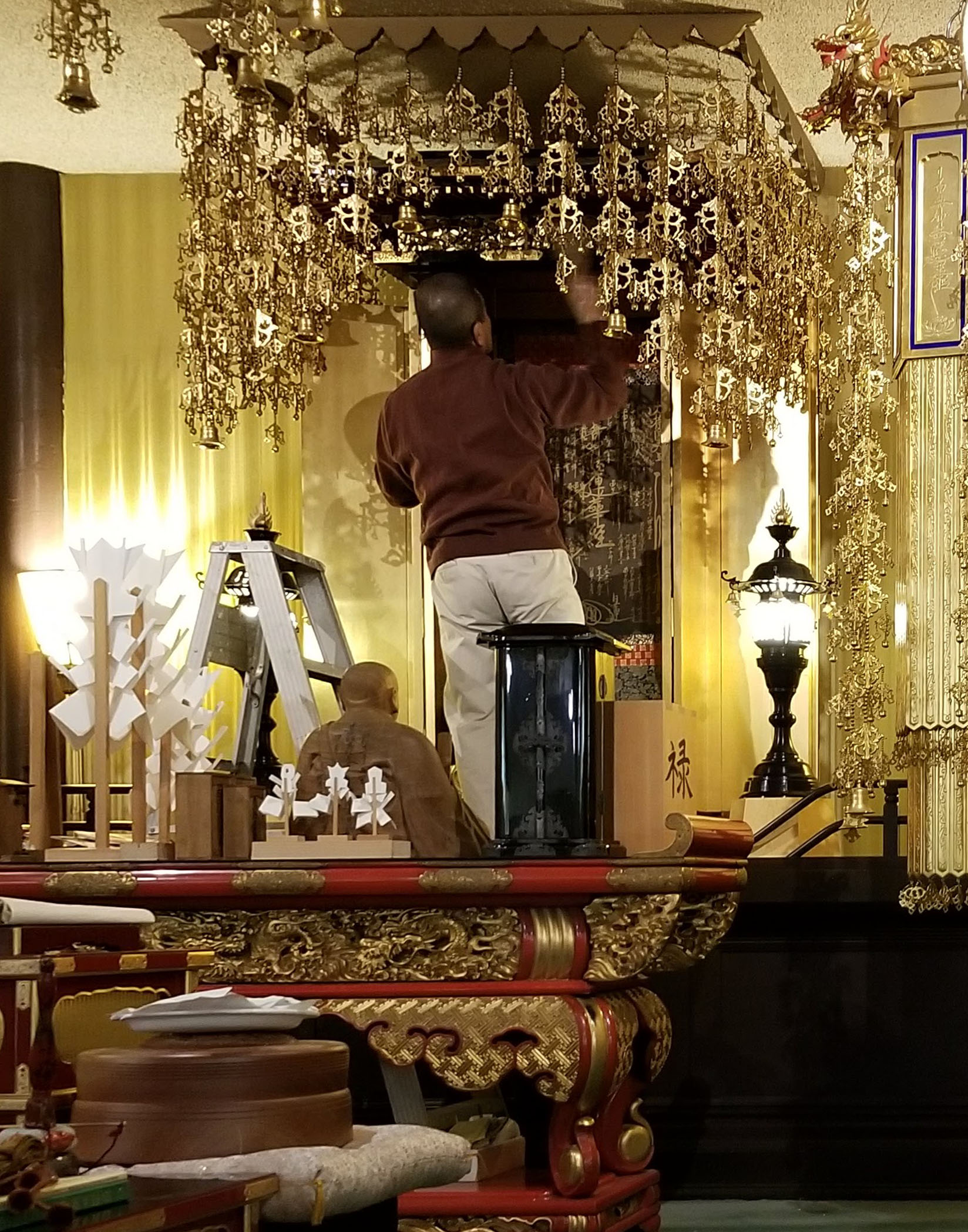
Before beginning, Ven. Kenjo Igarashi lit incense and then cleansed his hands in the smoke. After moving the statue of Nichiren he cleansed a large calligraphy brush with the incense smoke and proceeded to dust the statue. 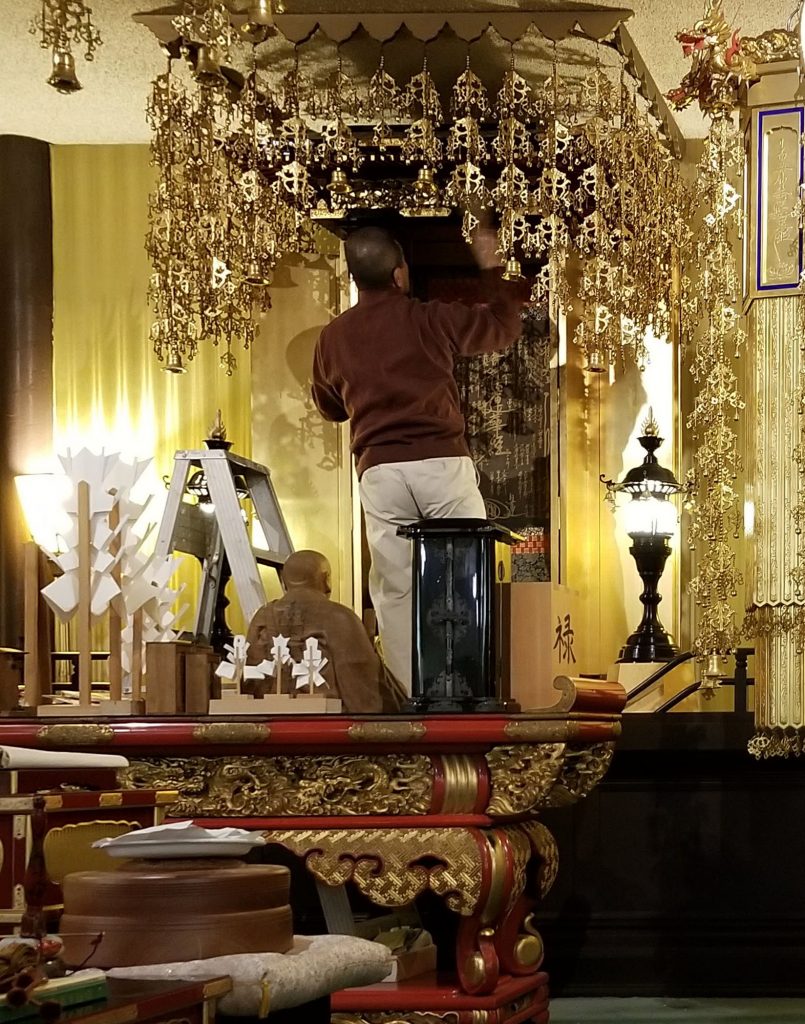
The annual cleaning of the altar includes dusting the inside of the Butsudan. Here’s a video that includes 125 Mandala Gohonzons inscribed by Nichiren Shonin.
-
Namu
Joy and gratitude are fundamental practices of Buddhism. We say Namu because we appreciate our lives, we appreciate our practice and relationship to the Lotus Sutra or Myoho Renge Kyo. Namu is an expression of our relationship to the Lotus Sutra. Namu is not a question, it is not a seeking for something outside our lives, Namu is an expression of what is already in our lives and our ever-deepening relationship to those truths. Namu is not ‘I want this’, it is instead saying ‘I am this’.
Practice Guide -
Daily Dharma – Dec. 24, 2017
When the sky is blue, the land is bright. In this way those who know the Lotus Sutra can see the reasons for occurrences in the world. For those who are incapable of understanding the truth of the “3000 existences contained in one thought,” Lord Śākyamuni Buddha with his great compassion, wraps this jewel with the five characters of myō, hō, ren, ge and kyō and hangs it around the neck of the ignorant in the Latter Age of Degeneration. The four great Bodhisattvas will protect such people, just as the Duke of Chou assisted the young ruler, King Chen, or the Four Elders attended the child Emperor Hui.
Nichiren wrote this in his treatise on Spiritual Contemplation and the Most Venerable (Kanjin Honzon-Shō). This reminds us that whether or not we are able to make sense of the Buddha’s most difficult teaching, what is important is to rely on his determination to help us become enlightened. It is in our practice of reciting the sacred title: “Namu Myoho Renge Kyo,” that we express all the teachings of the Buddha and help all beings become enlightened.
The Daily Dharma is produced by the Lexington Nichiren Buddhist Community. To subscribe to the daily emails, visit zenzaizenzai.com
-
Day 32
Day 32 covers Chapter 28, The Encouragement of Universal-Sage Bodhisattva, closing the Eighth Volume of the Sutra of the Lotus Flower of the Wonderful Dharma.
Having last month heard Śākyamuni Buddha’s instructions to Universal Sage, we conclude the Chapter 28, The Encouragement of Universal-Sage Bodhisattva.
“Universal-Sage! Anyone who keeps, reads and recites this sūtra [in the later five hundred years] after [my extinction], will not be attached to clothing, bedding, food or drink, or any other thing for living. What he wishes will not remain unfulfilled. He will be able to obtain the rewards of his merits in his present life. Those who abuse him, saying, ‘You are perverted. You are doing this for nothing,’ will be reborn blind in their successive lives in retribution for their sin. Those who make offerings to rum and praise him, will be able to obtain rewards in their present life. Those who, upon seeing the keeper of this sūtra, blame him justly or unjustly, will suffer from white leprosy in their present life. Those who laugh at him will have few teeth, ugly lips, flat noses, contorted limbs, squint eyes, and foul and filthy bodies, and suffer from bloody pus of scabs, abdominal dropsy, tuberculosis, and other serious diseases in their successive lives. Therefore, Universal-Sage! When you see the keeper of this sūtra in the distance, you should rise from your seat, go to him, receive him, and respect him just as you respect me.
When the Buddha expounded this chapter of the Encouragement of Universal-Sage, as many Bodhisattvas as there are sands in the River Ganges obtained the dhārāṇis by which they could memorize hundreds of thousands of billions of repetitions of teachings, and as many Bodhisattvas as the particles of dust of one thousand million Sumeru-worlds [understood how to] practice the Way of Universal-Sage.
When the Buddha expounded this sūtra, the great congregation including the Bodhisattvas headed by Universal-Sage, the Śrāvakas headed by Śāriputra, and the other living beings such as gods, dragons, men and nonhuman beings, had great joy, kept the words of the Buddha, bowed [to him], and retired.
[Here ends] the Eighth Volume of the Sūtra of the Lotus Flower of the Wonderful Dharma.
-
Universal Meaning
Most modern Buddhist scholars believe that the Lotus Sutra was compiled about 500 years after Sakyamuni’s death – that is, during the first century of our era. (It was not composed all at once. Some parts are considered older than others.) In the light of this historical assessment, we can deduce that the Lotus Sutra constituted an effort to unify the diverse Buddhist schools of thought and practice which had already developed. No matter when the sutra was actually written, however, its doctrine should be understood as conveying universal meaning – the truth which transcends any limits of time or place. The Lotus Sutra embodies thought meant to unify all the Buddhist sects, old and new, regardless of their origin.
Introduction to the Lotus Sutra
-
The Identity Perceived by Buddhas
It is the identity perceived by Buddhas that is the real state of things – the very Truth itself. Sakyamuni, fearing that such reasoning was above the comprehension of the people generally, embodied the Truth in the concrete form of his own person, in order that they might there see it for themselves, and thus addressed them: “Now, the three worlds – the mortal, the material, and the spiritual – are all my own possession; and all the living beings they contain are my own children.”
Doctrines of Nichiren (1893)