The king and queen took off their necklaces of pearls worth hundreds of thousands, and strewed the necklaces to the Buddha. The necklaces flew up to the sky [seven times as high as the tāla-tree], and changed into a jeweled platform equipped with four pillars. On the platform was a couch of great treasures, and thousands of millions of heavenly garments were spread [on the couch]. The Buddha [went up,] sat cross-legged [on the couch], and emitted great rays of light. King Wonderful-Adornment thought, ‘The Buddha is exceptional. He is exceedingly handsome. He has the most wonderful form.’
The Buddha uses this description as part of the story of King Wonderful-Adornment in Chapter Twenty-Seven of the Lotus Sūtra. This King was led by the supernatural powers of his children to meet Cloud-Thunderpeal-Star- King Flower-Wisdom Buddha who was teaching the Wonderful Dharma in that world. The King and his wife the Queen were both so inspired by that Buddha that they allowed the symbols of their wealth and power to be transformed into a sacred platform from which the Buddha could lead all beings to enlightenment. When they found that Buddha, the beauty of his wisdom far outshone the beauty of their jewels.
The Daily Dharma is produced by the Lexington Nichiren Buddhist Community. To subscribe to the daily emails, visit zenzaizenzai.com
Day 19 concludes Chapter 14, Peaceful Practices, and begins Chapter 15, The Appearance of Bodhisattvas from Underground.
Having last month considered the Parable of the Priceless Gem in the Top Knot, we hear of the superiority of this Sutra of the Lotus Flower of the Wonderful Dharma.
“Mañjuśrī! This Sutra of the Lotus Flower of the Wonderful Dharma is the most excellent and profound teaching of all the Tathāgatas. Therefore, I expound it lastly just as the powerful king gave the brilliant gem lastly, the one which he had kept [in his topknot) for a long time.
“Mañjuśrī! This Sutra of the Lotus Flower of the Wonderful Dharma is the treasury of the hidden core of the Buddhas, of the Tathāgatas. It is superior to all the other sūtras. I kept it [in secret] and refrained from expounding it for the long night. Now I expound it to you today for the first time.”
The most excellent and profound and superior to all the other sūtras – Namu-Myoho-Renge-Kyo
Enemies find it difficult to attack when two people are together. Therefore, do not keep your brothers at a distance even for a brief period, regardless of what faults they may have; always be close to them. Whenever you get angry, it is clearly written on your face. Please remember that at no time do gods or deities protect those who are short tempered. It is true that you are destined to become a Buddha, but isn’t it regrettable for you to get hurt, pleasing your enemy and causing us grief?
Nichiren wrote this passage in his “Emperor Shushun” Letter (Sushun Tennō Gosho) addressed to his disciple Shijō Kingo. Nichiren knew the temperament of this Samurai warrior, and gave him detailed instructions for how to navigate the political hazards he faced. No matter how vindictive his Lord Ema became, Nichiren reminded him to persist in leading Ema by the Buddha Dharma and to rely on those who kept the Lotus Sūtra with him. As a result, Kingo outlived both Ema and Nichiren himself and is well known as one of Nichiren’s first followers.
The Daily Dharma is produced by the Lexington Nichiren Buddhist Community. To subscribe to the daily emails, visit zenzaizenzai.com
Day 18 concludes Chapter 13, Encouragement for Keeping this Sutra, and begins Chapter 14, Peaceful Practices.
Having last month heard eighty billion nayuta Bodhisattva-mahāsattvas offer to spread the dharma, we repeat in gāthās.
Thereupon the Bodhisattvas sang in Gathas with one voice:
Do not worry!
We will expound this sūtra
In the dreadful, evil world
After your extinction.
Ignorant people will speak ill of us,
Abuse us, and threaten us
With swords or sticks.
But we will endure all this.
Some bhikṣus in the evil world will be cunning.
They will be ready to flatter others.
Thinking that they have obtained what they have not,
Their minds will be filled with arrogance.
Some bhikṣus will live in aranyas or retired places,
And wear patched pieces of cloth.
Thinking that they are practicing the true Way,
They will despise others.
Being attached to worldly profits,
They will expound the Dharma to men in white robes.
They will be respected by the people of the world
As the Arhats who have the six supernatural powers.
They will have evil thoughts.
They will always think of worldly things.
Even when they live in aranyas,
They will take pleasure in saying that we have faults.
They will say of us,
“Those bhikṣus are greedy for worldly profits.
Therefore, they are expounding
The teachings of heretics.
They made that sūtra by themselves
In order to deceive the people of the world.
They are expounding that sūtra
Because they wish to make a name for themselves.”
In order to speak ill of us, in order to slander us
In the midst of the great multitude,
In order to say that we are evil,
They will say to kings, ministers and brahmanas,
And also to householders and other bhikṣus,
“They have wrong views.
They are expounding
The teachings of heretics.”
But we will endure all this
Because we respect you.
The Daily Dharma from Aug. 9, 2017, offers this:
Medicine-King Bodhisattva and Great-Eloquence Bodhisattva, along with their attendants, declare these verses to the Buddha in Chapter Thirteen of the Lotus Sutra. The Buddha had asked previously who would teach the Lotus Sūtra after the Buddha’s death. These Bodhisattvas declare their aspirations to maintain their practice of the Buddha Dharma in the face of unimaginable difficulties. We may believe that this practice will lead to permanent comfort and pleasure. But knowing that we are in a world that is constantly changing, we realize that any difficulty is temporary, and that the way to a beneficial outcome may only go through difficulties. This knowledge and faith in the Buddha’s teachings increases our capacity to be a beneficial force in this world of conflict.
The Daily Dharma is produced by the Lexington Nichiren Buddhist Community. To subscribe to the daily emails, visit zenzaizenzai.com
One of attitudes toward our practice that Bodhisattvas try to cultivate is childlike. That is with an open-eyed pure eagerness to embrace Buddhism in our lives without all the filters and conditions that we impose upon things as we age. If we think of a puppy or a young child, someone who is eagerly and openly enjoying every experience then we can really begin to get to the depths of having the sutra expounded to ourselves.
The Buddha possesses 32 marks of physical excellence, all of which belong to the category of matter. The Brahma’s voice, pure and immaculate voice of the Buddha, however is invisible. Therefore it is impossible for us to depict it in pictures or statues.
Nichiren wrote this passage in his Treatise on Opening the Eyes of Buddhist Images, Wooden Statues or Portraits (Mokue Nizō Kaigen no Koto). The statues, portraits and other images of the Buddha and other protective deities which we use in our practice are not meant to be idols. They are living examples of the perfections to which we aspire and from which we draw strength. The ceremony in which we “Open the Eyes” of an Omandala or anything else we use in our practice reminds us that everything around us has life. When we hear the Buddha’s voice from them, leading us to enlightenment, then we learn how to improve the world for ourselves and all beings.
The Daily Dharma is produced by the Lexington Nichiren Buddhist Community. To subscribe to the daily emails, visit zenzaizenzai.com
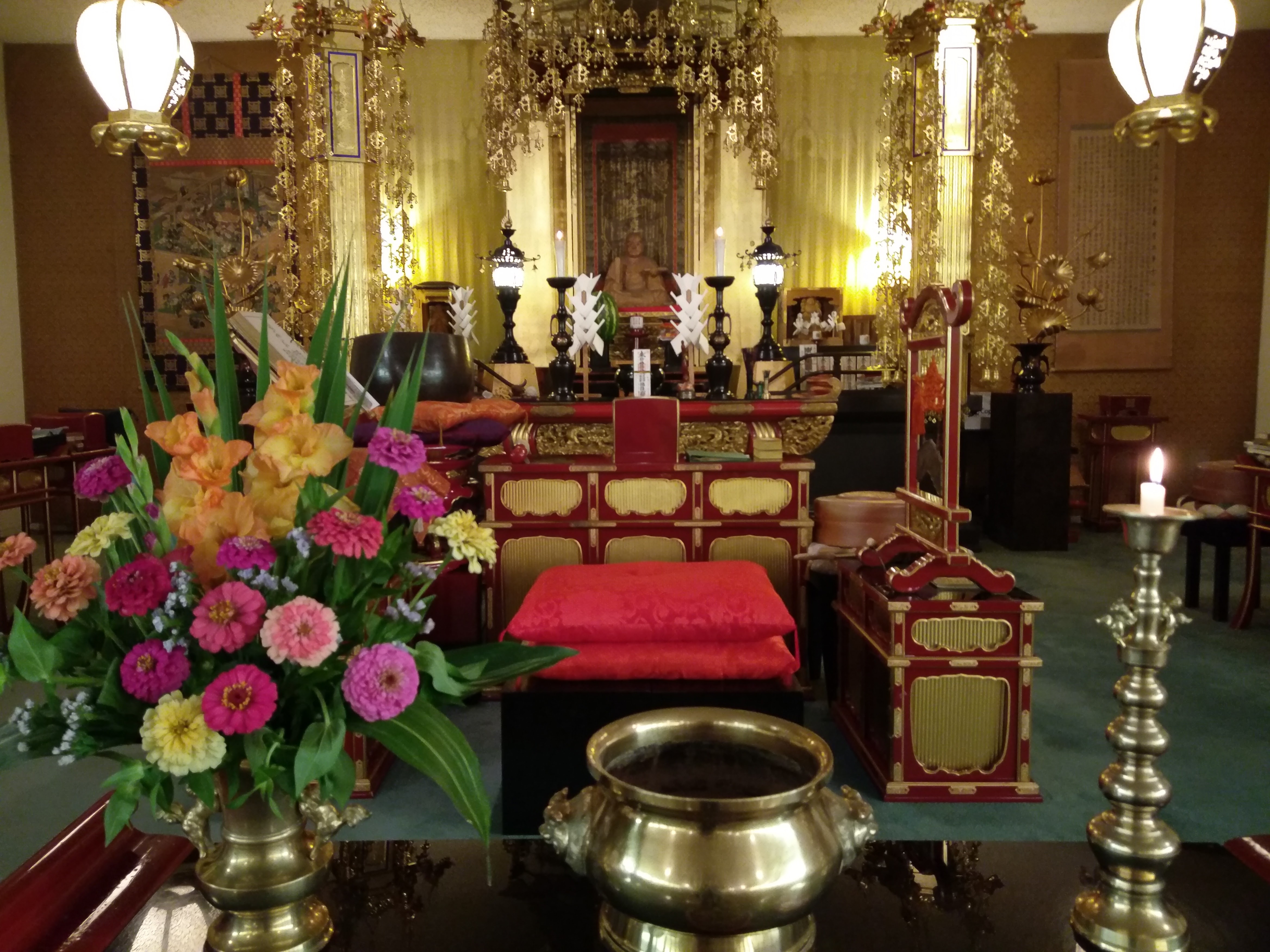
I attended the Sunday service at the Sacramento Nichiren Buddhist Church and picked up an omamori that I asked Rev. Igarashi to create for a friend who is pregnant. You can see the omamori in the center of the above picture.
One of the tangible benefits of being a member of a Nichiren Shū church with a priest who has survived five 100-day ascetic trials to gain special merits and knowledge is the chance to call upon all of the resources Buddhism offers. May my friend’s pregnancy be uncomplicated.
And on the topic of babies, Rev. Igarashi’s lecture dealt with just how rare it is that we are born as humans and even rarer that we are born as humans and encounter the Lotus Sūtra.
Nichiren described being born human as rare as the one-eyed turtle finding a suitable hollow in a floating log, or a thread lowered from the heavens passing through the eye of a needle on earth.
The reference to the turtle comes from the Miscellaneous Āgama Sutra. The story is told of a blind turtle, whose life span is immeasurable kalpas. The turtle lives at the bottom of the sea. Once every 100 years, it rises to the surface. There is only one log floating in the sea with a suitable hollow in it. Since the turtle is blind and the log is tossed about by the wind and waves, the likelihood of the turtle reaching the log is extremely remote. It is even rarer, says Śākyamuni, to be born a human being; having succeeded in doing so, one should use the opportunity to master the four noble truths and attain deliverance.
“That is why Nichiren Shonin said, ‘If you are born into this world if you waste your life then don’t regret after you pass away’, ” said Rev. Igarashi.
Unfortunately, many people don’t share their Buddhism for fear of what others might say. This, Rev. Igarashi said, is like the Aesop fable “The Man, the Boy, and the Donkey.”
A man and his son were once going with their Donkey to market. As they were walking along by its side a countryman passed them and said: “You fools, what is a Donkey for but to ride upon?”
So the Man put the Boy on the Donkey and they went on their way. But soon they passed a group of men, one of whom said: “See that lazy youngster, he lets his father walk while he rides.”
So the Man ordered his Boy to get off, and got on himself. But they hadn’t gone far when they passed two women, one of whom said to the other: “Shame on that lazy lout to let his poor little son trudge along.”
Well, the Man didn’t know what to do, but at last he took his Boy up before him on the Donkey. By this time they had come to the town, and the passers-by began to jeer and point at them. The Man stopped and asked what they were scoffing at. The men said: “Aren’t you ashamed of yourself for overloading that poor Donkey of yours—you and your hulking son?”
The Man and Boy got off and tried to think what to do. They thought and they thought, till at last they cut down a pole, tied the Donkey’s feet to it, and raised the pole and the Donkey to their shoulders. They went along amid the laughter of all who met them till they came to Market Bridge, when the Donkey, getting one of his feet loose, kicked out and caused the Boy to drop his end of the pole. In the struggle the Donkey fell over the bridge, and his fore-feet being tied together he was drowned.
“That will teach you,” said an old man who had followed them: “PLEASE ALL, AND YOU WILL PLEASE NONE.”
Rev. Igarashi said, “You have to think about why you are born into this world. Not just enjoy your life or make money. We are born into this world to practice Buddhism and get enlightenment and then try to save other people. …
“Practice and study the Lotus Sūtra, then if you understand only just a little bit you have to talk to other people and try to save them. That’s why we are born into this world. Now we can chant Namu-Myoho-Renge-Kyo and chant the Lotus Sūtra so we don’t waste our time. We try to get enlightenment and don’t end up regretting after we pass away. …
“Please practice for yourself first, study, then if you understand just a little bit of Lotus Sūtra and Nichiren Buddhism maybe you become a very rookie Bodhisattvas. Then you try to save other people and move up the rungs of Bodhisattvas. …
“Try to practice and study and don’t waste your time.”
Day 17 covers all of Chapter 12, Devadatta, and opens Chapter 13, Encouragement for Keeping this Sutra.
Having last month heard Śāriputra’s doubts about an 8-year-old female dragon becoming a Buddha, we meet the daughter of the dragon king.
At that time the daughter of the dragon-king had a gem. The gem was worth one thousand million Sumeru-worlds. She offered it to the Buddha. The Buddha received it immediately. She asked both Accumulated-Wisdom Bodhisattva and Venerable Śāriputra, “I offered a gem to the World-Honored One. Did he receive it quickly or not?”
Both of them answered, “Very quickly.”
She said, “Look at me with your supernatural powers! I will become a Buddha more quickly. ”
Thereupon the congregation saw that the daughter of the dragon-king changed into a man all of a sudden, performed the Bodhisattva practices, went to the Spotless World in the south, sat on a jeweled lotus-flower, attained perfect enlightenment, obtained the thirty-two major marks and the eighty minor marks [of the Buddha], and [began to] expound the Wonderful Dharma to the living beings of the worlds of the ten quarters. Having seen from afar that [the man who had been] the daughter of the dragon-king had become a Buddha and [begun to] expound the Dharma to the men and gods in his congregation, all the living beings of the Sahā-World, including Bodhisattvas, Śrāvakas, gods, dragons, the [six other kinds, that is, in total] eight kinds of supernatural beings, men, and nonhuman beings, bowed [to that Buddha] with great joy. Having heard the Dharma [from that Buddha], [a group of] innumerable living beings [of that world] understood the Dharma, and reached the stage of irrevocability, and [another group of] innumerable living beings [of that world] obtained the assurance of their future attainment of enlightenment. At that time the Spotless World quaked in the six ways. Three thousand living beings of the Sahā World reached the stage of irrevocability, and another group of three thousand living beings [of the Sahā-World] aspired for Bodhi, and obtained the assurance of their future attainment of enlightenment. The Accumulated-Wisdom Bodhisattva, Śāriputra, and all the other living beings in the congregation received the Dharma faithfully and in silence.
Excuse me while I digress here. I’ve been reading The Nichiren Mandala Study Workshop‘s three volume “The mandala in Nichiren Buddhism.” One of the tidbits I picked up is the name of the 8-year-old daughter of the Dragon-King Sāgara. Her name is Ryūnyo. (Ryū being the word for dragons.)
In a discussion concerning Tōkōzan Myōho-ji, the authors explain the relationship between the goddess Shichimen, the dragon girl Ryūnyo and Nichiren:
On the main altar a grouping of statues is enshrined … while a backside room is dedicated to the goddess Shichimen, a female protective deity adopted in the Minobu School quite early on. According to tradition, Nichiren’s disciples Nichirō and Nambu Sanenaga climbed mount Shichimen on the 19th day of the ninth month in 1297 in order to pray to the resident deity. In the Shintō pantheon, Shichimen is actually a celestial nymph and in Nichiren’s Buddhism she is considered to be a manifestation of the Dragon Girl Ryūnyo described in the Lotus Sūtra. Local legends describe an encounter with Nichiren in 1277, while he was preaching around Minobu. Disguised as a human female, she listened to the sermon and later revealed herself as the dragon girl Ryūnyo. … Shichimen is the protective deity of Kuon-ji and very dear to the Minobu School. Several Abbots of this tradition placed her on the mandala on the same spatial level of the other two Shintō deities Tenshō and Hachiman.
I also recently got my hands on a copy of the Japanese-English Buddhist Dictionary, which offers this on the dragon girl:
Ryūnyo-jōbutsu –’The nāga (ryū) girl attains Buddhahood.’ – This phrase alludes to the well-known story in the [Lotus Sutra] about an exceptionally intelligent eight-year-old nāga girl who, under the guidance of Mañjuśrī, grasps the concept of shohō-jissō [the real state of all elements]. When she appears before the Buddha, she is transformed into a boy, and attains Buddhahood in one of the worlds to the south of this one.
People have approached me on occasion, saying they feel incapable of teaching people about Buddhism or about the Lotus Sutra. Really all it takes is to learn to tell your story. It doesn’t need to be complex. It doesn’t need to be fancy. It simply needs to be your story as a person who practices the Lotus Sutra. You might be a visual person so your story might not even contain words. It might be pictures. It can be anything as long as your story is in there somewhere. Your story will connect with others in ways technical explanations may not.
Excellent, excellent, Ajita! You asked me a very important question. All of you should concentrate your minds, wear the armor of endeavors, and be resolute. Now I will reveal, I will show, the wisdom of the Buddhas, their supernatural powers without hindrance, their dauntless powers like a lion’s, and their great power of bravery.
The Buddha makes this declaration to Maitreya Bodhisattva, whom he calls Ajita (Invincible) in Chapter Fifteen of the Lotus Sūtra. In the story, innumerable Bodhisattvas spring up from underground and vow to the Buddha to keep the sūtra after his extinction. Maitreya, knowing the minds of many others who have come to hear the Buddha teach, asks about these Bodhisattvas, whom he has never seen before. This question from Maitreya then leads to the Buddha later giving his most difficult teaching in Chapter Sixteen. The Buddha’s declaration in this passage shows how important questioning is to our faith.
The Daily Dharma is produced by the Lexington Nichiren Buddhist Community. To subscribe to the daily emails, visit zenzaizenzai.com