
There are some who may come to activities, perhaps frequently, but then the rest of their life is preoccupied with other things and so do not practice or follow Buddhism. There may be religious experience, but there is not fundamental embracing and manifesting in life of religious action. We could say they only have a nominal belief in Buddhism. It is worth our while to frequently reflect on our day-to-day actions and see how deeply our religious belief extends into our lives. Perhaps it is deep or perhaps it is shallow; honesty is the place where it can begin to change.
Lecture on the Lotus SutraAll posts by John Hughes
Daily Dharma – Aug. 30, 2017
The merits of the [fiftieth] person
[Who hears this sūtra] are immeasurable.
Needless to say, so are the merits of the first person
Who rejoices at hearing it in the congregation.
The Buddha sings these verses to Maitreya Bodhisattva in Chapter Eighteen of the Lotus Sutra. This chapter includes a story of a person who hears the Wonderful Dharma, then explains it to the best of their ability to someone else. In this way there is a chain of fifty people who hear versions of this teaching modified by the capacities of those transmitting it. The effectiveness of this teaching does not depend on who delivers it. No matter what our capacity, any of us can teach the Lotus Sutra and practice it in our lives.
The Daily Dharma is produced by the Lexington Nichiren Buddhist Community. To subscribe to the daily emails, visit zenzaizenzai.com
You and me and everyone else
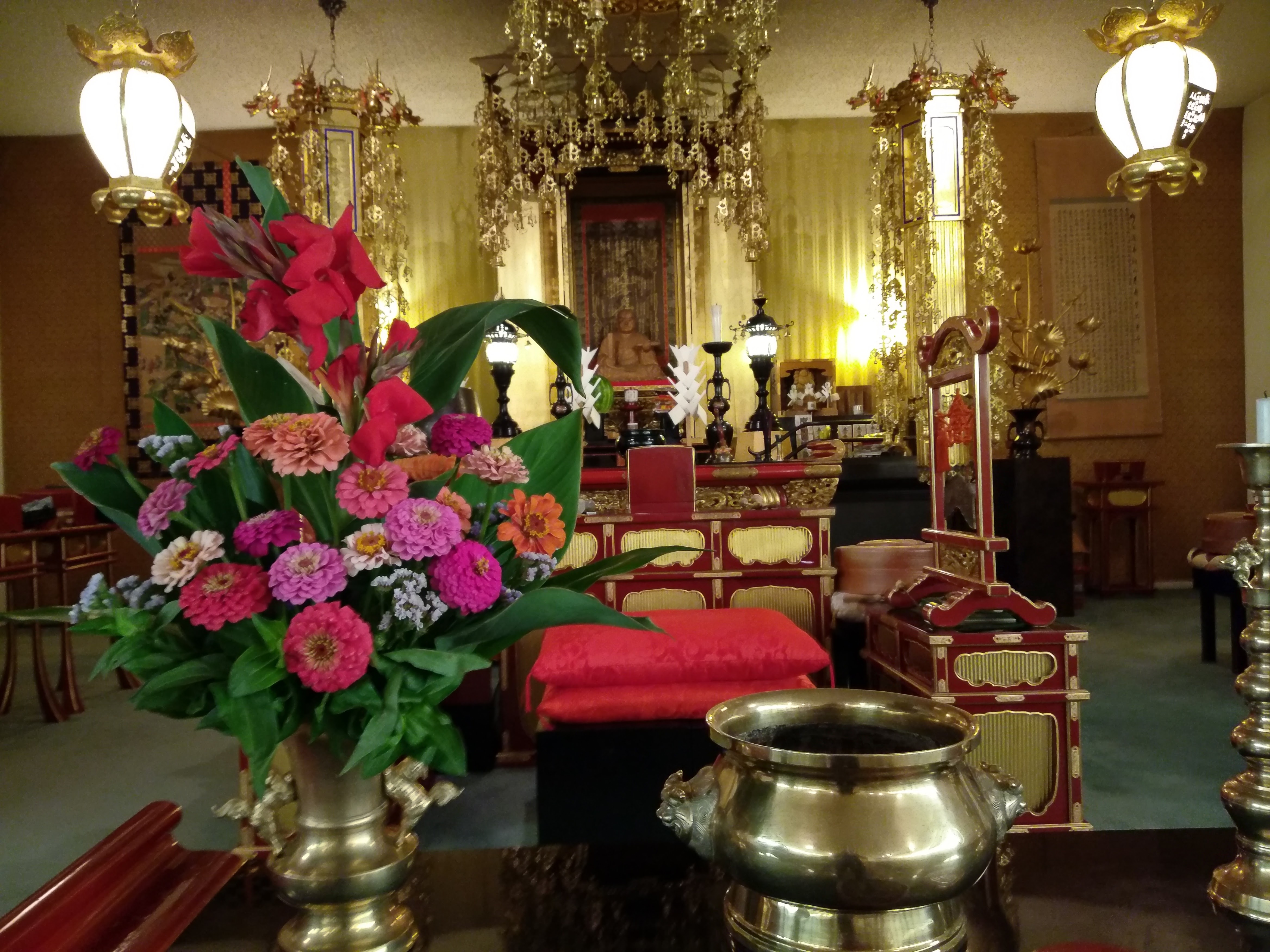
Attended the Kaji Kito service at the Sacramento Nichiren Buddhist Church on Aug. 27. The sermon from Ven. Kenjo Igarashi covered a range of Buddhist concepts but the one item that stuck with me was the inclusive nature of the Buddhist practice.
Today’s quote from Lotus Seeds summarizes this well:
The bodhisattvas are as concerned about relieving the suffering of others as they are about relieving their own. One might even say they know we are all in the same boat, the Great Vehicle of the Mahayana, which takes all people to the other shore of perfect and complete awakening. Thus, the advancement of the individual is impossible without the advancement of all.
Lotus Seeds
But beyond the Bodhisattva practice for oneself and others is the fundamental teaching of 3000 realms in a single moment.
In the time since 2015, when I joined Nichiren Shu, I’ve had to unlearn a good portion of what I thought Nichiren Buddhism taught. The Daimoku is not, for example, solely a wish-granting gem, the more you polish it the more you get.
More subtle, but no less profound, is the meaning of 3,000 realms in a single thought moment, one of the defining elements of Nichiren Buddhism.
The basics are simple enough. Here’s the summary from Lotus Seeds:
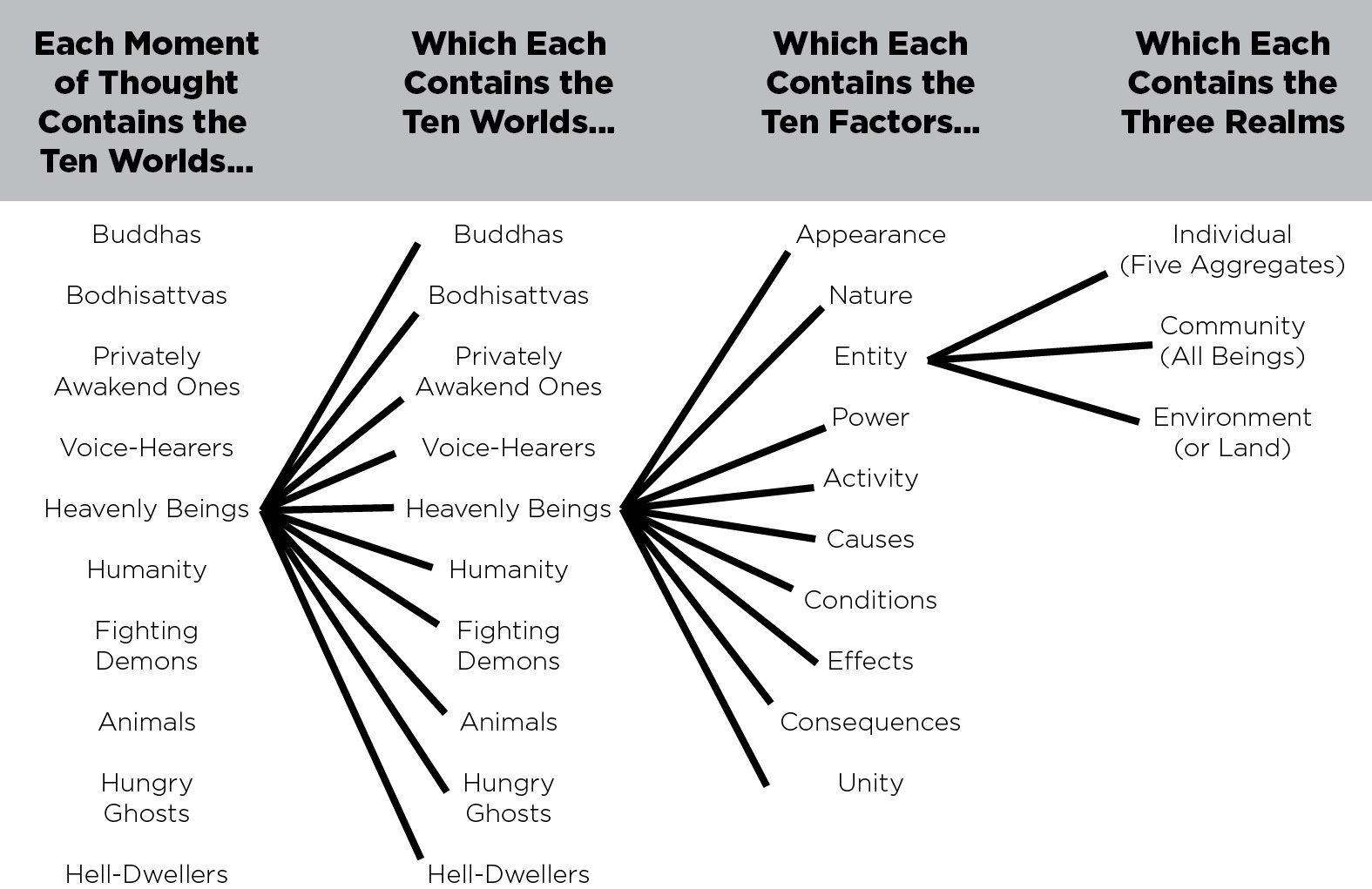 Ichinen Sanzen, the Three Thousand Worlds Contained in One Thought, is the theoretical cornertone of Nichiren Buddhism. It is a universal vision of life as rich, dynamic, and meaningful. Ichinen Sanzen reveals thal all life contains all Ten Worlds, including Buddhahood, and that these worlds operate according to the causes and conditions that we all set in motion. In a praclical sense, this theory means that we are able to make the cause that will allow the world of Buddhahood to emerge in our lives when we chant Namu Myoho Renge Kyo.Lotus Seeds
This description works fine for self-inspection but, as the Bodhisattvas teach us, self-inspection is only part of the practice.
I recently finished “Buddha Seed: Understanding the Odaimoku Namu Myoho Renge Kyo,” a 53-page book adapted by the Nichiren Buddhist International Center from the lectures of Rev. Taiko Seno.
Buddha Seed introduced me to the full meaning of 3000 realms:
“What does this number three thousand represent? It represents everything not only of the earth, but also of the universe and includes everything in the past, present, and future. Everything of the universe from animals, plants, other beings, visible or invisible, and their activities, workings, and movements are included in the three thousand realms. Everything of the universe exists within each one of us. Everything influences us, works together as primary cause and environmental cause and brings effects, rewards and retributions. All of us exist in relationship with everything in the universe.”
Or as Rev. Igarashi put it Sunday: Ichinen sanzen holds that each moment contains all of the universe.
To paraphrase Rev. Igarashi:
“There are a lot of people living in this world, more than 5 billion. And each moment of Ichinen Sanzen contains all of these people. That’s why if somebody is fighting I’m not happy. If somebody is unhappy, I’m not happy. That’s why praying for world peace is very important. If the world is at peace, we are all happy. That’s why Shakyamuni warned against focusing on one’s own happiness. Everyone must be happy.
That’s why all of the time I give you purification. You have to extinguish your bad karma. You chant Namu-Myoho-Renge-Kyo and the Lotus Sutra and accumulate merit while trying to help other people like Bodhisattvas. Not just for you. Not just for me. All 5 billion people’s spirit living in my mind. That’s why your actions made in this world decide your next world to go. Your actions are very important. Your actions accumulate merit.
Shakyamuni said everyone is equal but your karmas, your actions, your cause and condition are different. That’s why we have to try to accumulate good karma and help other people and try to extinguish our bad karma which we made in our previous life. That’s why I give you purification so that your karma is different and therefore your life is different.”
Day 12
Day 12 concludes Chapter 7, The Parable of the Magic City, and completes the Third Volume of the Sutra of the Lotus Flower of the Wonderful Dharma.
Having last month witnessed the sixteen princes renouncing the world and becoming śramaṇeras, we continue in gāthās with how those sixteen śramaṇeras practiced the Way to Buddhahood and taught the Dharma.
Those sixteen śramaṇeras practiced the Way to Buddhahood.
They are now in the worlds of the ten quarters.
They have already attained
Perfect enlightenment [and become Buddhas].Those who heard the Dharma from those śramaṇeras
Are now living under those Buddhas.
To those who are still in Śrāvakahood
[The Buddhas] teach the Way to Buddhahood.I was one of the sixteen śramaṇeras.
You were among those to whom I expounded the Dharma.
Therefore, I now lead you with expedients
To the wisdom of the Buddha.Because I taught you in my previous existence,
I expound the Sūtra of the Lotus Flower of the Wonderful Dharma
In order to lead you into the Way to Buddhahood.
Think it over! Do not be surprised! Do not be afraid!
“Because I taught you in my previous existence…” I am able to hear today the Sūtra of the Lotus Flower of the Wonderful Dharma. Imagine that.
We’re All in the Same Boat
The bodhisattvas are as concerned about relieving the suffering of others as they are about relieving their own. One might even say they know we are all in the same boat, the Great Vehicle of the Mahayana, which takes all people to the other shore of perfect and complete awakening. Thus, the advancement of the individual is impossible without the advancement of all.
Lotus SeedsDaily Dharma – Aug. 29, 2017
Having heard from you
Of the duration of your life,
Living beings as many as the particles of earth
Of eight Sumeru-worlds
Aspired for unsurpassed [enlightenment].
The Bodhisattva Maitreya sings these verses in Chapter Seventeen of the Lotus Sutra. He describes the effect on all beings of the Buddha’s revealing his existence as the Ever-Present Śākyamuni. If we believed that the Buddha was just a man who lived 2500 years ago, we might think that we had to wait until another being became enlightened before we could follow them on the path to our own awakening. But with this understanding that the Buddha is always helping us, here and now, then we awaken our capacity to see things as they are and work confidently for the benefit of all beings.
The Daily Dharma is produced by the Lexington Nichiren Buddhist Community. To subscribe to the daily emails, visit zenzaizenzai.com
Day 11
Day 11 continues Chapter 7, The Parable of the Magic City
Having last month concluded this portion of Chapter 7, The Parable of the Magic City, we begin again from the top.
The Buddha said to the bhikṣus:
“When Great-Universal-Wisdom-Excellence Buddha attained Anuttara-samyak-saṃbodhi, five hundred billion Buddha-worlds in each of the ten quarters quaked in the six ways, and all those worlds, including those intercepted from the brilliant rays of light of the sun and the moon by the neighboring worlds, were illumined [by great rays of light], and the living beings of those worlds were able to see each other for the first time. They said to each other, ‘How did you appear so suddenly?’ The palaces of the gods of those worlds, including the palace of Brahmans, also quaked in the six ways. The great rays of light which illumined all those worlds were brighter than the rays of light emitted by those gods.
In reading this today I realized that this is a telling of the story of a Buddha’s light from the perspective of the observer as compared to the first chapter, where we are first told of the rays of light emitted by the Buddha and then learn of the reaction to the light. Imagine what was hidden before is suddenly revealed. That is the light of a Buddha. Without it, more people fall into the lower regions and fewer people enter the heavens.
The Treasured Gem
From the moment of [Nichiren’s] recovery [after 21 days of prayer and fasting before the image of Kokuzo Bosatsu], a new clarity began to enter his life. Through his diligent studies, he began to recognize differences among the various sutras. This recognition was based upon what he called “The Treasured Gem” – a gift of knowledge divided into two parts. The first part was drawn from the Nirvana Sutra that said: “Rely on the Dharma, and not on any person.” Thus, a man could never be misled by clever people. The second part was to rely on reason, on written proof, and finally, on that proof drawn from one’s own experience.
Nichiren, Leader of Buddhist Reformation in JapanDaily Dharma – Aug. 28, 2017
When he said this, people would strike him with a stick, a piece of wood, a piece of tile or a stone. He would run away to a distance, and say in a loud voice from afar, ‘I do not despise you. You will become Buddhas.’
The Buddha tells this story of Never-Despising Bodhisattva in Chapter Twenty of the Lotus Sūtra. This Bodhisattva did not read or recite sūtras. His sole practice was to tell everyone he met, “I respect you deeply. I do not despise you.” Despite this pure practice, many people became angry and abused him because of their own perverted minds. He did not stay where he could suffer their abuse, and he still maintained his respect for them, despite their behavior. This and the other examples in the Lotus Sūtra of Bodhisattvas are examples for us who aspire to practice this Wonderful Teaching.
The Daily Dharma is produced by the Lexington Nichiren Buddhist Community. To subscribe to the daily emails, visit zenzaizenzai.com
Day 10
Day 10 concludes Chapter 6, Assurance of Future Buddhahood, and opens Chapter 7, The Parable of a Magic City.
Having last month begun the prediction of future Buddhahood for Great Maudgalyāyana, we complete the prediction in gāthās and conclude Chapter 6.
Thereupon the World-Honored One, wishing to repeat what he had said, sang in gāthās:
After he gives up his present existence,
This Great Maudgalyāyana, a disciple of mine,
Will see many Buddhas,
Many World-Honored Ones.
He will see eight thousand of them,
And then two hundred billions of them.In order to attain
The enlightenment of the Buddha,
He will make offerings to them, and respect them.
He will perform brahma practices under those Buddhas,
And keep the teachings of those Buddhas
For innumerable kalpas.After the extinction of each of those Buddhas,
He will erect a stūpa of the seven treasures.
There will be a long golden yasti
On the top of the stūpa.
He will offer flowers, incense and music
To the stūpa-mausoleum of the Buddha.He will finally complete
The Way of Bodhisattvas,
And become a Buddha
Called Tamala [pattral-candana-Fragrance
In a world called
Mind-Happiness.The duration of the life of that Buddha
Will be twenty-four [small] kalpas.
He will expound to gods and men
The enlightenment of the Buddha.As many Śrāvakas as there are sands in the River Ganges
Will have the six supernatural powers,
Including the three major supernatural powers.
They will be exceedingly powerful and virtuous.Innumerable Bodhisattvas also will live there.
They will be resolute in mind, and strenuous.
They will never falter
In seeking the wisdom of the Buddha.After the extinction of that Buddha,
His right teachings
Will be preserved for forty small kalpas.
So will the counterfeit of them.The five hundred disciples of mine
Are powerful and virtuous.
They also shall be assured
Of their future Buddhahood.
They will become Buddhas
In their future lives.Now I will tell you
About my previous existence
And also about yours.
All of you, listen attentively!
At this point I want to attach some biographical information about Maudgalyayana, foremost in supernatural powers, from Lotus World:
Shariputra and his lifelong friend Maudgalyayana were born into brahmin families in neighboring villages near Rajagriha, the capital of the kingdom of Magadha, in ancient India. As young men they were both disillusioned with worldly life. Together they left home to find enlightenment and eventually became the leading disciples of the skeptical philosopher Sanjaya. This teaching did not satisfy them for long, however, so they both set out again to find the truth. The two friends made an agreement that whoever discovered it first would find and tell the other.
Shariputra traveled to Rajagriha. There he met Ashvajit. Ashvajit was one of the five ascetics who became the first disciples of Shakyamuni Buddha after he preached the sermon on the Middle Way and the Four Noble Truths at Deer park in Varanasi. Ashvajit’s calm demeanor so impressed Shariputra that he asked him who his teacher was and what teaching he had received. Ashvajit told Shariputra about Shakyamuni Buddha and gave him a summary of the Dharma as he understood it in the following verse:
Of those things that arise from a cause,
The Tathagata has told the cause,
And also what their cessation is:
This is the doctrine of the Great Recluse.
Upon hearing these words, Shariputra’s quick mind realized the profound implications of this seemingly simple verse and he became a stream-enterer, the first of four stages leading to complete liberation from birth and death. At that moment, he knew that Shakyamuni Buddha was the teacher he and his friend had been looking for.
Shariputra immediately found Maudgalyayana and shared Ashvajit’s verse with him. Maudgalyayana also became a stream-enterer; together the two agreed to see Shakyamuni Buddha. But first Shariputra insisted they go to their former teacher Sanjaya and try to convince him to join them. Sanjaya, however, was not willing to relinquish his position as a teacher in order to become the disciple of another. He even tried to convince Shariputra and Maudgalyayana to stay, offering them positions as co-leaders of his own movement. Shariputra and Maudgalyayana were not interested in mere leadership—they were determined to attain liberation under a true teacher, so they both left, taking half of Sanjaya’s 500 disciples with them.
When Shakyamuni Buddha saw the two friends coming to meet him, he announced to the assembly that they would become his chief disciples. The Buddha ordained the two as monks right away. After a week of intensive practice, Maudgalyayana attained the fourth stage of Hinayana enlightenment and became an arhat who would no longer have to be reborn.Lotus World: An Illustrated Guide to the Gohonzon