
Because we seek the power to control things in our lives we fail to seek that which can ultimately give us the ability to end suffering. We seek mistakenly to eliminate suffering by clinging to mistaken views. We may think that if we only had just a little more money or a better house or a better job or a different spouse that all things would be well. We merely look at the surface and think that the conditions that surround us are the things we need to change, never looking at our lives and seeing what we need to change within ourselves. Seeing that we are fundamentally enlightened beings who are living lives of common people can allow us to see the heart of the cause for suffering and free our minds from the attachments that actually are the root of sufferings.
Lotus Path: Practicing the Lotus Sutra Volume 1All posts by John Hughes
Daily Dharma – Aug. 5, 2017
Furthermore, the good men or women who do not speak ill of this sūtra but rejoice at hearing it after my extinction, should be considered, know this, to have already understood my longevity by firm faith.
The Buddha makes this declaration to his disciple Maitreya in Chapter Seventeen of the Lotus Sūtra. After learning the merits of understanding the ever-present nature of the Buddha, Maitreya hears that this understanding is present in anyone who finds joy in this sūtra. From the parables told earlier in the sūtra, we know that this joy is not the same as the joy that comes from ending suffering. It is the joy in our awakening Buddha nature.
The Daily Dharma is produced by the Lexington Nichiren Buddhist Community. To subscribe to the daily emails, visit zenzaizenzai.com
Day 19
Day 19 concludes Chapter 14, Peaceful Practices, and begins Chapter 15, The Appearance of Bodhisattvas from Underground.
Having last month concluded the fourth set of peaceful practices, we consider the Parable of the Priceless Gem in the Top Knot.
“Mañjuśrī! It is difficult to hear even the title of this Sutra of the Lotus Flower of the Wonderful Dharma [even if you try to do so, walking about] innumerable worlds. Needless to say, it is more difficult to see, keep, read and recite this sūtra.
“Mañjuśrī! I will tell you a parable. Suppose a powerful wheel-turning-holy-king demanded surrender of the kings of smaller countries by threat of force. They did not obey his demand. He led soldiers, and went and suppressed them. He was very glad to see that some soldiers distinguished themselves in war. According to their merits, he gave them paddy fields, houses, villages, cities, garments or ornaments; or various treasures such as gold, silver, lapis lazuli, shell, agate, coral or amber; or elephants, horses, vehicles, menservants, maidservants or subjects. But he did not give a brilliant gem which he was keeping in his top-knot to anyone because the gem on the head of the king was the only one [in the world]. If he had given it to anyone, the followers of the king would have been much surprised.
“Mañjuśrī! I am like the king. I obtained the world of the Dharma by my powers of dhyāna-concentration and of wisdom, and became the king of the triple world. But the kings of the Maras did not assent to my demand for surrender to me. Therefore, my army led by generals, that is, by sages and saints, fought with them. I was glad to see that some distinguished themselves [in war]. In order to cause them to rejoice, I expounded many sūtras to the four kinds of devotees. I gave them the treasures of the Dharma such as dhyāna-concentrations, emancipations, the roots without āsravas, and the powers without āsravas, and also the city of Nirvana, telling them that they had already attained extinction. Although I led them [by giving these things to them) and caused them to rejoice, [ did not expound to them the Sutra of the Lotus Flower of the Wonderful Dharma.
“Mañjuśrī! When he saw a soldier of extraordinary merit, the wheel-turning-holy-king joyfully gave that soldier the unbelievably precious gem, which he had kept in his top-knot for a long time and had not given to anyone. I am like the king. I am the great king of the Dharma in the triple world. I expound the Dharma and teach all living beings. Because I see that my soldiers led by generals, that is, by sages and saints, have already obtained extraordinary merits in their fight with the Mara of the five aggregates, with the Mara of illusions, and with the Mara of death, and that they have already eliminated the three poisons, left the triple world, and destroyed the nets of the Maras, I now expound this Sutra of the Lotus Flower of the Wonderful Dharma with great joy. This sūtra leads all living beings to the knowledge of all things. I did not expound it before because, if I had done so, many people in the world would have hated it and few would have believed it.
“It is difficult to hear even the title of this Sutra of the Lotus Flower of the Wonderful Dharma.” Namu Myoho Renge Kyo
Moment to Moment
The Ten Worlds all exist at the same time in each moment. And they are also changing in nature according to our age and circumstances. They are not fixed in any moment and no moment is permanent.
Physician's Good MedicineDaily Dharma – Aug. 4, 2017
But the merits to be given to the person who fills the one thousand million Sumeru-worlds with the seven treasures and offers that amount of the seven treasures to the Buddhas, to the Great Bodhisattvas, to the Pratyekabuddhas, and to the Arhats, are less than the merits to be given to the person who keeps even a single gāthā of four lines of this Sūtra of the Lotus Flower of the Wonderful Dharma.
The Buddha gives this explanation to Star-King-Flower Bodhisattva in Chapter Twenty-Three of the Lotus Sūtra. Generosity is the first of the perfections of a Bodhisattva, a being who vows to delay their own enlightenment so that they can benefit others. The offering of material goods helps remove the suffering caused by our sense of self-importance, and prepares us for the Buddha’s highest teaching. By offering the Buddha’s wisdom, embodied in this Lotus Sūtra, we benefit all beings.
The Daily Dharma is produced by the Lexington Nichiren Buddhist Community. To subscribe to the daily emails, visit zenzaizenzai.com
Day 18
Day 18 concludes Chapter 13, Encouragement for Keeping this Sutra, and begins Chapter 14, Peaceful Practices.
Having last month completed Day 18, we return to the top and the eighty billion nayuta Bodhisattva-mahāsattvas whose offer to spread the dharma goes unanswered.
Thereupon the World-Honored One looked at the eighty billion nayuta Bodhisattva-mahāsattvas. These Bodhisattvas had already reached the stage of avaivartika, turned the irrevocable wheel of the Dharma, and obtained dhārāṇis. They rose from their seats, came to the Buddha, joined their hands together [towards him] with all their hearts, and thought, “If the World-Honored One commands us to keep and expound this sūtra, we will expound the Dharma just as the Buddha teaches.”
They also thought, “The Buddha keeps silence.’ He does not command us. What shall we do?”
In order to follow the wish of the Buddha respectfully, and also to fulfill their original vow, they vowed to the Buddha with a loud voice like the roar of a lion:
“World-Honored One! After your extinction, we will go to any place [not only of this Sahā-World but also] of the worlds of the ten quarters, as often as required, and cause all living beings to copy, keep, read and recite this sūtra, to expound the meanings of it, to act according to the Dharma, and to memorize this sūtra correctly. We shall be able to do all this only by your powers. World-Honored One! Protect us from afar even when you are in another world!”
Imagine being a great Bodhisattva who has “already reached the stage of avaivartika, turned the irrevocable wheel of the Dharma, and obtained dhārāṇis” and still being unsure, waiting for some acknowledgment, some direction, and yet even with these doubts pushing ahead. With a roar like a lion!
Daily Dharma – Aug. 3, 2017
We have never seen
These many thousands of billions
Of Bodhisattvas.
Tell me, Most Honorable Biped!
Where did they come from?
Maitreya Bodhisattva sings these verses to the Buddha in Chapter Fifteen of the Lotus Sūtra. In the story, the Buddha has asked who among those gathered to hear him teach will continue teaching this Wonderful Dharma in our world of suffering after the Buddha passes into his final extinction. Some Bodhisattvas say they will teach in other worlds, since the beings of this world are too defiled to hear the Buddha’s teaching. Other Bodhisattvas vow to remain in our world, but the Buddha tells them not to bother. At that moment, the ground cracks open, and innumerable Bodhisattvas spring up and vow to carry on the work of the Buddha. Maitreya and others had never seen these Bodhisattvas before. His asking the Buddha respectfully to explain what they do not understand. This example emphasizes that we must continue to question how the Buddha’s teaching applies to our lives rather than dogmatically accepting whatever happens.
The Daily Dharma is produced by the Lexington Nichiren Buddhist Community. To subscribe to the daily emails, visit zenzaizenzai.com
Shodaigyo Practice
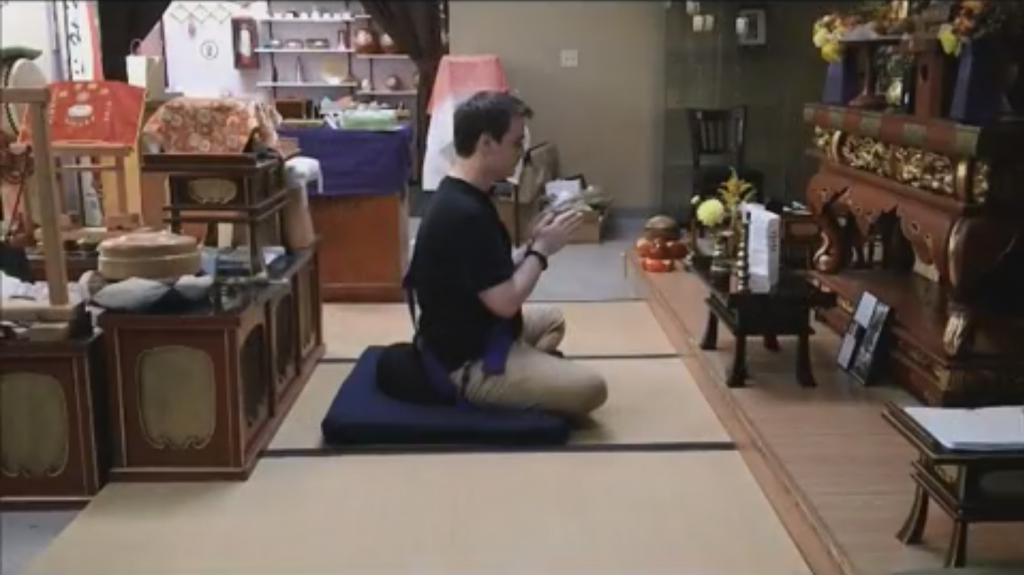
This last week I attended the four-day Enkyoji Buddhist Network 2017 Summer Retreat at the Seattle Choeizan Enkyoji Nichiren Buddhist Temple.
I’m not officially a member of this network. I chose to attend the retreat because I was interested in their efforts to promote propagation of Nichiren Shu Buddhism in America, something that no one else seems to be doing. Certainly no one is as focused on propagation as the Enkyoji Buddhist Network.
Before I continue I should note that the Enkyoji Buddhist Network is not a rogue group, but a recognized Nichiren Shu organization. Lots of information is available on their website EnkyojiBuddhistNetwork.org.
My new-found passion for propagation of Nichiren Shu Buddhism is one of the odd but telling things about my migration from Soka Gakkai to Nichiren Shu. In more than 25 years of Soka Gakkai membership I never felt comfortable saying more than “I’m a Buddhist.” I certainly didn’t want to do the sort of compulsory propagation encouraged in the late 1980s before Soka Gakkai’s split with Nichiren Shoshu. The lay-leader-led group meetings were never the sort of gatherings that I could invite, say, my boss to attend.
Now, however, I’m eager to tell people I’m a Nichiren Shu practitioner and invite people I meet in Sacramento to attend services at the Sacramento Nichiren Buddhist Church. But I’m also aware that dropping someone who knows little or nothing about Buddhism into the church’s regular Sunday service – not to mention the monthly Kaji Kito service – would do little more than overawe that person.
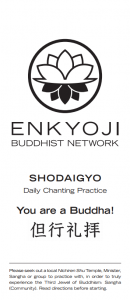 This is why I was so excited to learn at the retreat that the Enkyoji Buddhist Network, working with the Nichiren Shu propagation office in Japan, has developed a simple practice suitable for any level of practitioner.
This is an abbreviated Shodaigyo service. The original Shodaigyo service, which incorporates periods of silent sitting mediation with Odaimoku chanting, was designed by Bishop Nichijun Yukawa of the Nichiren Shu in the 1950s. (Here’s the traditional version of the service.)
From the brochure:
- Practice this program for a minimum of two weeks, with at least one session a day. You can further deepen your practice by setting a specific time daily in the morning and/or evening.
- Do not practice this program for a specific purpose such as quitting addictions or to acquire something. As this practice has been arranged in a very short format, attachments and distractions tend to arise easily if a specific goal is set.
- Think of this practice as an exercise for general well-being in order to taste the preciousness of life. If your well-being increases, the total well being of this world also increases. This is a very important concept in Nichiren Shu Buddhism.
- This program draws on more than 750-years of history in Nichiren Shu Buddhism as well as the 2500-year tradition of Buddhism as a whole. In the Enkyoji lineage of Nichiren Shu Buddhism, we believe that this traditional program will enrich your life on the way to attaining the Buddha’s enlightenment.
The tri-fold brochure is designed so that it can be used as the focus of the service with Namu-Myoho-Renge-Kyo on the center panel and the instructions for the 8 steps of the service arranged on either side.
Between Ryusho Jeffus Shonin’s 35-Day Practice Guide and Enkyoji Buddhist Network‘s Shodaigyo practice I’m ready to spread Nichiren Shu Buddhism everywhere I go.
Day 17
Day 17 covers all of Chapter 12, Devadatta, and opens Chapter 13, Encouragement for Keeping this Sutra.
Having last month heard the doubts of Accumulated-Wisdom Bodhisattva at the idea of an 8-year-old female dragon becoming a Buddha, we hear Śāriputra’s doubts.
Thereupon Śāriputra said to the daughter of the dragon-king:
“You think that you will be able to attain unsurpassed enlightenment [and become a Buddha] before long. This is difficult to believe because the body of a woman is too defiled to be a recipient of the teachings of the Buddha. How can you attain unsurpassed Bodhi? The enlightenment of the Buddha is far off. It can be attained only by those who perform the [Bodhisattva] practices with strenuous efforts for innumerable kalpas. A woman has five impossibilities. She cannot become 1. the Brahman-Heavenly-King, 2. King Sakra, 3. King Mara, 4. a wheel-turning-holy-king, and 5. a Buddha. How can it be that you, being a woman, will become a Buddha, quickly [or not]?”
Ryusho Jeffus Shonin in his Lecture on the Lotus Sutra has this to say about prejudice:
In the example of the dragon girl, it is worthy of considering how prejudices can enter our way of thinking and influence us in negative ways. Because a woman bleeds, which is the result of giving birth, she was considered impure, and yet giving birth, bringing new life into the world is one of the purest things. I once heard someone say that women bleed giving birth and men bleed killing. Perhaps we should give this some thought. Nichiren wrote a response to a woman believer saying that because a woman bleeds she is considered impure by society, but in the eyes of the Buddha that distinction does not apply.
Lecture on the Lotus Sutra
The Supreme Being in Ourselves
[T]he object of worship, the Supreme Being, is to be sought nowhere but in the innermost recess of every man’s nature, because the final aim of worship is the complete realization of the Supreme Being in ourselves.
Nichiren, The Buddhist Prophet