
All posts by John Hughes

Day 9

Day 9 covers Chapter 5, The Simile of Herbs, and introduces Chapter 6, Assurance of Future Buddhahood.

Having last month heard The Simile of Herbs, we consider the capacities, appearances, entities and natures of the hearers.

“The various teachings I expound are of the same content, of the same taste. Those who emancipate themselves [from the bonds of existence,] from illusions, and from birth and death, will finally obtain the knowledge of the equality and differences of all things. But those who hear or keep my teachings or read or recite the sutras in which my teachings are expounded, or act according to my teachings, do not know the merits that they will be able to obtain by these practices. Why is that? It is because only I know their capacities, appearances, entities and natures. Only I know what teachings they have in memory, what teachings they have in mind, what teachings they practice, how they memorize the teachings, how they think of the teachings, how they practice the teachings, for what purpose they memorize the teachings, for what purpose they think of the teachings, for what purpose they practice the teachings, and for what purpose they keep what teachings. Only I see clearly and without hindrance that they are at various stages [of enlightenment]. I know this, but they do not know just as the trees and grasses including herbs in the thickets and forests do not know whether they are superior or middle or inferior. My teachings are of the same content, of the same taste. Those who emancipate themselves [from the bonds of existence,] from illusions, and from birth and death, will finally attain Nirvana, that is, eternal tranquility or extinction. They will be able to return to the state of the Void.

“Although I knew the equality and differences of all things, I refrained from expounding it to them in order to protect them because I saw their [various] desires.

The Daily Dharma from Dec. 20, 2016, offers this:

Only I see clearly and without hindrance that they are at various stages [of enlightenment]. I know this, but they do not know just as the trees and grasses including herbs in the thickets and forests do not know whether they are superior or middle or inferior.

The Buddha makes this declaration in Chapter Five of the Lotus Sūtra, as he explains the simile of herbs. This is a good reminder for us on the Bodhisattva path of how important it is to have respect for all beings. We can believe we know whether someone else is less enlightened than we are, or even more enlightened than we are. But for Bodhisattvas, this belief is irrelevant. Only the Buddha knows who is where on the path. We do not need to know. We just need to find ways to benefit others, no matter how close they may be to enlightenment.

The Daily Dharma is produced by the Lexington Nichiren Buddhist Community. To subscribe to the daily emails, visit zenzaizenzai.com
3,000 Conditions in Each Moment

In other words, the Ten Worlds are all present and within each world is the potential of all Ten Worlds. Those 100 worlds all contain the Ten Suchnesses. And those 1000 worlds and suchnesses are all Void, Temporary and the Middle Way, creating 3,000 conditions in each moment, all present, all connected and all related always.

Physician's Good Medicine

Daily Dharma – July 25, 2017

Those who, without concentrating their minds,
Offered nothing but a flower to the picture of the Buddha,
Became able to see
Innumerable Buddhas one after another.

We can read these words of the Buddha from Chapter Two of the Lotus Sūtra as if we had to wait until another life to see Buddhas. But by making offerings to an image of the Buddha, by practicing respect towards a representation of the Buddha, we start to look for and recognize the Buddha in ourselves and in all of the beings who share the world with us. When we see this world of conflict and suffering as the Buddha’s Pure Land, then we see all beings as our enlightened teachers. We see innumerable Buddhas.

The Daily Dharma is produced by the Lexington Nichiren Buddhist Community. To subscribe to the daily emails, visit zenzaizenzai.com

Day 8

Day 8 concludes Chapter 4, Understanding by Faith, and closes the second volume of the Sutra of the Lotus Flower of the Wonderful Dharma.

Having last month discussed the son’s “greatest joy” at escaping his inheritance, now it’s time consider the expedient used by the father.

Thereupon the rich man thought of an expedient to persuade his son to come to him. He [wished to] dispatch messengers in secret. He said to two men looking worn-out, powerless and virtueless, ‘Go and gently tell the poor man that he will be employed here for a double day’s pay. If he agrees with you, bring him here and have him work. If he asks you what work he should do, tell him that he should clear dirt and that you two also will work with him.’

“The two messengers looked for the poor son. Having found him, they told him what they had been ordered to tell. The poor son [came back with them,] drew his pay in advance, and cleared dirt with them. Seeing him, the father had compassion towards him, and wondered [why he was so base and mean]. Some days later he saw his son in the distance from the window. The son was weak, thin, worn-out, and defiled with dirt and dust. The father took off his necklace, his garment of thin and soft cloth, and other ornaments. He put on tattered and dirty clothing, smeared himself with dust, and carried a dirt-utensil in his right hand. He looked fearful. He [came to the workers and] said, ‘Work hard! Do not be lazy!’

“With this expedient the father came to his son. He said to him, ‘Man! Stay here and work! Do not go anywhere else! I will pay you more. Do not hesitate to take trays, rice, flour, salt and vinegar as much as you need! You can have an old servant if you want to. Make yourself at home! I feel like your father. Do not worry any more! I am old, and you are young. When you work, you do not deceive [the other workers]. You are not lazy. You do not get angry [with the other workers], or reproach them. You are not like the other workers who do these evil things. From now on I will treat you as my son.’

“The rich man gave him a name and called him son. The poor son was glad to be treated kindly, but still thought that he was a humble employee. Therefore, the rich man had him clear dirt for twenty years. After that the father and son trusted each other. Now the son felt no hesitation in entering the house of his father, but still lodged in his old place.

There was a time when I, too, felt unworthy. How could I be the beneficiary of such treasures? I was “glad to be treated kindly, but still thought that [I] was a humble employee.

This quote from the Lecture on the Lotus Sutra fits well here:

Every day we look around us and we see our worlds our lives as being perhaps small and full of suffering or troubles. Yet the image that is presented to us in the ceremony in the air is an expansive one and one of great beauty. Just as the seating of the two Buddhas side by side presents us with a view of the eternity of time, the image of the joined worlds is one of infinite space. So now we have an expansive time element and an expansive space element all in one moment.

When we place ourselves in front of the Honzon as presented in the Lotus Sutra in these chapters we place ourselves outside of our present time and our present space. Again this allows us the opportunity to view our current condition in this life as really one of great reward. How many people everyday participate in such a grand drama?

It is not easy for us to see this as we live out our lives and experience our day-to-day problems. Yet this is the invitation that the Buddha makes to us – to realize that we are not merely some lonely person chanting Odaimoku and practicing the Lotus Sutra, but that we are actually participants in a drama unlike anything that can be contained by either space or time.Lecture on the Lotus Sutra

Daily Dharma – July 24, 2017

The good men or women who expound even a phrase of the Sūtra of the Lotus Flower of the Wonderful Dharma even to one person even in secret after my extinction, know this, are my messengers. They are dispatched by me.

The Buddha declares these lines to Medicine-King Bodhisattva at the beginning of Chapter Ten of the Lotus Sūtra. When we are caught up in the suffering and unhappiness of this world of conflict, we can yearn for an escape from its troubles. We can believe that living in this world was not our choice, that we are here by chance or due to an obligation we no longer want to meet. When the Buddha reminds us that we are Bodhisattvas, beings whose existence is for the benefit of all beings, we realize that both the joys and the suffering we experience are for the benefit of others.

The Daily Dharma is produced by the Lexington Nichiren Buddhist Community. To subscribe to the daily emails, visit zenzaizenzai.com

Respecting Ancestors

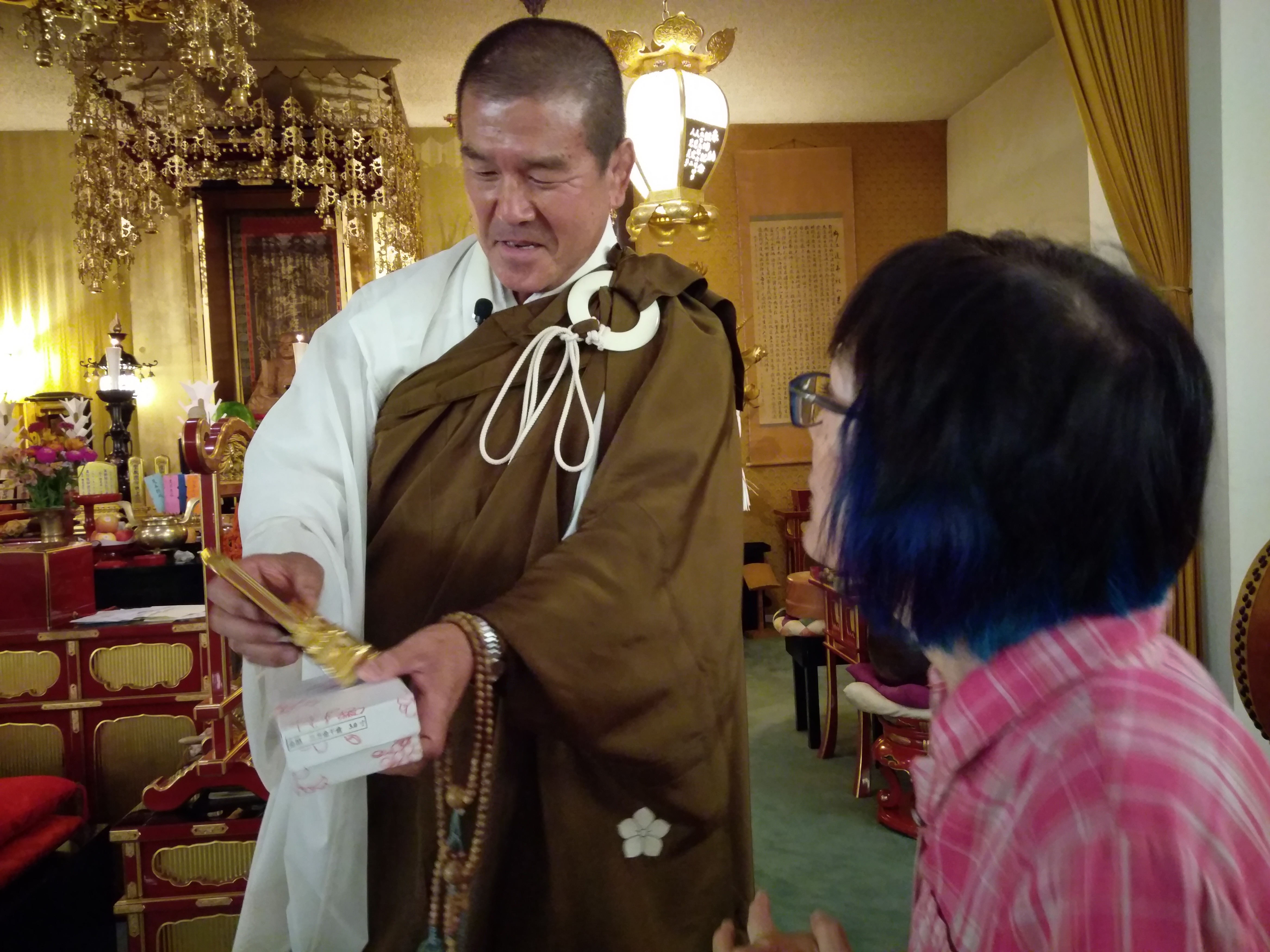
Rev. Igarashi explains memorial tablet inscribed with my wife’s mother’s name and date of death.

Memorial tablets on my altar with a mandala Gohonzon offering.

Attended the Obon service at the Sacramento Nichiren Buddhist Church with my wife. In addition to honoring our ancestors, we were there for the eye-opening of a memorial tablet for my wife’s mother, Mary “Michiko Wada” Buchin. Rev. Igarashi purchased the tablet and had it inscribed in Japan during a recent visit. This is the same process I went through for my parent’s memorial tablet.

Following the prayers for ancestors and the eye-opening, Rev. Igarashi gave his annual Obon lecture. (See last year.) And added a little science this time.

Each of us is, he explained, the product of our ancestors and carry our ancestors with us in our DNA. While they may have died, they live on in our bodies. It is out of this connection that we honor our ancestors and pray for their spirits.

I’ve had my DNA analyzed by 23andMe. On the health side I find that I have one of the recessive genes that could have given my son Cystic Fibrosis. I’m glad I didn’t know that before my son was conceived.

On the ancestry side I enjoyed the discovery that my 99.4% European ancestry (74.6% British & Irish; 3.7% French & German; 0.9% Scandinavian) is seasoned with 0.3% Sub-Saharan African (0.1% West African and 0.2% Broadly Sub-Saharan African.) The remaining fraction is 0.2% unassigned and a tantalizing less than 0.1% East Asian & Native American.

Imagine all of those ancestors.

Day 7

Day 7 concludes Chapter 3, A Parable, and begins Chapter 4, Understanding by Faith.

Having last month considered the teaching of the One Buddha Vehicle, we are reminded that the Buddha is our father and we are all Bodhisattvas.

(The Buddha said to Śāriputra:)
All of you
All Are of my you children.
I am your father.

You were under the fires of many sufferings
For the past innumerable kalpas.
Therefore, I saved you
From the triple world [with expedients].

I once told you that you had attained extinction.
But you eliminated only birth and death
[By that extinction].
The extinction you attained was not the true one.
What you should do now is
Obtain the wisdom of the Buddha.

The Bodhisattvas in this multitude
Should hear
With one mind
The true teaching of the Buddhas.

The Buddhas, the World-Honored Ones,
Say only expediently [that some are not Bodhisattvas]
To tell the truth,
All living beings taught by them are Bodhisattvas.

The Daily Dharma from March 24, 2016, offers this:

This verse comes from Chapter Three of the Lotus Sūtra. In Chapter Two, the Buddha declared that he only teaches Bodhisattvas. If we believe that we are not Bodhisattvas, we could conclude that the Buddha does not teach us. Part of what the Buddha is explaining here is that we are all Bodhisattvas. The way to reach the Buddha’s enlightenment is by living as Bodhisattvas: beings whose every breath is intended to improve our world.

The Daily Dharma is produced by the Lexington Nichiren Buddhist Community. To subscribe to the daily emails, visit zenzaizenzai.com

Our Common Karma

Moreover, an existence of any kind is never an individual matter, but always the result of a common karma, shared by all born in the same realm of existence. Hence the expiation made by any one individual is, in fact, made for the sake of all his fellow-beings. Both the persecutors and the persecuted share the common karma accumulated in the past, and therefore share also in the future destiny, the attainment of Buddhahood. Nichiren’s repression of others’ malice and vice is at the same time his own expiation and self-subjugation. How, then, should his followers not share his merit in extinguishing the accumulated sins, and preparing for the realization of the primeval Buddha-nature? “Therefore,” Nichiren exhorts his disciples, “believe in me, and emulate my spirit and work, in the firm faith that the Master is the savior and leader! Work together, united in the same faith! Then, the expiation of sins will be achieved for ourselves and for all our fellow-beings, because we all share in the common karma.”

Nichiren, The Buddhist Prophet

Daily Dharma – July 23, 2017

World-Honored One! It is difficult for anyone in the world to believe this. It is as difficult as to believe a handsome, black-haired man twenty-five years old who points to men a hundred years old and says, ‘They are my sons,’ or as to believe men a hundred years old who point to a young man and say, ‘This is our father. He brought us up.’

Maitreya Bodhisattva explains his perplexity to the Buddha in Chapter Fifteen of the Lotus Sūtra. The Buddha had just revealed that he was who taught all the Bodhisattvas who have appeared from underground to continue teaching the Wonderful Dharma after the extinction of the Buddha. Maitreya realizes that his doubts are no different from those of those gathered to hear the Buddha teach and asks the Buddha to explain. When our experience does not match what the Buddha teaches, we should not keep silence and just accept what he tells us. It is only through sincere questioning that we find the Buddha’s mind and make it our own.

The Daily Dharma is produced by the Lexington Nichiren Buddhist Community. To subscribe to the daily emails, visit zenzaizenzai.com

Day 6

Day 6 continues Chapter 3, A Parable

Having last month considered the expedient used to save the children, we now consider whether this constituted a falsehood.

“The children rode in the large carts, and had the greatest joy that they had ever had because they had never expected to get them. Śāriputra! What do you think of this? Do you think that the rich man was guilty of falsehood when he gave his children the large carts of treasures?”

Śāriputra said:

“No, World-Honored One! He saved his children from the fire and caused them to survive. [Even if he had not given them anything,] he should not have been accused of falsehood because the children should be considered to have already been given the toys [they had wished to have] when they survived. He saved them from the burning house with the expedient. World-Honored One! Even if he had not given them the smallest cart, he should not have been accused of falsehood because he thought at first, ‘I will cause them to get out with an expedient.’ Because of this, he should not. Needless to say, he was not guilty of falsehood when he remembered his immeasurable wealth and gave them the large carts in order to benefit them.”

The Buddha said to Śāriputra:

“So it is, so it is. It is just as you say. Śāriputra! The same can be said of me. [I thought, ‘] I am the father of the world. I eliminated fear, despondency, grief, ignorance and darkness. I obtained immeasurable insight, powers and fearlessness. I have great supernatural powers, the power of wisdom, the paramita of expedients, the paramita of wisdom, great compassion, and great loving-kindness. I am not tired of seeking good things or of benefiting all living beings. I have appeared in the triple world, which can be likened to the rotten and burning house, in order to save all living beings from the fires of birth, old age, disease, death, grief, sorrow, suffering, lamentation, stupidity, darkness, and the three poisons, to teach all living beings, and to cause them to attain Anuttara-samyak-saṃbodhi. I see that all living beings are burned by the fires of birth, old age, disease, death, grief, sorrow, suffering and lamentation. They undergo various sufferings because they have the five desires and the desire for gain. Because they have attachments and pursuits, they have many sufferings in their present existence, and will suffer in hell or in the world of animals or in the world of hungry spirits in their future lives. Even when they are reborn in heaven or in the world of humans, they will still have many sufferings such as poverty or parting from their beloved ones or meeting with those whom they hate. Notwithstanding all this, however, they are playing joyfully. They are not conscious of the sufferings. They are not frightened at the sufferings or afraid of them. They do not dislike them or try to get rid of them. They are running about this burning house of the triple world, and do not mind even when they undergo great sufferings.[‘]

The Daily Dharma from April 25, 2017, offers this:

The Buddha offers this explanation to his disciple Śāriputra in Chapter Three of the Lotus Sūtra. He compares his teaching of suffering and Nirvāṇa to a father luring his children from a dangerous house with a promise of better toys. The children were so preoccupied with their own entertainment that they could not hear their father’s warning. In this triple world of beautiful forms, fascinating ideas and consuming desires, it is easy to stay with our childish games and ignore the Buddha’s teaching. Our maturity as Bodhisattvas comes when we set these aside for the benefit of all beings.

The Daily Dharma is produced by the Lexington Nichiren Buddhist Community. To subscribe to the daily emails, visit zenzaizenzai.com