
The Lotus Sutra as the Physician’s Cure can bring us back from spiritual death by revealing the heart of what enlightenment is and what our relationship with the infinite past and infinite future means. This life, this lived experience, is not just this moment, or just a collection of previous moments or just the unfolding of future moments. This life is all of those and our connection with all life in the universe. Intellectually this has no energy; on the spiritual level of the heart it has unlimited energy. This I know; this I have felt. My experiences, though, are beyond the realm of theoretical understanding or sharing. I do this writing and tell these stories in the hope of in some small way sharing my experience.
Physician's Good MedicineAll posts by John Hughes
Daily Dharma – Feb. 15, 2017
Of the people who put their faith in the Lotus Sutra today, some have faith like fire while others have it like water. Those who have faith like fire refer to those who become enthusiastic upon listening to the preaching, but their passion cools down as time goes by, and eventually forget the teaching. On the other hand, those whose faith is like water mean those whose faith is like a ceaselessly flowing water, namely those who retain their faith without retreating. You have constantly sent me donations and asked me questions about the way of faith. Your faith is like water, is it not? How precious you are!
Nichiren wrote this passage in his Reply to Lord Ueno (Ueno-dono Gohenji). To those who stayed with Nichiren and this teaching, despite all difficulties, his gratitude was boundless. We too are capable of this gratitude, not just towards the Buddha and Nichiren, but towards all those who practice the Buddha Dharma with us, and, most importantly, towards those still caught up in the mesh of suffering.
The Daily Dharma is produced by the Lexington Nichiren Buddhist Community. To subscribe to the daily emails, visit zenzaizenzai.com
Day 8
Day 8 concludes Chapter 4, Understanding by Faith, and closes the second volume of the Sutra of the Lotus Flower of the Wonderful Dharma.
Having last month considered why these sravakas did not want to do the bodhisattva practices, we come to the sravakas appreciation of what the Buddha had accomplished.
The rich man knew
That his son was base and mean.
Therefore, he made him nobler
With expedients,
And then gave him
All his treasures.In the same manner,
You knew that we wished
To hear the Lesser Vehicle.
Therefore, you did a rare thing.
You prepared us with expedients,
And then taught us the great wisdom.Today we are not what we were then.
We have obtained
What we did not expect
To obtain
Just as the poor son obtained
The innumerable treasures.World-Honored One!
We have attained enlightenment, perfect fruit.
We have secured pure eyes
With which we can see the Dharma-without-asravas.We observed the pure precepts of the Buddha
In the long night.
Today we have obtained the effects and rewards
[Of our observance of the precepts].
We performed the brahma practices for long
According to the teachings of the King of the Dharma.
Now we have obtained the great fruit
Of the unsurpassed Dharma-without-asravas.We are Sravakas in this sense of the word.
We will cause all living beings
To hear the voice telling
Of the enlightenment of the Buddha.We are Arhats
In the true sense of the word.
All gods and men,
All Maras and Brahmans
In the worlds
Should make offerings to us.You, the World-Honored One, are the great benefactor.
By doing this rare thing,
You taught and benefited us
Out of your compassion towards us.
The Daily Dharma from Dec. 17, 2016, offers this perspective:
Today we are not what we were then.
We have obtained
What we did not expect
To obtain
Just as the poor son obtained
The innumerable treasures.
Subhūti, Mahā-Kātyāyana, Mahā-Kāśyapa, and Mahā-Maudgalyāyana, all disciples of the Buddha, speak these lines in Chapter Four of the Lotus Sūtra as they explain their story of the wayward son. They compare the father’s treasure house in the story to the Buddha’s enlightenment. Until they had been led by the Buddha’s expedient teachings, they could not even imagine themselves as enlightened, any more than the wayward son in the story could imagine the contents of his father’s treasure house.
Daily Dharma – Feb. 14, 2017
The great multitude, having seen the two Tathāgatas sitting cross-legged on the lion-like seat in the stūpa of the seven treasures, thought, “The seat of the Buddhas is too high. Tathāgata! Raise us up by your supernatural powers so that we may be able to be with you in the sky!”
This description comes from Chapter Eleven of the Lotus Sūtra. Many-Treasures Buddha has arrived where the Buddha was teaching so that he could endorse this Wonderful Dharma. He invited the Buddha to join him in an enormous stūpa tower hanging in the sky. When the Buddha raises up those gathered to hear him teach, he puts them all on the same level as himself and all the other Buddhas. He shows them that they too have the capacity to hear his teachings and put them into practice. Nichiren depicted this “ceremony in the air” in the Omandala Gohonzon and advised us to use this as the focus of our practice. When we put ourselves into this great multitude we listen for the Buddha teaching and realize the benefit we create in this world.
The Daily Dharma is produced by the Lexington Nichiren Buddhist Community. To subscribe to the daily emails, visit zenzaizenzai.com
Day 7
Day 7 concludes Chapter 3, A Parable, and begins Chapter 4, Understanding by Faith.
Having last month covered the fate of those who slander this sutra, we conclude the chapter with those who should hear this sutra.
Expound it to clever people
Who have profound wisdom,
Who hear much,
Who remember well,
And who seek
The enlightenment of the Buddha!Expound it to those who have seen
Many thousands of myriads
Of millions of Buddhas
And planted the roots of good
In their previous existence,
And who are now resolute in mind!Expound it
To those who make efforts,
Who have compassion towards others,
And who do not spare their lives!Expound it to those
Who respect others,
Who have no perfidy in them,
Who keep away from ignorant people,
And who live alone
In mountains or valleys!Sariputra!
Expound it to those
Who keep away
From evil friends,
And who approach
Good friends!Expound it to the Buddha’s sons
Who keep the precepts
As cleanly and as purely
As they keep gems,
And who seek
The sutra of the Great Vehicle!Expound it to those
Who are not angry
But upright, gentle,
Compassionate
Towards all others,
And respectful to the Buddhas!Expound it to the Buddha’s sons
Who expound the Dharma without hindrance
To the great multitude
With their pure minds
By telling them
Various stories of previous lives,
Parables and similes,
And also by giving them various discourses!Expound it to the bhiksus
Who seek the Dharma in all directions
In order to obtain
The knowledge of all things,
Who join their hands together
Towards the sutra of the Great Vehicle,
Who receive it respectfully,
Who keep it with joy,
And who do not receive
Even a gatha of any other sutra!Expound it to those
Who seek this sutra
As eagerly as they seek
The sariras of the Buddha![Expound it to those]
Who receive [this sutra]
And put it on their heads,
And who do not seek
Any other sutra
Or think of the books of heresy!(The Buddha said to Sariputra:)
Those who seek the enlightenment of the Buddha
Are as various as previously stated.
A kalpa will not be long enough
To describe the variety of them.
They will be able to understand [this sutra] by faith.
Expound to them
The Sutra of the Lotus Flower of the Wonderful Dharma!
The Daily Dharma from April 30, 2015, offers this:
Expound it to clever people
Who have profound wisdom,
Who hear much,
Who remember well,
And who seek
The enlightenment of the Buddha!
The Buddha sings these verses to all those gathered to hear him teach in Chapter Three of the Lotus Sūtra. Much of this teaching is about how we see things as opposed to how certain we are of what we see. When we believe that those whom we wish to benefit are stupid, lazy and incompetent, then it surely will be difficult to help them. But when we realize the Buddha nature within all beings, then we can see them as wise and compassionate despite the obstacles they face.
The Daily Dharma is produced by the Lexington Nichiren Buddhist Community. To subscribe to the daily emails, visit zenzaizenzai.com
The Buddhist Body
[T]o abstract a phase of Buddhist thought, apart from other factors, is as if one were to dissect a human body into parts, and treat one of them as a unit.
Nichiren, The Buddhist ProphetDaily Dharma – Feb. 13, 2017
Needless to say, anyone who not only keeps this sūtra but also gives alms, observes the precepts, practices patience, makes endeavors, concentrates his mind, and seeks wisdom, will be able to obtain the most excellent and innumerable merits. His merits will be as limitless as the sky is in the east, west, south, north, the four intermediate quarters, the zenith, and the nadir. These innumerable merits of his will help him obtain the knowledge of the equality and differences of all things.
The Buddha makes this declaration to Maitreya Bodhisattva in Chapter Seventeen of the Lotus Sūtra. We often think of merits as bonus points we get for good deeds. Good karma we create to offset the bad karma that came from our less skillful actions. Another way of looking at merits is as a measure of clarity. The more merit we gain, the more we see things for what they are. When we offer our merits for the benefit of all beings, we resolve to use this clarity to enhance the lives of others.
The Daily Dharma is produced by the Lexington Nichiren Buddhist Community. To subscribe to the daily emails, visit zenzaizenzai.com
Day 6
Day 6 continues Chapter 3, A Parable
Having last month covered the gathas description of the burning manor house, we come to the owner of this burning house and his dilemma.
This old and rotten house
Was owned by a man.
Shortly after he went out
To a place in the neighborhood,
Fires broke out suddenly
In the house.Raging flames came out
Of all sides at the same time.
The ridges, rafters,
Beams and pillars
Burst, quaked, split, broke and fell.
The fences and walls also fell.All the demons yelled.
The eagles, crested eagles,
And other birds, and kumbhandas
Were frightened and perplexed
They did not know
How to get out of the house.
The wild beasts and poisonous vermin
Hid themselves in holes.In that house also lived
Demons called pisacakas.
Because they had few merits and virtues,
They suffered from the fire.
They killed each other,
Drank blood, and ate flesh.The small foxes were
Already dead.
Large wild beasts
Rushed at them and ate them.
Ill-smelling smoke rose
And filled the house.The centipedes, millipedes,
And poisonous snakes
Were driven out of their holes
By the fire,
And eaten
By the kumbhanda-demons.The hair of the hungry spirits caught fire.
With hunger, thirst and burning,
The spirits ran about
In agony and dismay.The house was so dreadful.
[In that house] there were
Poisonings, killings and burnings.
There were many dangers, not just one.At that time the house-owner
Was standing outside the gate.
He heard a man say to him:
“Some time ago
Your children entered this house to play.
They are young and ignorant
They are engrossed in playing.”
The Parable of the Burning House in gathas is significantly different from the prose version. Last month, we detailed the all of the creatures in the house and this time around the reaction of the occupants to the sudden fire. And it was just today when I was reading this section that I appreciated that of all of the occupants of the house, only the children, who are engrossed in playing, fail to realize their dilemma. What does that say about our “higher” intelligence? Are we too smart for our own good?
Driving Out Misfortune, Welcoming Good Fortune
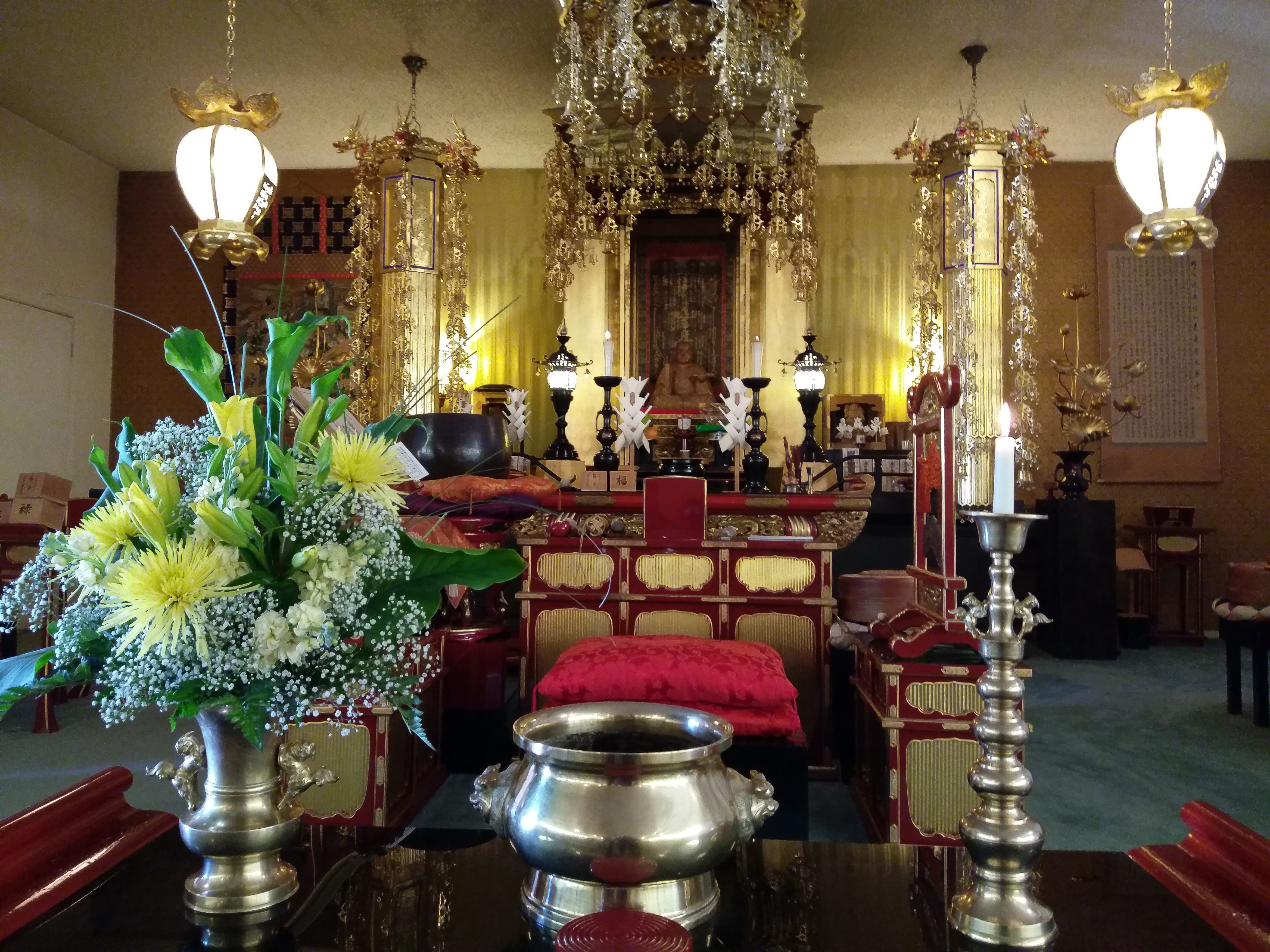
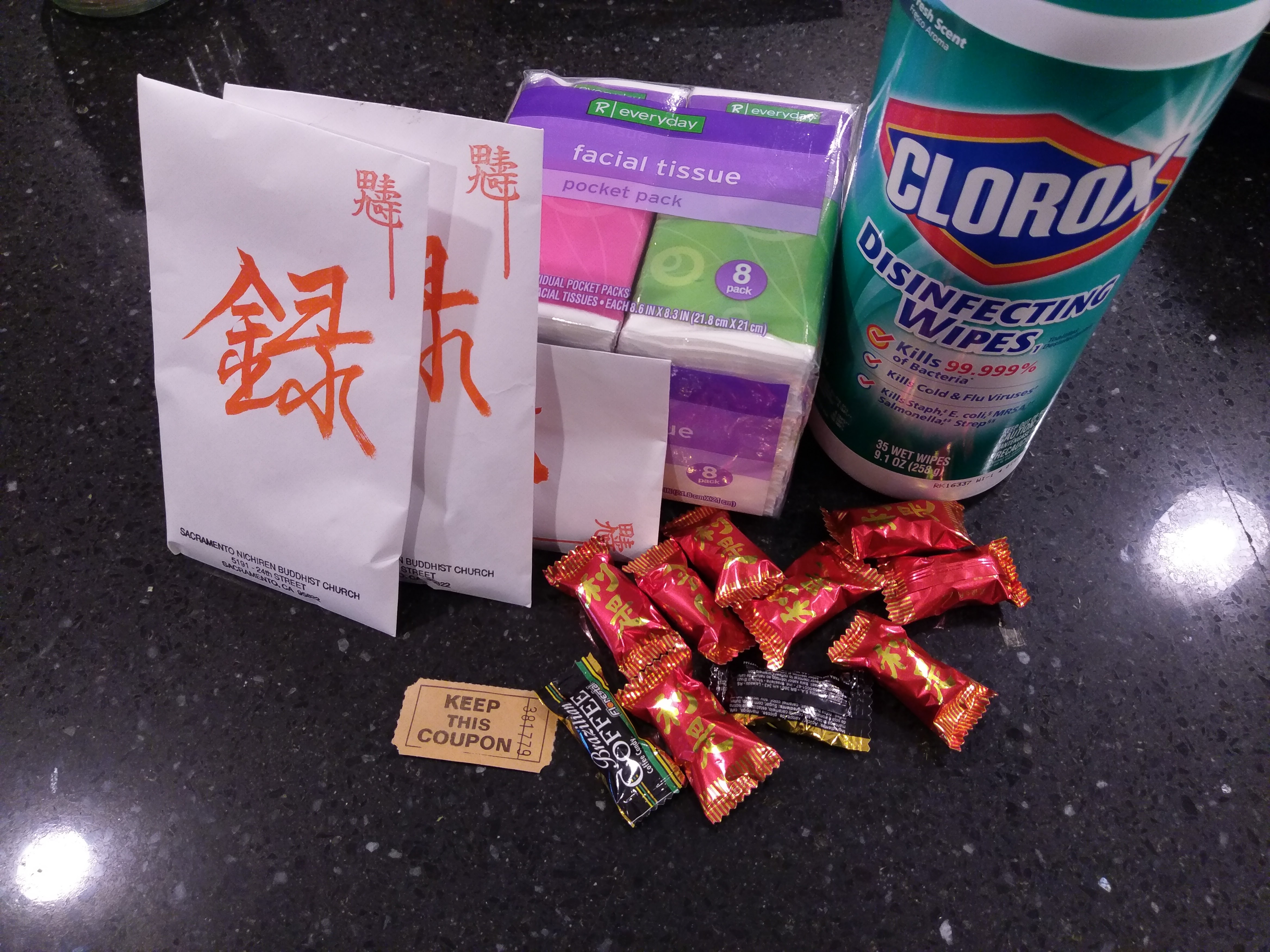
Today was my third Setsubun service, which marks the transition from Winter to Spring in the lunar calendar. Following the regular sutra recitation, the priest offered a purification prayer and then had those people born in the particular Chinese Zodiac year, the Rooster this year, help him bring good fortune to everyone by tossing hard candy into audience. After all the candy was gathered up, small bags of roasted sesame seeds were passed out. (See explanation below on that.) Finally a raffle of “paper products” was held. Why paper products? No clue. But the winning of raffle prizes was marked as a sign of good fortune ahead.
Here’s an explanation of Setsubun from the official Nichiren Shu newsletter.
Nichiren Shu News, April 1, 2015
By Rev. Kanjo Bassett
Setsubun is the last day of winter in the traditional Chinese calendar year comprised of 24 solar periods. In the Edo period, Setsubun became a popular celebration of seeing out the old year and welcoming the new.
The practice of throwing roasted soybeans to drive out oni, Japanese demons, dates from the Muromachi period. This practice then spread and split into endless local variations and traditions all over the country.
The one thing common among all these traditions is that demons do not like the smell of either roasted soybeans or sun-dried sardines hung in the front doorway, a custom still seen today in the Japanese countryside.
There is also the side benefit that once the demons are dispatched, one can eat the beans and dried sardines for good luck, preferably washed down with gulps of sake.
These days, large temples and shrines invite famous people to put on traditional dress and throw bags of beans from the ceremony hall foyer to the crowds below. Ikegami Honmonji holds one of the largest Setsubun celebrations in Tokyo. More than 10,000 people attended this year’s event, which began with a ceremony and prayers to dispel misfortune and bring good fortune to the whole world.
As the famous professional wrestler Rikidozan is buried on the temple grounds, the invited bean-throwing guests included a number of former professional, K-1 and sumo wrestlers, such as Akebono Taro, a former sumo champion, Jun Akiyama, president of the Pro Wrestling Association, and Katsuhiko Nakajima, a popular pro wrestler from the same association.
Setsubun also begins a busy month of celebrations that includes the Buddha’s Nirvana Day on the 15th of February and Nichiren Shonin’s birthday on the 16th of February.
Anger and Retaliation
Giving peace and appeasing people’s anger is one purpose of religion. Anger cannot calm anger by itself. Retaliation cannot stop retaliation by itself. Anger can be calmed by a peaceful mind, and retaliation can be calmed only by compassion. Unfortunately, though we know this well, our actions are often less ideal than we intend them to be. This is one of the silliest characteristics of human beings. Animals know better than we do. We must change our ways now, otherwise the tragedies of human life will continue forever.
Buddhism is a teaching that can provide peace, ease, and compassion. There are many teachings that can help to prepare us to accept these virtues.
Spring Writings