
Some people say that Buddhism is not a religion but a lifestyle, or a way of living. In fact, Buddhism originated as a means to save suffering people. The scriptures containing the Buddha’s teachings are collectively known as the “sutras” or “0-kyo.” Of all the sutras, the Lotus Sutra is the conclusion, the final teaching.
Spring WritingsAll posts by John Hughes
Daily Dharma – Feb. 12, 2017
You, the World-Honored One, are our leader.
You give peace to gods and men.
Hearing that you assured us of our future Buddhahood,
We are relieved and satisfied.
These verses are sung by Maha-Prajāpatī Bhikṣuṇī, Yaśodharā Bhikṣuṇī, and their attendants in Chapter Thirteen of the Lotus Sūtra. In our lives we have many desires, some of which we may not recognize. We believe that when these desires are met, only then can we be happy and peaceful. At the foundation of these desires is the desire for liberation. These women recognize that with this desire we have to become enlightened, just knowing that it will be fulfilled is enough to bring joy.
The Daily Dharma is produced by the Lexington Nichiren Buddhist Community. To subscribe to the daily emails, visit zenzaizenzai.com
Day 5
Day 5 begins Chapter 3, A Parable
Having last month covered Sariputra’s realization that the deception he experienced was his own, we come to the gathas and return to Śāriputra’s doubts.
Hearing this truthful voice,
I have the greatest joy
That I have ever had.
I have removed all the mesh of doubts.You have taught us the Great Vehicle without a break from of old.
Your voice is rare to hear.
It dispels the sufferings of all living beings.
I once eliminated asravas.
Hearing this voice of yours,
I have now removed all sorrows.I walked about mountains and valleys,
Or sat under a tree in a forest, thinking this over.
I reproached myself with a deep sigh:
‘Why was I deceived?
We also are sons of the Buddha
[Just as the Bodhisattvas are].
We entered the same [ world]
[Of the] Dharma-without-asravas.
But we shall not be able to expound
Unsurpassed enlightenment in the future.
We are in the same [world of the] Dharma.
But we shall not be given
The golden body with the thirty-two marks,
The ten powers, and the emancipations [of the Buddha].
We are deprived of the hope
To have the eighty wonderful marks,
The eighteen unique properties
And the other merits [of the Buddha].’[Sitting] in the midst of the great multitude,
You benefited all living beings.
Your fame extended over the worlds of the ten quarters.
When I was walking alone,
I saw all this, and thought:
‘I am not given this benefit. I have been deceived.’I thought this over day and night,
And wished to ask you,
‘Am I disqualified
[From having this benefit] or not?’I always saw you praising the Bodhisattvas.
Therefore, I thought this over day and night.
Now hearing from you,
I understand that you expound the Dharma
According to the capacities of all living beings.
You lead all living beings
To the place of enlightenment
By the Dharma-without-asravas, difficult to understand.
The Daily Dharma from June 1, 2016, offers this:
Hearing this truthful voice of yours, I feel like dancing [with joy]. I have never felt like this before. Why is that? We [Śrāvakas and the Bodhisattvas] heard this Dharma before. [At that time] we saw that the Bodhisattvas were assured of their future Buddhahood, but not that we were. We deeply regretted that we were not given the immeasurable insight of the Tathāgata.
The Buddha’s disciple Śāriputra makes this proclamation to the Buddha in Chapter Three of the Lotus Sūtra. The Buddha had just explained that everything he taught before the Lotus Sūtra was not his true enlightenment; it was preparation for receiving his highest teaching. Śāriputra, the wisest of the Buddha’s disciples, understood immediately that he would be able to do far more than end his own suffering. He would eventually become a Buddha himself. Those gathered were also overjoyed, knowing that Śākyamuni was not the only Buddha they would meet. This ties together the Buddha’s insight that when we are assured of our enlightenment, we are able to meet innumerable enlightened beings.
The Daily Dharma is produced by the Lexington Nichiren Buddhist Community. To subscribe to the daily emails, visit zenzaizenzai.com
Actualizing the Lotus Sutra in Our Own Lives
[W]hether or not we identify with the Bodhisattvas who emerge from the ground is a matter for our practice. I do believe that as we practice we do realize a connection with the Lotus Sutra that transitions it from a historical document to a living teaching directed specifically to ourselves. This is a transition that is available to us buried in the Lotus Sutra, but unlike those specifically spelled out in the teachings this one requires us to manifest it through our practice. This is also a transition from theoretically understanding the teaching to actualizing it in our own lives.
Lecture on the Lotus SutraDaily Dharma – Feb. 11, 2017
Anyone who rejoices at hearing the Dharma
And utters even a single word in praise of it
Should be considered to have already made offerings
To the past, present, and future Buddhas.
Such a person is rarely seen,
More rarely than the udumbara-flower.
The Buddha sings these verses to his disciple Śāriputra and all those gathered to hear him teach in Chapter Two of the Lotus Sūtra. It is natural to admire and respect those who make great sacrifices for the sake of improving the world, and who lead us to know what deserves those offerings. It is sometimes difficult to see the joy that comes from those efforts. In these verses the Buddha reminds us that even when our reaction to his Dharma is just a smile, or saying “Wonderful,” our admiration is a reminder of our own capacity for such great efforts.
The Daily Dharma is produced by the Lexington Nichiren Buddhist Community. To subscribe to the daily emails, visit zenzaizenzai.com
Day 4
Day 4 finishes Chapter 2, Expedients, and completes the first volume of the Sutra of the Lotus flower of the Wonderful Dharma.
Having last month covered why expedients were necessary, we come to the truth of the reality of all things.
The Buddhas’ sons who complete the practice of the Way
Will become Buddhas in their future lives.I expounded the teaching of the Three Vehicles
Only as an expedient.
All the other World-Honored Ones also
Expound the teaching of the One Vehicle [with expedients].The great multitude present here
Shall remove their doubts.
The Buddhas do not speak differently.
There is only one vehicle, not a second.The number of the Buddhas who passed away
During the past innumerable kalpas was
Hundreds of thousands of billions,
Uncountable.All those World-Honored Ones expounded
The truth of the reality of all things
With various stories of previous lives, parables and similes,
That is to say, with innumerable expedients.All those World-Honored Ones expounded
The teaching of the One Vehicle,
And led innumerable living beings [with expedients]
Into the Way to Buddhahood.All those Great Saintly Masters
Who knew the deep desires
Of the gods, men, and other living beings
Of all the worlds,
Revealed the Highest Truth
With various expedients.
In browsing my quotes looking for something to say on this point, I wandered off into something else I’ve been thinking about: Why we chant. That brought me to this quote from Lotus Path: Practicing the Lotus Sutra Volume 1:
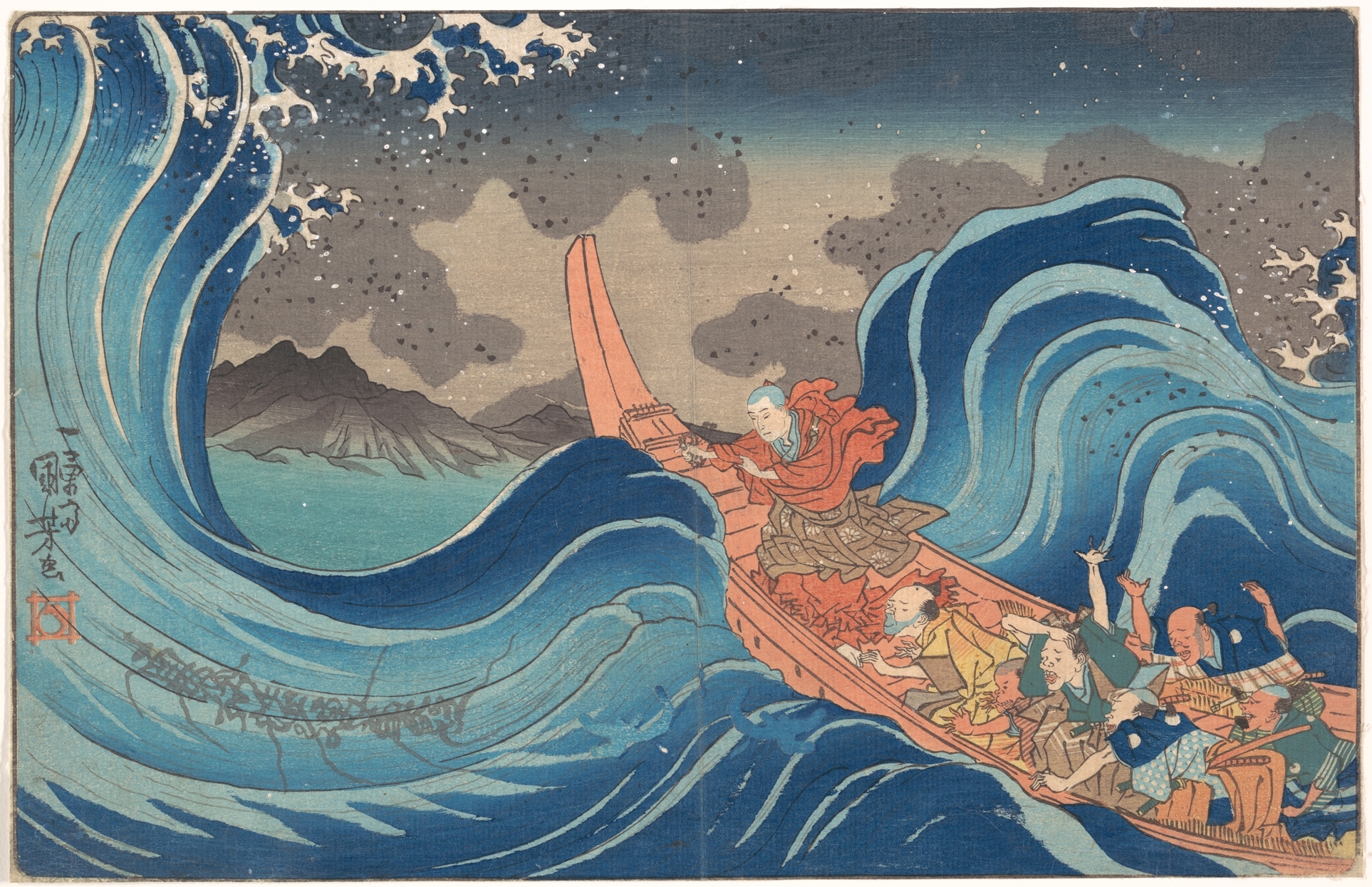
There is a story told of Nichiren on his way to his second exile, his trip to Sado Island. It is said that the water was so rough that all those on board the boat feared for their lives. According to the story, Nichiren took one of the oars and with the blade wrote the Odaimoku onto the surface of the water in order to calm the sea.
Whether or not you believe this happened exactly as it is told, there is certain documentary support for believing that he actually did attempt to do this. Still, the fact of the matter is that Nichiren placed all of his faith in the power of the Lotus Sutra. We too can cast the Odaimoku upon the ocean of our suffering, and with our practice we can calm the waters. We can change ourselves so that we can safely and confidently navigate the rough seas in which we may find ourselves.
Lotus Path: Practicing the Lotus Sutra Volume 1
And this plays into news I learned yesterday that the New York Metropolitan Museum of Art is making high-resolution digital copies of works in its collection of 441,175 items available online. Among that offering is Utagawa Kuniyoshi’s (1797–1861) woodblock print “A Vision of Prayer on the Waves”
Threefold Training
The Eightfold Path is often taught in terms of the “Threefold Training,” consisting of precepts, meditation, and wisdom.
Precepts refer to the ethical demand of right speech , right action, and right livelihood. Right effort is sometimes included in this category, as well. There are five precepts at the heart of Buddhist morality. These are: not killing, not stealing, not engaging in sexual misconduct, not lying, and not using intoxicants that cloud the mind. Through ethical living, we refrain from making bad causes and take responsibility for developing a life of integrity and confidence.
Meditation refers to mental discipline and refinement, covering right effort, right mindfulness, and right concentration. By training the mind, we are able to sharpen and strengthen our ability to maintain a peaceful mind and see things as they are, not simply as we wish them to be.
Wisdom refers to the development of right views and right intentions. This means that we are able to see the true nature of reality just as the Buddha sees it.
The Buddha taught that we are able to free ourselves from craving and ignorance and attain awakening when precepts, meditation, and wisdom are developed together.
Lotus SeedsDaily Dharma – Feb. 12, 2017
The Buddhas expound the Dharma
In perfect freedom.
Knowing the various desires and dispositions
Of all living beings,
They expound the Dharma
With innumerable parables
And with innumerable similes
According to their capacities.
These verses are sung by Subhūti, Mahā-Kātyāyana, Mahā-Kāśyapa, and Mahā-Maudgalyāyana in Chapter Four of the Lotus Sūtra. They show the realization by the Buddha’s disciples of why the Buddha uses different teachings for different people. For us who do not know the various desires and dispositions of all living beings, the Buddha gives this Lotus Sūtra. When we put this teaching into practice, and use it to benefit all beings, it is as if we are teaching from the Buddha’s own mind.
The Daily Dharma is produced by the Lexington Nichiren Buddhist Community. To subscribe to the daily emails, visit zenzaizenzai.com
Ritually Copying the Lotus Sutra
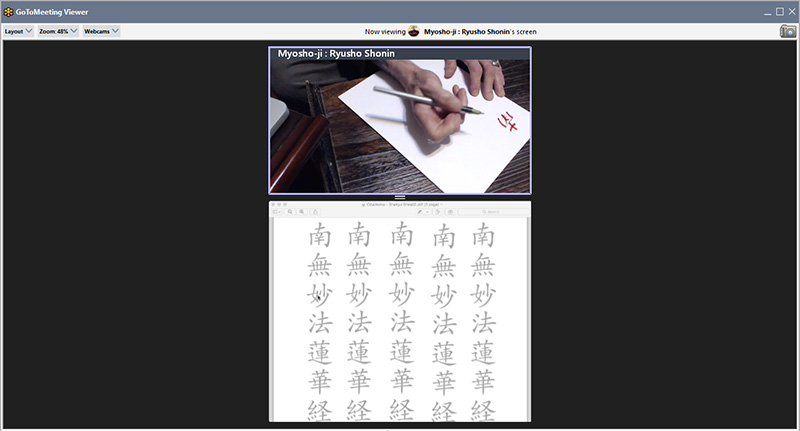
Devotion to the Lotus Sutra is manifested in the five practices of upholding, reading, reciting, explaining, and copying the text of the Lotus Sutra.
I’ve participated in Shakyo practice, the ritual copying of the Lotus Sutra, during which I traced the letters of Namu Myoho Renge Kyo.
That practice seems so shallow compared to this tale from Readings of the Lotus Sutra, a collection of essays edited by Stephen F. Teiser and Jacqueline I. Stone.
The tale of the seventh-century nun Miaozhi, as recounted in Huixiang’s Accounts of the Propagation of the Lotus Sutra, provides a vivid example of the effort that might go into [ritually copying the sutra].
To produce the pulp used in making the paper for her sutra, Miaozhi planted saplings in the nearby hills, which she nurtured daily with perfumed water. Once the trees had matured, she constructed a hut from mud mixed with fragrant water, where she had a craftsman boil and press the bark into paper, ensuring all the while that he observed the proper protocols to purify both himself and the materials. With the paper in hand, she built yet another chamber for copying the sutra, again with utmost attention to ritual purity. Having finally located a skilled calligrapher who was willing to uphold her ritual specifications, Miaozhi first had the man fast for a period of forty-nine days, after which he finally began to inscribe the text. Each time he entered the sanctuary to copy the Sutra, he was required to bathe and don a purified robe. Miaozhi knelt in adoration beside him as he wrote, incense burner in hand and right knee to the ground. When the scribe withdrew at the end of the day, she remained in the chamber to offer incense and ritually circumambulate the work in progress. The task finally completed, Miaozhi created splendid accoutrements for the manuscript, including ten sets of specially constructed robes that were to be worn (after bathing) by persons who came to pay obeisance to the sutra.
Day 3
Day 3 covers the first half of Chapter 2, Expedients.
Having last month covered the gathas concerning the unknown wisdom of the Buddhas, we witness the confusion sown by the Buddha’s revelations.
The great multitude at that time included Sravakas. [They also included] Ajnata-Kaundinya, and other Arhats, twelve hundred altogether, who had already eliminated asravas. [They also included] the bhiksus, bhiksunis, upasakas, and upasikas, [that is, the four kinds of devotees] who had already aspired for Sravakahood or Pratyekabuddhahood. All of them thought:
Why does the World-Honored One extol so enthusiastically the power of the Buddhas to employ expedients? Why does he say that the Dharma attained by him is profound and difficult to understand, and that the true purpose of his teachings is too difficult for Sravakas and Pratyekabuddhas to know? He expounded to us the teaching of emancipation. We obtained this teaching and reached Nirvana. We do not know why he says all this.
I’ll continue next month with Sariputra’s request for an explanation. For now, I want to insert this wonderful explanation of “expedients” from Lotus Path: Practicing the Lotus Sutra Volume 1:
Previous to teaching the Lotus Sutra the Buddha taught expedients to lead people to the ultimate teaching of the Lotus Sutra. In many ways it was as if he were leading the blind to the train station so they could then find the way to the true complete teachings contained in the Lotus Sutra. But we need to remember that the train station is not the destination, the expedients are not the sum of the Buddha’s teachings.
Lotus Path: Practicing the Lotus Sutra Volume 1