
All posts by John Hughes

Day 3

Day 3 covers the first half of Chapter 2, Expedients.

Last month I opened the Buddha’s explanation of the need for expedients. This month I continue with the Buddha’s description of the insight of the Buddhas.

Sariputra! The insight of the Tathagatas is wide and deep. [The Tathagatas] have all the [states of mind towards] innumerable [living beings,] unhindered [eloquence,] powers, fearlessness, dhyana-concentrations, emancipations, and samadhis. They entered deep into boundlessness, and attained the Dharma which you have never heard before.

Sariputra! The Tathagatas divide [the Dharma] into various teachings, and expound those teachings to all living beings so skillfully and with such gentle voices that living beings are delighted. Sariputra! In short, the Buddhas attained the innumerable teachings which you have never heard before. No more, Sariputra, will I say because the Dharma attained by the Buddhas is the highest Truth, rare [to hear] and difficult to understand. Only the Buddhas attained [the highest Truth, that is,] the reality of all things’ in regard to their appearances as such, their natures as such, their entities as such, their powers as such, their activities as such, their primary causes as such, their environmental causes as such, their effects as such, their rewards and retributions as such, and their equality as such [despite these differences].

This true nature of reality is discussed in Lotus Seeds:

Though the One Vehicle is expressed throughout the first half of the Lotus Sutra, the core passage, according to Nichiren Shonin, is in the very first prose passage of the second chapter, “Tactfulness.” In that passage, the Buddha first reveals to his wisest disciple, Śāriputra, that the teaching of the Buddha is beyond the ability of even his most advanced disciples to understand. He tells Śāriputra that the true nature of reality can only be understood by the buddhas, and that this true nature of reality consists of Ten Factors (or “suchnesses”). … These Ten Factors are integral parts of the law of cause and effect, and they are found in the lives of all beings. They are present in the lives of ordinary beings, and they are present in the lives of Buddhas. It is due to the common ground of the Ten Factors that ordinary people are capable of becoming buddhas, and buddhas are capable of appearing as ordinary people.
Lotus Seeds
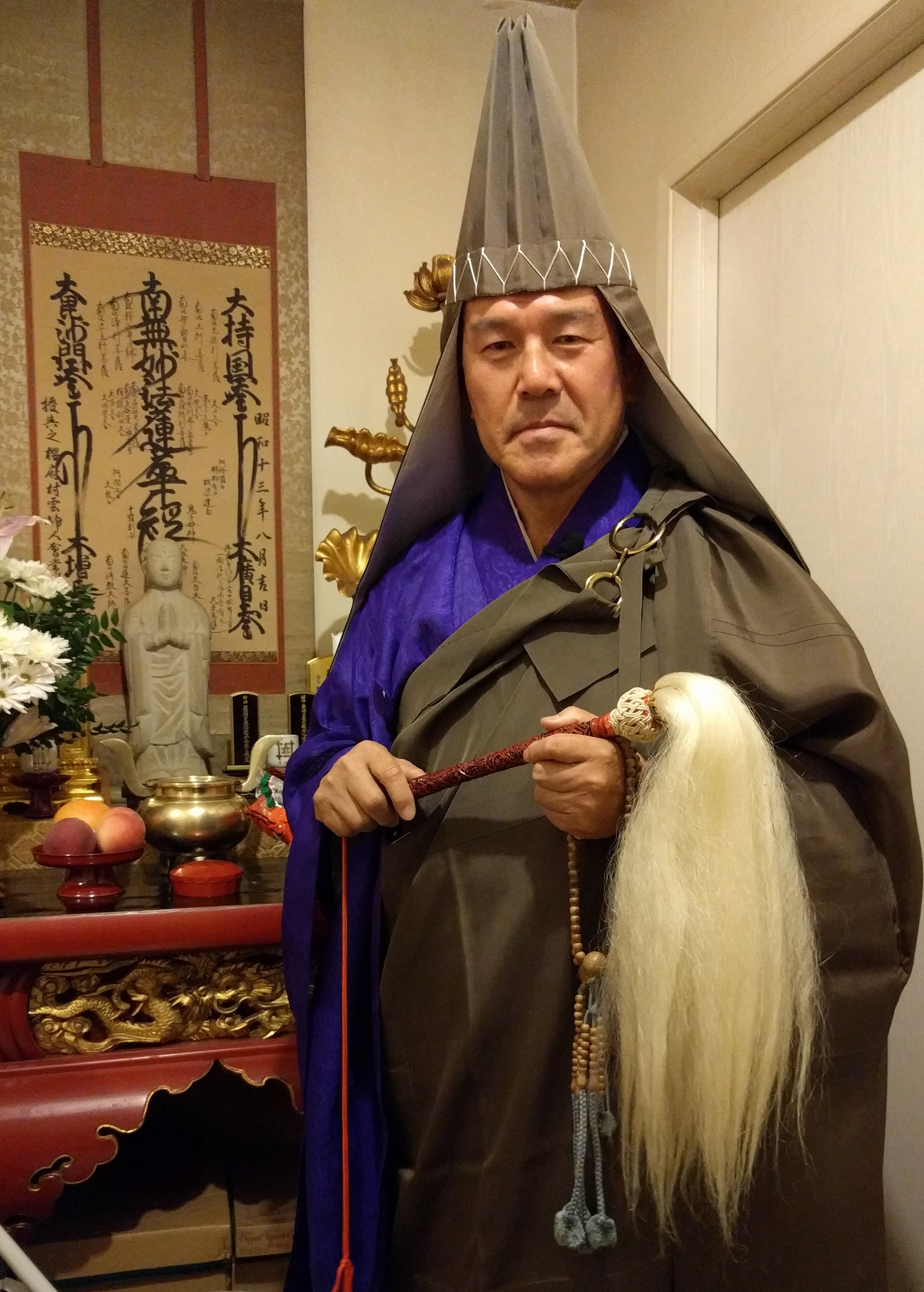
Focusing on Rissho Anshin Before Rissho Ankoku

Ven. Kenjo Igarashi
Ven. Kenjo Igarashi
This is the monthly lecture for November by Ven. Kenjo Igarashi of the Sacramento Nichiren Buddhist Church.

Deng Xiaoping (1904-1997), a former leader of China known for introducing economic reforms and opening the country to foreign investment, famously said, “Let some people get rich first.” While Deng’s policies led to China’s rapid economic growth, some suggest that his ideas increased the gap between the rich and poor. This contrasts with the egalitarianism so prominent during the rule of his predecessor, Mao Zedong (1893-1976). Deng seems to suggest that China’s economic growth needs to start from economic success of the individual, which would in turn help the society, and ultimately the country. I would like to use Deng’s idea as an analogy to introduce “rissho anshin” (立正安心), a new term that I have coined.

Throughout my years as a minister, I have seen and met many people who visit a Buddhist temple for the first time. Many of them want to explore their interests in Buddhism, yet there are those that have a problem in their life that they believe Buddhism could help them resolve. For the majority of these people, they are merely curious to “test out” Buddhism as a remedy for their problems. They are not as interested in the spiritual aspect of religion, but only see it from a philosophical perspective. However, the major difference between philosophy and religion is that the latter incorporates prayer.

Nichiren Shonin is known for his various forms of prayer for differing purposes, ranging from those specific for a lay follower to prayers he hoped would help save Japan from the destructive effects of “mappo” (末法) or “the period of degeneration of Buddhist teachings”. His Rissho Ankoku Ron (立正安国論), which literally translates to “establishing the right teaching for peace of the land”, addresses his concerns with the countless forms of suffering he saw in Japan. He believed that this could be fixed if more people followed the teachings of the Lotus Sutra. Nichiren Shonin prayed not only for a single person, but the whole country of Japan.

We may aspire to be like him and pray for something grand like world peace or the end of all suffering. However, I personally think that we must first attempt to practice what I like to call “rissho anshin” or “establishing one’s peace of mind”, before embarking on a path to help others. We cannot expect someone who is suffering or unhappy with his or her life to have the capacity to pray for world peace. However, we can use the teachings of the Lotus Sutra, or the “right teaching” as Nichiren Shonin called it, to work towards attaining happiness, after which we can pray for peace within one’s family, the country, and then the world. Thus, we can take small steps that would allow us to ultimately practice what Nichiren Shonin stated in his Rissho Ankoku Ron.

In referring back to Deng’s quote, we see that while not everyone can become wealthy simultaneously, it is possible for those that “get rich first” to help others using their newly acquired wealth. This leads to what can be seen as a domino effect, thus increasing the number of affluent people, and subsequently, economic growth of the country as a whole. In the same way, we see that not everyone can be at peace with himself or herself. However, it is possible for those that have already attained happiness to pray for suffering individuals, which would hopefully decrease suffering and ultimately lead to world peace.

I am hoping that you will, if not so already, become at peace with yourself, and reach a point where you will be encouraged to extend your happiness to others through prayer.

The Buddha’s Example

As to the relation between the particular and the universal, the case of Buddha is not only an example, but the typical representative. He was born as a human being, passed through mental struggles, and finally attained Buddhahood, and lived the fifty years of his ministry as the Truth-revealer. This is an actual life of a particular person, and no one can deny its facts, except the docetists, against whom the orthodox Buddhists took a united stand. Yet he was a Buddha, because he was enlightened in cosmic truths and realized the universal nature of Buddhahood, which is called Bodhi, or Enlightenment. He is Bodhi incarnate, so to speak, and Bodhi is the universal and fundamental nature (dhammata) of the spiritual existence, which is pre-existent to appearance of particular Buddhas, and the a priori basis of their attainment.

Nichiren, The Buddhist Prophet

Daily Dharma – Nov. 5, 2016

You skillfully expound the Dharma with various parables and similes,
And with various stories of previous lives.
Now my mind is as peaceful as the sea.
Hearing you, I have removed the mesh of doubts.

Śāriputra, the wisest of the Buddha’s disciples, sings these verses in Chapter Three of the Lotus Sūtra. After the Buddha announced in Chapter Two that he had not revealed his highest wisdom, that everything he had taught before then was preparation, Śāriputra was the first to understand what the Buddha meant. The parables, similes and other parts of the Lotus Sūtra help us to understand how to read them, and how to make them real in our lives. When we find the true purpose of what the Buddha is teaching us, our mind and the world become peaceful together.

The Daily Dharma is produced by the Lexington Nichiren Buddhist Community. To subscribe to the daily emails, visit zenzaizenzai.com

Day 2

Day 2 completes Chapter 1, Introductory.

Having last month discussed the story of Wonderful-Light Bodhisattva and one of his followers, it’s time to start again with Manjusri’s answer to Maitreya.

Thereupon Manjusri said to Maitreya Bodhisattva-mahasattva and the other great men:

Good men! I think that the Buddha, the World-Honored One, wishes to expound a great teaching, to send the rain of a great teaching, to blow the conch-shell horn of a great teaching, to beat the drum of a great teaching, and to explain the meaning of a great teaching.

Good men! I met many Buddhas in my previous existence. At that time I saw the same good omen as this. Those Buddhas emitted the same ray of light as this, and then expounded a great teaching.

Therefore, know this! I think that this Buddha also is emitting this ray of light, and showing this good omen, wishing to cause all living beings to hear and understand the most difficult teaching in the world to believe.

One of the meanings of “introductory,” the title of this first chapter, is “intended to persuade someone to purchase something for the first time,” as in an introductory offer. I am struck by the idea of this introductory offer of the Sutra of the Lotus Flower of the Wonderful Dharma.

All of you, know this, join your hands together,
And wait with one mind!
The Buddha will send the rain of the Dharma
And satisfy those who seek enlightenment.

Daily Dharma – Nov. 4, 2016

All things are possible if people are united in one spirit. Nothing can be accomplished if they are not united. It is also true in non-Buddhist scriptures. For instance, a king of Y’in in old China, King Chieh who had an army of seven hundred thousand men disunited in spirit, was defeated by King Wu of Chou and his army of eight hundred men, who were united in one spirit. So that if a person has two thoughts, nothing can be accomplished. Even if there are hundreds or thousands of people, if they are united in one they are surely able to accomplish their aim.

Nichiren wrote this passage in his Treatise on Cooperation (Itai Doshin-ji). When we develop the Bodhisattva mind of compassion, we learn that compassion is present in all beings. As we aspire to the Buddha mind of wisdom, we find that all beings have wisdom. When we act from compassion and wisdom rather than fear and delusion, we are united with the true minds of all beings.

The Daily Dharma is produced by the Lexington Nichiren Buddhist Community. To subscribe to the daily emails, visit zenzaizenzai.com

Day 1

Day 1 covers the first half of Chapter 1, Introductory

Having last month discussed the Arhats, Sravakas and Bodhisattvas present in the audience at the start of the Sutra of the Lotus Flower, I need to discuss the others present.

Sakra-Devanam-Indra was also present. Twenty thousand gods were attending on him. There were also Beautiful-Moon God, Universal-Fragrance God, Treasure-Light God, and the four great heavenly-kings. Ten thousand gods were attending on them. Freedom God and Great-Freedom God were also present. Thirty thousand gods were attending on them. Brahman Heavenly-King who was the lord of the Saha-World, Great Brahman Sikhin, and Great Brahman Light were also present. Twelve thousand gods were attending on them.

There were also the eight dragon-kings: Nanda Dragon-King, Upananda Dragon-King, Sagara Dragon-King, Vasuki Dragon­.Kng, Taksaka Dragon-King, Anavatapta Dragon-King, Manasvin Dragon-King, and Utpalaka Dragon-King, each accompanied by hundreds of thousands of attendants. There were also the four kimnara-kings: Dharma Kimnara-King, Wonderful-Dharma Kimnara-King, Great-Dharma Kimnara-King, and Dharma­Keeping Kimnara-King, each accompanied by hundreds of thousands of attendants.

There were also the four gandharva-kings: Musical Gandharva­King, Musical-Voice Gandharva-King, Beautiful Gandharva-King, and Beautiful-Voice Gandharva-King, each accompanied by hundreds of thousands of attendants.

There were also the four asura-kings: Balin Asura-King, Kharaskandha Asura-King, Vemacitrin Asura-King, and Rahu Asura-King, each accompanied by hundreds of thousands of attendants.

There were also the four garuda-kings: Great-Power-Virtue Garuda-King, Great-Body Garuda-King, Great-Fulfillment Garuda­King, and Free-At-Will Garuda-King, each accompanied by hundreds of thousands of attendants.

In my brief time as a Nichiren Shu practitioner I’ve discovered that the perceived importance of the protective deities varies widely. The Ven. Kenjo Igarashi strongly believes of their existence and their protection powers. Others I’ve talked with seem to want the subject to be one of those matters of historical interpretation and not relevant to modern practice.

To me, Buddhism without the deities is like a photograph without color. Yes, you can understand a picture of shades of gray, but how much more wonderful and beautify is the world in color.

These deities were important to Nichiren. That’s why they are included in the Mandala Gohonzon. I highly recommend “Lotus World: An Illustrated Guide to the Gohonzon,” by Rev. Ryuei Michael McCormick

Revering the Teachings of the Buddha

In Chapter X we have a transition which shifts the importance of revering the relics of the Buddha to revering the teachings of the Buddha. In this shift we replace the body of the Buddha with the teachings of the Buddha. The Buddha makes it clear that Buddhas are not entities to be worshiped; it is their teachings that are important.

Lecture on the Lotus Sutra

Daily Dharma – Nov. 3, 2016

When they expound the scriptures of non-Buddhist schools, or give advice to the government, or teach the way to earn a livelihood, they will be able to be in accord with the right teachings of the Buddha.

The Buddha gives this explanation to Constant-Endeavor Bodhisattva in Chapter Nineteen of the Lotus Sūtra, describing those who keep the Lotus Sūtra. In this chapter, the Buddha shows that our practice of this Wonderful Dharma is not separate from our existence in this world. The purpose of the Buddha’s wisdom is not to escape to a better life, but to see our lives for what they are, and to use that clarity for the benefit of all beings.

The Daily Dharma is produced by the Lexington Nichiren Buddhist Community. To subscribe to the daily emails, visit zenzaizenzai.com

Day 32

Day 32 covers Chapter 28, The Encouragement of Universal-Sage Bodhisattva, closing the Eighth Volume of the Sutra of the Lotus Flower of the Wonderful Dharma.

Having last month covered Universal-Sage Bodhisattva’s vow, it is time to move to the promises made to anyone “who keeps, reads and recites this sutra, memorizes it correctly, understands the meanings of it, and acts according to it.”

Anyone who keeps the Sutra of the Lotus Flower of the Wonderful Dharma [while it is] propagated in the Jambudvipa, should think, ‘I can keep [this sutra] only by the supernatural powers of Universal­Sage.’ Anyone who keeps, reads and recites this sutra, memorizes it correctly, understands the meanings of it, and acts according to it, know this, does the same practices that I do. He should be considered to have already planted deeply the roots of good under innumerable Buddhas [in his previous existence]. He will be caressed on the head by the hands of the Tathagatas.

I’m going enjoy the caress and leave for next month the promise made to those who copy the sutra.