
The Buddha was aware that the process of cause and effect extends beyond a single lifetime. Based upon his deep insight into the processes of life and death and of cause and effect, the Buddha saw that who we are and what we are faced with in this life are the result of our actions in previous lifetimes. Furthermore, what we will become in future lifetimes will be determined by what we do in the present. In other words, our every thought, word, and deed has the power to create our own destiny, both now and in the future.
Lotus SeedsAll posts by John Hughes
Daily Dharma – Nov. 2, 2016
Anyone who rejoices at hearing this sūtra,
And who receives it respectfully,
Know this, has already reached
The stage of not-returning.
The Buddha sings these verses in Chapter Three of the Lotus Sūtra. The state of non-returning means having the certainty of reaching enlightenment. As Bodhisattvas, when we go into any realm, whether higher or lower, it is to benefit the beings there. It is easy to become discouraged by the difficulties we face in this world of conflict, and to forget that we are not alone in our efforts to help others. When we return to the joy of the Lotus Sūtra, the Buddha reminds us of who we are, what we are doing, and where we are going, no matter what obstacles we may find.
The Daily Dharma is produced by the Lexington Nichiren Buddhist Community. To subscribe to the daily emails, visit zenzaizenzai.com
Day 31
Day 31 covers Chapter 27, King Wonderful-Adornment as the Previous Life of a Bodhisattva.
Having last month discussed the great supernatural powers, merits, virtues and wisdom of Pure-Store and Pure-Eyes, its time to discuss their role in spreading the Lotus Sutra.
Thereupon that Buddha expounded the Sutra of the Lotus Flower of the Wonderful Dharma, wishing to lead King WonderfulAdornment also out of his compassion towards all living beings. The two sons, Pure-Store and Pure-Eyes, came to their mother, joined their ten fingers and palms together, and said, ‘Mother! Go to Cloud Thunderpeal-Star-King-Flower-Wisdom Buddha! We also will go to attend on him, approach him, make offerings to him, and bow to him because he is expounding the Sūtra of the Lotus Flower of the Wonderful Dharma to all gods and men. Hear and receive [the sutra]!’
The mother said to them, ‘[Yes, I will. But] your father believes in heresy. He is deeply attached to the teachings of brahmanas. Go and tell him to allow us to go [to that Buddha]!’
The Daily Dharma from July 30, 2016, offers this perspective:
The two sons, Pure-Store and Pure-Eyes, came to their mother, joined their ten fingers and palms together, and said, ‘Mother! Go to Cloud Thunderpeal-Star-King-Flower-Wisdom Buddha! We also will go to attend on him, approach him, make offerings to him, and bow to him because he is expounding the Sūtra of the Lotus Flower of the Wonderful Dharma to all gods and men.
The Buddha tells the story of King Wonderful-Adornment in Chapter Twenty-Seven of the Lotus Sūtra. The two sons chose to be born at a time when Cloud-Thunderpeal-Star-King-Flower-Wisdom Buddha was alive and led their parents to follow that Buddha and learn the Wonderful Dharma from him. They overcame their father’s attachment to wrong views, not by arguing against those views, but by demonstrating the wonders that come from the Buddha’s great teaching. This shows how when we as Bodhisattvas live this difficult teaching we lead others to it.
The Daily Dharma is produced by the Lexington Nichiren Buddhist Community. To subscribe to the daily emails, visit zenzaizenzai.com
Daily Dharma – Nov. 1, 2016
Universal-Sage! Anyone who keeps, reads and recites this sūtra [in the later five hundred years] after [my extinction], will not be attached to clothing, bedding, food or drink, or any other thing for living. What he wishes will not remain unfulfilled. He will be able to obtain the rewards of his merits in his present life.
The Buddha makes this promise to Universal-Sage Bodhisattva in Chapter Twenty-Eight of the Lotus Sūtra. When we who are living in this latter age of Degeneration keep and practice this Sūtra, we change the focus of our own existence. We lose our dependence on the things we thought we needed to make us happy, and thus learn to appreciate them for what they are. We set aside our fear of losing these things and gain the courage to handle situations we previously thought were impossible. We stop focusing on what we need to live and find gratitude for what sustains our lives.
The Daily Dharma is produced by the Lexington Nichiren Buddhist Community. To subscribe to the daily emails, visit zenzaizenzai.com
Day 30
Day 30 covers all of Chapter 26, Dhāraṇīs
Last month I introduced the ten rakshasis and their mother, Hariti. Now to finish up the chapter:
Having sung these gathas, the raksasis said to the Buddha:
World-Honored One! We also will protect the person who keeps, reads and recites this sutra, and acts according to it so that he may be peaceful, that he may have no trouble, and that poison taken by him may be neutralized.
The Buddha said to the raksasis:
Excellent, excellent! Your merits will be immeasurable even when you protect the person who keeps only the name of the Sutra of the Lotus Flower of the Wonderful Dharma. Needless to say, so will be your merits when you protect the person who keeps the sutra itself, and makes to a copy of this sutra hundreds of thousands of offerings such as flowers, incense, necklaces, powdered incense, incense applicable to the skin, incense to burn, streamers, canopies, music, and various lamps like lamps of butter oil, oil lamps, lamps of perfumed oil, lamps of sumanas-flower oil, lamps of campaka flower oil, lamps of varsika-flower oil, and lamps of utpala-flower oil. Kunti! You [raksasis] and your attendants should protect this teacher of the Dharma.
I would like to think that I enjoy the protection of these deities, especially Plunderer of Energy of All Beings.
Firm and Full Dedication
The word Namu … comes to signify a firm and full dedication of our lives, in both its physical and spiritual aspects. In other words, we express our faith in the Buddha and his teachings, particularly in the Lotus Sutra, and at the same time dedicate ourselves to the Buddha, Dharma and Sangha in every possible way.
Odaimoku: The Significance Of Chanting Namu Myoho Renge KyoDaily Dharma – Oct. 31, 2016
I have expounded many sūtras. I am now expounding this sūtra. I also will expound many sūtras in the future. The total number of the sūtras will amount to many thousands of billions. This Sūtra of the Lotus Flower of the Wonderful Dharma is the most difficult to believe and the most difficult to understand.
The Buddha declares these lines to Medicine-King Bodhisattva in Chapter Ten of the Lotus Sūtra. At the beginning of this Sūtra, the Buddha held back from teaching because he thought people might not be ready to hear it. He also said that the Dharma he teaches cannot be understood by reasoning. We need both faith and understanding to practice the Wonderful Dharma. The Buddha also reminds us to appreciate how difficult faith and understanding are, both for ourselves and others.
The Daily Dharma is produced by the Lexington Nichiren Buddhist Community. To subscribe to the daily emails, visit zenzaizenzai.com
Day 29
Day 29 covers all of Chapter 25, The Universal Gate of World-Voice-Perceiver Bodhisattva.
Having last month focused on his wisdom, it’s time to conclude the chapter.
Suppose you are in a law-court for a suit,
Or on a battlefield, and are seized with fear.
If you think of the power of World-Voice-Perceiver,
All your enemies will flee away.His wonderful voice [comes from] his perceiving the voice of the world.
It is like the voice of Brahman, like the sound of a tidal wave.
It excels all the other voices of the world.
Therefore, think of him constantly!Do not doubt him even at a moment’s thought!
The Pure Saint World-Voice-Perceiver is reliable
When you suffer, and when you are confronted
With the calamity of death.By all these merits, he sees
All living beings with his compassionate eyes.
The ocean of his accumulated merits is boundless.
Therefore, bow before him!
The Daily Dharma from Oct. 4, 2015, offers this thought:
Do not doubt him even at a moment’s thought!
The Pure Saint World-Voice-Perceiver is reliable
When you suffer, and when you are confronted
With the calamity of death.
The Buddha sings these verses in Chapter Twenty-Five of the Lotus Sūtra. The calamity of death is something we all will face eventually, whether it our own or that of those we love. The other calamities in our lives are relatively minor losses which can prepare us for this great calamity. The Bodhisattva World-Voice-Perceiver is the embodiment of Compassion: the desire to benefit all beings. When we learn to use all of the suffering in our lives, especially the calamity of death, as a way to remove our delusions and benefit others, then we can see the world with the eyes of the Buddha and know the joy he declares is at the core of our being.
The Daily Dharma is produced by the Lexington Nichiren Buddhist Community. To subscribe to the daily emails, visit zenzaizenzai.com
Nichiren Memorial Service
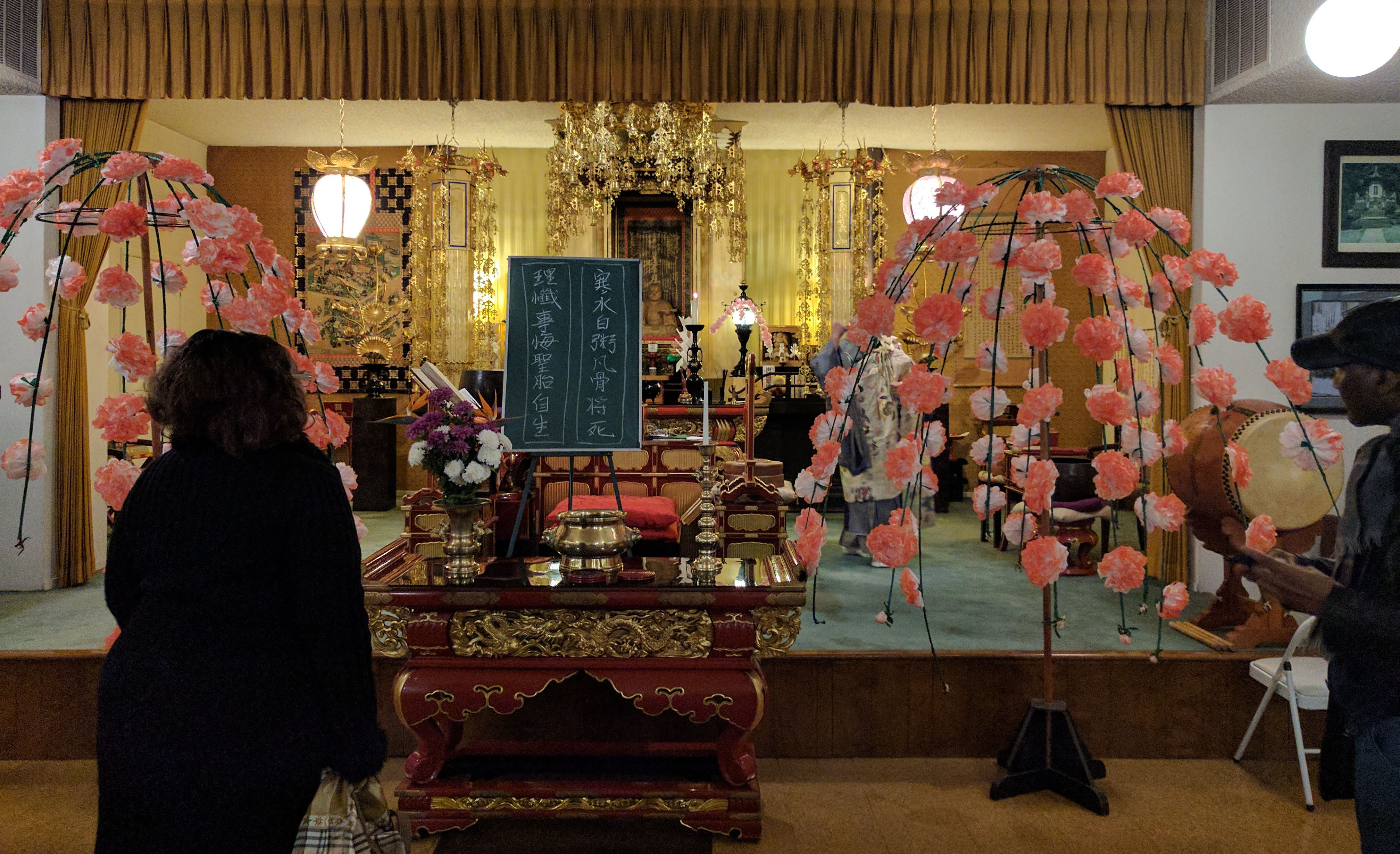

Following the service, Rev. Igarashi continued his discussion of his experience during aragyo, the 100-day ascetic practice which he endured on five occasions.The practice features pouring ice-cold water over the body for purification several times a day and limiting sleep to less than 3 hours and food to just a thin porridge, miso soup and maybe a pickle twice a day. Through these hardships the priests work to remove their bad karma and earn the help of protective deities.
The universal message from all this is the need for both practice and study in everyone’s life. Not just studying the Lotus Sutra. Not just chanting the Odaimoku. Through study and practice, our bad karma is extinguished and our enlightment naturally appears.
Communion with Buddha
The rulership of a single monarch implied the equality of all people, just as faith in the unique personality of Buddha as the saviour of all mankind presupposed the intrinsic value and destiny of every individual to be in communion with him.
History of Japanese Religion