
Tendai had examined the manifold views of reality, and found justification in each of them; and his ambition was to unify them, by looking at every particular existence as if it were an adequate representative of the whole cosmos (dharma-dhatu). His conception of reality is equivalent to seeing every thing sub specie aeternitatis, but his aeternitas differed greatly from that of Spinoza in being not monistic, but “according to the three thousand aspects” — ten realms to each of ten, this hundred in the ten categories of existence, and this thousand multiplied by the three categories of group existence.
Nichiren, The Buddhist ProphetAll posts by John Hughes
Daily Dharma – Oct. 26, 2016
Upon seeing such passages in various sutras as “The truth lies beyond language,” and “It is found where the mind is extinguished,” they will embrace an evil thought that the holy scriptures of the Buddha do not reveal his true Enlightenment. As a result, devils get hold of these three categories of people in the Latter Age of Degeneration, and even destroy the country.
Nichiren wrote this passage in his Treatise on Chanting the Great Title of the Lotus Sūtra (Shō Hokke Daimoku-shō). He reminds us that even though words are limited, we must not cast out the Buddha’s true teaching as unable to lead us to enlightenment. We can revere the Buddha Dharma without making it into a dogma. When we ignore completely what the Buddha left for us, what remains is our own selfish desires and confusion. When the individuals in a society are focused only on their own personal benefit, how can that society survive?
The Daily Dharma is produced by the Lexington Nichiren Buddhist Community. To subscribe to the daily emails, visit zenzaizenzai.com
Day 24
Day 24 concludes Chapter 19, The Merits of the Teacher of the Dharma and closes the Sixth Volume of the Sutra of the Lotus Flower of the Wonderful Dharma.
Having completed the merits of the mind last month, I circle back to the start, the merits of the nose.
Furthermore, Constant-Endeavor! The good men or women who keep, read, recite, expound or copy this sutra, will be able to obtain eight hundred merits of the nose. With their pure noses, they will be able to recognize all the various things above, below, within and without the one thousand million Sumeru-worlds.
And the “various things” that can be recognized are truly amazing:
He will be able to know by smell
Whether an unborn child is a boy or a girl,
Or a child of ambiguous sex,
Or the embryo of a nonhuman being.He will be able to know by smell
Whether a woman is an expectant mother,
Or whether she will give an easy birth
To a happy child or not.
The Daily Dharma on Aug. 2, 2016, addressed these merits:
He will be able to know by smell
What a man or a woman is thinking of,
Or whether he or she is greedy, ignorant or angry,
Or whether he or she is doing good.
The Buddha gives this explanation to Constant-Endeavor Bodhisattva in Chapter Nineteen of the Lotus Sūtra, describing those who keep the Lotus Sūtra. As Bodhisattvas we chose to come into this world, as frightening and dangerous as it is, to make things better for all beings. We do not lose any of the six senses we have, but learn to use them in ways that may seem impossible to others. Any of our senses can be deluded. When we remove our attachments and delusions, we see with the Buddha’s eye the world as it is.
The Daily Dharma is produced by the Lexington Nichiren Buddhist Community. To subscribe to the daily emails, visit zenzaizenzai.com
Or, more to the point, with the Buddha’s nose the world as it is.
Anyone who keeps this sutra
Will be able to have these merits of the nose
Although he has not yet obtained the nose
Of the Bodhisattva [who attained] the Dharma-without-asravas.
Daily Dharma – Oct. 25, 2016
The supernatural powers
Employed by that Buddha
For the expounding of the Dharma
Will be inconceivable.
The Buddha sings this verse in Chapter Six of the Lotus Sūtra after predicting the future Buddhahood of his disciple Subhūti. Anything we do not understand can seem supernatural. Things we find common in our modern world would seem magical to those who lived in the Buddha’s time. It is only through our greater understanding that we can create our modern wonders. It should not then surprise us that with the Buddha’s mind, which he reminds us that we too can reach, the things we can accomplish will seem magical to those mired in delusion.
The Daily Dharma is produced by the Lexington Nichiren Buddhist Community. To subscribe to the daily emails, visit zenzaizenzai.com
Day 23
Day 23 covers all of Chapter 18, The Merits of a Person Who Rejoices at Hearing This Sutra, and opens Chapter 19, The Merits of the Teacher of the Dharma.
Last month, I introduced the Merits of the Teacher of the Dharma. Now for the first of those merits:
They will be able to adorn and purify their six sense-organs with these merits. With their pure eyes given by their parents, these good men or women will be able to see all the mountains, forests, rivers and oceans inside and outside the one thousand million Sumeru-worlds, [each of which is composed of six regions] down to the Avici Hell and up to the Highest Heaven. They also will be able to see the living beings of those worlds, to know the karmas which those living beings are now doing and the region to which each of those living beings is destined to go by his karmas.
Thereupon the World-Honored One, wishing to repeat what he had said, sang in gathas:
Listen! I will tell you of the merits
Of those who fearlessly expound
To the great multitude
This Sutra of the Lotus Flower of the Wonderful Dharma.
They will be able to obtain the excellent eyes
Adorned with eight hundred merits.
Their eyes will be pure
Because of this adornment.With their eyes given by their parents,
They will be able to see Mt. Meru, Mt. Sumeru,
The Surrounding Iron Mountains,
And the other mountains,
And the forests, oceans and rivers
Inside and outside the one thousand million Sumeru-worlds.
They will be able to see the living beings
Of those worlds [each being composed of the six regions]
Down to the Avici Hell and up to th Highest Heaven.
Although they have not yet obtained heavenly eyes,
They will be able to see all this
With their natural eyes.
As I begin walking through these merits, it is important to underscore that these senses are not yet heavenly. In this case, these feats are accomplished “with their eyes given by their parents.”
Self-Work
There is a lot of messy stuff in our lives for which a lot of work is required to sort out. There is no instant on button for Buddhist practice, regardless of the path chosen. Just as there is a whole
growing cycle required for the lotus blossom to manifest, so it is in our lives. Simply put there is a lot of self-work in order to manifest the lotus blossom in our lives.
Daily Dharma – 0ct. 24, 2016
Anyone who wishes to expound this sūtra
Should give up jealousy, anger, arrogance,
Flattery, deception and dishonesty.
He should always be upright.
The Buddha sings these verses to Mañjuśrī in Chapter Fourteen of the Lotus Sūtra in which he describes the peaceful practices of a Bodhisattva. The way we live our lives can either reinforce our delusions or help us gain more clarity about how things really are. In these verses, the Buddha advises against these actions not because he will think less of us when we do them, but because when we find ourselves behaving these ways it is because we are not seeing things for what they are.
The Daily Dharma is produced by the Lexington Nichiren Buddhist Community. To subscribe to the daily emails, visit zenzaizenzai.com
Day 22
Day 22 covers all of Chapter 17, The Variety of Merits.
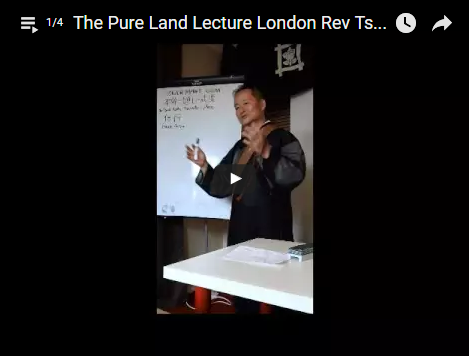
Last week I wrote a blog post about a video lecture on the Pure Land as understood by Nichiren Shu. Today’s reading from Chapter 17 provides another Lotus Sutra quote specifically explaining that the Eternal Buddha is always present and that this Saha World is the Pure Land.
Ajita! The good men or women who hear of my longevity of which I told you, and understand it by firm faith, will be able to see that I am expounding the Dharma on Mt. Grdhrakuta,* surrounded by great Bodhisattvas and Sravakas. They also will be able to see that the ground of this Saha-World is made of lapis lazuli, that the ground is even, that the eight roads are marked off by ropes of jambanada gold, that the jeweled trees are standing in lines, and that the magnificent buildings are made of treasures. They also will be able to see that the Bodhisattvas are living in those buildings. They will be able to see all this because, know this, they have already understood [my longevity] by firm faith.
*Mount Sacred Eagle
The Impermanent Nature of Things
The Buddha taught that what we are today is a result of what we have thought and done in the past, and what we shall be in the future will be a result of what we think and do in the present.
Unfortunately, we trap ourselves in a vicious cycle of suffering by not recognizing the impermanent nature of things. Neither do we realize the ways in which we are setting in motion the various causes that will eventually determine the nature of our lives. Because of this ignorance, in our attempts to get those things that we mistakenly believe will bring permanent self-fulfillment, we act in ways that are far from beneficial, both for ourselves and for others. Most of us are familiar with the phrase “what goes around comes around,” but how many of us actually make sure that all of our words, actions, and thoughts are the kind that we would like to see mirrored back to us by the people, places, and events in our daily lives?
Lotus SeedsDaily Dharma – Oct. 23, 2016
The gods, men and asuras in the world think that I, Śākyamuni Buddha, left the palace of the Śākyas, sat at the place of enlightenment not far from the City of Gayā, and attained Anuttara-samyak-saṃbodhi [forty and odd years ago]. To tell the truth, good men, it is many hundreds of thousands of billions of nayutas of kalpas since I became the Buddha.
The Buddha makes this proclamation in Chapter Sixteen of the Lotus Sutra. This was the first time he revealed himself not as the temporal Siddhartha Gautama, the man who left home and became enlightened, but as the Ever-Present Buddha Śākyamuni who has been alive for innumerable eons helping beings to become enlightened and will continue that existence for twice that time into the future. This is the highest teaching of the Buddha, the purpose of all his expedient teachings that came before, and the Wonderful Dharma that is most difficult to believe and understand. When we comprehend the existence of this Ever-Present Buddha for even the blink of an eye, we gain more clarity about the world than through any of the Buddha’s other teachings.
The Daily Dharma is produced by the Lexington Nichiren Buddhist Community. To subscribe to the daily emails, visit zenzaizenzai.com