All posts by John Hughes

Daily Dharma – April 27, 2016

How did you teach these innumerable Bodhisattvas
In such a short time,
And cause them to aspire for enlightenment
And not falter in seeking enlightenment?

Maitreya Bodhisattva sings these verses to the Buddha in Chapter Fifteen of the Lotus Sūtra. Despite the Buddha’s explanation that he personally taught all of the Bodhisattvas who appear in Chapter Fifteen, Maitreya and others are still confused by what the Buddha has told them. Since they have faith that whatever the Buddha teaches is for their benefit, they persist with their sincere questioning, assured that the Buddha is leading them to enlightenment. While faith is an important part of our practice, recognizing our own confusion, and using questions to resolve that confusion are equally important. The Buddha does not ask for blind obedience. He knows we cannot find peace until we bring our whole being to his practice.

The Daily Dharma is produced by the Lexington Nichiren Buddhist Community. To subscribe to the daily emails, visit zenzaizenzai.com

Day 2

Day 2 completes Chapter 1, Introductory

Yesterday’s consideration of the circle that is life brings my attention today to the circular relationship of the lives of the great disciples.

When we begin this second of the 32 days of the Lotus Sutra, Manjusri is answering Maitreya’s request to explain the meaning of the great omen seen by the multitude – the light emitted by Sakyamuni “from the white curls between his eyebrows, and illumined all the corners of eighteen thousand worlds in the east, down to the Avici Hell of each world, and up to the Akanistha Heaven of each world.” Manjusri tells about one of his long-ago lives and in doing so explains the story of a Bodhisattva called Wonderful-Light, who had 800 disciples.

One of the eight hundred disciples [of Wonderful-Light] was called Fame-­Seeking. He was attached to gain. He read and recited many sutras, but did not understand them. He forgot many parts of those sutras. Therefore, he was called Fame-Seeking. But he [later] planted the roots of good, and became able to see many hundreds of thousands of billions of Buddhas. He made offerings to them, respected them, honored them, and praised them.

Maitreya, know this! Wonderful-Light Bodhisattva at that time was no one but myself; and Fame-Seeking Bodhisattva, no one but you. This good omen we see now is not different from what I saw at that time. Therefore, I think that the Tathagata of today also will expound the sutra of the Great Vehicle called the ‘Lotus Flower of the Wonderful Dharma, the Dharma for Bodhisattvas, the Dharma Upheld by the Buddhas.’

And in gathas:

There was a lazy man
Among the disciples
Of Wonderful-Light, the Teacher of the Dharma.
[The lazy man] was attached to fame and gain.

Always seeking fame and gain,
He often visited noble families.
He did not understand what he had recited,
Gave it up, and forgot it.
Because of this,
He was called Fame-Seeking.

But he [later] did many good karmas,
And became able to see innumerable Buddhas.
He made offerings to them,
Followed them, practiced the Great Way,
And performed the six paramitas.
Now he sees the Lion-Like One of the Sakyas.

He will become a Buddha
In his future life.
He will be called Maitreya.
He will save innumerable living beings.

The lazy man who Lived after the extinction
Of [Sun-Moon-] Light Buddha was
No one but you.
Wonderful-Light, the Teacher of the Dharma, was I.

The ray of light of [Sun-Moon-] Light Buddha,
That is, the good omen, was the same as what I see now. Judging from this, the present Buddha also will expound The Sutra of the Lotus Flower of the Wonderful Dharma.

Back in the days of my youth, when all telephones were wired (and they even had dials to “dial” a phone number), the handsets were often attached to the phone with a coiled wire. When relaxed, the coils appeared to be individual loops with beginnings and ends, but as you pulled on the coil you realized the beginnings and ends were an illusion and when you stretched the coil to its limit it became a single line. That’s today’s image for the circle of life.


Coiled phone cable

Daily Dharma – April 26, 2016

We know the defects of the Lesser Vehicle.
But we do not know how to obtain
The unsurpassed wisdom of the Buddha.

The Buddha’s disciples Maudgalyāyana, Subhūti and Mahā-Kātyāyana sing these verses in Chapter Six of the Lotus Sūtra. They have heard the Buddha teach that the expedient teachings about Suffering are incomplete. However they still have not yet embraced the One Vehicle teaching of the Lotus Sūtra which leads all beings to enlightenment. Nichiren explained, in his Treatise on Opening the Eyes of Buddhist Images, how teachings that came before the Lotus Sūtra were based on the mind of the hearer, where the Wonderful Dharma is itself the mind of the Buddha. When we read, recite, copy and expound the Lotus Sūtra, we are becoming of one mind with the Buddha.

The Daily Dharma is produced by the Lexington Nichiren Buddhist Community. To subscribe to the daily emails, visit zenzaizenzai.com

Day 1

Day 1 covers the first half of Chapter 1, Introductory

I find this circle of 32 days enjoyable, with a sense of completion and renewed anticipation as I move from one end through the beginning again. What if we could appreciate the circle of our lives in the same way?

And so it begins again with “Thus have I heard.”

Here I’d like to bring up an explanation offered by Ryusho Jeffus Shonin:

There are actually two ways of looking at the phrase “thus have I heard.” The difference is which way or which direction “thus have I heard” points. In one understanding, “thus have I heard” points to the text that follows. So in this interpretation Ananda is saying what he heard from the Buddha and it is titled Myoho Renge Kyo. The other interpretation is “thus have I heard” is pointing to Myoho Renge Kyo, and what follows is an explanation, or interpretation of Myoho Renge Kyo. In the first understanding the text of the sutra is primary, in the second the text is secondary to the title. As different sentence constructions it might look like this. ‘Myoho Renge Kyo is what I heard’ versus ‘This is what I heard. The Buddha one …’ The difference is slight but important. In the first Myoho Renge Kyo is the most important thing and all that follows is a way to understand Myoho Renge Kyo. The second understanding places the text of the sutra as key and the title is a summary of the contents.

Nichiren argues that “thus have I heard” is referring to Myoho Renge Kyo and this supports the conclusion that chanting the title as a single practice is very much appropriate and correct. Everything then recounted in the text of the sutra is similar to an exegesis of the most important thing, which is Myoho Renge Kyo.

Lecture on the Lotus Sutra

“Thus have I heard” at that point between the end and the beginning, containing both, encompassing everything. Namu Myoho Renge Kyo

Daily Dharma – April 25, 2016

However, we now live in the Latter Age of Degeneration, when disputes and quarrels are rampant while the True Dharma is lost. There is nothing but evil lands where evil rulers, evil subjects and evil people reject the True Dharma, showing respect only to evil dharmas and evil teachers. Evil spirits take advantage of this, filling the lands with the so-called three calamities and seven disasters.

Nichiren wrote this passage in his Treatise on the True Way of Practicing the Teaching of the Buddha (Nyosetsu Shugyō-shō). It can be hard for us to imagine how what we believe can change our society. We think we have to create a new political system, or put the right people in power, or acquire wealth before we can have peace. What would happen in a world where people believed their happiness was intertwined with that of others? What happens in a world where people believe their happiness has to come at the expense of others? Our beliefs are far more powerful than we realize. When we put our belief in the Buddha’s description of the world as it is, and see our place in it as Bodhisattvas who have chosen to be here to benefit others, the world changes before our eyes.

The Daily Dharma is produced by the Lexington Nichiren Buddhist Community. To subscribe to the daily emails, visit zenzaizenzai.com

Founder’s Day

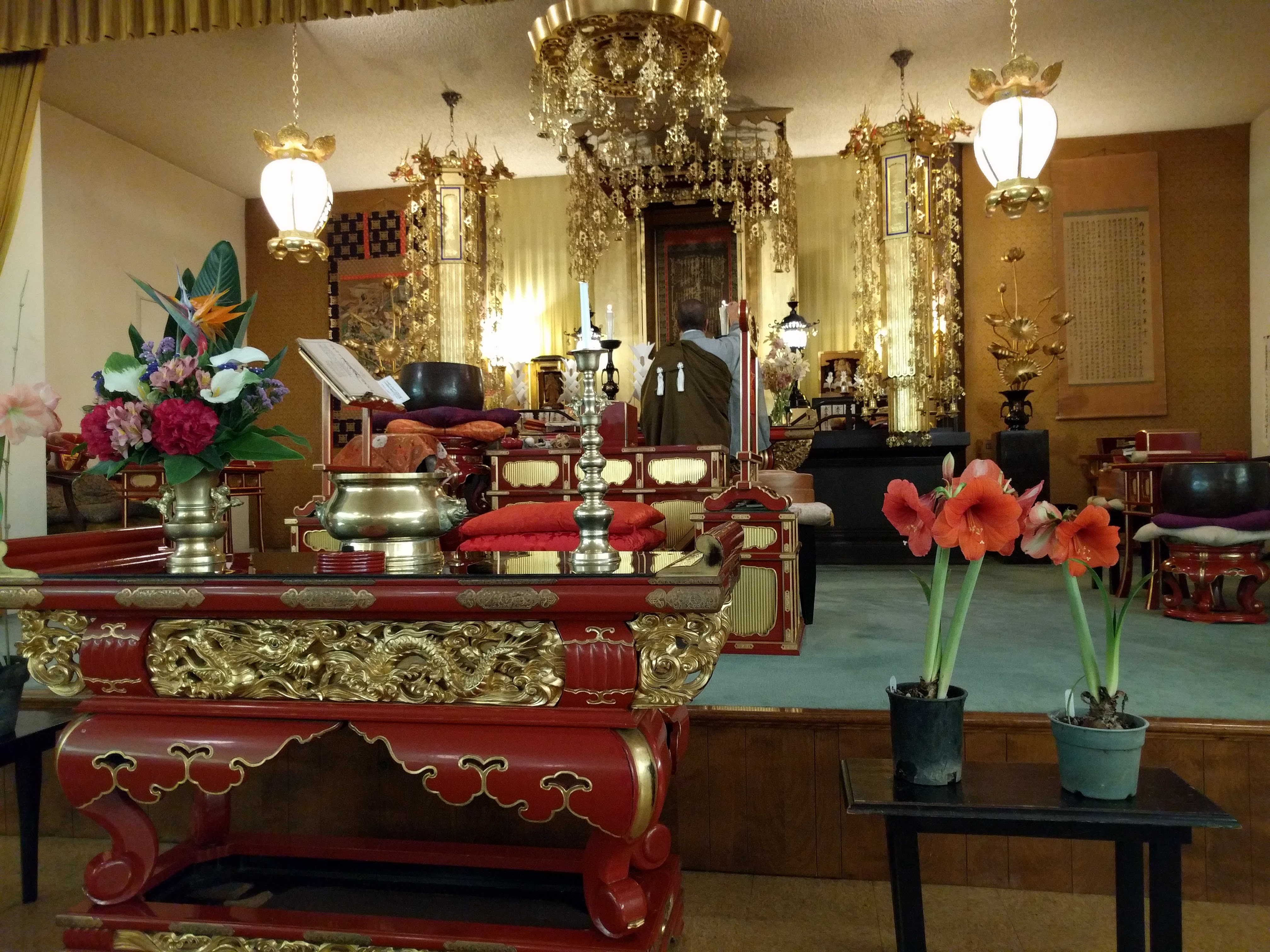
Ven. Kenjo Igarashi prepares altar before the Kaishu-e service honoring the founding of the Nichiren Shu lineage.
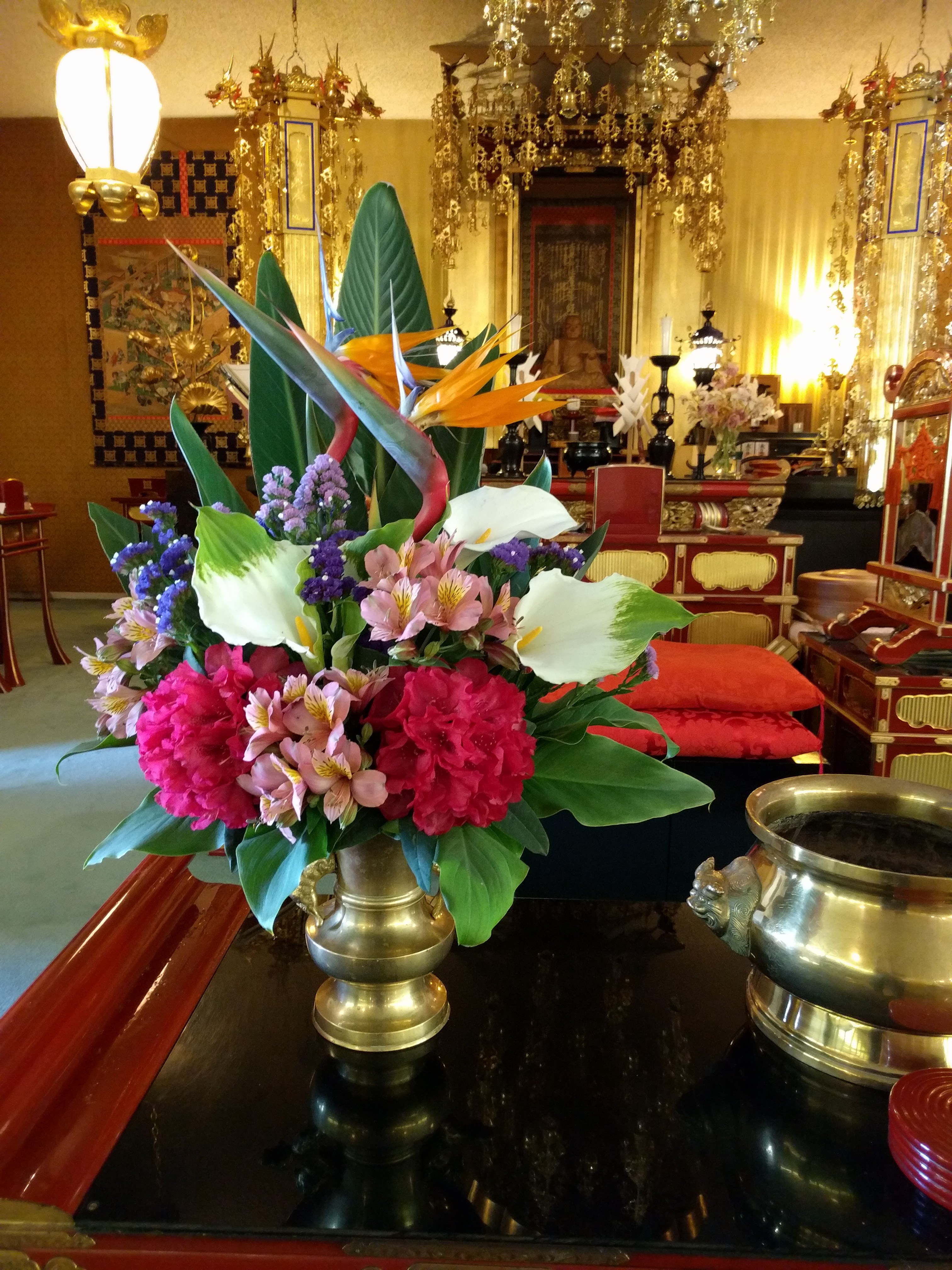
Flowers next to the incense offering bowl.

On the morning of April 28, 1253, Nichiren Shonin chanted Namu Myoho Renge Kyo to the rising sun, setting the stage for the restoration of devotion to the Lotus Sutra and the Eternal Buddha as the Buddhist practice best suited for the Latter Days of the Dharma. Out of this effort grew the Nichiren Shu tradition that continues today.

Today’s service at the Sacramento Nichiren Buddhist Church celebrated Kaishu-e, the founding of Nichiren Shu.

As an aside, we also learned today that it was on April 28, 1968, that Ven. Kenjo Igarashi took his original vows to become a priest.

And about this fixation of mine on flowers. For more than 25 years I practiced a variety of Nichiren Buddhism that shuns statues and allows only greens, no flowers, on altars. Having both the joy of flowers and the physical representation of the objects of devotion has proved to be one of my favorite aspects of Nichiren Shu practice. With the constant references to offerings of flowers in the Lotus Sutra and Nichiren’s promotion of statues as objects of devotion, it seems so unnatural to have ever not had flowers and statues on my altar.

Flowers next to hand-carved wooden tablet of Chapter 16 of the Lotus Sutra.

Day 32

Day 32 covers Chapter 28, The Encouragement of Universal-Sage Bodhisattva, closing the Eighth Volume of the Sutra of the Lotus Flower of the Wonderful Dharma.

Today completes my first month of my self-imposed single-topic sharing of what I read each day. On this last day I’ll set aside for future months the ambivalent attitude about women shown by Universal Sage Bodhisattva and instead take this opportunity to focus on Sakyamuni’s promise:

Universal-Sage! Anyone who keeps, reads and recites this Sutra of the Lotus Flower of the Wonderful Dharma, memorizes it correctly, studies it, practices it, and copies it, should be considered to see me, and hear this sutra from my mouth. He should be considered to be making offerings to me. He should be considered to be praised by me with the word ‘Excellent!’ He should be considered to be caressed by me on the head. He should be considered to be covered with my robe.

And…

Universal-Sage! If you see anyone who keeps, reads and recites the Sutra of the Lotus Flower of the Wonderful Dharma in the later five hundred years after my extinction, you should think, ‘Before long be will go to the place of enlightenment, defeat Mara and his followers, attain Anuttara-samyak-sambodhi, turn the wheel of the Dharma, beat the drum of the Dharma, blow the conch-shell horn of the Dharma, send the rain of the Dharma, and sit on the lion-like seat of the Dharma in the midst of the great multitude of gods and men.’

Daily Dharma – April 24, 2016

Arouse your power of faith,
And do good patiently!
You will be able to hear the Dharma
That you have never heard before.

The Buddha sings these verses in Chapter Fifteen of the Lotus Sūtra. These are another emphasis of the superiority of those who put the Buddha’s teachings into practice rather than those who merely hear and understand them. It is only when we are engaged in creating benefit in the world, in helping all beings to become enlightened, that we are able to hear the Buddha’s highest teaching, the teaching of his own enlightenment.

The Daily Dharma is produced by the Lexington Nichiren Buddhist Community. To subscribe to the daily emails, visit zenzaizenzai.com

Day 31

Day 31 covers Chapter 27, King Wonderful-Adornment as the Previous Life of a Bodhisattva.

This story of two sons who, at the invitation of their mother, seek to convince their father, a king, to hear the Buddha is always inspiring. And this time through I want to underline the effect of their efforts:

By displaying these various wonders, they purified the mind of their father, that is, of the king, and caused him to understand the Dharma by faith.

And…

Thereupon the two sons descended from the sky, came to their mother, joined their hands together, and said to her, ‘Our father, the king, has now understood the Dharma by faith. He is now able to aspire for Anuttara-samyak-sambodhi. We did the work of the Buddha for the sake of our father.

And…

The two sons led their father by these expedients and caused him to understand the teachings of the Buddha by faith and to wish [to act according to those teachings].

They did the work of the Buddha and caused the king, their father, to understand the Dharma by faith and to wish to act according to those teachings.

Daily Dharma – April 23, 2016

Every Buddha vows at the outset:
“I will cause all living beings
To attain the same enlightenment
That I attained.”

The Buddha sings these verses in Chapter Two of the Lotus Sūtra. The Buddha holds nothing back from us. There is nothing hidden or secret in his teachings. He is not threatened by anyone who reaches his wisdom, since he knows this is the potential we all have in us. By his example we can discern between the knowledge that separates from others, and that which unites us with our fellow beings.

The Daily Dharma is produced by the Lexington Nichiren Buddhist Community. To subscribe to the daily emails, visit zenzaizenzai.com