Day 17 covers all of Chapter 12, Devadatta, and opens Chapter 13, Encouragement for Keeping this Sutra.
So, again, my one-topic-a-day vow forces me to ignore the Dragon girl who defies all convention concerning female virtues, animal or otherwise, and quickly becomes a Buddha and also the reassurance given to Sakyamuni’s aunt and the mother of Rahula that when Sakyamuni said all sravakas would eventually attain enlightenment he meant all, both men and women. I’ll return to these in the coming months.
Today, what grabbed was the role that the teacher played in the king’s search for bodhi. This king, of course, was Sakyamuni in a previous life and the seer, Devadatta. Hear is what the teacher did:
Devadatta was my teacher. He caused me to complete the six paramitas. He caused me to have loving-kindness, compassion, joy and impartiality. He caused me to have the thirty-two major marks and the eighty minor marks [of the Buddha]. He caused me to have my body purely gilt. He caused me to have the ten powers and the four kinds of fearlessness. He caused me to know the four ways to attract others. He caused me to have the eighteen properties and supernatural powers [of the Buddha]. He caused me to have the power of giving discourses. I attained perfect enlightenment and now save all living beings because Devadatta was my teacher.
Devadatta was a good friend of Sakyamuni, at least he was in that lifetime.
Enemies find it difficult to attack when two people are together. Therefore, do not keep your brothers at a distance even for a brief period, regardless of what faults they may have; always be close to them. Whenever you get angry, it is clearly written on your face. Please remember that at no time do gods or deities protect those who are short tempered. It is true that you are destined to become a Buddha, but isn’t it regrettable for you to get hurt, pleasing your enemy and causing us grief?
Nichiren wrote this passage in his “Emperor Shushun” Letter (Sushun Tennō Gosho) addressed to his disciple Shijō Kingo. Nichiren knew the temperament of this Samurai warrior, and gave him detailed instructions for how to navigate the political hazards he faced. No matter how vindictive his Lord Ema became, Nichiren reminded him to persist in leading Ema by the Buddha Dharma and to rely on those who kept the Lotus Sūtra with him. As a result, Kingo outlived both Ema and Nichiren himself and is well known as one of Nichiren’s first followers.
The Daily Dharma is produced by the Lexington Nichiren Buddhist Community. To subscribe to the daily emails, visit zenzaizenzai.com
Day 16 concludes Chapter 11, Beholding the Stupa of Treasures, and completes the Fourth Volume of the Sutra of the Lotus Flower of the Wonderful Dharma.
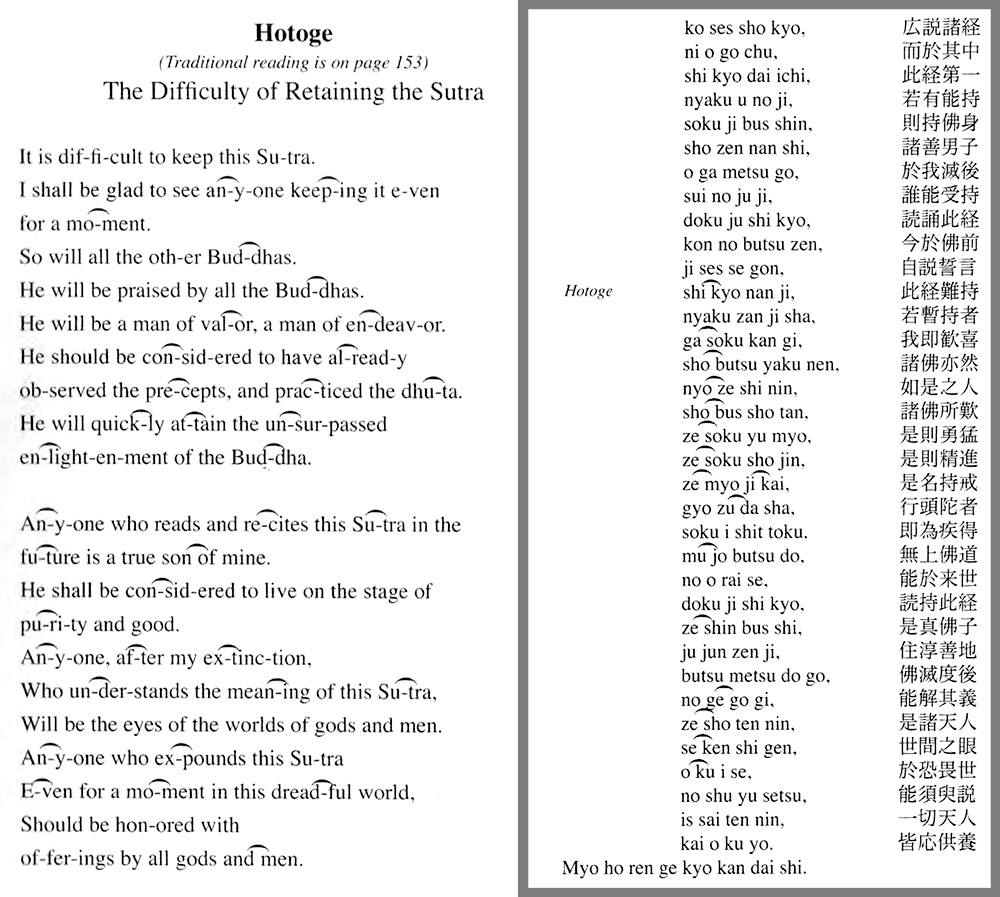
In the grand scheme of things – as in that giant stupa of treasures – something about Many Treasures and his vow and his role proving the veracity of what Sakyamuni has preached in the Lotus Sutra should be the top issue here. If not that, then the wonderful examples of easy and difficult things to do, e.g. the easy task of grasping a Mt. Sumeru and hurling it to a distance of countless Buddha-worlds vs the difficult task of expounding this sutra in the evil world after the Buddha’s extinction. But today I want to reiterate the Hotoge versus and the reason why they are embellished with the odd rhythmic reading.
First the verses:
It is difficult to keep this sutra.
I shall be glad to see
Anyone keeping it even for a moment.
So will all the other Buddhas.
He will be praised by all the Buddhas.
He will be a man of valor,
A man of endeavor.
He should be considered
To have already observed the precepts,
And practised the dhuta.
He will quickly attain
The unsurpassed enlightenment of the Buddha.
Anyone who reads and recites this sutra in the future
Is a true son of mine.
He shall be considered to live
On the stage of purity and good.
Anyone, after my extinction,
Who understands the meaning of this sutra,
Will be the eye of the worlds
Of gods and men.
Anyone who expounds this sutra
Even for a moment in this dreadful world,
Should be honored with offerings
By all gods and men.
“I am no magistrate,” said the official. “I am not interested in your arguments. I am only interested in getting you onto that ship, out of Kamakura, and on to Izu. Now keep quiet!”
Nichiren put his palms together and bowed. His disciples cried out to him, some in tears. The guards kept back all but one. Nichiro, now a strong young man of 16, would not be cowed. He slipped past the guards and ran down to the boat just as it was being pushed off into the surf.
“Get back!” screamed the official.
But Nichiro would not get back. Crying for his master as he reached out to him, he waded out into the bay after the boat. Nichiren exhorted him to be calm, but his disciple was too overwrought and would not listen. “Take me with you!” He shouted again and again. Exasperated, the official took an oar and struck the young monk with bone shattering force. Clutching at his broken right arm, Nichiro finally backed away, his face white with pain.
Tears fell from Nichiren’s eyes as he saw his faithful disciple so brutalized. “Nichiro! Calm yourself. Is this how a disciple of the Buddha should act? From now on, when you see the sun setting in the west behind Izu, think of me. When I see the sun rising from the sea, I shall think of you.”
Nichiro nodded. “Forgive me, master.” Becoming faint, he went down on his knees in the water, sweat and tears coursing down his face. One of the guards finally reached him and escorted him back to where Nissho and the other monks were gathered.
As the boat moved away Nichiren began to chant the final verses from the eleventh chapter of the Lotus Sutra, “It is difficult to keep this sutra. I shall be glad to see anyone keeping it even for a moment.” The rocking of the waves caused his voice to fade in and out, giving the recitation an odd rhythm. The passage ended with, “Anyone who expounds this sutra even for a moment in this dreadful world should be honored with offerings by all gods and men.” From that point on Nichlren knew that he and his disciples had truly become practitioners of the Lotus Sutra as its predictions of hardships that would be faced by the teachers of the True Dharma began to be fulfilled in their own lives.
If you hear his name, and see him,
And think of him constantly,
You will be able to eliminate all sufferings.
The Buddha gives this description of World-Voice-Perceiver Bodhisattva (Kannon, Kanzeon, Avalokitesvara) to Endless-Intent Bodhisattva in Chapter Twenty-Five of the Lotus Sūtra. World-Voice-Perceiver is the embodiment of compassion. The power of World-Voice-Perceiver is the power of compassion. World-Voice-Perceiver is also known as the one who brings fearlessness. When we can face up to the suffering in the world, both our own and that of others, we can see it for what it is. Then we are no longer afraid of suffering. What else is there to be afraid of?
The Daily Dharma is produced by the Lexington Nichiren Buddhist Community. To subscribe to the daily emails, visit zenzaizenzai.com
Day 15 concludes Chapter 10, The Teacher of the Dharma, and opens Chapter 11, Beholding the Stūpa of Treasures.
Since I get to return to the Stupa of Treasures when I complete the first half of the Lotus Sutra tomorrow, I’ll focus today on what is always my favorite message to those who wish to spread the teaching of this sutra:
Medicine-King! How should the good men or women who live after my extinction expound this Sutra of the Lotus Flower of the Wonderful Dharma to the four kinds of devotees when they wish to? They should enter the room of the Tathagata, wear the robe of the Tathagata, sit on the seat of the Tathagata, and then expound this sutra to the four kinds of devotees. To enter the room of the Tathagata means to have great compassion towards all living beings. To wear the robe of the Tathagata means to be gentle and patient. To sit on the seat of the Tathagata means to see the voidness of all things. They should do these [three] things and then without indolence expound this Sutra of the Lotus Flower of the Wonderful Dharma to Bodhisattvas and the four kinds of devotees.
And in gathas:
If you wish to expound this sutra,
Enter the room of the Tathagata,
Wear the robe of the Tathagata,
Sit on the seat of the Tathagata,
[And after doing these three things,]
Expound it to people without fear!
To enter the room of the Tathagata means
to have great compassion.
To wear his robe means to be gentle and patient.
To sit on his seat means to see the voidness of all things.
Expound the Dharma only after you do these [three] things!
The latter part of the seventh fascicle of the Commentary on the Great Sun Buddha Sutra, which both Grand Masters Kobo and Dengyo saw, reads: “It is needless to say that reciting sutras earnestly in the Tendai Sect is namely the perfect and sudden way of breathing meditation.”
Hasshu Imoku-sho, Writings of Nichiren Shonin, Doctrine 2
Each of Sakyamuni’s countless sutras is a river flowing into the Sutra of the Lotus Flower of the Wonderful Dharma, the all encompassing ocean of the Buddha’s teaching. Each chant of Namu-Myoho-Renge-Kyo recites not only the Lotus Sutra but all of the Buddha’s sutras.
Namu Myoho Renge Kyo, Namu Myoho Renge Kyo, Namu Myoho Renge Kyo – the perfect and sudden way of breathing meditation.
They also will be able to see the living beings of those worlds, to know the karmas which those living beings are now doing and the region to which each of those living beings is destined to go by his karmas.
The Buddha gives this explanation to Constant-Endeavor Bodhisattva in Chapter Nineteen of the Lotus Sūtra, describing those who keep the Lotus Sūtra. In our world of conflict and ignorance, we sometimes envy people who use force to get what they want. In this deluded state of mind, we believe that cruelty, violence and greed can make us happy. When we use the Buddha’s wisdom to see things for what we are, we realize the power that comes from patience, generosity, compassion and selflessness. We avoid the misery of self-importance, and find the peace that comes from being tied into this world rather than setting ourselves apart from it.
The Daily Dharma is produced by the Lexington Nichiren Buddhist Community. To subscribe to the daily emails, visit zenzaizenzai.com
The thoughts we have are mostly words, and the words are about the things we want. Words can help us make sense of the world around us, especially the words the Buddha uses to teach us. But words can also confuse us when we mistake our expectations for the reality of the world. When the Buddha calls us to become Bodhisattvas, to realize that our happiness is linked to that of all beings, his words open a part of our mind with which we are not familiar. He asks us to set aside the habits we have learned from this world of conflict and see his world in a new way.
As someone who made a career of words and the arrangement of words to communicate ideas, such a reminder of the power of the Buddha’s words is particularly compelling.
This advice from the Daily Dharma echoes the English translation of the Verses for Opening the Sutra that I recite each day:
The most excellent teaching of the Great Vehicle is very difficult to understand. I shall be able to approach enlightenment when I see, hear or touch this sutra. Expounded is the Buddha’s truth. Expounding is the Buddha’s essence. The letters composing this sutra are the Buddha’s manifestation.
One word wraps all of my thoughts in the same way the Odaimoku encompasses the ocean of the Buddha’s teaching. That word in my mind is “faith.”
Day 14 covers all of Chapter 9, The Assurance of Future Buddhahood of the Śrāvakas Who Have Something More to Learn and the Śrāvakas Who Have Nothing More to Learn, and opens Chapter 10, The Teacher of the Dharma.
Limited to just one topic, I’m going to skip Ananda and Rahula and the Sravakas, some of whom have something more to learn and some of whom have nothing more to learn, and focus on the promise contained at the start of Chapter 10, The Teacher of the Dharma.
Thereupon the World-Honored One said to Medicine-King Bodhisattva in the presence of the eighty thousand great men:
Medicine-King! Do you see the innumerable gods, dragon-kings, yaksas, gandharvas, asuras, garudas, kirnnaras, mahoragas, men, and nonhuman beings, and [the four kinds of devotees:] bhiksus, bhiksunis, upasakas, and upasikas, and those who are seeking Sravakahood or Pratyekabuddhahood or the enlightenment of the Buddha in this great multitude? If in my presence any of them rejoices, even on a moment’s thought, at hearing even a gatha or a phrase of the Sutra of the Lotus Flower of the Wonderful Dharma, I will assure him of his future Buddhahood, saying to him, ‘You will be able to attain Anuttara-samyak-sarnbodhi.’
The Buddha said to Medicine-King:
If after my extinction anyone rejoices, even on a moment’s thought, at hearing even a gatha or a phrase of the Sutra of the Lotus Flower of the Wonderful Dharma, I also will assure him of his future attainment of Anuttara-samyak-sambodhi. If anyone keeps, reads, recites, expounds and copies even a gatha of the Sutra of the Lotus Flower of the Wonderful Dharma, and respects a copy of this sutra just as he respects me, and offers flowers, incense, necklaces, incense powder, incense applicable to the skin, incense to burn, canopies, banners, streamers, garments and music to it, or just joins his hands together respectfully towards it, Medicine-King, know this, he should be considered to have appeared in the world of men out of his compassion towards all living beings, although he already made offerings to ten billion Buddhas and fulfilled his great vow under those Buddhas in a previous existence.
And in gathas:
Anyone who keeps
The Sutra of the Lotus Flower of the Wonderful Dharma,
Know this, has compassion towards all living beings
Because he is my messenger.
Anyone who keeps
The Sutra of the Lotus Flower of the Wonderful Dharma
Should be considered to have given up his pure world and come here
Out of his compassion towards all living beings.
The merits of the Buddha are beyond the expression of our words. Only the Buddha, only the World-Honored One, knows the wishes we have deep in our minds.
In Chapter Eight of the Lotus Sutra, Pūrṇa has these words in mind while looking at the face of the Buddha. The thoughts we have are mostly words, and the words are about the things we want. Words can help us make sense of the world around us, especially the words the Buddha uses to teach us. But words can also confuse us when we mistake our expectations for the reality of the world. When the Buddha calls us to become Bodhisattvas, to realize that our happiness is linked to that of all beings, his words open a part of our mind with which we are not familiar. He asks us to set aside the habits we have learned from this world of conflict and see his world in a new way.
The Daily Dharma is produced by the Lexington Nichiren Buddhist Community. To subscribe to the daily emails, visit zenzaizenzai.com