
All posts by John Hughes

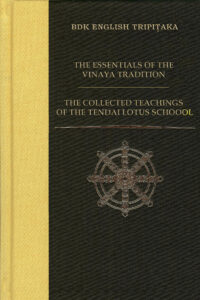
The Collected Teachings of the Tendai Lotus School

bdkt_collected_teachings_tendai_lotus-bookcover
Available for purchase and download as PDF

The Collected Teachings of the Tendai Lotus School by Gishin was translated from the Japanese by Paul L. Swanson and published in 1995 as part of the BDK English Tripiṭaka (97-II).

From the Translator’s Introduction

The Collected Teachings of the Tendai Lotus School (Tendai Hokkeshū Gishū) is an introduction to the doctrine and practice of the Japanese Tendai school. It was compiled by Gishin (781-833), the monk who accompanied Saichō (767-822) to T’ang China as his interpreter, so that he might help to transmit the Chinese T’ien-t’ai tradition to Japan. He later succeeded Saichō as head of the Tendai establishment on Mt. Hiei. The content of this work consists, for the most part, of extracts from the writings of Chih-i (538-97), the founder of Chinese T’ien-t’ai Buddhism; and it concisely outlines the basic tenets of Tendai doctrine and practice. Except for the introduction and colophon, it takes the form of a catechism. It is divided into two major sections, on doctrine and on practice. The section on doctrine contains a discussion of the Four Teachings, the Five Flavors, the One Vehicle, the Ten Suchlikes, Twelvefold Conditioned Co-arising, and the Two Truths. The section on practice discusses the Four Samādhis and the Three Categories of Delusions.

The Collected Teachings of the Tendai Lotus School was compiled in response to an imperial request that each Buddhist school prepare a description and defense of its own doctrine for submission to the court. The resulting texts are often referred to as “The Six Sectarian Texts Compiled by Imperial Request in the Tenchō. …

The exact date of compilation of this present work is uncertain. The Tendai zasu ki, an ecclesiastical history of the Tendai prelates, claims that Gishin compiled it in 823; but the closing verse in the Collected Teachings itself mentions the Tenchō era (824-34). It was probably submitted to the court in 830 along with the other five works.

The Collected Teachings of the Tendai Lotus School is the shortest of the works submitted to the court by the six Buddhist schools. … Its content is limited to Tendai proper and does not discuss esoteric Buddhism, Zen, or precepts, the other three of the so-called “four pillars of Japanese Tendai.” This was the cause of some controversy, since it ignored both esoteric Buddhism, which was in such great demand at the time, and the important issue of Hinayāna vs. Mahāyāna precepts. Perhaps Gishin felt that a straightforward presentation of the unique features of Tendai proper, as presented in the writings of Chih-i, was most important. Thus the final incorporation of esoteric Buddhism into Japanese Tendai was left to later monks such as Ennin (794-864), Enchin (814-89), and Annen (841-?).

Tendai Lotus School Teachings, p 1-2

At the conclusion of the Preface, Gishin writes:

This compilation first presents the two main topics, Doctrine and Contemplation. Next, under these categories it lists all the essential points and outlines them. However, the doctrine is vast, so that shallow and ignorant people become lost. Mysterious reality is deep and profound, so that fools cannot measure it. It is like scooping up the ocean with a broken gourd or viewing the heavens with a tiny tube. Therefore I clumsily take up this great rope [of the vast Buddha-dharma] and feebly attempt to compose this work. At times the text is brief and the meaning hidden, at times [it is] short or long. If one tried to exhaust all the details, the result would be too complicated. As an incomplete presentation of the essentials of our school, it resembles a crude commentary. The attempts at summation often miss the mark, and the essential content is difficult to outline.

The reason that the Four Teachings and the Five Flavors stand at the beginning is that these are the fundamental doctrines of the original Buddha and the basis of this [Tendai] school’s profound teaching. The other doctrines are numerous, but they depend on and proceed from these first two. This work consists of one fascicle and is called The Collected Teachings of the Tendai Lotus School.

Tendai Lotus School Teachings, p 7

At the end, Gishin offers this verse:

In praise it is said:

After Kuśināgara [where the Buddha entered final Nirvāṇa] ,
In the midst of the era of the semblance Dharma,
The two sages of Mt. Nan-yo and Mt. T’ien-t’ai
And the two leaders Chan-jan and Saichō
Firmly established the Path for the myriad years,
And its doctrine crowned all schools.

In the Tenchō period (824-834) Buddhism again flourished.
The Emperor mercifully requested
A presentation of the admirable [doctrines].
Therefore, of the luxuriant meanings
I have outlined just a few.

Tendai Lotus School Teachings, p 136

The text translated by Swanson was actually copied in the middle of the winter of 1649 by “an anonymous private monk”:

Colophon

The Collected Teachings is a composition by Master [Gi]shin of Mt. Hiei. Whether on teachings or on the practice of contemplation, it is an outline of the 80,000 doctrines in the twelvefold scripture, a summary of the essentials concerning all the subjects of this [Tendai] school, rolled up in many pages. It should be recognized as a substantial vessel of scholarship. It is also a book that has reached the attention of the Emperor. It has already been officially presented to the court. How can it not be transmitted? In the past it was popular, but it became old with the years. Since there are not a few errata [in the text], I am now correcting and editing it, adding punctuation, having catalpa wood plates carved, and bringing it to print. It is hoped that this work by such a virtuous elder will not disappear for a thousand years.

Tendai Lotus School Teachings, p 137

See Tendai Lotus Teachings and Nichiren


Book Quotes

Book List

Daily Dharma – Feb. 25, 2023

You, the World-Honored One, are exceptional.
You reminded me of the teachings
Of innumerable Buddhas in the past
As if I had heard them today.

Ānanda, the Buddha’s cousin and one of his leading disciples, sings these verses in Chapter Nine of the Lotus Sūtra. In the Story, Ānanda had just been personally assured by the Buddha that he would become a Buddha himself in a future life. All the teachings of the Buddha across all time are always available to us. What prevents us from hearing them and putting them into practice is nothing more than our own attachment to our suffering and our doubts about our capacity for wisdom and compassion. When we take to heart the assurance that we and all beings can become enlightened, it clears away our delusion and allows to see the Buddha teaching us in all aspects of our lives.

The Daily Dharma is produced by the Lexington Nichiren Buddhist Community. To subscribe to the daily emails, visit zenzaizenzai.com

Day 19

Day 19 concludes Chapter 14, Peaceful Practices, and begins Chapter 15, The Appearance of Bodhisattvas from Underground.


Having last month considered the request of the Bodhisattva-mahāsattvas, more than eight times the number of the sands of the River Ganges, who had come from the other worlds, we consider the arrival of the Bodhisattva-mahāsattvas who sprang up from underground.

When he had said this, the ground of the Sahā-World, which was composed of one thousand million Sumeru-worlds, quaked and cracked, and many thousands of billions of Bodhisattva-mahāsattvas sprang up from underground simultaneously. Their bodies were golden-colored, and adorned with the thirty-two marks and with innumerable rays of light. They had lived in the sky below this Sahā-World. They came up here because they heard these words of Śākyamuni Buddha. Each of them was the leader of a great multitude. The Bodhisattvas included those who were each accompanied by attendants as many as sixty thousand times the number of the sands of the River Ganges. Needless to say, [they included those who were each accompanied by less attendants, for instance,] fifty thousand times, forty thousand times, thirty thousand times, twenty thousand times or ten thousand times the number of the sands of the River Ganges, or by attendants just as many of the sands of the River Ganges, or by attendants as many as a half, or a quarter of the number of the sands of the River Ganges, or by attendants as many as the sands of the River Ganges divided by a thousand billion nayuta, a billion, ten million, a million, ten thousand, a thousand, a hundred, ten, five, four, three or two attendants, or only by one attendant. [The Bodhisattvas] who preferred a solitary life came alone. The total number of the Bodhisattvas was innumerable, limitless, beyond calculation, inexplicable by any parable or simile.

See 800 Years: The Sky Below This Sahā-World

The Essentials for Calming and Inight

Not found in the Shutei Hoyo Shiki is a teaching by Chih-i in his “Essentials for Practicing Calming and Insight Dhyana Meditation.” I feel it is important to include it in this book of important matters. These essentials are Zeal, Vigor, Mindfulness, Discernment, and Single-Mindedness.

Zeal
First, a person must possess the desire, the willingness to change something. Without this aspiring to change there is no initial cause for implementation.
Vigor
Next, a person must approach the task with effort, and a willingness to accomplish the task without letting up. Not being afraid to challenge the root causes of which may be the most difficult. Unrelenting adherence to the Six Perfections, the Eightfold Path even when it seems most difficult or most discouraging.
Mindfulness
Generation of a mind that is able to see what is based upon reality and what is based on our interpretation. A mind that is aware that there are noble acts and acts that are to be avoided. Develop a mind that is free from the outflows of impurity. Being awake in the moment and aware.
Discernment
Discrimination of action based on mindfulness. To make critical judgments about what is wise. Assessments of value and achievements against what will be lost or unattainable by acting a certain way. It isn’t always a case of clear-cut choices. Sometimes the choice is between two unpleasant courses that one hopes will yield the greatest potential for future better choices.
Single-Mindedness
Achieving a focus that prohibits us from being distracted and side-tracked. Making a single-minded effort to cultivate one’s mind so that nothing can interfere with our efforts.
Important Matters, p 96-97

Daily Dharma – Feb. 24, 2023

The Buddha is the master of the human and heavenly realms, the parent of all living beings, and the teacher who opens the way and leads us all to enlightenment. Lowly parents lack the virtue of a master, and the master without the virtue of parents is frightening. People with the virtues of parents or master do not necessarily possess the virtue of the teacher.

Nichiren wrote this passage in his Treatise on Prayers (Kitō-shō). This illustrates three aspects of the ever-present Buddha to which we can aspire as we practice his highest teachings. Parents care about their children, but they can lack the skill and knowledge necessary to benefit them. A skillful master can be wise about how to live in this world of conflict, but without a true concern for the well-being of those he leads, can degenerate into cruelty and selfishness. As a teacher, the Buddha has found us all within himself, and cares for us as he cares for himself. He has also found himself within all of us, and knows what it takes to lead us to his wisdom.

The Daily Dharma is produced by the Lexington Nichiren Buddhist Community. To subscribe to the daily emails, visit zenzaizenzai.com

Day 18

Day 18 concludes Chapter 13, Encouragement for Keeping this Sutra, and begins Chapter 14, Peaceful Practices.


Having last month considered how a retired place is the first thing to find, we consider in gāthās the proper practices and things to be approached.

Thereupon the World-Honored One, wishing to repeat what he had said, sang in gāthās:

A Bodhisattva who wishes
To expound this sūtra without fear
In the evil world
After [my extinction]
Should perform proper practices
And approach proper things.

He should keep away
From kings, princes and ministers,
From other government officials,
From players of dangerous sports,
From caṇḍālas, from heretics,
And from aspirants for the teaching of Brahman.

He should not approach arrogant people,
Or the scholars who are deeply attached
To the Three Stores of the Lesser Vehicle,
Or the bhikṣus
Who violate the precepts,
Or self-appointed Arhats,
Or the bhikṣunīs/
Who like to laugh playfully.

He should not approach the upāsikās
Who are attached to the five desires
Or who seek in their present life
The extinction[-without-remainder].

When they come to him
With good intent
In order to hear
About the enlightenment of the Buddha,
He should expound the Dharma to them
Without fear,
But should not wish to receive
Anything from them.

He should not approach
Or make friends with a widow
Or with an unmarried woman
Or with a eunuch.

He should not approach
Slaughterers or cooks
Or those who kill for profit,
Such as hunters or fishermen.

He should not approach
Butchers
Or procurers
Of prostitutes.

He should not approach
Dangerous wrestlers
Or makers of various amusements
Or immoral women.

He should not expound the Dharma
To a woman in an enclosed place.
When he expounds the Dharma to her,
He should not laugh playfully.

When he goes to a village to beg for food,
He should take a Bhikṣu with him.
If he cannot find a Bhikṣu [to take with him],
He should think of the Buddha with all his heart.

These are the proper practices he should perform
And the proper things he should approach.
He should expound the Dharma peacefully
Only after doing all this!

The Daily Dharma from June 6, 2022, offers this:

When they come to him
With good intent
In order to hear
About the enlightenment of the Buddha,
He should expound the Dharma to them
Without fear,
But should not wish to receive
Anything from them.

The Buddha makes this explanation to Mañjuśrī Bodhisattva in Chapter Fourteen of the Lotus Sūtra in which he describes the peaceful practices of a Bodhisattva. In our zeal to practice this Wonderful Dharma we may come to expect that because this is such a wonderful teaching, we deserve to be rewarded for providing it to others. With this expectation, we then lose our focus on using the Dharma to benefit others and instead use it to benefit ourselves. When we show how to give freely, without expectations, we embody generosity, the same generosity the Buddha himself demonstrated when he provided the teaching to us.

The Daily Dharma is produced by the Lexington Nichiren Buddhist Community. To subscribe to the daily emails, visit zenzaizenzai.com

The Three Refuges

It is by taking refuge in the Three Jewels the Buddha, the Dharma, and the Sangha that we can receive their all-encompassing and complete benefit. We do not create this immeasurable benefit. Rather, our practice makes it possible to receive these benefits.

We are refugees lost in the wilderness who have wandered lifetime after lifetime looking for shelter and a means to happiness. Finally, we have come upon the sublime place to attain awakening and achieve our heart’s true desire. This place is the refuge of the Buddha, the Dharma, and the Sangha.

With little effort we receive immeasurable benefit. This principle is written about in the Mo-Ho Chih-Kuan. Through our assiduous practices we gradually attain enlightenment. Our objective is enlightenment for all beings. When we take refuge, we may initially only be seeking the end to our suffering, hence we have only exerted small effort. As we continue our practice our focus should begin to shift to the desire to enable all people to experience the great joy we have. To cultivate and manifest the desire to save all beings requires greater effort than to merely think only of oneself. The more we engage in the selfless practice for others, the more our own benefit of enlightenment increases.

Important Matters, p 92

Daily Dharma – Feb. 23, 2023

Your face is most wonderful.
Your light illumines the worlds of the ten quarters.
I once made offerings to you.
Now I have come to see you again.

Gladly-Seen-By-All-Beings Bodhisattva sings these verses to Sun-Moon-Pure-Bright-Virtue Buddha in a story told in Chapter Twenty-Three of the Lotus Sūtra. That Bodhisattva was the previous life of Medicine-King Bodhisattva who accepted all of the misfortunes of this world of delusion and ignorance so that he could benefit all beings living here. When we awaken our nature as Bodhisattvas, and resolve to use the Buddha’s teachings to purify this world, then we are assured we will never fail to meet Buddhas and repay the good they do for us.

The Daily Dharma is produced by the Lexington Nichiren Buddhist Community. To subscribe to the daily emails, visit zenzaizenzai.com

Day 17

Day 17 covers all of Chapter 12, Devadatta, and opens Chapter 13, Encouragement for Keeping this Sutra.


Having last month learned the identity of the seer, we consider the prediction of future Buddhahood given to Devadatta.

He said to the four kinds of devotees:

“Devadatta will become a Buddha after innumerable kalpas.’ He will be called Heavenly-King, the Tathāgata, the Deserver of Offerings, the Perfectly Enlightened One, the Man of Wisdom and Practice, the Well-Gone, the Knower of the World, the Unsurpassed Man, the Controller of Men, the Teacher of Gods and Men, the Buddha, the World-Honored One. The world of that Buddha will be called Heavenly-Way. That Buddha will live for twenty intermediate ka]pas. He will expound the Wonderful Dharma to all living beings. [Hearing the Dharma from him,] as many living beings as there are sands in the River Ganges will obtain Arhatship; another group of innumerable living beings will aspire for the enlightenment of cause-knowers; and another group of living beings as many as there are sands in the River Ganges will aspire for unsurpassed enlightenment, obtain the truth of birthlessness, and reach the stage of irrevocability. After the Parinirvana of Heavenly-King Buddha, his right teachings will be preserved in that world for twenty intermediate kalpas. During that time a stupa of the seven treasures sixty yojanas tall and forty yojanas wide and deep will be erected to enshrine the śarīras of his perfect body. Gods and men will bow to the wonderful stupa of the seven treasures and offer various flowers, incense powder, incense to burn, incense applicable to the skin, garments, necklaces, banners, streamers, jeweled canopies, music and songs of praise [to the stupa]. [By doing all this,] innumerable living beings will attain Arhatship; another group of innumerable living beings will attain Pratyekabuddhahood; and another group of inconceivably numerous living beings will aspire for Bodhi and reach the stage of irrevocability.”

He said to the bhikṣus:

“Good men or women in the future who hear this chapter of Devadatta of the Sūtra of the Lotus Flower of the Wonderful Dharma with faithful respect caused by their pure minds, and have no doubts [about this chapter], will not fall into hell or the region of hungry spirits or the region of animals. They will be reborn before the Buddhas of the worlds of the ten quarters. They will always hear this sūtra at the places of their rebirth. Even when they are reborn among men or gods, they will be given wonderful pleasures. When they are reborn before the Buddhas, they will appear in lotus-flowers.”

The Daily Dharma from May 15, 2022, offers this:

Good men or women in the future who hear this Chapter of Devadatta of the Sūtra of the Lotus Flower of the Wonderful Dharma with faithful respect caused by their pure minds, and have no doubts [about this chapter], will not fall into hell or the region of hungry spirits or the region of animals. They will be reborn before the Buddhas of the worlds of the ten quarters.

The Buddha makes this prediction in Chapter Twelve of the Lotus Sūtra. In this Chapter, he assures Devadatta, an evil man who creates great harm, that he too will eventually reach the enlightenment of the Buddha. This prediction is for the rest of us too. It shows that when we nourish our capacity for respect for all beings, no matter how much harm they create, then we uproot the causes of our own greed and fear, and we will always find ourselves in a realm where the Buddha teaches the Wonderful Dharma.

The Daily Dharma is produced by the Lexington Nichiren Buddhist Community. To subscribe to the daily emails, visit zenzaizenzai.com

Declaring Vows

The notion of taking vows has generally lost its significance. I say this because it used to be that when one took a vow, especially a religious vow, one did so with an understating that to break such a vow was a serious matter with serious consequences. Today, many people shrug their shoulders as they walk away, ignoring what they swore to do.

A vow is more than a simple promise. It isn’t something undertaken only to be followed when convenient or when there is nothing better to do. When we take vows in Buddhism, whether it is vows to uphold our faith, as in jukai, or the Four Great Vows, we are saying directly to the Buddha, “With my whole heart and being, I will do these things.”

Each day we should repeat the Four Great Vows as a pledge we make to the Buddha, a pledge we will carry out. We vow to strive with every ounce, every molecule of our life. It is tempting to make excuses or even forget about these vows. That is a serious mistake.

Important Matters, p 91