
All posts by John Hughes

Day 18

Day 18 concludes Chapter 13, Encouragement for Keeping this Sutra, and begins Chapter 14, Peaceful Practices.


Having last month considered the proper practices the Bodhisattva-mahāsattvas should perform and the the proper things the Bodhisattva should approach, we consider how a retired place is the first thing to find.

“He should always make it a pleasure to sit in dhyāna. He should live in a retired place and concentrate his mind. Mañjuśrī! [A retired place] is the first thing he should approach.

“The Bodhisattva-mahāsattvas also should know the following truth. All things are insubstantial. They are as they are. Things are not perverted. They do not move. They do not go. They do not turn. They have nothing substantial just as the sky has not. They are inexplicable. They are not born. They do not appear. They do not rise. They are nameless. They are formless. They have no property. They are immeasurable and limitless. They have no obstacle or hindrance. He should see all this. Things can exist only by dependent origination. Only perverted people say, ‘Things are permanent and pleasant.’ This truth is the second thing he should approach.”

The Daily Dharma from May 12, 2021, offers this:

He should always make it a pleasure to sit in dhyāna. He should live in a retired place and concentrate his mind. Mañjuśrī! [A retired place] is the first thing he should approach.

The Buddha gives this explanation to Mañjuśrī Bodhisattva in Chapter Fourteen of the Lotus Sūtra in which he describes the peaceful practices of a Bodhisattva. For those who are awakening their nature as Bodhisattvas to benefit all beings, and setting aside their attachment to their own suffering, this can be a difficult transition. Our habits of engaging with the drama and delusion in the world can be too strong to overcome. This is why the Buddha emphasizes the importance of quietly reflecting on what happens around us, and our reactions to them. Through dhyāna meditation, we learn not to believe everything we think, and that we can change our understanding of the world. We also learn that allowing our minds to change is the only way we can benefit other beings.

The Daily Dharma is produced by the Lexington Nichiren Buddhist Community. To subscribe to the daily emails, visit zenzaizenzai.com
Hear Me Roar!

Hear me roar like the lion!

“The Buddha is the unexcelled King of the Dharma. Once we chant what he preached with his golden lips, the spiritual phrases of the sacred teachings, those words will become a Dharma-wheel that travels throughout the earth. The yakshas chant to the sky as an offering to the Four Heavenly Kings. After the Heavenly Kings hear it, they then pass it on until it reaches the King ofthe Brahma Heaven. This chanting spreads out to the dead and to the living. The dragon-gods are as pleased as when people listen to the speech ofa king. Who would not praise it? The merit of chanting is like this.”

Wu-chin, Goho-ron (Treatise on Protecting the Dharma), Shute Hoyo Shiki, page 393

Even though our ears are not fine-tuned and so are unable to hear many frequencies, our voices are heard and cause the universe to move. We can have a voice of love or of hate, and then what we hear in return, what we experience is in accord with our voice. Think how the universe is moved when we recite the words of the Buddha. Even our small voice reaches the heavens.

Important Matters, p 38-39

Buddha and Hell

OMONSU DONO NYOBO GOHENJI

Suppose we ask where the Buddha is, and where hell is. Some sutras state that hell is below the earth, while others state that the Pure Land of Buddhas is in the west. But the explicit truth is that both hell and Buddha exist within five feet of our bodies. It probably can be said that hell exists in one’s mind when he despises his father and neglects his mother. As the seed of the lotus brings forth its root and flower, we have the Buddha in our minds.

(Background : January 5, 1281, 58 years old, at Minobu, Showa Teihon, p. 1856)

Explanatory note

We, Buddhists, sometimes wonder where the Buddha is and where hell is. When we look back upon the past, we have experienced the various states of joy and anger, happiness and sadness from one moment to another. These various states are divided into ten realms of living beings in Buddhism. They are : the realms of hell, hungry spirit, animal, asura (shura), man, heavenly being, sravaka (shomon), Pratyekabuddha (engaku), Bodhisattva, and
Buddha.

Our minds are sometimes calm, and it appears that we are one step closer to the Pure Land of Buddha, but in the next moment, our minds would change to the realm of asura or hungry spirit. In short, we may think that we live peacefully, but we may be at the gate of the terrible hell.

We will find a light of truth when we overcome our suffering and hardship. Our aspiration to attain Buddhahood and fear of falling into hell will force us to find the true meaning of our life.

In other words, hell does not exist anywhere but in our minds. The mind that is so filled with anger, evil desires, and complaints is the same mind with which we aspire for Buddhahood.

Nichiren Daishonin saw suffering people who were trembling with fear and despair. These people thought there was no hope in this world and wished to escape from that reality. They dreamed of going to the Pure Land of the Amida Buddha, a place which they had never seen before. Looking at this, Nichiren taught them that they had the wrong faith and that they should seek the Buddha’s enlightened world in this real Saha-world. This was his compassionate way to lead us to the true teaching of the Buddha Sakyamuni.

We are easily moved by a religion that claims to remove our misfortune or sufferings and to take us to an imaginative heaven. However, Nichiren teaches us that there is no other place if we are not relieved of our suffer ings in this real world. How can we receive Buddha’s compassion and find true peace and happiness? He says that it is only by polishing our minds.

Rev. Matsuda

Phrase A Day

Daily Dharma – Jan. 20, 2023

Now I will transmit [the Dharma] to you. Keep, read, recite and expound [this sūtra in which the Dharma is given], and cause all living beings to hear it and know it! Why is that? It is because I have great compassion. I do not begrudge anything. I am fearless. I wish to give the wisdom of the Buddha, the wisdom of the Tathāgata, the wisdom of the Self-Existing One, to all living beings.

The Buddha gives these instructions in Chapter Twenty-Two of the Lotus Sūtra. In this transmission, the Buddha bestows his highest teaching not just on those gathered 2500 years ago. He gives it to all of us who hear and keep his teaching today. When the Buddha revealed his true nature as existing through all time and space, he assured us that he is always teaching us, and that the Lotus Sūtra is the vehicle by which he comes to us. By giving us this teaching, he does not lose it. In the same way, when we benefit other beings, we should not be afraid of losing anything, other than our delusion and attachments.

The Daily Dharma is produced by the Lexington Nichiren Buddhist Community. To subscribe to the daily emails, visit zenzaizenzai.com

Day 17

Day 17 covers all of Chapter 12, Devadatta, and opens Chapter 13, Encouragement for Keeping this Sutra.


Having last month considered in gāthās when the Buddha was a King seeking the Dharma in his previous existence, we learn the identity of the seer.

The Buddha said to the bhikṣus:

“The king at that time was a previous life of myself. The seer at that time was a previous life of Devadatta. Devadatta was my teacher. He caused me to complete the six pāramitās. He caused me to have loving-kindness, compassion, joy and impartiality. He caused me to have the thirty-two major marks and the eighty minor marks [of the Buddha]. He caused me to have my body purely gilt. He caused me to have the ten powers and the four kinds of fearlessness. He caused me to know the four ways to attract others. He caused me to have the eighteen properties and supernatural powers [of the Buddha]. He caused me to have the power of giving discourses. I attained perfect enlightenment and now save all living beings because Devadatta was my teacher.”

The Daily Dharma from Dec. 8, 2022, offers this:

I attained perfect enlightenment and now save all living beings because Devadatta was my teacher.

The Buddha makes this declaration in Chapter Twelve of the Lotus Sūtra. Devadatta was a cousin of the Buddha who became jealous of the Buddha’s enlightenment. Several times he tried to kill the Buddha. He also caused a split in the Buddha’s Sangha, and convinced a young prince to kill his father and usurp the throne. Devadatta was so evil that he fell into Hell alive. Despite all this, the Buddha credits Devadatta with helping him become enlightened, and assures Devadatta personally that he will become enlightened. This shows us that even those beings who create great harm have Buddha nature. They may not deserve our admiration, but they at least deserve our respect.

The Daily Dharma is produced by the Lexington Nichiren Buddhist Community. To subscribe to the daily emails, visit zenzaizenzai.com

Sparking Great Joy

I wonder if in our time we have somehow relegated passion to the bin or feel it inappropriate, or even substandard to intellectual mastery. It’s as if intellectualism has been divorced from passion. Your words — whether eloquent or not — when coupled with your passion of faith can move people and cause them to become happy. Your passion for the Dharma and the joy it brings you can awaken the Buddha in those you meet. That little spark of your passion is like a small jolt of electricity that startles the slumbering Buddha, causing it to open its eyes and begin to seek out its full awakening. You may not see it, you may think your efforts are inconsequential, but that is the mistake of the intellect. In Chapter XXII we are told our mission is to cause people to have great joy simply by sharing any truth of the Buddha’s teachings. Causing people to have great joy is not about convincing someone of some intellectual or philosophical profundity. It is about having great joy in yourself for them and the Buddha already in their lives.

Important Matters, p 37

The Buddha Dharma and the Worldly Law

SHOKYO TO HOKEKYO TONO NAN-I NO KOTO

Since the Buddha dharma is not understood correctly and is not believed righteously, the worldly law becomes disorderly. The Buddha dharma is like a body while the worldly law is like its shadow. When the body bends, its shadow also bends.

(Background : May 26, 1280, 58 years old, at Minobu, Showa Teihon, p.1752)

DANNOTSU BO GOHENJI

To serve your master (in your work) is to practice the teaching of the Lotus Sutra. The sutra says that worldly politics and economy are not against its ultimate reality.

(Background : April 11, 1278, 56 years old, at Minobu, Showa Teihon, p.1493)

Explanatory note

An old Chinese book says that a wise man predicted destruction of his country because its people did not bother to comb their hair, and his prediction became true.

There is a Japanese saying, “Eyes are the windows of one’s mind.” The slightest movement of our eyes shows what we are thinking. Our thoughts are expressed in our attitudes, which become social movements.

Such matters are taught in Buddhism. But people generally think that Buddhism concerns individual’s inner self only. Nichiren Daishonin clarified this matter. Merely holding hands in gassho and reciting the sutra are not the practice of faith in Nichiren Buddhism. But faith must appear in our daily works.

We, Nichiren Buddhists, keep the teaching of “Rissho Ankoku,” that is, to establish the righteousness of the Buddha’s teaching is to secure the nation. We must understand that the social movement is the reflection of the people’s religion. We must remember that Nichiren Daishonin advised Kingo Shijo to stay on his work when Kingo wanted to quit his work for the sake of devotion to his faith. We must keep Nichiren’s advice in our minds and practice our faith in our home and work.

Rev. Kanai

Phrase A Day

Daily Dharma – Jan. 19, 2023

If they hear the Dharma, some will attain enlightenment;
Others will be reborn in heaven.
The living beings in the evil regions will decrease;
And those who do good patiently will increase.

The Brahma-Heavenly-Kings of the Southwest sing these verses to Great-Universal-Wisdom-Excellence Buddha in Chapter Seven of the Lotus Sūtra. They are imploring that Buddha to share his highest teaching with them, and demonstrating that they are ready to receive it. Those living in evil regions are in great difficulty, because they do not know how to keep from reinforcing their delusions and truly benefit themselves. When a Buddha appears to show all beings the world as it is, he helps us to shed our delusions. But we must still come to him and show through our respect for him that we are ready for his teaching.

The Daily Dharma is produced by the Lexington Nichiren Buddhist Community. To subscribe to the daily emails, visit zenzaizenzai.com

Day 16

Day 16 concludes Chapter 11, Beholding the Stūpa of Treasures, and completes the Fourth Volume of the Sūtra of the Lotus Flower of the Wonderful Dharma.


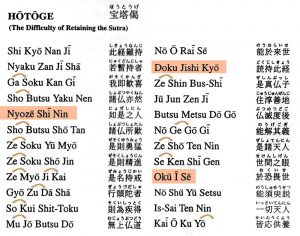
Having last month considered the difficulty in teaching this sutra, we conclude Chapter 11, Beholding the Stūpa of Treasures with Hōtōge.

Good men!
Who will receive and keep this sūtra,
And read and recite it
After my extinction?
Make a vow before me
[To do all this]!

It is difficult to keep this sūtra.
I shall be glad to see
Anyone keeping it even for a moment.
So will all the other Buddhas.
He will be praised by all the Buddhas.
He will be a man of valor,
A man of endeavor.
He should be considered
To have already observed the precepts,
And practiced the dhuta.
He will quickly attain
The unsurpassed enlightenment of the Buddha.

Anyone who reads and recites this sūtra in the future
Is a true son of mine.
He shall be considered to live
On the stage of purity and good.

Anyone, after my extinction,
Who understands the meaning of this sūtra,
Will be the eye of the worlds
Of gods and men.

Anyone who expounds this sūtra
Even for a moment in this dreadful world,
Should be honored with offerings
By all gods and men.

[Here ends] the Fourth Volume of the Sūtra of the Lotus Flower of the Wonderful Dharma.

These verses have a distinctive beat. The origin of that beat is explained in Lotus in a Sea of Flames:

Hotoge words with beats

“I am no magistrate,” said the official. “I am not interested in your arguments. I am only interested in getting you onto that ship, out of Kamakura, and on to Izu. Now keep quiet!”

Nichiren put his palms together and bowed. His disciples cried out to him, some in tears. The guards kept back all but one. Nichiro, now a strong young man of 16, would not be cowed. He slipped past the guards and ran down to the boat just as it was being pushed off into the surf.

“Get back!” screamed the official.

But Nichiro would not get back. Crying for his master as he reached out to him, he waded out into the bay after the boat. Nichiren exhorted him to be calm, but his disciple was too overwrought and would not listen. “Take me with you!” He shouted again and again. Exasperated, the official took an oar and struck the young monk with bone shattering force. Clutching at his broken right arm, Nichiro finally backed away, his face white with pain.

Tears fell from Nichiren’s eyes as he saw his faithful disciple so brutalized. “Nichiro! Calm yourself. Is this how a disciple of the Buddha should act? From now on, when you see the sun setting in the west behind Izu, think of me. When I see the sun rising from the sea, I shall think of you.”

Nichiro nodded. “Forgive me, master.” Becoming faint, he went down on his knees in the water, sweat and tears coursing down his face. One of the guards finally reached him and escorted him back to where Nissho and the other monks were gathered.

As the boat moved away Nichiren began to chant the final verses from the eleventh chapter of the Lotus Sutra, “It is difficult to keep this sutra. I shall be glad to see anyone keeping it even for a moment.” The rocking of the waves caused his voice to fade in and out, giving the recitation an odd rhythm. The passage ended with, “Anyone who expounds this sutra even for a moment in this dreadful world should be honored with offerings by all gods and men.” From that point on Nichiren knew that he and his disciples had truly become practitioners of the Lotus Sutra as its predictions of hardships that would be faced by the teachers of the True Dharma began to be fulfilled in their own lives.

The Roar of the Lion

I’m guessing the first time you recited the sutra alone you were just as shy and timid as in a group. To chant the sutra takes incredible courage. The sutra talks about the roar of the lion, yet when we first start chanting a lion is not what would come to mind for many. Over time you overcame those doubts and fears, you were manifesting the behavior of a lion, though you probably didn’t think about it at the time. The lion is fearless, and over time you become fearless in your recitation.

The lion, besides being fearless, focuses on the task at hand. So too, even though we may be confident in our recitation and chanting Odaimoku, we need to remain focused on the sutra, the task at hand, acquiring the nourishment of the Dharma.

“If a Phrase of the sutra fills your heart it will be an aid to reaching the other shore. By deeply reflecting on and mastering the Dharma it will become a great vessel for crossing over. Being able to see and hear the Dharma follows upon its joyful reception, as a vassal always follow after his lord. Whether somebody accepts this teaching or abandons it, they will form a causal connection with it through hearing. Whether somebody follows it or goes against it, they will finally be able to achieve liberation through hearing it.”

Venerable Ching-hsi, Hokkemongu-ki; Shutei Hoyo Shiki, page 392

It is noteworthy that the quote above does not say, ‘When you have memorized a phrase,’ nor does it say, ‘When you have comprehended a phrase.’ ”

Instead it says when your heart is full of the sutra – that is when you have joy and excitement, even irrationally. With that joy you have the tool you need to liberate yourself from suffering.

Important Matters, p 35-36